




Iran’s Strait of Hormuz vessel blacklist is now reported at 77 ships. Reuters reported on September 14 that the Persian Gulf Strait Authority published an updated list of 77 vessels accused of breaching Iranian passage protocols, expanding the previously reported 56-vessel state.
The change materially increases the vessel-screening burden for cargo owners and charterers, but the basic decision rule remains the same: PGSA listing, sanctions exposure, actual ability to transit, security risk, insurance response and contractual acceptability are separate questions and must be checked separately before fixture.
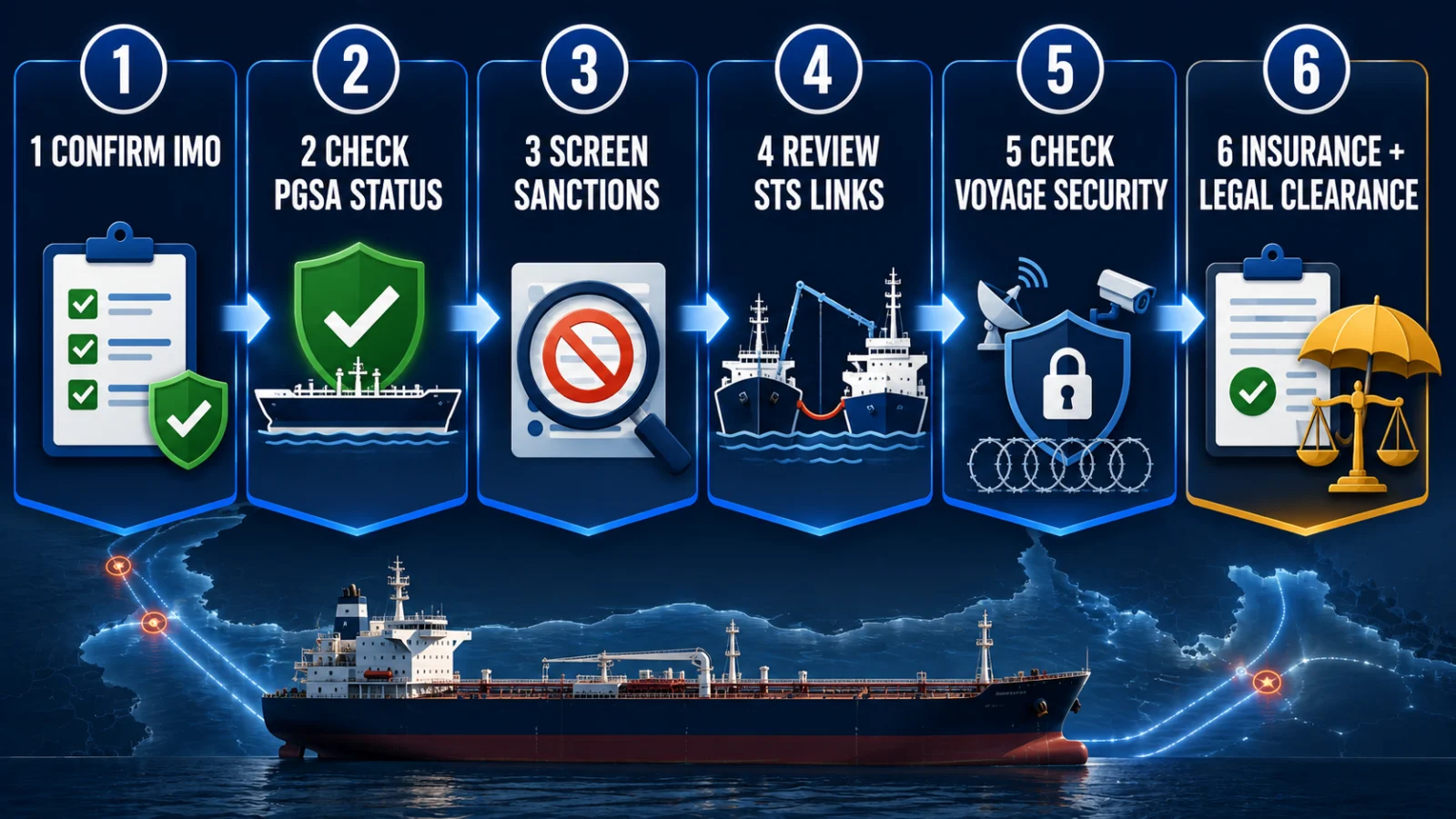
Direct answer: before fixing a vessel for Persian Gulf or Hormuz trade, confirm the ship by IMO number, check the latest PGSA status, screen sanctions separately, review recent STS and transshipment relationships, verify current routing and maritime-security instructions, confirm war-risk and P&I cover, and escalate unresolved legal or security issues before fixture. A vessel that was clear against the earlier 56-vessel state should be checked again because the reported list has expanded to 77.
Critical distinction: a reported PGSA listing is a material Iranian compliance and transit-risk flag. It is not automatically the same thing as an OFAC, UN, UK or EU sanctions designation, and it does not by itself establish whether a particular vessel will physically be permitted or prevented from crossing Hormuz.
How many vessels are currently on the PGSA blacklist?
The latest reporting reviewed on September 14 supports a total of 77 vessels.
Reuters reported that PGSA issued an updated list of 77 vessels accused of violating Iranian protocols for passage through the Strait of Hormuz. This supersedes the previously reported 56-vessel state.
The exact September 14 PGSA roster or underlying official list was not independently recovered during this review, so TPS has not reconciled all 77 vessel names and IMO numbers row by row. Charterers should therefore check the latest authoritative PGSA material through legally permissible channels rather than relying only on an aggregate count.
Recheck the IMO number even if the vessel was previously clear. The list has expanded more than once, and vessel names, flags, ownership and management can also change.
What does PGSA say can happen to listed vessels?
Reuters reported on September 14 that PGSA said vessels on the updated list face future passage restrictions and potential measures including fines, detention or confiscation.
Those enforcement consequences remain attributed to PGSA through current reporting because TPS did not independently recover the exact September 14 PGSA list or post containing the full wording.
PGSA also warned that vessels cooperating with listed ships may themselves be added and urged insurers, P&I clubs and classification societies to avoid providing services to listed vessels.
This is an important risk signal, but stated enforcement policy and actual enforcement are not identical. Earlier maritime intelligence showed that some vessels already listed by Iran subsequently transited the Strait.
Does PGSA listing mean a vessel physically cannot pass Hormuz?
No automatic conclusion should be made.
Lloyd’s List Intelligence reported in September that at least seven vessels on an earlier Iranian list subsequently transited the Strait despite being listed. That evidence shows why cargo owners should distinguish the published compliance state from the vessel’s actual ability to cross on a particular voyage.
A listed ship can still present serious commercial, legal, insurance and operational problems even if physical transit remains possible. The relevant questions include whether Iran may enforce against the vessel, whether other sanctions regimes restrict the transaction, whether the owner and insurer will accept the voyage, and whether the current security environment makes the transit operationally acceptable.
Are companies avoiding PGSA-listed vessels?
Yes. Reuters previously reported that at least three Indian refiners and a global energy company planned to avoid vessels on Iran’s blacklist because of operational and security concerns.
The expansion from 56 to 77 vessels increases the number of ships requiring that additional compliance decision. It does not establish a universal industry prohibition, and companies may apply different contractual, insurance, sanctions and voyage-risk policies.
What is happening to actual Hormuz vessel traffic?
Commercial traffic remains far below pre-conflict levels.
Reuters reported on September 14 that commodity-vessel traffic through Hormuz remained below the recent 10-day average over the weekend. Preliminary tracking data showed four commodity vessels exiting and 10 entering the Gulf during the cited weekend period, while the recent average was around 14 vessels a day.
Tracking figures can exclude vessels operating without AIS transmission, so they should be treated as an indicator of the abnormal operating environment rather than a complete count of every movement.
A clean blacklist result is not a safe-passage certificate. Current military activity, attacks on commercial shipping, low transit volumes, Iranian routing requirements, crew exposure and war-risk insurance remain separate voyage-risk factors.
What should a cargo owner check before chartering?
Confirm the exact vessel identity
Use the IMO number. Do not rely on the vessel name alone because names, flags, registered ownership and management can change.
Check the latest PGSA status
Determine whether the vessel appears on the current 77-vessel state or a later authoritative update. Record the source and date of the check.
Screen sanctions separately
Check the vessel, registered owner, operator, manager, beneficial ownership where relevant, transaction counterparties and payment chain against the sanctions regimes applicable to the voyage.
Review STS and transshipment links
PGSA says cooperation with a listed vessel through STS, transshipment or similar activity can create additional listing risk. Review relevant recent counterparties and voyage history using reliable vessel data.
Assess current route and security risk
Check authoritative maritime warnings, intended route, recent attacks, military activity, transit conditions and current Iranian routing or restricted-zone instructions.
Check insurance, contract and escalation
Confirm P&I and war-risk response, sanctions clauses, safe-port language, trading warranties and allocation of detention, delay, deviation and cancellation risk. Escalate uncertain cases before fixture.
Why PGSA status and sanctions status must stay separate
PGSA’s Non-Compliant Vessels mechanism represents Iran’s stated transit and enforcement position. U.S., UN, UK, EU and other sanctions systems operate under separate legal frameworks.
OFAC FAQ 1249 says U.S. persons cannot make payments to or receive safe-passage services from the Government of Iran or the IRGC in connection with Hormuz passage. OFAC also identifies PGSA as a designated entity and warns that dealings involving designated Iranian parties can create sanctions exposure.
Do not solve a transit problem by creating a sanctions problem. Any payment, guarantee, coordination or service involving PGSA or another designated Iranian party needs to be assessed under the sanctions rules applicable to the parties and transaction.
Can STS with a listed vessel create additional PGSA risk?
Yes, according to PGSA’s stated policy.
PGSA has said vessels cooperating with listed ships through STS oil transfers, transshipment or similar activity can themselves be added to the non-compliant list.
Public information reviewed still does not establish a precise look-back period, whether every STS interaction is treated identically, the evidentiary threshold for secondary listing, treatment of unrelated transactions, a detailed public delisting test or a guaranteed delisting timeframe.
Is the PGSA blacklist the same as a sanctions list?
No.
| Check | What it tells you | What it does not prove |
|---|---|---|
| PGSA NCV status | Iran’s current stated non-compliance position toward the vessel | That the vessel is OFAC, UN, UK or EU sanctioned |
| Sanctions screening | Whether vessels or transaction parties face restrictions under an applicable sanctions regime | That Iran will permit passage |
| STS / voyage-history review | Whether relationships may create additional due-diligence concerns | That a violation necessarily occurred |
| Restricted-zone / routing review | Whether Iranian geographic or coordination requirements may affect the route | That a particular enforcement measure will occur |
| Security review | The current attack, military and routing environment | Guaranteed safe or unsafe passage |
| P&I / war-risk / legal review | Insurance, contractual and legal acceptability | Zero enforcement, detention or casualty risk |
What if the vessel is not on the PGSA list?
Absence from the latest list removes one warning flag but does not amount to full clearance.
The fixture may still be unacceptable because of sanctions, ownership or control, recent counterparties, AIS behaviour, cargo, flag-state concerns, insurance restrictions, contractual limits, military activity or Iranian routing requirements.
NOT LISTED ≠ SANCTIONS CLEARED ≠ VOYAGE RISK ACCEPTABLE ≠ TRANSIT GUARANTEED.
What if the vessel is on the PGSA list?
A current listing should trigger escalation before fixture or before a planned Hormuz transit even though earlier evidence showed that listing did not automatically prevent every vessel from physically crossing the Strait.
- Confirm that the listing belongs to the correct IMO number.
- Identify the reported basis for listing where reliable information exists.
- Determine whether the proposed voyage requires Hormuz passage or enters an area subject to Iranian routing or coordination requirements.
- Check applicable sanctions for the vessel, owner, manager, charterer, cargo owner, insurer, bank and counterparties.
- Determine whether any required communication, payment or coordination involving Iranian authorities is legally permissible.
- Check current attacks, maritime warnings, military activity and routing instructions.
- Obtain P&I, war-risk, security, compliance or sanctions-law guidance where required.
- Review charterparty sanctions, safe-port, detention, deviation and cancellation provisions.
PGSA has said vessels may request removal from its list by making a formal application with supporting justification. Public material reviewed does not establish a guaranteed decision standard or processing time.
Should India-linked cargo owners care?
Yes. Reuters has reported that Indian refiners were among companies planning to avoid PGSA-listed vessels.
The risk extends beyond crude. Earlier reported lists included LNG, LPG and clean-product vessels, while severe disruption around the Strait can affect crude, gas, chemicals, fertilisers, dry bulk and other Persian Gulf cargo flows.
For the wider Indian energy and trade exposure, see ThePulseSignal’s explainer on why the Strait of Hormuz matters to India.
What the current evidence does not establish
- the complete independently reconciled 77-vessel roster;
- that every PGSA-listed vessel will be physically prevented from transiting;
- that every listed ship will actually be detained, fined or confiscated;
- that every STS interaction automatically causes secondary listing;
- that PGSA status automatically creates another country’s sanctions designation;
- that absence from the PGSA list makes a voyage acceptable;
- the final operational effect of all Iranian restricted-zone or routing measures;
- that every commercial operator has adopted the same vessel policy;
- that every Hormuz transit will face an attack; or
- that current military, transit and insurer conditions will remain unchanged.
What should charterers monitor next?
- further additions to or removals from the reported 77-vessel PGSA list;
- publication or recovery of the exact September 14 PGSA roster and any later revisions;
- documented fines, detention, confiscation or other enforcement against listed vessels;
- further evidence of listed vessels being permitted or prevented from transiting;
- clarification of STS and transshipment secondary-listing rules;
- PGSA delisting criteria and decisions;
- new OFAC or other sanctions guidance;
- UKMTO, IMO and other authoritative maritime-security warnings;
- war-risk and P&I guidance;
- charterer and insurer restrictions; and
- changes in actual vessel traffic through Hormuz.
Frequently asked questions
How many ships are on Iran’s Hormuz blacklist?
Reuters reported on September 14 that PGSA’s updated list contains 77 vessels. TPS has not independently reconciled the complete official September 14 roster vessel by vessel.
Can a blacklisted ship still cross the Strait?
Listing has not automatically prevented every transit. Lloyd’s List Intelligence previously reported that at least seven listed vessels had subsequently crossed the Strait. Actual passage and enforcement remain voyage-specific.
Can STS with a listed ship create risk?
Yes. PGSA says vessels cooperating with listed ships through STS or transshipment can themselves be added.
Is a PGSA-listed vessel automatically OFAC sanctioned?
No. PGSA status and sanctions status are separate checks.
Is a vessel safe to charter if it is not on the blacklist?
No automatic conclusion follows. Sanctions, insurance, counterparties, current attacks, Iranian routing requirements and contractual conditions can still make a fixture unacceptable.
Verification note
Reuters reported on September 14 that PGSA expanded its vessel list to 77 and attributed potential passage restrictions, fines, detention and confiscation to the Iranian authority. TPS also checked the earlier official PGSA chartering and STS statement, current sanctions guidance, maritime-industry transit evidence and current Hormuz traffic reporting. The exact September 14 PGSA roster was not independently recovered, so the 77-vessel total and enforcement language remain attributed to the current reporting rather than presented as a vessel-by-vessel primary-source reconciliation.
Last verified: September 14, 2026.