






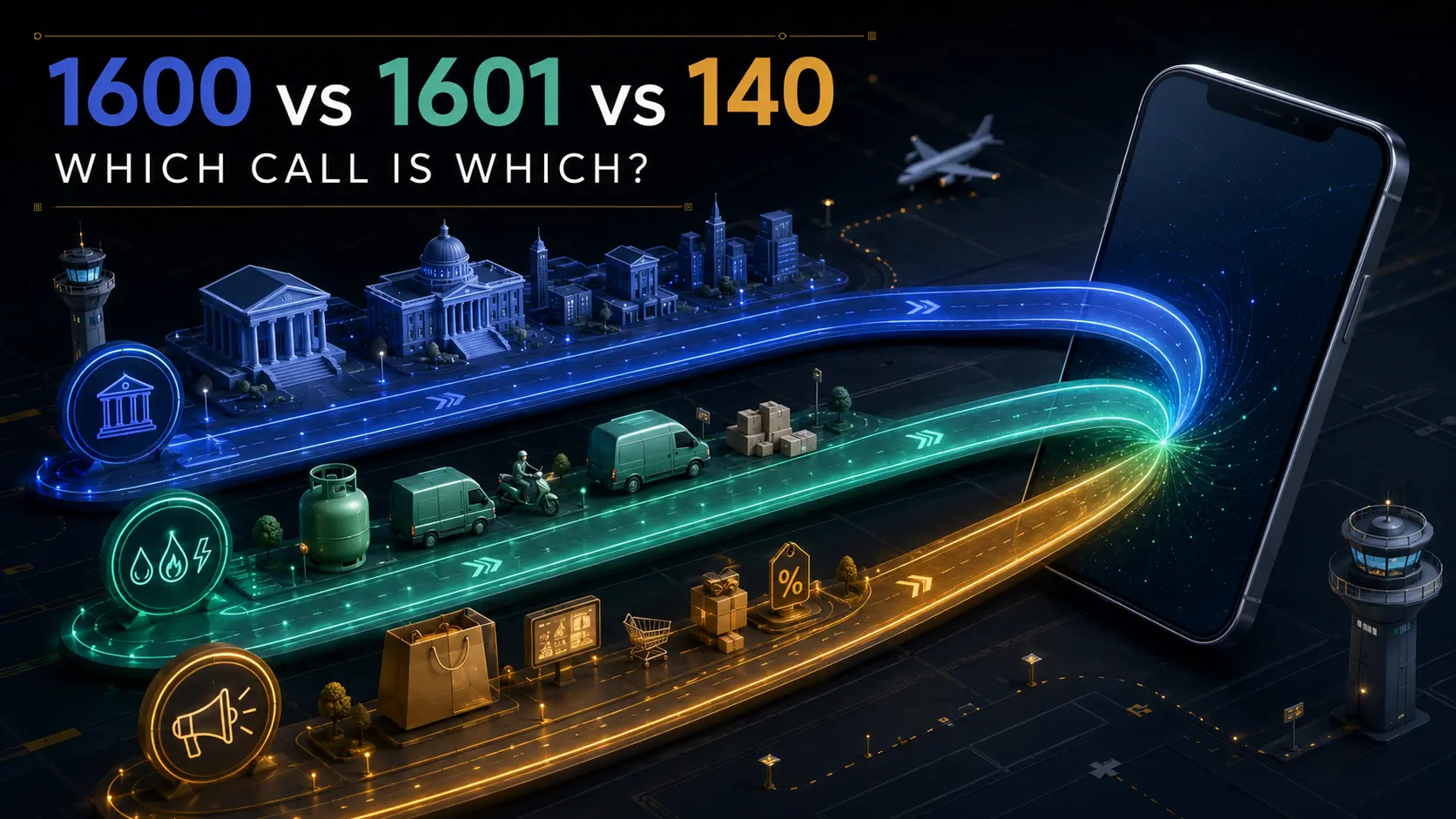
1600 vs 1601 vs 140 numbers now have a clearer regulatory separation in India: TRAI says 1600-series numbers are used for service and transactional calls from covered BFSI and government entities, 1601 is being introduced for similar calls from other sectors beginning with utilities, courier and logistics, while 140-series numbers are used for promotional calls.
The confusion is understandable because older official and commercial material may still describe 1601 as a financial-sector prefix. The numbering framework has evolved, so the date and source behind an explanation matter.
Direct answer
1600 currently identifies covered BFSI and government service or transactional communications.
1601 is now being rolled out for eligible non-BFSI and non-government service or transactional callers, starting with utilities, courier and logistics.
140 is the designated promotional-call series under the TRAI commercial-communication framework.
Why Google results may conflict
A 2024 DoT release used financial calls starting with 1601 as an example. Later TRAI directions developed 1600 for BFSI/government, and the August 2026 release starts 1601 implementation for other sectors.
That makes some older webpages stale even if they were reasonable when originally published.
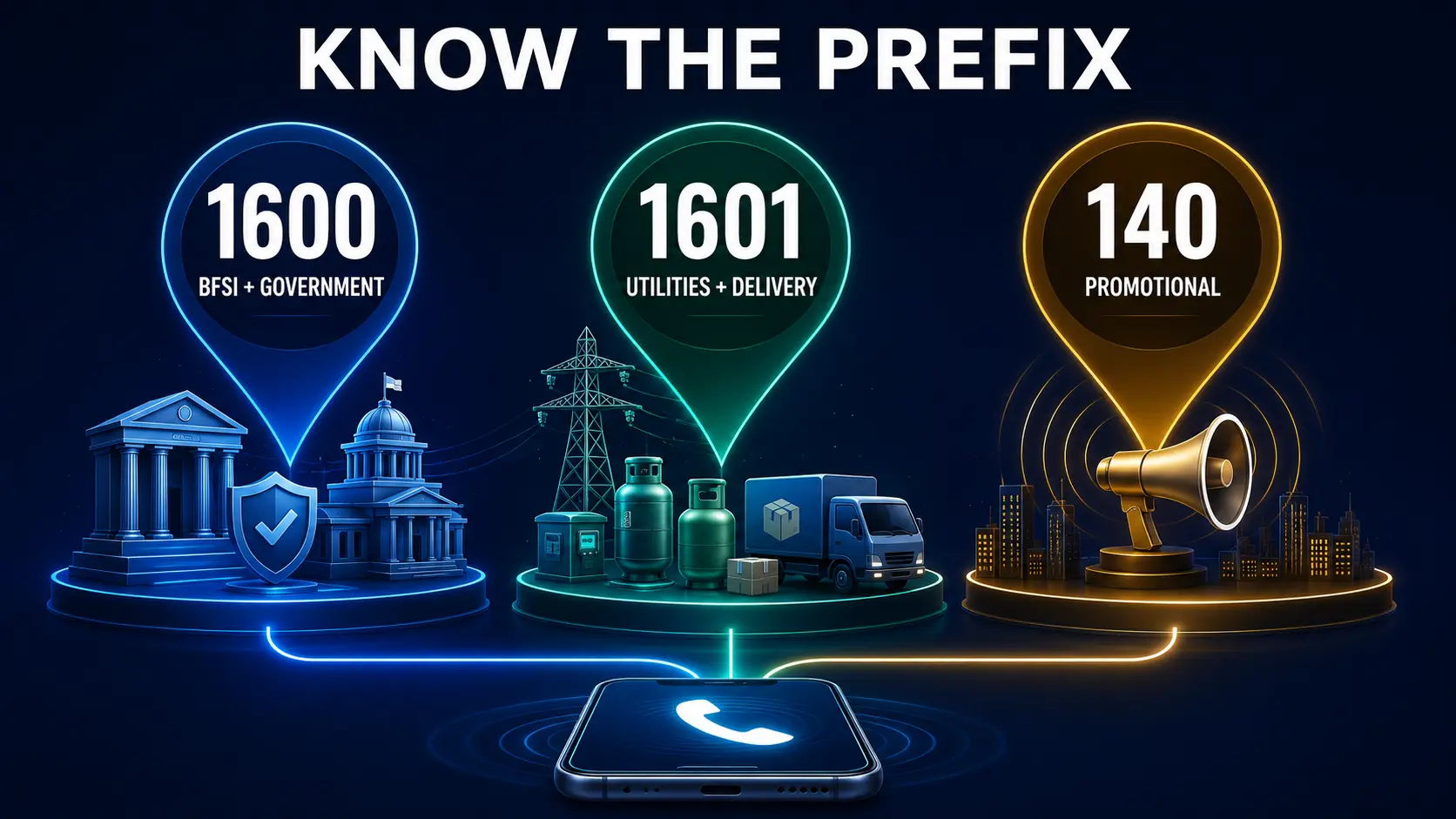
BFSI + Government
Service and transactional calls from covered entities regulated by RBI, SEBI, IRDAI and PFRDA, plus government-to-citizen communications under the applicable framework.
Utilities + Delivery First
Service and transactional calls from sectors other than BFSI and government, beginning with utility, courier and logistics entities in Phase I.
Promotional Calls
Promotional voice calls by registered entities, subject to telecom commercial-communication and consumer-preference rules.
In this number-series comparison
- Quick comparison
- What 1600 means
- What 1601 means
- What 140 means
- Why older pages conflict
- How the framework evolved
- Service vs promotional calls
- Can one company use different series?
- Which calls can DND block?
- What about normal 10-digit calls?
- Does a prefix guarantee safety?
- How a consumer should interpret a call
- Verification method
- Limitations
- FAQs
1600 vs 1601 vs 140 numbers: quick comparison
| Number series | Primary current purpose | Who is covered | Promotional use? | Consumer takeaway |
|---|---|---|---|---|
| 1600 | Service and transactional calls | Covered BFSI entities and government communications | No — not the promotional purpose of this designated series | Think regulated financial/government service communication. |
| 1601 | Service and transactional calls | Other sectors; Phase I starts with utilities, courier and logistics | No | Think utility or delivery-related service communication as rollout expands. |
| 140 | Promotional calls | Registered entities across sectors using the promotional framework | Yes | Think marketing or promotional communication, subject to consumer preferences. |
The key difference is purpose plus eligible caller category. 1600 and 1601 are intended for service/transactional communications, while 140 is the promotional-call series.
What does a 1600 number mean?
TRAI’s July 10, 2026 clarification states that it has mandated the use of 1600xx-series numbers for service and transactional calls by regulated BFSI entities to their existing customers and by government entities for government-to-citizen communication.
The BFSI group named by TRAI includes entities regulated by:
- Reserve Bank of India;
- Securities and Exchange Board of India;
- Insurance Regulatory and Development Authority of India;
- Pension Fund Regulatory and Development Authority.
The regulatory objective is to give important financial and government communications a distinctive trusted numbering identity.
1600 does not mean “marketing from a bank.” A promotional bank offer and a genuine service or transactional communication are different communication purposes under the telecom framework.
What does a 1601 number mean now?
TRAI’s August 10, 2026 release says 1601 is being implemented for service and transactional calls by sectors other than BFSI and government.
Phase I begins with:
- electricity distribution companies;
- water utilities;
- city-gas distribution companies;
- LPG distribution entities;
- other eligible utility-service providers;
- courier companies;
- express-logistics companies;
- parcel-delivery providers;
- freight and logistics providers engaged in delivery of consignments.
TRAI says 1601-series numbers are to be allocated directly to eligible entities after verification by telecom service providers, rather than to intermediaries or aggregators.
The rollout is not instantaneous. Telecom service providers have 90 days from the order to complete migration and onboarding of eligible Phase-I entities.
For the consumer-focused explanation of this new series, see 1601 Number Meaning in India.
What does a 140 number mean?
TRAI’s July 2026 clarification says the 140xx series is designated for promotional calls by entities from any sector.
Entities using 140 for promotional calling must operate within the Telecom Commercial Communications Customer Preference framework.
That matters because customers retain the ability to manage promotional communication preferences through the DND framework.
140 is not the “fraud number series.” It is a designated promotional-call series. A promotional call can be legitimate while still being unwanted by a particular consumer.
Why do some websites still say 1601 is for banks?
Because older material reflects an earlier stage of the numbering framework.
The Department of Telecommunications announced the broader 160xxxxxxx series in May 2024 for service and transactional calls.
That announcement gave financial entities regulated by bodies such as RBI, SEBI, PFRDA and IRDA as an example and said their service or transactional calls would start from 1601.
Subsequent TRAI directions developed the 1600-series implementation for BFSI and government communications. Then, in August 2026, TRAI explicitly announced 1601 for sectors other than BFSI and government.
Therefore: an older page saying “1601 = financial entities” may reflect the 2024 description, but it should not be treated as the complete current August 2026 explanation.
The safest wording is that the trusted-number framework evolved. The reviewed official sources do not require us to claim that every historical 1601 allocation was mechanically “reassigned” from one industry to another.
How the 1600, 1601 and 140 framework evolved
Before the dedicated 160 series
140 carried multiple commercial-call types
DoT’s 2024 explanation said the 140 series had been used for promotional as well as service and transactional calling, which contributed to consumers ignoring important calls.
May 30, 2024
DoT introduces 160xxxxxxx
The new 160-series was introduced as a separate identity for service and transactional voice calls. The announcement used financial calls starting with 1601 as an example.
2025–2026
TRAI mandates 1600 adoption for BFSI
TRAI issued phase-wise directions requiring regulated BFSI entities to use the 1600-series for covered service and transactional communications.
July 10, 2026
TRAI clarifies 1600 vs 140
TRAI publicly clarified that 1600 is for BFSI/government service and transactional calls and 140 is for promotional calls.
August 10, 2026
1601 begins rollout for other sectors
TRAI starts Phase-I implementation for utilities, courier and logistics entities outside BFSI and government.
What is the difference between a service call and a promotional call?
This distinction is more important than the industry alone.
Relates to an existing service, account, transaction, delivery, utility relationship or other permitted non-promotional communication.
Commercial outreach intended to advertise, sell or promote where the communication falls within the promotional framework.
A bank can need to communicate account-related information and separately want to market a new product. Those are different purposes.
Likewise, a courier may need to call about a parcel delivery, while a logistics company could separately conduct promotional outreach.
The series follows the communication purpose and applicable regulatory framework, not simply the brand name printed on the caller’s website.
Can the same company need different number series?
Potentially, yes, because one entity can make different types of communication.
The important distinction is not “one company equals one number family forever.” It is whether the communication is service/transactional or promotional and which designated numbering rules apply to that entity and call type.
For example, the August 2026 TRAI release expressly says that assigned 1601 numbers cannot be used for promotional voice calls.
So a company receiving a 1601 allocation cannot simply use that same number to run promotional sales campaigns.
Can DND block 140, 1600 or 1601 calls?
TRAI’s July 10 clarification draws an important distinction.
Customers can manage promotional calls from the 140 series through the DND preference framework.
The same clarification says tagging, blocking or filtering calls originating from the designated 1600-series numbers is not permitted under the TCCCPR framework because those calls are intended to be important service/transactional communications from covered BFSI and government entities.
The August 2026 1601 release establishes the new service/transactional identity for the first non-BFSI sectors, but it does not in the reviewed press release provide an identical consumer-filtering paragraph for 1601.
Do not extend a 1600-specific blocking statement to 1601 unless TRAI publishes or the controlling direction contains the same rule. This article therefore does not make that assumption.
What about calls from normal 10-digit mobile numbers?
The entire trusted-number initiative exists partly because fraudsters and genuine businesses have both historically used ordinary 10-digit numbers, making it difficult for consumers to identify who is calling.
However, the new 1601 rollout includes a 90-day onboarding period.
That means a consumer should not conclude that every utility or courier call from a normal number became fraudulent on August 10.
During the rollout: verify an unexpected call using the organisation’s official app, website or published customer-care route rather than relying only on whether the caller already uses 1601.
Does 1600 or 1601 automatically mean a call is safe?
The designated series provides a stronger caller-identity framework because eligibility and allocation are controlled through telecom operators and the applicable regulatory system.
That is useful evidence of caller identity.
It is still not a reason to disclose an OTP, UPI PIN, card PIN, password or other secret authentication credential.
The detailed safety companion is locked at:
Is a 1601 Number Safe? 7 Checks Before You Trust the Caller
That page will own the action/fraud intent and will link back to this comparison and the main 1601 meaning guide.
How should you interpret an unfamiliar 1600, 1601 or 140 call?
| If the call begins with | Your first interpretation | What to verify |
|---|---|---|
| 1600 | Covered BFSI or government service/transactional communication. | Does the call relate to a real account, service or government interaction? |
| 1601 | Non-BFSI service/transactional caller under the new framework; Phase I starts with utilities and delivery/logistics. | Do you actually have the referenced utility service, parcel or transaction? |
| 140 | Promotional commercial call. | Do your DND preferences permit that category of promotional communication? |
| Normal 10-digit number | No special trusted-series identity from the prefix alone. | Verify independently if the caller claims to represent a bank, utility, courier or government service. |
160-series trusted-call cluster
- 1601 Number Meaning in India — what the new 1601 prefix means when it appears on your phone.
- Is a 1601 Number Safe? — predefined safety and scam-check companion.
- How to Complain About Spam Calls in India — DND, 1909 and official complaint workflow.
- CERT-In Cyber Threats 2026 — wider cyber-risk context.
How this 1600 vs 1601 vs 140 guide was verified
Verification method
ThePulseSignal compared the August 10, 2026 TRAI 1601-series release, TRAI’s July 10 clarification on 1600 and 140 numbers, the original May 2024 DoT 160-series announcement, and TRAI’s phase-wise 1600 adoption material for BFSI entities.
The July 10, 2026 TRAI clarification was treated as the controlling source for the current 1600-versus-140 distinction.
The August 10, 2026 TRAI release was treated as the controlling source for the new 1601 rollout, its Phase-I sectors, verification requirements, direct allocation, 90-day onboarding window and prohibition on promotional use.
The May 2024 DoT announcement was used to explain why older material may still associate 1601 with financial entities.
The article does not describe the change as a universal technical reassignment because the reviewed official documents do not explicitly use that wording.
Official sources reviewed
Limitations and unresolved facts
- The trusted-number framework has changed over time, so older official material may use numbering examples that do not fully reflect the August 2026 structure.
- The reviewed official documents do not state that every earlier 1601 allocation was technically reassigned from BFSI to other industries.
- The August 10 rollout gives telecom service providers 90 days to migrate and onboard eligible Phase-I 1601 entities.
- The absence of a 1601 number during that transition does not by itself prove that a utility or courier call is fraudulent.
- TRAI may add additional industries to the 1601 framework in later phases.
- The July 10 clarification expressly describes DND/blocking treatment for 1600 and 140; this article does not assume identical filtering rules for 1601 without controlling evidence.
- A designated number prefix is an identity signal and does not justify sharing authentication secrets.
- This article explains the consumer-facing number families; exact number-allocation mechanics can include additional operator and regulatory requirements not needed to answer the comparison query.
1600 vs 1601 vs 140 numbers: frequently asked questions
What is the difference between 1600 and 1601 numbers?
Current TRAI material uses 1600 for covered BFSI and government service/transactional calls, while 1601 is being introduced for service/transactional calls from other sectors, starting with utilities, courier and logistics.
What is the difference between 1601 and 140?
1601 is for eligible service and transactional calls in the new non-BFSI framework. The 140 series is designated for promotional calls.
Are 1600 numbers for banks?
TRAI says regulated BFSI entities including those regulated by RBI, SEBI, IRDAI and PFRDA use the designated 1600-series framework for covered service and transactional calls.
Are 1601 numbers for banks?
The current August 2026 TRAI release says 1601 is being implemented for sectors other than BFSI and government. Older material may still associate 1601 with financial entities because of the 2024 numbering description.
Who can use 1601 first?
Phase I includes electricity, water, city gas, LPG distribution, courier, parcel-delivery, express-logistics and freight/logistics entities meeting the eligibility rules.
Can promotional calls come from 1601?
No. TRAI’s August 2026 release says assigned 1601 numbers shall not be used for promotional voice calls.
Are 140 calls scams?
No. The 140 series is a designated promotional-call series. A legitimate promotional call can still be unwanted, which is why TRAI provides consumer-preference and DND controls.
Can DND block 140 calls?
Yes. TRAI’s July 2026 clarification says consumers can manage promotional calls from the 140 series through DND preferences.
Can DND block 1600 calls?
TRAI’s July 2026 clarification says tagging, blocking or filtering calls originating from the designated 1600 series is not permitted under the applicable framework.
Does the same rule automatically apply to 1601?
The August 2026 press release establishes 1601 as a service/transactional series but does not contain the same explicit blocking paragraph reviewed for 1600. This article therefore does not assume an identical rule without further controlling evidence.
Why do Google results disagree about 1601?
Some pages reflect older DoT and industry explanations. TRAI’s August 2026 release is newer and explicitly places the new 1601 rollout outside BFSI and government.
Last verified: August 10, 2026.