






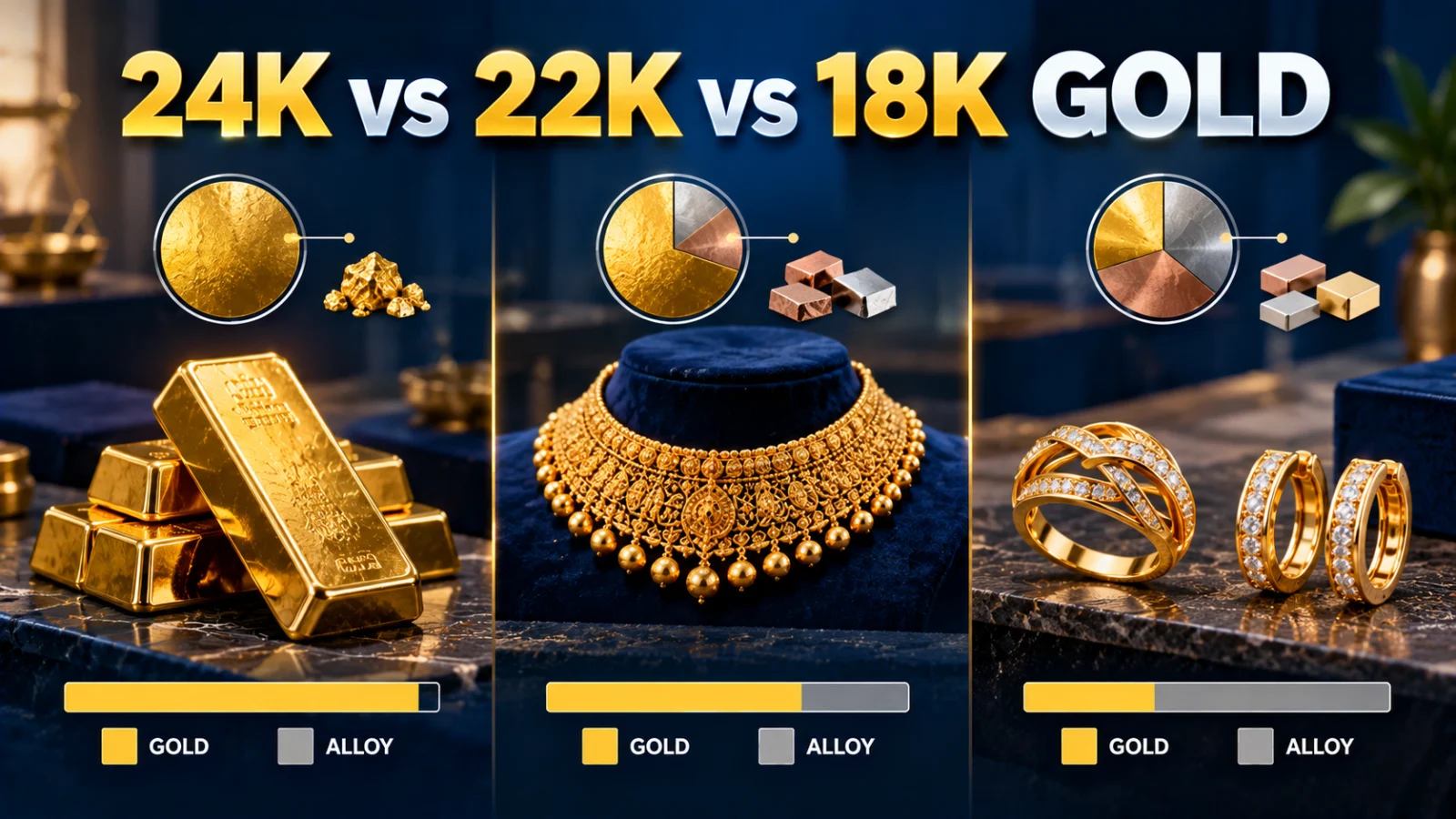
24K vs 22K vs 18K gold is mainly a comparison of how much gold is present in the metal and how much of the remaining weight can be alloying material. Higher purity means more fine gold per unit weight, but it does not automatically make a jewellery article better for every design or every buyer.
For Indian buyers, one detail is especially important: under the Bureau of Indian Standards framework for hallmarked gold jewellery and artefacts, the listed high-purity grade is 24KS/995. BIS also lists 22K/916 and 18K/750, along with other permitted grades. That is different from casually treating every reference to 24K gold as a BIS 999 jewellery grade.
| Grade | Fineness | Approximate gold content | What it means for the buyer |
|---|---|---|---|
| 24KS | 995 | 99.5% | Highest BIS-listed fineness among the jewellery/artefact grades discussed here; very high gold content, while actual suitability still depends on product design and manufacturing. |
| 22K | 916 | 91.6% | High gold content with a larger alloy fraction than 24KS, allowing different working and wear characteristics. |
| 18K | 750 | 75% | Lower gold content and a larger alloy fraction, which can support different colours, constructions and jewellery designs. |
What do 24K, 22K and 18K actually measure?
Karat describes gold purity, not the physical weight of the jewellery. In the traditional 24-part system, a higher karat number means a greater share of the metal is gold.
Fineness expresses the same basic idea in parts per thousand. A fineness of 916 means 916 parts out of 1,000 are gold. A fineness of 750 means 750 parts out of 1,000 are gold.
That is why 22K/916 corresponds to approximately 91.6% gold and 18K/750 corresponds to 75% gold.
What does 916 gold mean?
916 gold means a fineness of 916 parts gold per 1,000 parts of the metal by mass. In the BIS system, that corresponds to 22K gold.
So if two jewellery articles have the same gross metal weight but one is 22K/916 and the other is 18K/750, the 22K article contains more fine gold before any separate discussion of making charges, stones, tax or other retail components.
What does 750 gold mean?
750 means 750 parts gold per 1,000, or 75% gold by mass. That corresponds to 18K.
The remaining share is alloying material. The exact metals used in that alloy can vary, so the number 750 tells you the gold proportion but does not by itself tell you every mechanical, colour or wear characteristic of the finished jewellery.
How much actual gold is inside a 22K or 18K piece?
A useful way to understand purity is to calculate the equivalent fine-gold content:
Fine-gold equivalent = article weight × fineness ÷ 1,000
10g of 22K/916
10 × 916 ÷ 1,000 = 9.16g equivalent fine-gold content.
10g of 18K/750
10 × 750 ÷ 1,000 = 7.50g equivalent fine-gold content.
10g of 24KS/995
10 × 995 ÷ 1,000 = 9.95g equivalent fine-gold content.
This calculation is a purity illustration. It is not a complete retail-price formula. A jewellery bill can include other components such as workmanship or making charges, stones or other materials, taxes and seller-specific commercial terms.
Why are 22K and 18K jewellery alloyed?
Pure or near-pure gold is highly malleable. Jewellery makers can combine gold with other metals to change working properties, durability and colour. As the karat falls, the alloy fraction becomes larger.
That does not mean every lower-karat article is automatically stronger than every higher-karat article. Exact alloy composition, heat treatment, manufacturing technique, thickness, setting design and the overall structure of the piece also affect how jewellery behaves in use.
Does higher purity always mean better jewellery?
No. Higher purity means more gold. It does not automatically mean a better finished product for every use.
A buyer prioritising maximum gold content may prefer a higher-fineness article. Another buyer may prefer a design that uses a larger alloy fraction because of colour, setting requirements, construction or expected wear. The correct comparison therefore depends on what the buyer values, not only on which karat number is highest.
24K vs 22K vs 18K: which is best for which use?
| Buyer priority | What to consider |
|---|---|
| Maximum gold content | A higher-fineness grade contains more fine gold for the same metal weight. |
| High-purity wearable jewellery | 22K/916 provides high gold content while still incorporating a larger alloy fraction than 24KS/995. |
| Design flexibility or larger alloy fraction | 18K/750 contains 75% gold and leaves a greater share for alloying metals, which can support different colours and constructions. |
These are comparison principles rather than universal rules. TPS does not treat one karat as automatically superior for every jewellery design.
Why equal-weight 22K and 18K pieces should not have the same underlying gold value
Suppose two metal articles each weigh 10g. The 22K/916 article represents about 9.16g of fine gold, while the 18K/750 article represents about 7.5g.
The difference is 1.66g of equivalent fine-gold content. That is why purity changes the raw-gold component of value even when gross weight is identical.
But this should not be turned into a claim that the final retail prices must differ by exactly the same proportion. The final price can contain components unrelated to the fine-gold quantity.
Does 18K being 75% gold mean it should cost 75% of 24K jewellery?
No. A purity percentage describes the proportion of gold in the metal. It does not specify the complete selling price of the jewellery.
The useful comparison is narrower: for equal metal weight, a lower-fineness article contains less fine gold. Once you move from metal content to the final shop price, other components can materially affect the number.
BIS 24KS/995 is not the same claim as generic 24K/999 shorthand
Consumers often see 24K associated with 999 or 999.9 fineness in bullion and international gold-market contexts. For this article’s Indian jewellery comparison, however, the controlling BIS jewellery/artefact grade is 24KS/995.
TPS therefore keeps those concepts separate rather than rewriting 24KS/995 as a BIS 999 jewellery standard.
What this article does not cover
This page compares known purity grades. It does not tell you whether a particular jewellery article is genuinely hallmarked or whether a specific HUID is valid. That is a separate verification task covered by TPS at How to Check Gold Purity and HUID in India.
It also does not calculate the full jewellery bill, today’s gold rate or the market forces that move gold prices.
Verification note
TPS checked the BIS hallmarking guidance for permitted gold fineness grades and reconciled it with established gold-industry material explaining caratage, fineness and alloying. The article keeps the BIS jewellery grade 24KS/995 separate from generic 999 or 999.9 bullion terminology and treats fine-gold calculations only as purity illustrations.
Limitations and unresolved facts
Fineness alone does not reveal the exact alloy recipe, design strength, workmanship, setting construction, seller pricing, exchange terms or resale outcome of a specific article. Those details must be checked for the individual product rather than inferred from the karat number alone.