






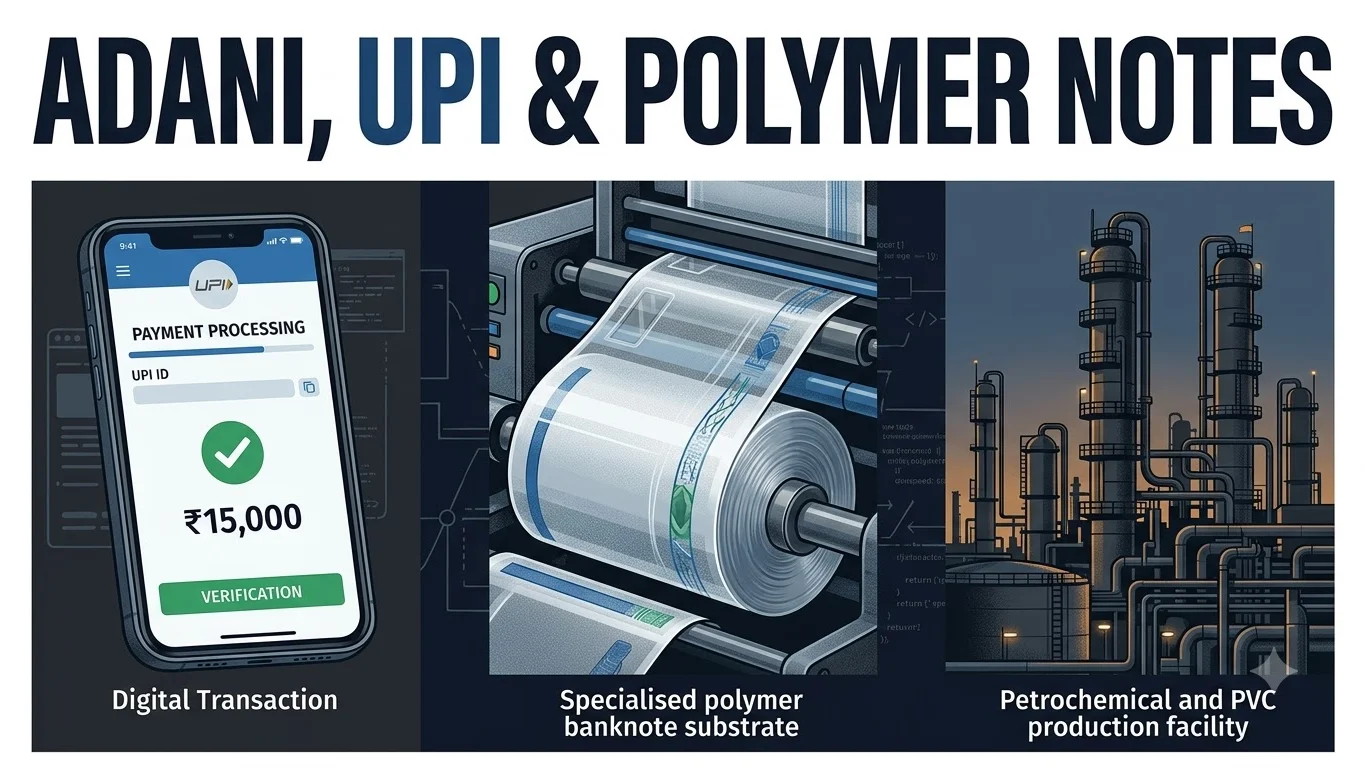
The viral Adani RBI polymer notes theory combines three developments that are individually real: India’s September UPI merchant-fee framework changed, RBI-linked banknote printer BRBNMPL has begun a procurement process for specialised polymer banknote substrate, and Adani Enterprises is developing major PVC capacity at Mundra.
What the reviewed evidence does not establish is the claimed causal chain connecting those developments. TPS found no primary document saying UPI merchant fees were introduced to push users back toward cash, no BRBNMPL or RBI document naming an Adani company as the polymer-substrate supplier, and no Adani disclosure saying its Mundra PVC project was built for India’s polymer banknotes.
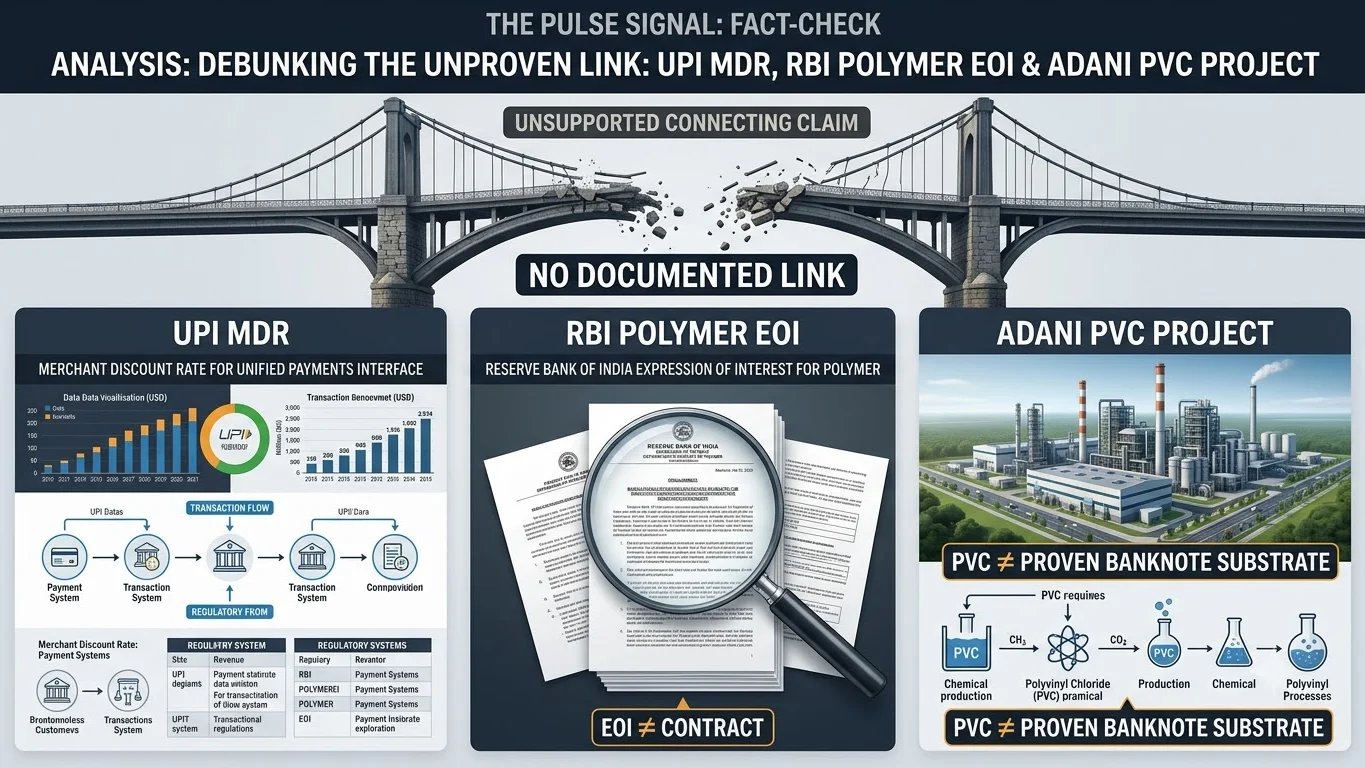
Direct answer: the UPI policy change, RBI polymer-note programme and Adani PVC project are all documented. The alleged connection between them is not established by the primary evidence reviewed. A future supplier relationship cannot be ruled out in the abstract, but proving one would require a bid, shortlist, award, contract or company disclosure that actually names the parties and product.
What exactly is the viral Adani RBI polymer notes theory?
The theory generally follows four steps: new UPI merchant charges will make digital payments less attractive; people will therefore return to cash; RBI is preparing polymer banknotes; and Adani’s polymer investment is positioned to supply the resulting currency demand.
The problem is that each step requires separate evidence. The existence of three developments at roughly the same time does not by itself prove that one caused the next or that they are part of a coordinated procurement plan.
Are consumers now being charged for ordinary UPI payments?
No. Under the current framework, person-to-person UPI payments remain free regardless of amount. Merchant payments up to ₹2,000 and qualifying small-merchant transactions also remain zero-MDR.
The September change applies merchant-side MDR to specified higher-value merchant transactions. The government says roughly 96% of merchant UPI transactions remain unaffected and has advised merchants not to pass the MDR directly to consumers.
TPS already explains the detailed merchant rules, thresholds and who actually bears the charge in its UPI MDR 2026 explainer.
Could UPI MDR still push some merchants or customers toward cash?
It could influence behaviour at the margin, and that possibility is being debated. Some merchants and commentators have warned that additional payment costs could make cash more attractive for higher-value transactions. Others argue that UPI’s convenience, scale and consumer adoption make a broad reversal unlikely.
Those are forecasts. The current framework has not yet produced enough post-implementation evidence to show that India is moving materially back toward cash because of MDR.
Is there evidence UPI MDR was designed to revive cash?
No such motive was established in the government or payment-policy material reviewed by TPS. The official justification centers on sustaining the payment ecosystem, compensating participating institutions and supporting continued digital-payment infrastructure.
A future rise in cash usage would not by itself prove that increasing cash usage was the original policy objective.
Is RBI really moving toward polymer banknotes?
Yes. This part of the viral discussion is grounded in a real procurement trail.
RBI-owned Bharatiya Reserve Bank Note Mudran Private Limited issued a global expression of interest for manufacturers and suppliers of opacified polymer substrate sheets with security features suitable for printing Indian banknotes. The procurement process opened in July 2026.
RBI Governor Sanjay Malhotra later said the central bank was targeting broader introduction around the beginning of FY2027-28, subject to successful field trials and operational assessment.
Does the BRBNMPL EOI mean a supplier has already won the contract?
No. An expression of interest is not the same thing as a final supplier award.
An EOI can identify capable manufacturers, test market interest and establish technical or eligibility requirements. A procurement link becomes materially stronger when there is documentary evidence such as a qualified bidder list, commercial tender, award notice, signed contract or official supplier disclosure.
The reviewed BRBNMPL material confirms that India is seeking specialised polymer substrate. It does not establish that Adani has been selected to provide it.
Has Adani been named as an RBI polymer-note supplier?
TPS did not recover a BRBNMPL, RBI, government or Adani primary document naming an Adani entity as the polymer-banknote substrate supplier or contract winner.
That evidence boundary matters. It is more accurate to say no documented link was found in the reviewed primary material than to make the stronger claim that Adani could never participate in a future procurement.
What is Adani actually building at Mundra?
Adani Enterprises describes a major polyvinyl chloride, or PVC, project at Mundra. Current company material describes a first-stage plant with capacity of about one million tonnes per year.
The company’s stated commercial case is India’s PVC supply deficit and demand from sectors such as agriculture, construction and infrastructure. The reviewed disclosure does not describe the project as an RBI banknote-substrate plant.
Is PVC automatically the same material as polymer banknote substrate?
No. The word polymer describes a broad class of materials; it does not mean every polymer product is interchangeable.
For example, the Bank of England says its polymer banknotes use specialised polypropylene film. India can set its own final security and material specifications, but this illustrates why a general PVC production project cannot automatically be treated as proof of banknote-substrate capability or selection.
The correct evidence would be India’s actual technical specification together with supplier documentation linking a company and product to that requirement.
What about the claim that Adani invested $4 billion for polymer currency?
The wording is misleading based on the primary material reviewed.
One Adani clarification says India had been importing close to $4 billion worth of PVC annually. That figure describes the scale of India’s PVC import market; it is not evidence that Adani invested $4 billion specifically to supply polymer banknotes.
Separate older petrochemical plans have also used multibillion-dollar investment figures across broader projects and partnerships. Those figures should not be converted into a banknote-specific investment without direct evidence.
India’s polymer-note idea predates today’s UPI and Adani developments
The chronology is important. India’s interest in polymer banknotes did not begin in 2026.
Government records from December 2012 said RBI was considering polymer currency and planned a field trial involving ₹10 notes, with improved durability among the stated reasons. Polymer-note trial plans were discussed again in later years.
That history substantially weakens any claim that the idea of polymer currency originated because of the current Adani PVC project or the September 2026 UPI MDR framework.
Does the older history prove Adani can never become a supplier?
No. Historical chronology answers one question: the polymer-note policy idea clearly existed long before the current Adani PVC and UPI developments.
It does not answer every future procurement question. If an Adani company later bids for, qualifies for or wins a relevant security-substrate contract, that should be assessed from the new procurement evidence at that time.
What evidence would actually prove an Adani–RBI procurement link?
A credible link would require documentary evidence such as a BRBNMPL or RBI bidder list naming an Adani entity, an official shortlist, a tender award, a signed supply contract, a government procurement disclosure, or an Adani filing explicitly describing banknote-substrate supply.
Without one of those links, the existence of a PVC factory and a separate polymer-banknote procurement process remains correlation, not procurement proof.
Is RBI replacing all paper currency with polymer notes?
Current evidence does not support that claim. RBI’s current programme is described as a trial and phased introduction subject to operational assessment. The evidence reviewed does not establish an immediate replacement of all Indian paper banknotes.
What the evidence shows today
| Claim | Evidence status |
|---|---|
| UPI merchant-fee rules changed in September 2026 | Confirmed |
| Ordinary P2P UPI users now pay a direct UPI fee | Not supported |
| BRBNMPL is seeking polymer substrate for Indian banknotes | Confirmed |
| Adani is developing major PVC capacity at Mundra | Confirmed |
| Adani has been selected to supply RBI polymer-banknote substrate | No reviewed primary evidence establishes this |
| UPI MDR was designed to push Indians back to cash to support polymer-note demand | No reviewed primary evidence establishes this |
What happens next?
The strongest future evidence would come from BRBNMPL supplier qualification or award documents, RBI polymer-note trial specifications, Adani corporate disclosures, or measured UPI-versus-cash behaviour after the new MDR framework takes effect.
If any authoritative document establishes a real procurement relationship, this same article should be updated. Until then, the strongest evidence-backed conclusion is that the three underlying developments are real but the alleged causal connection remains unproven.
Verification note
TPS reviewed the September UPI policy material, BRBNMPL’s polymer-substrate procurement notice, Adani’s current PVC-project disclosures, historical government records on India’s polymer-note trials and supporting current reporting. The evidence confirms each underlying development separately; no reviewed primary document establishes the alleged Adani–UPI–RBI procurement chain.