






Amanath Co-operative Bank restrictions will continue beyond September 12, 2026. The Reserve Bank of India has extended the existing Directions on The Amanath Co-operative Bank Ltd., Bangalore through the close of business on December 12, 2026, subject to review. RBI says the other terms and conditions remain unchanged.
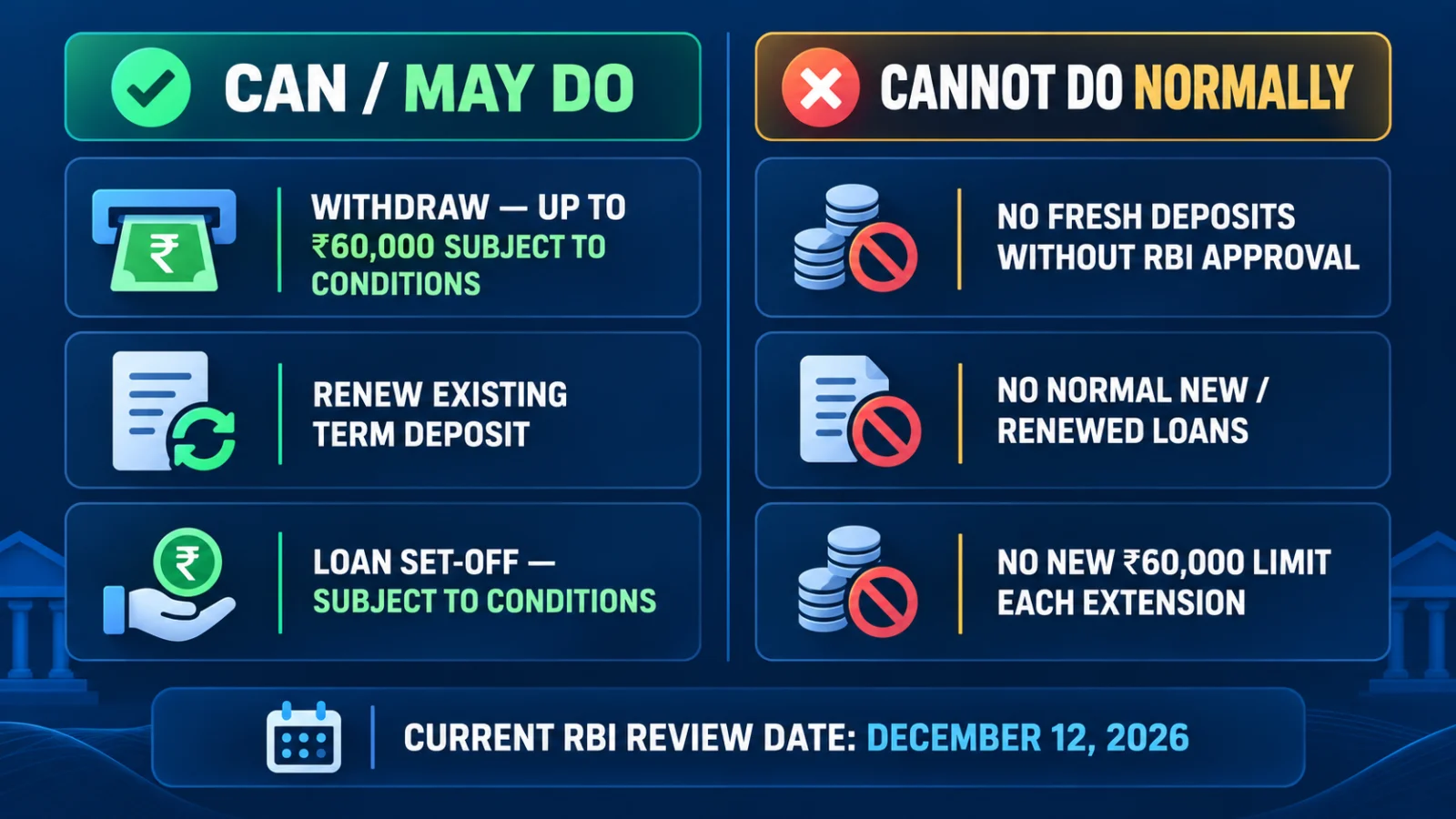
What this means for depositors: the existing withdrawal ceiling and operating restrictions do not expire on September 12. The underlying Directions continue, including the current ₹60,000 withdrawal ceiling subject to conditions, restrictions on accepting fresh deposits and restrictions on normal new or renewed lending.
What changed on September 8?
The earlier RBI Directions were due to run through the close of business on September 12, 2026. RBI has now extended them for another three months, through December 12, 2026.
The important point is that RBI did not announce a fresh set of relaxed banking conditions. It said the existing terms remain unchanged. Depositors should therefore not assume normal account access resumes after September 12.
How much can an Amanath Bank depositor withdraw?
The underlying RBI Directive permits a maximum withdrawal of ₹60,000 from the depositor’s covered deposit accounts, subject to the conditions in the Directive, including adjustment where the depositor has liabilities to the bank.
This ceiling applies across the covered deposit relationship described by the Directive; it should not be interpreted as ₹60,000 separately from every account.
The September extension does not create another fresh ₹60,000 withdrawal entitlement. RBI has extended the existing Directions rather than restarting the withdrawal ceiling for a new period.
What can and cannot depositors do now?
Withdraw deposits: Permitted within the existing ₹60,000 ceiling and subject to the Directive’s conditions and any amount already withdrawn.
Receive another ₹60,000 because the Directions were extended: No. The extension continues the existing terms; it does not create a new withdrawal cycle.
Place a fresh deposit normally: Restricted. The bank cannot accept fresh deposits without prior RBI approval under the Directive.
Renew an existing term deposit at maturity: Permitted in the same name and same capacity under the existing Directive.
Obtain a normal new or renewed loan: Restricted without prior RBI approval.
Adjust a qualifying deposit against a loan: May be permitted when the Directive’s conditions are satisfied, including relevant contractual, KYC and ownership conditions.
Can Amanath Bank accept fresh deposits?
Normal acceptance of fresh deposits remains restricted without prior written approval from RBI. That is different from renewal of an existing term deposit.
The underlying Directive specifically permits an existing term deposit to be renewed on maturity in the same name and same capacity. Depositors should therefore distinguish an allowed renewal from placing new money with the bank.
Can Amanath Bank grant or renew loans?
The Directions restrict the bank from granting or renewing loans and advances without RBI’s prior approval. This restriction continues because the September 8 extension leaves the existing terms unchanged.
Can a depositor use deposits to adjust a loan?
The Directive allows certain deposit-to-loan set-offs when the required conditions are met. Whether an individual depositor qualifies depends on the loan agreement, account ownership, KYC status, third-party interests, legal encumbrances and other conditions in the Directive.
This means a borrower-depositor should not assume either that set-off is automatically available or that it is completely prohibited. The bank must apply the controlling conditions to the specific account.
Has RBI cancelled Amanath Co-operative Bank’s licence?
The current extension is not a licence-cancellation notice. The regulatory state reviewed by TPS is continued operation under RBI Directions, and Amanath remains listed by the Deposit Insurance and Credit Guarantee Corporation as a bank under All Inclusive Directions.
RBI has also expressly cautioned that extending the Directions should not be interpreted as the regulator being satisfied with the bank’s financial position.
What about DICGC deposit insurance?
DICGC records show that Amanath has previously been processed under the All Inclusive Directions framework and that claim settlement has already taken place for eligible and traceable depositors.
That does not mean every depositor now has a new ₹5 lakh claim simply because RBI extended the Directions. An individual’s present DICGC position depends on their account, eligibility and whether a claim or payment has already been processed.
What should a depositor verify personally?
- How much has already been withdrawn under the current Directions.
- The total balance remaining across affected deposit accounts.
- Whether the depositor is also a borrower or surety with liabilities to the bank.
- Whether the transaction is a fresh deposit or renewal of an existing term deposit.
- Whether any DICGC claim or payment has already been processed for the account.
- The latest RBI and bank communication before requesting a consequential transaction.
What happens on December 12?
The current Directions run through the close of business on December 12, 2026, subject to review. That date should not be read as a promise that every restriction automatically disappears afterward.
RBI may withdraw, modify, relax, tighten or further extend the Directions before or at that checkpoint. TPS will update this same URL when the regulatory state changes.
What remains unresolved?
- An individual depositor’s remaining withdrawal availability after earlier withdrawals.
- An individual’s current DICGC claim or payment status.
- Whether a specific borrower-depositor qualifies for set-off.
- The bank’s current financial position beyond RBI’s stated supervisory caution.
- What RBI will decide at or before December 12, 2026.
Verification note: ThePulseSignal reviewed RBI’s September 8 extension state, the underlying June 2024 Directions governing withdrawals and banking operations, and current DICGC records for Amanath Co-operative Bank. Individual account outcomes remain dependent on account history and the controlling bank/RBI records.