






A container rollover means your box did not move on the sailing it was originally booked on and may need to be carried on a later vessel or service. The critical question is not simply whether someone says the container was “rolled.” It is: which vessel and voyage is now assigned, and has the box actually loaded on it?
Direct answer
How do you confirm where a rolled container is going?
Start with the original booking and confirm whether the booked vessel actually called and departed. Then check whether your individual container has a load event for that sailing. If it did not load, look for a carrier rollover or rebooking status, identify the replacement vessel and voyage, check the revised ETD, and finally wait for an actual load event on the replacement vessel.
A revised booking is the carrier’s current plan. A container load event is stronger evidence that the plan was physically executed.
Do not assume
“Next available vessel” is not a vessel assignment
A rollover confirms the original booked movement failed. It does not by itself prove that the box will sail on the very next vessel or on a specific date. Look for a named vessel, voyage and shipment-specific update.
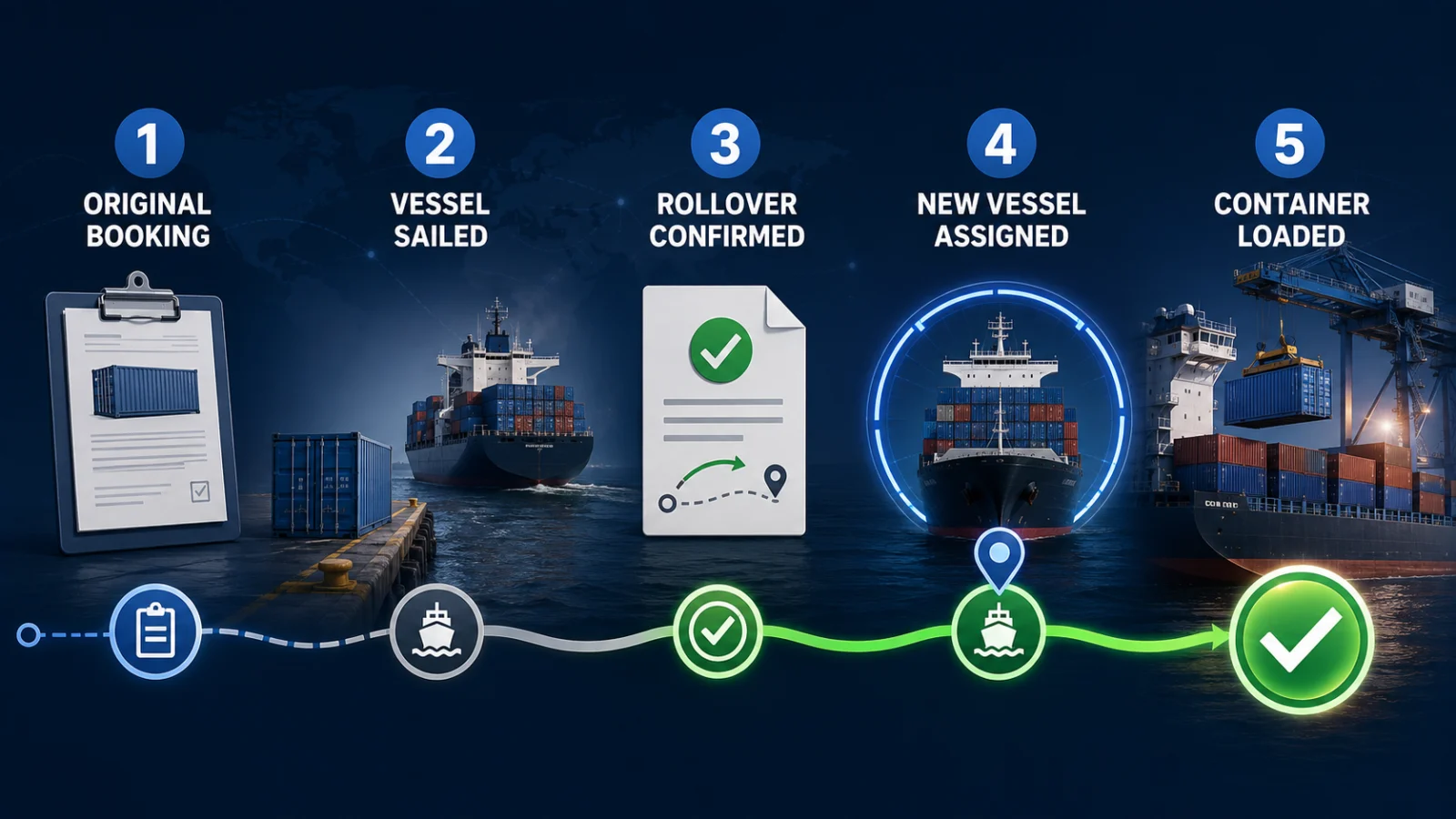
State 1
Booked
Container is planned on Vessel A / Voyage A.
State 2
Original vessel sailed
The booked vessel departed, but the container has no confirmed load on that sailing.
State 3
Rollover confirmed
The carrier recognizes the booking moved to a later sailing, but the replacement may still be vague.
State 4
Replacement assigned
A new vessel and voyage appear in the booking or carrier instructions.
State 5
Loaded
A container-specific load event confirms physical loading on the replacement vessel.
In this guide
- What container rollover means
- Prove the original sailing was missed
- Find the replacement vessel
- “Next available” vs named sailing
- Booking update vs physical load event
- Rollover evidence ladder
- Revised ETD and ETA
- Second-roll risk
- Origin vs transshipment rollover
- Rollover vs blank sailing, omission and vessel delay
- Why containers get rolled
- Charges and free-time treatment
- No-roll or protected products
- Why AIS cannot prove your box loaded
- Watch, verify or escalate
- Worked example
- Related TPS shipping diagnostics
- Verification boundaries
- Limitations
- FAQs
Container rollover means the booked sailing changed for the cargo
Carrier terms can describe rolling as moving cargo to a later sailing than the one shown in the original booking confirmation. A rollover can happen at the first load port or during a later transshipment connection.
The operational signature is usually:
Basic rollover pattern
That is different from a blank sailing, where the sailing itself is cancelled, and different from a port omission, where the vessel does not call the planned port.
First prove that the original booked movement actually failed
Do not diagnose a rollover from a delayed ETA alone. Establish two separate facts:
- Did the original vessel call and depart?
- Did your individual container load onto that vessel?
Vessel evidence
Schedule, carrier operational data or vessel movement can establish that the booked ship called or departed.
Container evidence
Shipment-specific tracking or carrier status should establish whether the box loaded onto that sailing.
Important: Vessel departure and container loading are different facts. The ship can sail while your box remains at the terminal.
Find the new vessel and voyage — not just a generic delay status
Once the original sailing is missed, the most useful replacement evidence is a shipment-specific update containing:
- new vessel name;
- new voyage number;
- revised estimated departure;
- revised estimated arrival where available;
- updated service or routing if it changed;
- revised terminal, cutoff or gate-in instructions where applicable.
If the carrier has only stated “next available sailing,” the final replacement may still be unresolved.
“Next available” and “next vessel” are not the same as a confirmed assignment
Maersk’s current Spot terms describe rollable cargo as cargo that may be moved to a later sailing and state that, in the majority of cases covered by its performance description, rolled cargo goes onto the next available calling vessel at the load port. That wording should not be converted into a universal guarantee that every rolled container moves on the immediately following ship.
Weak evidence
“Rolled,” “next available,” “later sailing” or a changed ETA without a specific vessel assignment.
Stronger plan evidence
Replacement vessel name, voyage number and revised ETD tied to your booking.
Strongest movement evidence
A shipment-specific load event showing the container actually loaded onto the replacement vessel.
Rollover does not guarantee the next weekly sailing. Capacity, operational constraints, documentation or another disruption can move the box again.
A revised booking is a plan; a load event is execution
This distinction should drive your verification:
Booking updated to Vessel B
The carrier currently intends to move the container on Vessel B.
Container loaded on Vessel B
Shipment-specific tracking indicates the physical loading event occurred.
Do not treat a future vessel assignment as identical to actual carriage.
Use a rollover evidence ladder
| Evidence | What it establishes | Confidence |
|---|---|---|
| Original booking | The intended vessel and voyage | Original plan |
| Original vessel departure | The booked ship sailed | Strong vessel evidence |
| No container load event on original sailing | The box is not confirmed loaded on the planned voyage | Important shipment evidence |
| Carrier rollover or rebooking notice | The carrier recognizes the sailing changed | Strong status evidence |
| New vessel + voyage | A replacement sailing is currently assigned | Strong planning evidence |
| Revised ETD | The current departure plan for the replacement sailing | Planning evidence |
| Load event on replacement vessel | The container physically loaded according to tracking | Very strong movement evidence |
| Replacement vessel departed | The vessel carrying the box has begun the voyage, assuming the preceding load evidence is valid | Very strong combined evidence |
Treat the revised ETD and ETA as current plans, not guarantees
A replacement sailing can itself be delayed, changed or rolled again. Record the current vessel, voyage and ETD, but continue checking until the container-specific load event appears.
A changed ETA alone does not explain whether the shipment was rolled, rerouted, delayed on the same vessel or affected by another operational event.
A rolled container can be rolled again
If the replacement booking changes from Vessel B to Vessel C before the box loads, the first reassignment was not the final executed movement.
Possible repeated rollover
This is why the final load event matters more than the first replacement booking.
Origin rollover and transshipment rollover start from different shipment states
Origin rollover
The container is waiting at its load port and misses the booked outbound vessel.
Transshipment rollover
The container already completed one sea leg, discharged at an intermediate hub and then misses the planned onward vessel.
Maersk’s terms recognize that cargo can be rolled at either the load port or a transshipment location. If your container has already discharged at an intermediate hub and the problem is the onward connection, use ThePulseSignal’s transshipment-port diagnostic guide.
Rollover, blank sailing, port omission and vessel delay are different failure states
| State | What happened | Primary question |
|---|---|---|
| Container rollover | The vessel calls or the sailing operates, but your container does not move on the booked sailing | Which later vessel is the box assigned to? |
| Blank sailing | The sailing/service position itself is cancelled | Which sailing replaces the cancelled voyage? |
| Port omission | The vessel continues but skips your planned port | Where will the cargo load or discharge instead? |
| Vessel delay | The booked vessel remains the planned carrier but arrives or departs later | Has the vessel schedule changed without changing the booked ship? |
If the sailing itself was cancelled, see ThePulseSignal’s blank-sailing replacement-vessel guide. If the vessel skipped your port entirely, use ThePulseSignal’s port-omission guide.
The cause matters, but it is secondary to confirming the new sailing
Rollovers can result from different operational conditions, including:
- capacity constraints or overbooking;
- operational or vessel restrictions;
- late cargo handover;
- missed terminal or documentation cutoffs;
- changes at a transshipment hub;
- other carrier or terminal constraints.
Hapag-Lloyd’s 2026 Mundra guidance, effective June 10, 2026, warned that missing revised export handover or FCL cutoffs could lead to rollover and associated customer charges.
TPS interpretation: determine the physical status first — original sailing missed, replacement assigned, replacement load confirmed — and investigate the cause and commercial responsibility separately.
Do not infer charge responsibility from the word “rollover” alone
A customer-caused cutoff failure and a carrier-capacity rollover are not automatically the same commercial situation.
Check:
- why the cargo rolled;
- the carrier’s booking terms;
- terminal rules;
- whether additional storage accrued;
- whether free time changed;
- whether the booking product includes any protected-loading or no-roll condition;
- whether an amendment or rebooking fee applies.
Physical status and financial responsibility are separate questions. Do not assume all rollover costs belong to either the carrier or the shipper without reviewing the applicable terms and cause.
Protected or no-roll products can change the contractual expectation
Some carriers offer products designed to provide greater loading certainty. PIL, for example, publishes conditions for a No Roll product that commits cargo to the nominated vessel or, under defined conditions, an alternative vessel within a specified departure window.
That does not create a universal industry rule. It demonstrates why the specific booking product matters.
Standard booking
Loading and rollover treatment depend on the carrier’s standard terms and operational conditions.
Protected / no-roll product
May carry separate loading commitments, exceptions or remedies defined by the product terms.
AIS can show the ship moved — not that your container was onboard
Automatic Identification System data is useful for vessel movement, but it does not provide container-level proof of loading.
Vessel departed ≠ container loaded. Use container tracking, carrier booking status or another shipment-specific operational event to establish whether your box was actually loaded.
AIS becomes useful after container-level evidence establishes that the box is on the vessel. It can then help corroborate the vessel’s movement.
Watch, verify or escalate
1
WATCH
A specific replacement vessel and voyage are assigned, the revised ETD is reasonable and no immediate cutoff, document or delivery action is required.
2
VERIFY
The booking only says “next available,” the new vessel is not named, the ETA changed without a clear reason or the assigned sailing has no load event yet.
3
ESCALATE
The container misses the replacement sailing again, documentation or customs deadlines are affected, charges are accumulating, or the carrier and terminal show conflicting shipment states.
Worked example: Vessel A sailed, but the container remained at origin
| Evidence | Interpretation |
|---|---|
| Booking shows Vessel A / Voyage 101 | Original planned movement. |
| Vessel A departs the load port | The original vessel sailed. |
| No shipment-specific load event for the container | The box is not confirmed onboard Vessel A. |
| Carrier status changes to rolled / rebooked | The original sailing is no longer the active plan. |
| Booking updates to Vessel B / Voyage 102 | Vessel B is the current replacement plan. |
| Revised ETD appears | Current planned departure is established. |
| Container load event appears for Vessel B | Strong evidence the replacement plan was physically executed. |
| Vessel B departs | The replacement movement has begun. |
If the booking changes to Vessel C before the container loads on Vessel B, treat Vessel B as a superseded plan rather than completed carriage.
Where container rollover fits in the TPS shipping-diagnostics cluster
Blank sailing: find the replacement vessel
Use this when the sailing or service position itself was cancelled.
Port omission: where will the container discharge?
Use this when the vessel skips the planned port entirely.
Container stuck at a transshipment port
Use this when the box has already reached an intermediate hub and the onward connection is uncertain.
Port disruption: is your shipment actually affected?
Use this when the starting signal is broader congestion, closure or operational disruption and you first need shipment-level impact confirmation.
Verification notes: confirmed, carrier plan, observed movement and unresolved
Confirmed
- Carrier terms recognize rolling cargo to a later sailing than the initial booking.
- Rollover can occur at a load port or transshipment location.
- Some customer-side cutoff failures can result in rollover.
- Some carriers offer separate protected or no-roll booking products.
Carrier plan
- A replacement vessel or voyage in the booking reflects the carrier’s current intended movement.
- A revised ETD is still a schedule estimate.
TPS interpretation
- A named vessel and voyage are stronger than “next available.”
- A shipment-specific load event is stronger evidence than a future booking assignment.
- Vessel AIS movement does not establish container-level loading.
Not established by rollover alone
- the final replacement vessel;
- that the next sailing will definitely carry the box;
- the cause of the rollover;
- charge responsibility;
- that the container physically loaded.
Needs shipment data
- actual load event;
- current vessel/voyage;
- terminal status;
- latest ETD/ETA;
- commercial treatment.
Verification method
ThePulseSignal reviewed Maersk Spot booking terms covering rollable cargo and later sailings, Georgia Ports Authority tariff language covering loaded export containers rolled from one vessel to a subsequent vessel, Hapag-Lloyd’s June 2026 Mundra guidance linking missed handover cutoffs to rollover, PIL No Roll product terms, and current industry explainers from Trackberry, Ship4wd, Go Freight AI and TradeLanes.
The article separates original booking evidence, vessel movement, shipment-specific load evidence, carrier reassignment and actual replacement-vessel loading.
Limitations and unresolved facts
No general article can identify the actual replacement vessel for a specific rolled container without current carrier or shipment data.
- Carriers may use different terminology for rollover, rebooking and later-sailing assignment.
- A replacement vessel can change before loading.
- Tracking events may be delayed or corrected.
- A missing load event is not by itself universal proof of rollover unless the carrier or surrounding shipment evidence supports that conclusion.
- Rollover can occur at origin or during transshipment.
- Charge responsibility depends on cause, carrier terms, terminal rules and booking product.
- Protected or no-roll products have carrier-specific conditions and exceptions.
- AIS data cannot prove container-level loading.
- ETD and ETA remain operational estimates rather than guarantees.
Container rollover: frequently asked questions
What does container rollover mean?
It means the container did not move on the originally booked sailing and is expected to move on a later vessel or service.
How do I confirm my container was rolled?
Check the original booking, confirm the booked vessel sailed, review container-level loading evidence and look for a carrier rollover or rebooking status assigning a later sailing.
How do I find which vessel my rolled container is on?
Look for a shipment-specific update showing the replacement vessel name, voyage number and revised ETD, then confirm an actual load event for the box.
Does “next available vessel” mean the next scheduled vessel?
Not necessarily. It indicates a later movement intention but does not by itself identify or guarantee the immediately following sailing.
Is rollover the same as blank sailing?
No. With rollover, the sailing can operate while your individual container does not move as booked. With blank sailing, the sailing or service position itself is cancelled.
Is rollover the same as port omission?
No. In a port omission, the vessel skips the planned port. In a typical origin rollover, the vessel calls but the container remains behind.
Can a rolled container be rolled again?
Yes. A replacement booking can change again before physical loading. That is why the actual load event is important.
Can AIS confirm my container is onboard?
No. AIS can show where the vessel is and whether it departed, but not whether your individual container was loaded.
Who pays rollover charges?
There is no universal answer. Responsibility depends on the cause, applicable carrier and terminal terms, and the booking product.
Bottom line
For a container rollover, do not stop at “rolled to next sailing.”
Best evidence chain: original booking → original vessel sailed → container not confirmed loaded → rollover/rebooking status → replacement vessel and voyage → revised ETD → actual load event → replacement vessel departure.
The carrier’s new booking tells you where the box is supposed to go. The load event tells you whether it actually got onto that vessel.
Last verified: August 22, 2026. This guide reflects current carrier and terminal material covering later-sailing rollover, replacement-vessel assignment, cutoff-related rollover and protected/no-roll booking conditions.