





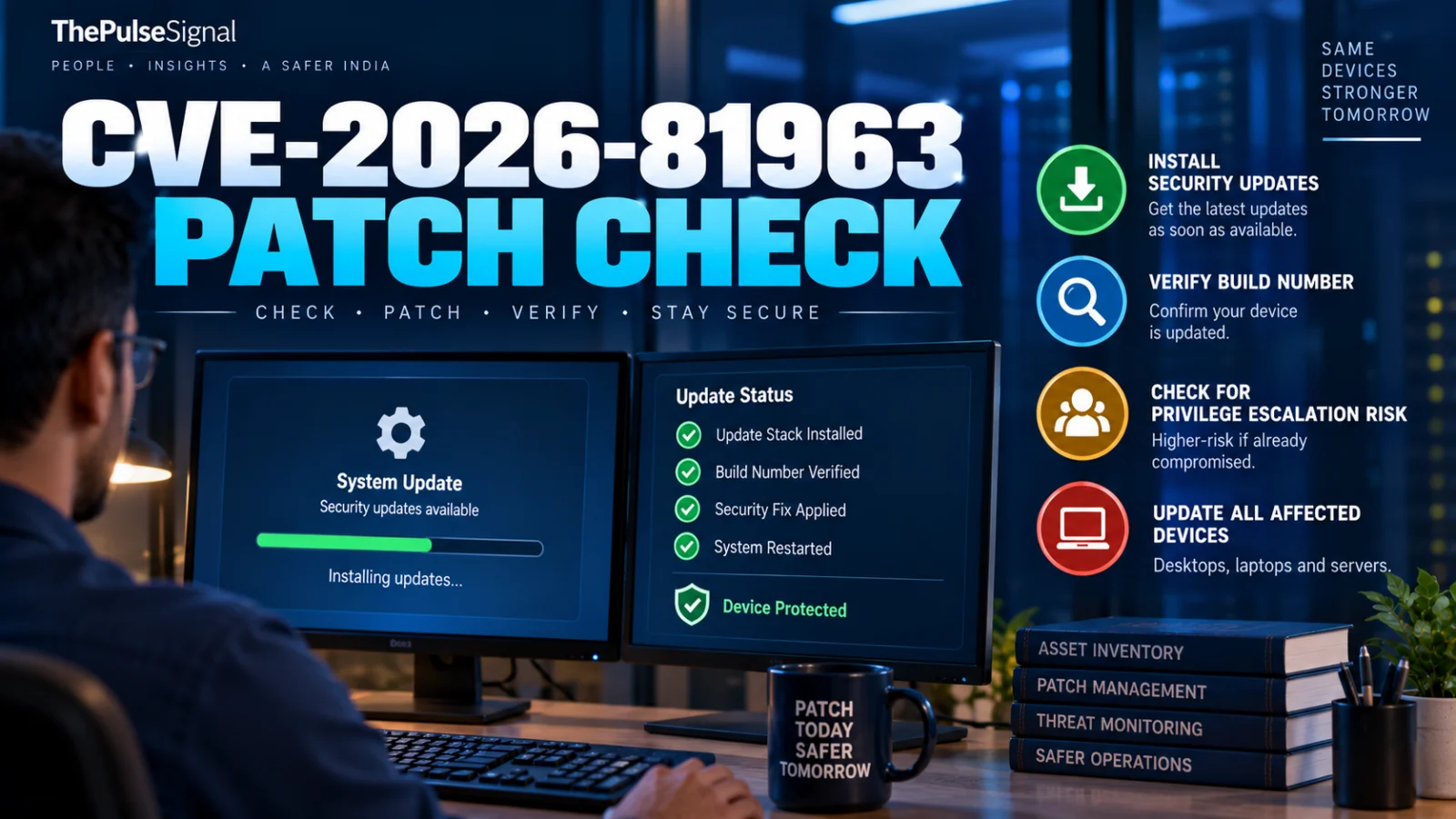
CVE-2026-81963 is an actively exploited Windows Update Stack privilege-escalation vulnerability with security fixes available. Microsoft describes the flaw as a local attack requiring prior low-level privileges, while CISA has added it to the Known Exploited Vulnerabilities catalog. The immediate administrator task is to check the Windows release and OS build, compare it with Microsoft’s fixed threshold and install a current security update when the system remains below that build.
Is CVE-2026-81963 remotely exploitable?
No remote unauthenticated attack path was established in the reviewed Microsoft evidence. Microsoft’s CVSS vector uses a local attack vector and requires low privileges before exploitation. The vulnerability is therefore a privilege-escalation step rather than evidence of a standalone internet-facing initial-access flaw.
Successful exploitation can allow elevation to higher privileges, including SYSTEM according to CISA’s KEV description.
Which Windows builds are affected?
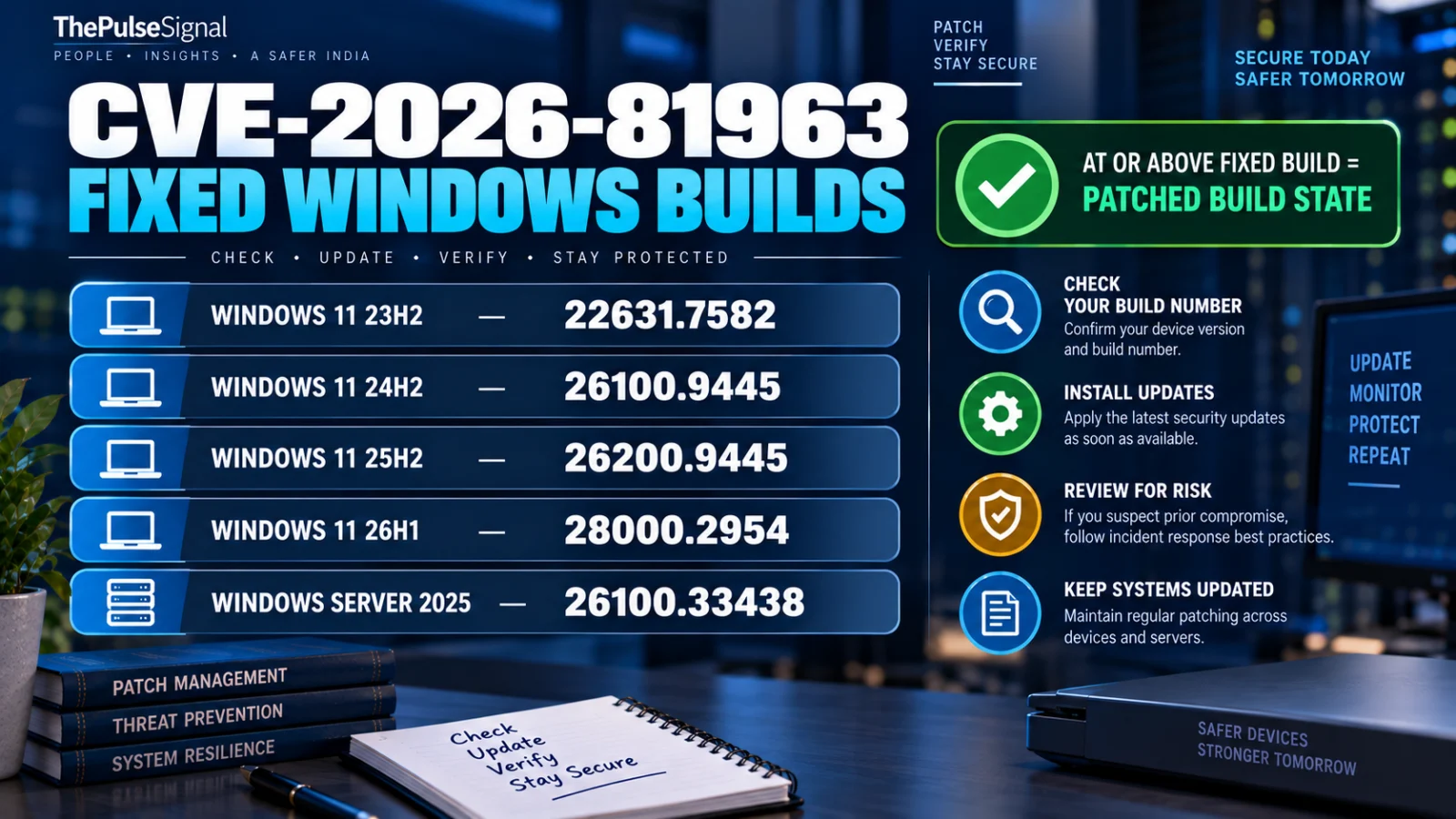
| Windows release | Vulnerable when below | September 2026 fix |
|---|---|---|
| Windows 11 23H2 | 22631.7582 | KB5122880 |
| Windows 11 24H2 | 26100.9445 | KB5124008 |
| Windows 11 25H2 | 26200.9445 | KB5124008 |
| Windows 11 26H1 | 28000.2954 | KB5124012 |
| Windows Server 2025 | 26100.33438 | KB5122871 |
| Windows Server 2025 Server Core | 26100.33438 | KB5122871 |
A system at or above the relevant fixed-build threshold is beyond the vulnerable build range identified in Microsoft’s September advisory data. A later cumulative security update can also contain the earlier fix, so administrators should not require one September KB string forever if the device has already advanced to a newer fixed build.
How do you check whether the Windows fix is installed?
1. Identify the Windows release
Run winver or open Settings → System → About and confirm whether the device is running Windows 11 23H2, 24H2, 25H2, 26H1 or Windows Server 2025.
2. Record the OS build
Compare the displayed build number with the fixed threshold for that Windows release.
3. Install current security updates if needed
If the build remains below Microsoft’s fixed threshold, use the organisation’s normal Windows Update, Windows Server Update Services or managed endpoint deployment process to install current security updates.
4. Verify after installation
Restart where required, then confirm that the resulting build is at or above the fixed threshold. Windows Update history can provide additional evidence of the deployed cumulative update.
Why does CISA KEV status matter?
CISA’s Known Exploited Vulnerabilities catalog is important because it means exploitation has been observed in the wild. CVE-2026-81963 is therefore not only a theoretical vulnerability.
However, KEV inclusion does not establish that every vulnerable Windows system has been attacked, that exploitation is widespread, or that the vulnerability is remotely reachable from the internet.
Does the attacker need an account or local foothold first?
Microsoft’s scoring specifies AV:L and PR:L: local attack vector and low privileges required. That means an attacker needs an existing local foothold or equivalent authorised low-privilege execution context before using this vulnerability for elevation.
TPS did not verify the initial-access mechanism used in observed attacks, so the article should not infer phishing, malware, exposed services or any other entry technique.
Does installing the patch prove the endpoint was never compromised?
No. Confirming a fixed build establishes the endpoint’s current patch state. It does not prove that exploitation did not occur before remediation.
Organisations with evidence or suspicion of earlier compromise should handle that as a separate incident-response question using endpoint telemetry, authentication logs, security tooling and any later Microsoft or CISA exploitation guidance.
Are there CVE-specific indicators of compromise?
TPS did not verify a reliable public set of unique indicators, attacker artefacts or exploitation signatures attributable specifically to CVE-2026-81963 during this review.
The absence of a published CVE-specific IOC should not be treated as evidence that a vulnerable endpoint is clean.
Is ransomware using CVE-2026-81963?
CISA’s current KEV ransomware-use field is Unknown. TPS did not verify a named ransomware operation, threat actor or campaign using the vulnerability.
What is CISA’s remediation deadline?
CISA lists a September 22, 2026 remediation due date for organisations subject to the applicable U.S. federal vulnerability-remediation requirements.
That date should not be presented as a general legal deadline for Indian companies, private organisations or ordinary Windows users. Other operators should follow their own risk-based patching requirements while treating KEV exploitation as a strong remediation priority.
What should endpoint teams do now?
- inventory Windows 11 and Windows Server 2025 versions and build numbers;
- identify systems below the Microsoft fixed-build threshold;
- deploy a current cumulative security update;
- verify the resulting build after installation;
- do not classify the issue as a remote unauthenticated Windows exploit;
- separate patch-state verification from historical compromise investigation;
- monitor Microsoft, CISA and relevant national CERT guidance for exploitation details or new indicators.
What happens next?
The article should be updated if Microsoft changes the affected-version table, CISA changes the ransomware-use field, a validated exploitation chain or IOC set becomes available, CERT-In issues material India-relevant guidance, or researchers identify a campaign that changes the current compromise-check advice.
TPS should maintain this same URL for those material CVE-2026-81963 developments.
Verification note
TPS reviewed Microsoft’s CVE-2026-81963 vulnerability data, CISA KEV status, Microsoft September 2026 security-update build information and Microsoft Windows update-verification guidance. Active exploitation and the affected/fixed build boundaries are supported; attacker attribution, ransomware use, exploitation prevalence and unique CVE-specific compromise indicators remain unresolved.