






NetScaler CVE-2026-8452 is now a known-exploited vulnerability, so administrators running affected NetScaler ADC or NetScaler Gateway builds should verify both the software version and the configuration that makes the appliance vulnerable, then upgrade to a fixed build. CISA added CVE-2026-8452 to its Known Exploited Vulnerabilities catalog on August 26, 2026. The underlying NetScaler security bulletin was originally published on June 30; the important new state is confirmed exploitation, not a newly disclosed CVE.
The vulnerability is a memory-overflow issue that NetScaler says can lead to unpredictable or erroneous behavior and denial of service. The vendor lists a specific configuration precondition: the appliance must be configured as a Gateway — including SSL VPN, ICA Proxy, CVPN or RDP Proxy — or as an AAA virtual server.
An affected version alone does not prove compromise, and the configuration check matters. Conversely, patching an exposed appliance fixes the vulnerable software state but does not by itself prove that exploitation did not occur before the upgrade.
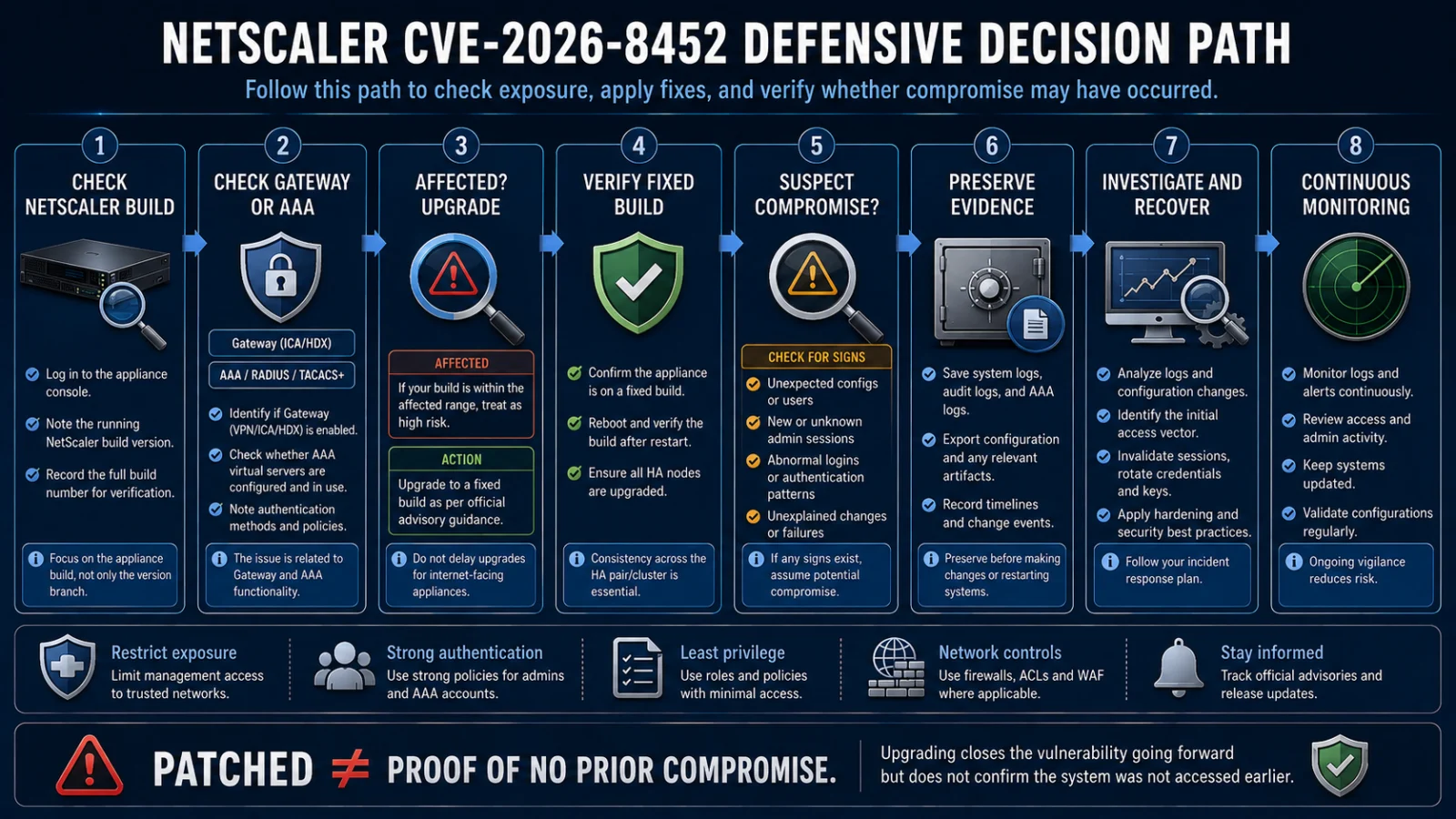
NetScaler CVE-2026-8452 decision path
Check the running NetScaler build
Compare the installed release and build with the vendor’s affected ranges. If the appliance is already on a fixed build or later supported release, the version condition for this vulnerability is remediated.
Check whether the configuration meets the precondition
CVE-2026-8452 requires the appliance to be configured as a Gateway or AAA virtual server. NetScaler specifically tells customers to inspect the configuration for authentication virtual servers and VPN virtual servers.
Upgrade affected appliances
If both the version and configuration conditions apply, upgrade to a supported build containing the fix. NetScaler Console can also identify impacted instances and route them into the upgrade workflow.
Separate patching from compromise assessment
If the appliance was exposed while vulnerable or there are other reasons to suspect compromise, preserve evidence and follow the vendor’s suspected-compromise guidance rather than treating the upgrade itself as proof that the earlier state was clean.
Which NetScaler versions are affected?
The NetScaler security bulletin lists the following supported product ranges as affected by the June 30 vulnerability set that includes CVE-2026-8452:
- NetScaler ADC and NetScaler Gateway 14.1 before 14.1-72.61
- NetScaler ADC and NetScaler Gateway 13.1 before 13.1-63.18
- NetScaler ADC 14.1-FIPS before 14.1-72.61 FIPS
- NetScaler ADC 13.1-FIPS and 13.1-NDcPP before 13.1-37.272
The vendor recommends upgrading affected systems to those fixed builds or later supported releases. Secure Private Access Hybrid deployments using NetScaler instances are also included in the bulletin’s affected scope.
The bulletin applies to customer-managed NetScaler ADC and NetScaler Gateway. Cloud Software Group states that Citrix-managed cloud services and Citrix-managed Adaptive Authentication are upgraded by the provider.
Which configuration makes CVE-2026-8452 relevant?
The vulnerability is not described as applying to every possible NetScaler configuration. NetScaler gives two relevant configuration states:
- a Gateway configuration, including SSL VPN, ICA Proxy, CVPN or RDP Proxy; or
- an AAA virtual server.
For configuration verification, the vendor tells administrators to inspect NetScaler configuration for authentication virtual servers and VPN virtual servers. The corresponding configuration patterns are add authentication vserver for an AAA virtual server and add vpn vserver for a Gateway.
This distinction is important because three different states should not be collapsed into one:
- Affected software: the installed build falls below the vendor’s fixed build.
- Applicable vulnerable configuration: the appliance is configured as a Gateway or AAA virtual server.
- Compromised appliance: separate evidence indicates successful exploitation or unauthorized activity.
The first two establish that remediation is required. They do not automatically establish the third.
What changed on August 26?
The vulnerability itself was not first disclosed on August 26. NetScaler’s security bulletin dates to June 30, 2026.
The material change is that CISA added CVE-2026-8452 to the Known Exploited Vulnerabilities catalog on August 26. The Canadian Centre for Cyber Security also updated its Citrix advisory to record the KEV addition and the exploitation-in-the-wild state.
That changes remediation priority. A vulnerability that was previously handled from a vendor advisory is now also confirmed through the U.S. government’s exploited-vulnerability prioritization system.
Does the August 29 CISA deadline apply to every NetScaler administrator?
No. The August 29 remediation deadline belongs to the relevant U.S. federal KEV compliance scope. TPS is not treating that date as a universal legal deadline for private companies, Indian organizations or other operators outside that federal mandate.
For other organizations, the KEV inclusion is still important security evidence because it confirms exploitation and can justify increasing remediation priority under the organization’s own vulnerability-management and incident-response process.
How can NetScaler Console help identify affected instances?
NetScaler Console’s Security Advisory capability supports CVE-2026-8452 identification. Administrators can use the CVE Detection view to locate impacted instances. NetScaler says the security-advisory scan can take a couple of hours to reflect impact, while an on-demand scan can be started when a faster assessment is needed.
For impacted instances, NetScaler documents a single-step remediation path through an upgrade to a release and build containing the fix. The Console can pre-populate vulnerable instances into the upgrade workflow.
NetScaler also warns that its Security Advisory feature does not support builds that have reached end of life. An appliance on an unsupported legacy release should therefore not be treated as safe merely because it is absent from a supported-build scan result.
Does patching prove the appliance was not compromised?
No. Upgrading corrects the vulnerable software state, but a successful patch does not retrospectively establish whether exploitation occurred before remediation.
If there is reason to suspect compromise, Cloud Software Group publishes a separate incident-response procedure for NetScaler ADC and NetScaler Gateway. That guidance begins with evidence preservation before recovery actions.
What should be preserved if compromise is suspected?
Cloud Software Group’s suspected-compromise guidance recommends preserving evidence before destructive recovery steps. Depending on the appliance and environment, that can include:
- taking a snapshot of a potentially compromised VPX instance;
- documenting system time, timezone settings and NTP configuration before isolation;
- preserving local NetScaler logs as well as remote syslog and NetScaler Console logs;
- generating a technical support bundle containing configuration, process and diagnostic information that may assist later analysis.
The vendor explicitly states that Cloud Software Group does not itself provide forensic investigations through the support-bundle process. Organizations should follow their own security and incident-response procedures for forensic assessment.
What if the appliance appears compromised?
The vendor’s general suspected-compromise procedure goes beyond patching. It includes isolating the affected device, revoking credentials and secrets associated with the suspected appliance, investigating connected systems, rebuilding or restoring from a known-good state where required, rotating restored secrets and hardening the rebuilt system.
Those are suspected-compromise actions, not automatic requirements for every administrator whose software version falls in the vulnerable range. The correct response depends on whether compromise is suspected or evidenced and on the organization’s incident-response process.
What credentials can matter after suspected compromise?
When compromise is suspected, NetScaler’s published guidance tells organizations to consider credentials and secrets stored on or used through the affected appliance. Examples include service-account passwords, RADIUS shared secrets, OAuth tokens, API keys, SNMP community names and certificates/private keys stored on the suspected platform.
The guidance also calls for investigation of connected systems such as authentication servers, sensitive systems, web-tier systems and management jump hosts. This is another reason an exposed edge appliance should not be treated as an isolated software-patching problem when there are actual signs of compromise.
Can NetScaler Console check for indicators of compromise?
NetScaler Console includes an Indicators of Compromise detection capability designed to help administrators assess whether appliances may have been affected by a vulnerability. The feature can return states including Potentially Compromised, No Compromise Detected, Skipped, Failed to Execute and Execution in Progress.
A “No Compromise Detected” scan result should be read as the result of the available detection logic, not as an absolute guarantee that no malicious activity ever occurred. NetScaler notes that IoC detection logic can be updated as additional indicators are discovered.
What should NetScaler administrators do now?
- Identify the running release and build. Compare it with the vendor’s affected and fixed ranges.
- Verify the configuration precondition. Determine whether the appliance is operating as a Gateway or AAA virtual server.
- Upgrade an affected appliance to a supported fixed build or later supported release.
- Do not confuse remediation with historical-compromise verification. If exposure or suspicious activity creates a compromise concern, preserve evidence before destructive recovery work.
- Use available NetScaler Console CVE and IoC capabilities where they are supported.
- Follow organizational incident-response procedures and current vendor guidance for suspected compromise.
What remains unknown?
CISA’s KEV inclusion establishes that CVE-2026-8452 has been exploited, but the reviewed primary evidence does not establish a reliable public victim count, India-specific exploitation, the full breadth of the exploitation campaign or attacker attribution.
TPS also did not establish a universal public campaign-specific indicator set that would allow every administrator to prove compromise from one simple file, IP address or log string. That is why the article separates four questions: is the build affected, does the configuration meet the precondition, has the appliance been patched, and is there evidence requiring compromise investigation?