




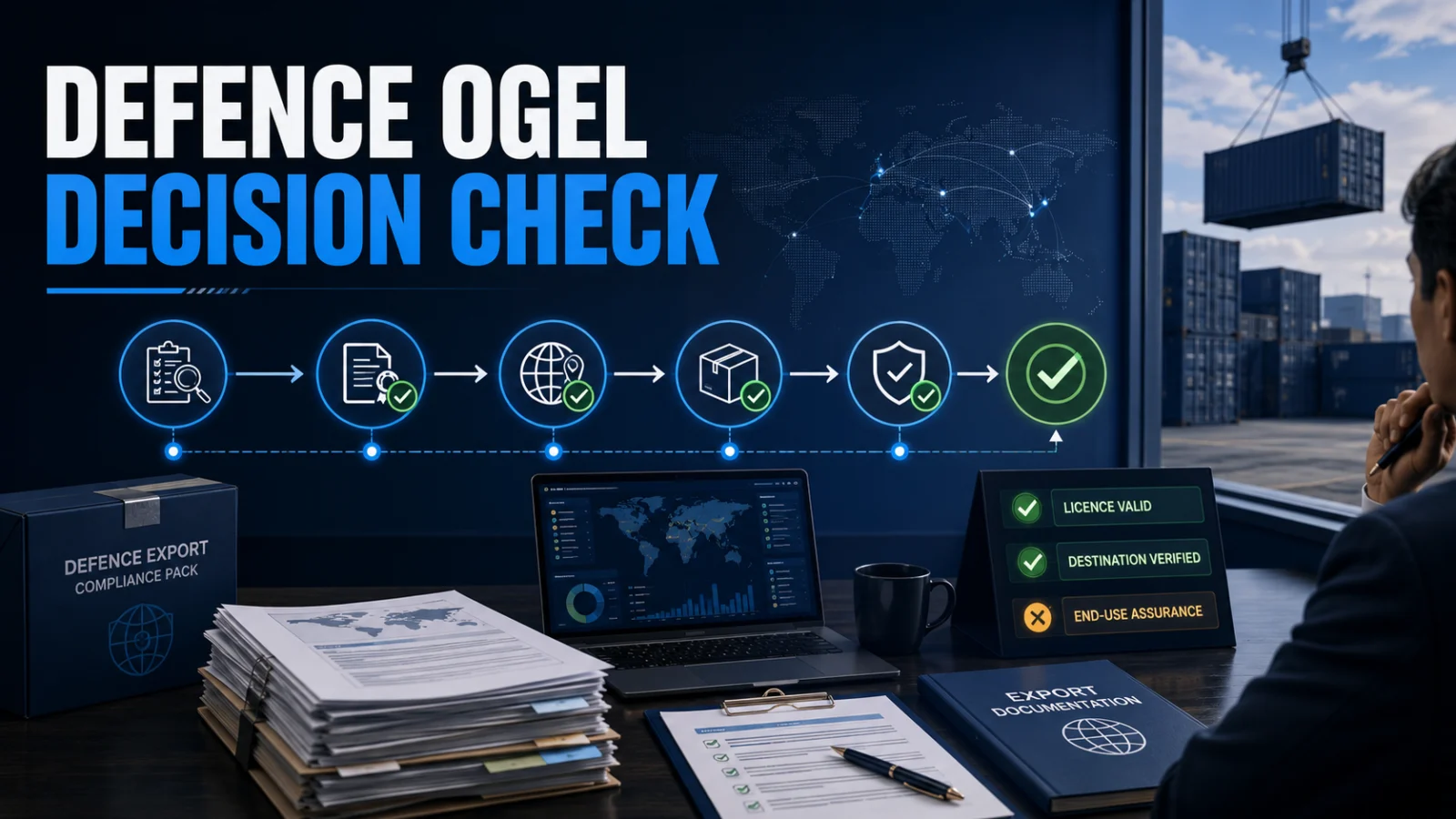
Defence OGEL rules in India were materially simplified in August 2026. The Department of Defence Production says the standard validity of an Open General Export Licence has increased from two years to three years, three separate OGEL procedures have been consolidated into one framework, and geographic coverage has been widened beyond the previous list of 41 countries.
That does not mean every defence product can now be exported to every country without further checks. An exporter still needs to verify whether the item is covered, whether the destination is permitted, whether the proposed transaction fits the OGEL framework and whether any separate authorisation or condition still applies.
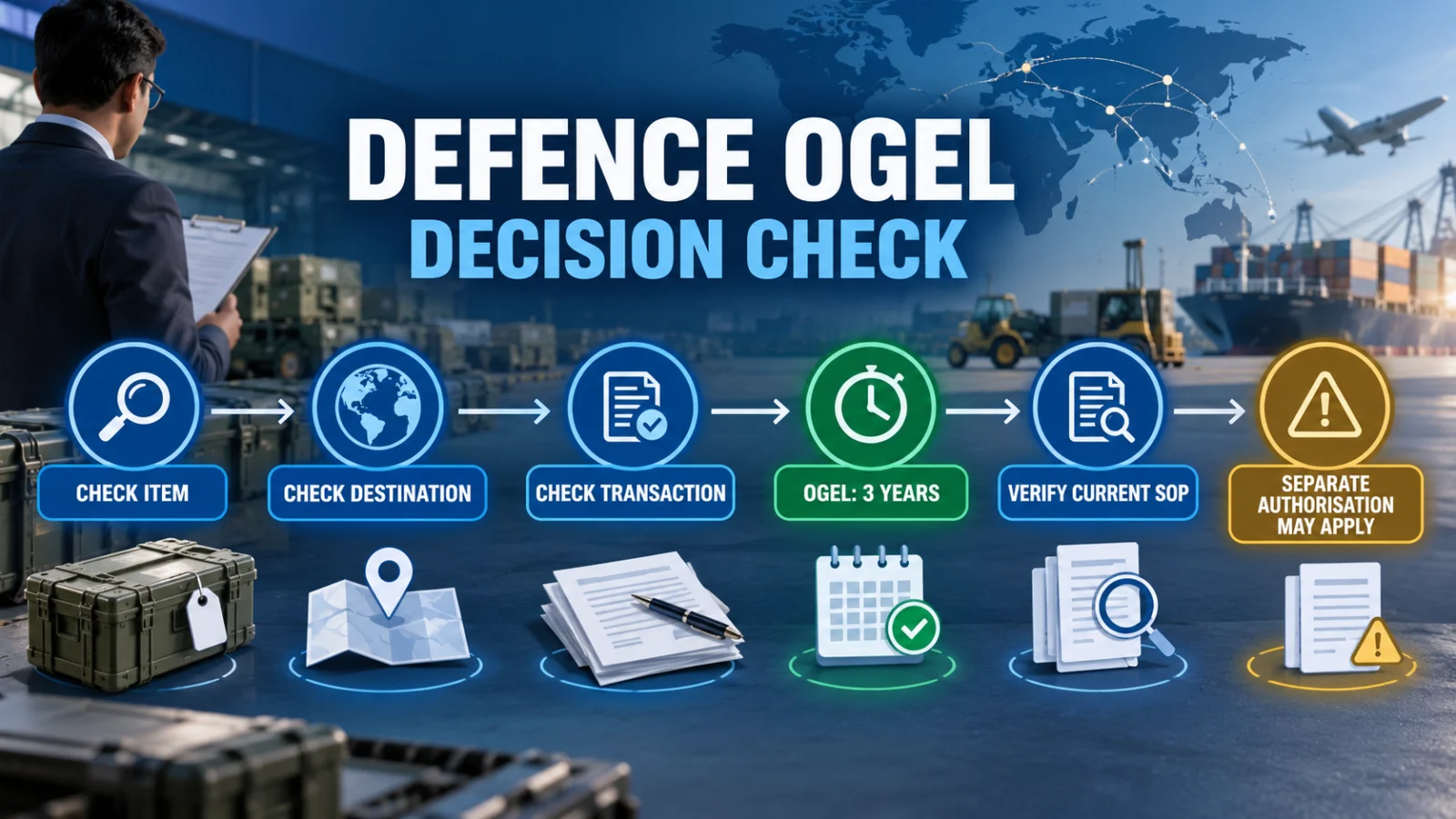
Can your defence export use OGEL?
1. Check the item
Confirm that the defence item or component falls within the current OGEL scope. The 2026 reform broadened item coverage in specified areas, but it did not turn OGEL into a blanket authorisation for every defence product.
2. Check the destination
The revised framework expands geographic coverage beyond the previous 41-country model, but negative or sensitive countries and destinations subject to relevant United Nations Security Council sanctions or arms embargoes remain outside the general expansion.
3. Check the transaction type
Determine whether the shipment is a regular commercial export, an international tender or exhibition transaction, or part of an eligible long-term arrangement with a Foreign Original Equipment Manufacturer. Different procedural simplifications may apply to these states.
4. Verify the current controlling SOP
Before relying on OGEL, confirm the current Department of Defence Production SOP, item coverage, destination restrictions and any transaction-specific conditions. Do not infer eligibility from the reform announcement alone.
What is a Defence OGEL?
An Open General Export Licence is designed to reduce the need for repeated individual export-authorisation applications for eligible defence exports. Under the framework described by the Department of Defence Production, an eligible exporter can operate under the OGEL mechanism for specified items and permitted destinations rather than seeking a separate authorisation for every qualifying consignment.
OGEL therefore simplifies the authorisation process, but it remains a controlled export mechanism. It is not unrestricted permission to export defence goods.
What changed in the 2026 Defence OGEL framework?
| Area | Earlier framework | 2026 change |
|---|---|---|
| Standard OGEL validity | 2 years | 3 years |
| OGEL procedures | Three separate SOPs | Consolidated into one unified SOP framework |
| Country coverage | 41 countries | Expanded broadly, subject to negative, sensitive and sanctions-related exclusions |
| Long-term Foreign OEM arrangements | Standard validity structure | Eligible OGEL validity may align with a qualifying long-term contract, subject to conditions |
| Item coverage | Earlier specified scope | Expanded for specified additional parts, components and protective-equipment use cases |
Does Defence OGEL now last three years?
Yes, the Department of Defence Production says the normal OGEL validity period has increased from two years to three years.
However, TPS did not recover a controlling provision establishing that every OGEL issued under the earlier two-year framework automatically gains an extra year. If you already hold an OGEL, verify its recorded validity and any transition instructions rather than assuming it has been extended automatically.
Does wider country coverage mean every destination is allowed?
No. The government’s announcement says the earlier 41-country coverage has been widened, but it preserves exclusions for negative or sensitive countries and for destinations affected by relevant United Nations Security Council sanctions or arms embargoes.
The practical rule is therefore not simply “all countries.” The practical rule is: broader coverage, subject to explicit exclusions and safeguards.
Because the reviewed announcement does not reproduce the complete current negative or sensitive destination list, exporters should verify the controlling list before committing to a shipment.
Can every defence item be exported under OGEL?
No. OGEL remains limited to eligible or specified items. The 2026 reform broadened the scope in some areas, including specified parts and components of small-calibre arms and certain protective equipment for civil end use, but this does not establish universal OGEL eligibility for all defence products.
For an actual transaction, the exporter needs the current item annexure or controlling SOP rather than relying on a general description of the reform.
What changed for international tenders and exhibitions?
The Department of Defence Production says stakeholder consultation has been dispensed with for exports of all items for international tenders and exhibitions under the revised procedure. This is a procedural simplification; it should not be read as removing every export-control restriction that could otherwise apply to the item, destination or transaction.
What changed for non-lethal defence exports?
The government says stakeholder consultation has also been dispensed with for exports of non-lethal defence items to most destinations, while safeguards continue for sensitive destinations.
This can reduce repeated procedural burden for qualifying exporters, but the exporter still has to confirm that the item and destination fall inside the current permitted framework.
How do long-term Foreign OEM contracts affect OGEL validity?
The revised framework includes a provision under which OGEL validity for eligible items and a qualifying Foreign Original Equipment Manufacturer may be aligned with the validity of the underlying long-term contract or agreement, subject to prescribed conditions.
This is different from saying every long-term overseas contract automatically receives an OGEL for the full contract period. The transaction still needs to satisfy the applicable eligibility and procedural conditions.
When might a separate export authorisation still be needed?
A separate authorisation or another controlling process may still be relevant when the proposed export falls outside the current OGEL item scope, involves an excluded or restricted destination, does not satisfy OGEL conditions, or is otherwise governed by a more specific export-control requirement.
The 2026 reform simplifies the framework; it does not abolish defence export controls.
What should an exporter verify before relying on OGEL?
- Confirm that the exporter is eligible to use the current OGEL framework.
- Check that the exact defence item or component is within the current OGEL scope.
- Check the destination against the current permitted and excluded-country framework.
- Identify whether the transaction is a regular shipment, international tender, exhibition or qualifying Foreign OEM arrangement.
- Verify the current validity period recorded for the applicable OGEL.
- Check whether any additional authorisation, condition, end-use requirement or safeguard applies to the transaction.
- Use the current Department of Defence Production SOP and annexures rather than relying only on a summary of the August 2026 announcement.
What remains unresolved?
- The complete current negative and sensitive destination list was not reproduced in the reviewed policy announcement.
- The complete unified OGEL item annexure was not recovered during this research.
- The reviewed evidence does not establish that every existing two-year OGEL automatically converts to three years.
- Transaction-specific eligibility depends on the current item, destination, exporter and applicable conditions.
- Future Department of Defence Production clarifications or SOP revisions can change the decision path described here.
Verification method
ThePulseSignal reviewed the Department of Defence Production and Ministry of Defence announcement issued through the Press Information Bureau, compared the stated old and new OGEL framework, and separated confirmed procedural changes from item-, destination- and licence-specific points that were not fully established by the reviewed source.
Frequently asked questions
How long is a Defence OGEL valid after the 2026 change?
The standard validity stated in the revised framework is three years instead of two years.
Can Indian defence exporters now use OGEL for every country?
No. Geographic coverage is broader, but negative or sensitive destinations and countries subject to relevant UNSC sanctions or arms embargoes remain excluded from the general expansion.
Does every defence product qualify for OGEL?
No. The item must fall within the current OGEL scope. Exporters should verify the controlling item list before relying on the licence.
Do existing two-year OGEL licences automatically become three-year licences?
The reviewed evidence does not establish an automatic extension for every existing licence. Existing holders should verify their current authorisation and any transition guidance.
Does OGEL replace all defence export authorisations?
No. OGEL simplifies eligible exports but does not eliminate other export-control requirements for transactions outside its scope.