






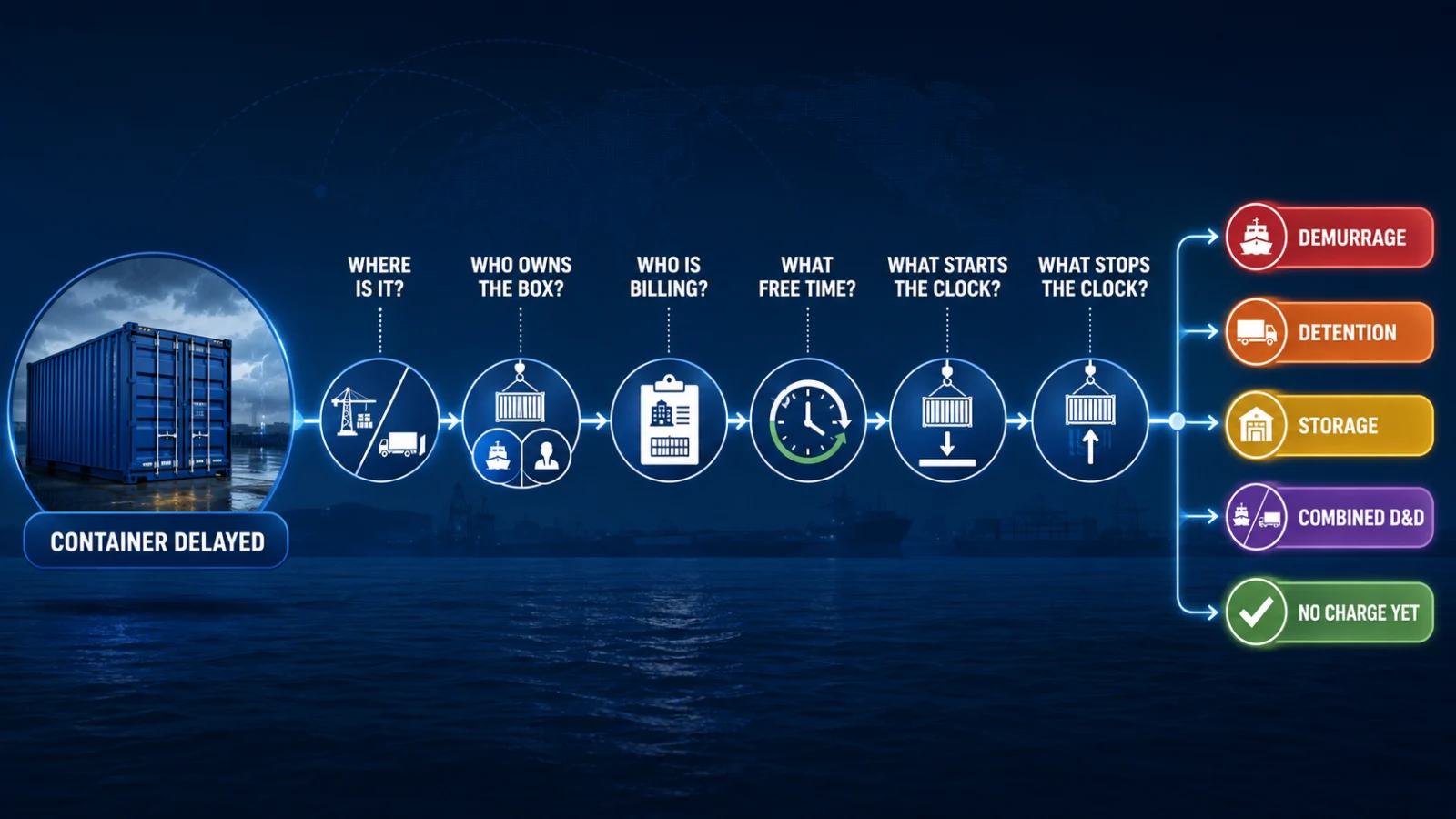
If a container is delayed, demurrage vs detention vs storage cannot be identified from the word “delay” alone. First establish where the container is, whose equipment it is, who is billing, what free time applies, what event started the clock and what event stops it.
Direct answer
Which container delay charge is running?
Under the standard model, demurrage usually concerns carrier equipment held inside a terminal, detention concerns carrier equipment held outside it, and storage concerns occupation of terminal, port or depot space. But local tariffs can combine these clocks or define their start points differently, so the applicable tariff controls the invoice.
Critical distinction
The charge name is not enough
Do not assume that “detention” always begins at gate-out or that storage is always included in demurrage. Current carrier rules show both combined D&D structures and country-specific treatment of terminal storage.
Clock A
Demurrage
Usually carrier-equipment time associated with the container remaining inside the port, terminal or depot beyond applicable free time.
Clock B
Detention
Usually carrier-equipment time outside the port or depot, although combined tariffs can start the detention period earlier.
Clock C
Storage
Time for occupying terminal, port, depot or yard space beyond that facility’s applicable free period.
In this guide
- The three-clock model
- Why tariff labels can mislead
- Start with container location
- Who is billing?
- Which free time applies?
- Find the start and stop events
- Can charges overlap?
- India example: combined detention
- What if the box is discharged but unavailable?
- Export containers
- Shipper-owned containers
- Five-question money-clock test
- FAQs
Demurrage vs detention vs storage: start with the three-clock model
| Charge | What is usually being held or occupied? | Typical location | Typical billing source |
|---|---|---|---|
| Demurrage | Carrier-owned container or equipment beyond free time | Inside terminal, port or depot | Shipping line / carrier |
| Detention | Carrier-owned container or equipment beyond free time | Outside terminal, port or depot | Shipping line / carrier |
| Storage | Terminal, port, depot or yard space | Inside facility | Terminal, port, depot or carrier if passed through |
Maersk’s general terms use this broad distinction: demurrage concerns a carrier container inside the facility, detention concerns the carrier container outside it, while storage compensates for use of port, terminal or depot space. CMA CGM’s general D&D terms use a similar equipment-based distinction.
But this table is a conceptual starting point, not a universal invoice rule. Country tariffs, negotiated contracts and combined D&D products can change how the clock is labelled and calculated.
Why the tariff matters more than the charge label
The dangerous shortcut is to identify the clock from its name alone.
For example, Maersk India’s current import rules say its Combined Detention calculation begins from the container discharge date, not the gate-out date. That means a charge carrying the word “detention” can cover an inside-and-outside period under a combined structure.
Maersk’s general terms also define Combined Demurrage and Detention as one free-time period covering the carrier container both inside and outside the terminal, port or depot.
Do not use this shortcut: “The container has not gated out, therefore detention cannot be running.” A combined tariff can make that conclusion wrong.
Question 1: Where is the container right now?
Start with the physical state.
Inside terminal / port / depot
Check carrier demurrage or combined D&D, plus any terminal or port storage clock.
Outside with consignee / trucker
Check carrier detention or the outside portion of a combined D&D period and identify the required empty-return point.
Location does not finish the diagnosis, but it eliminates many wrong assumptions.
Question 2: Who issued the tariff or invoice?
The billing party often tells you which asset is being charged.
| Billing party | What to inspect | Possible charge |
|---|---|---|
| Shipping line / carrier | D&D tariff, negotiated free time, booking terms, equipment type | Demurrage, detention, combined D&D, sometimes storage passed through |
| Terminal / port / CFS / depot | Facility tariff and container-storage free period | Storage, ground rent or facility-related dwell charge |
This matters because storage is not globally treated the same way. Maersk’s general terms explicitly say whether port, terminal or depot storage is invoiced separately is determined on a country basis. CMA CGM tariffs can likewise distinguish equipment D&D from storage charges.
Question 3: What exactly does your “free time” cover?
A statement such as “I have five free days” is incomplete.
You need to know whether those five days are:
- demurrage free time
- detention free time
- combined demurrage-and-detention free time
- terminal storage free time
- negotiated contractual free time; or
- a booking-specific or SPOT arrangement.
Maersk India currently says its import D&D is calculated on a calendar-day basis and warns that SPOT booking terms may differ from standard tariffs.
Never calculate from the number of free days alone. Record the clock name, tariff source, day-count convention and triggering event.
Question 4: What event starts the clock, and what event stops it?
The clock normally attaches to a logistics event, not the date when you first noticed the delay.
| Clock | Possible start event | Possible stop event |
|---|---|---|
| Import demurrage | Discharge, availability or another tariff-defined event | Full-container gate-out or another tariff-defined event |
| Import detention | Gate-out under a separated model, or discharge under some combined tariffs | Empty container returned to the specified facility |
| Terminal storage | Landing/discharge or a facility-defined day after landing | Container removed or delivered from terminal |
| Export detention | Empty carrier container released to shipper | Full container returned/gated into the facility |
| Export demurrage | Full container enters facility and remains beyond free time | Loading or another tariff-defined event |
The exact starting and ending events must come from the tariff that applies to the shipment. Even terminal storage rules can differ by location.
Can demurrage and storage run at the same time?
Potentially, yes.
The reason is that they can represent different underlying resources:
- demurrage can compensate the carrier for extended use of its container
- storage can compensate the terminal or port for continued occupation of its space.
Whether both appear separately on the customer’s bill depends on the local tariff. Some carrier tariffs include storage inside the demurrage amount, while others separate the terminal charge.
So a container remaining inside a terminal does not automatically mean there is only one economic clock.
India example: why “detention starts after gate-out” can fail
Current Maersk India import information provides a useful real-world example.
Its published rules state that:
- demurrage free time and calculation begin from the container discharge date
- its Combined Detention free time and calculation also begin from the container discharge date, not from gate-out
- free time is calculated on a calendar-day basis
- shipper-owned containers are not subject to detention under that tariff structure.
This does not mean every carrier or every India booking uses identical rules. It proves the opposite: you must inspect the actual local tariff and booking terms before calculating the clock.
What if the container is discharged but still not available for pickup?
Physical discharge does not mean every release required for collection is complete.
If your container is sitting inside the terminal because Customs clearance, carrier release, delivery authorization or terminal pickup readiness is still missing, first use the TPS guide Container Discharged but Not Available: Which Release Is Still Missing?.
Then return to the money-clock question: while that operational release remains unresolved, which carrier or terminal free-time period is continuing to run?
Delay cause ≠ charge name. Customs delay, carrier-document delay or terminal congestion may explain why the box cannot move. They do not automatically tell you whether the invoice line is demurrage, detention or storage.
Exports can create both detention and demurrage too
Do not use the shortcut “demurrage is import and detention is export.”
Under the standard carrier model, an export cycle can include:
- carrier releases an empty container
- shipper keeps the empty outside the terminal while loading it
- that outside-equipment period can create detention after free time
- the full container is gated into the terminal
- if it remains there too long before vessel loading, demurrage or terminal storage may become relevant under the applicable tariff.
If a container is rolled or misses its intended vessel, use the TPS guide Container Rollover: How to Confirm Which Vessel Your Cargo Was Rebooked On to establish the movement state separately from the cost calculation.
What changes for a shipper-owned container?
Detention normally relates to continued use of the carrier’s equipment. If the container is shipper-owned, the equipment-use logic changes.
For example, Maersk India’s current import page says shipper-owned containers are not subject to detention under its tariff, while demurrage can still apply.
That does not remove possible terminal storage or other facility charges. It only changes which carrier-equipment clocks may exist.
Use this five-question money-clock test
1
DEMURRAGE / COMBINED D&D
Most likely when carrier equipment remains within the relevant facility beyond the carrier’s applicable free-time rule, subject to local tariff terminology.
2
DETENTION
Most likely when carrier equipment remains with the merchant outside the facility beyond applicable free time, unless a combined tariff defines a broader period.
3
STORAGE
Most likely when terminal, port, depot or yard space is occupied beyond the facility’s storage free period.
Verification boundary
Carrier definitions provide a useful conceptual model, but they do not establish the amount payable for every shipment. The actual booking, local carrier tariff, negotiated free time, terminal tariff, container type, operational events and applicable law can change the calculation. Use the relevant tariff and invoice period rather than a generic online calculator when disputing or estimating a real charge.
Demurrage vs detention vs storage: frequently asked questions
Does detention always start when the container gates out?
No. That is common under separated D&D models, but combined tariffs can use a different start event. Maersk India’s current Combined Detention rule, for example, begins calculation from discharge rather than gate-out.
Can storage and demurrage both apply while the container is inside the terminal?
They can represent separate terminal-space and carrier-equipment costs. Whether they are invoiced separately or combined depends on the applicable local tariff.
Who charges container storage?
Storage normally relates to use of terminal, port, depot or yard space. The facility may invoice it directly, or a carrier may pass it through depending on the local arrangement.
Do weekends count toward free time?
Do not assume either way. Some tariffs use calendar days, while individual terminal rules may specify exclusions or different counting conventions.
Does Customs delay stop demurrage automatically?
Not automatically. The cause of the delay and the tariff’s charging rules are separate questions. Check the applicable carrier or terminal terms and any specific relief, waiver or legal rule that applies.
What is the fastest way to identify the running charge?
Find the container’s current location, equipment owner, invoice issuer, free-time type, start event and stop event. Those facts usually identify which clock needs to be checked.
Bottom line
Demurrage vs detention vs storage is not solved by memorising three definitions. A delayed container can sit inside a terminal while carrier and terminal clocks follow different rules, and combined tariffs can blur the usual inside/outside boundary.
Best diagnosis: container location → equipment owner → billing party → applicable tariff → free-time type → start event → stop event → current charge.
Last verified: August 22, 2026. Carrier definitions and current India examples were checked against Maersk, CMA CGM and published carrier/local tariff guidance. Local tariffs and contractual free-time arrangements can change, so shipment-specific calculation requires the current applicable tariff.