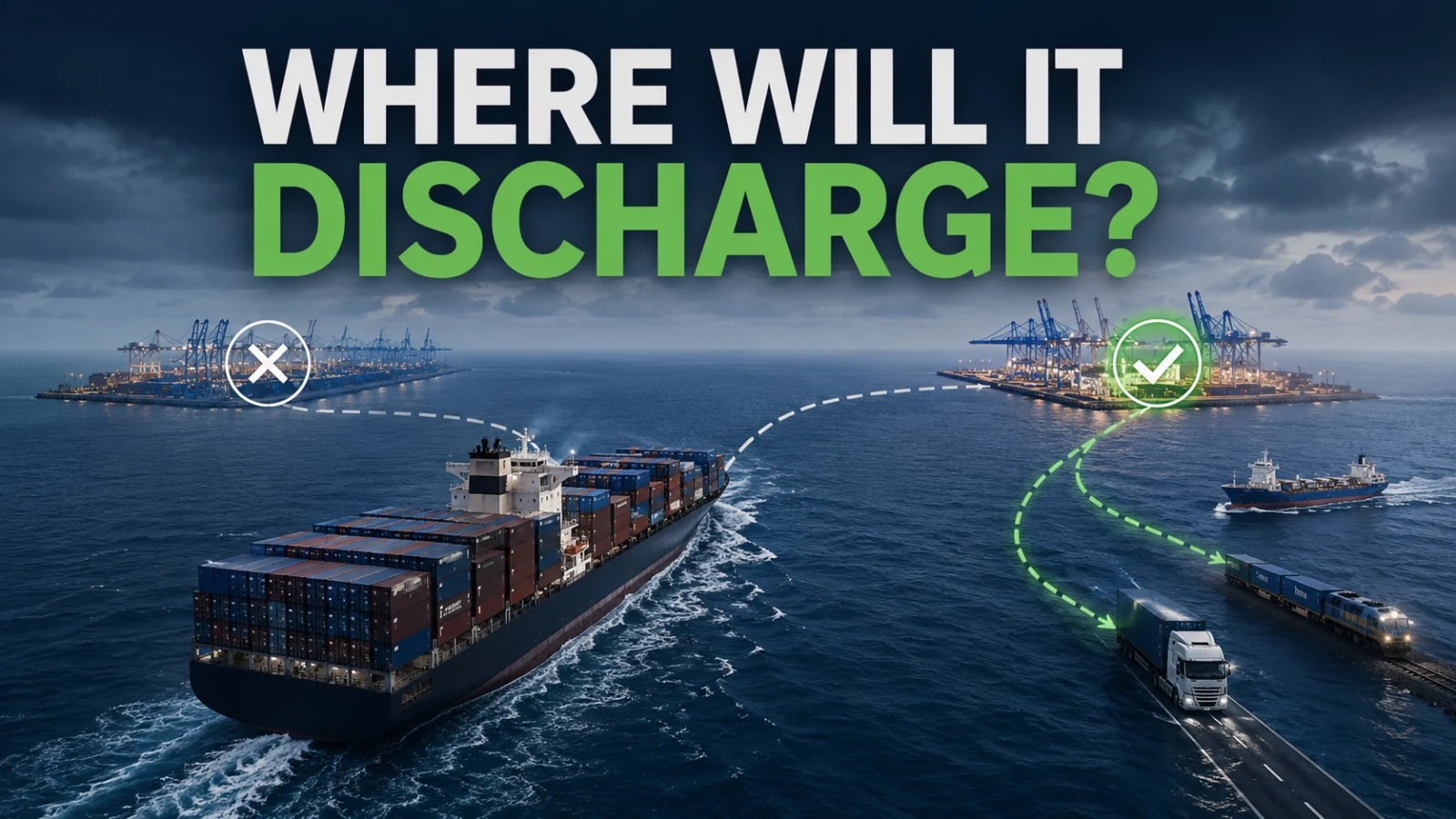





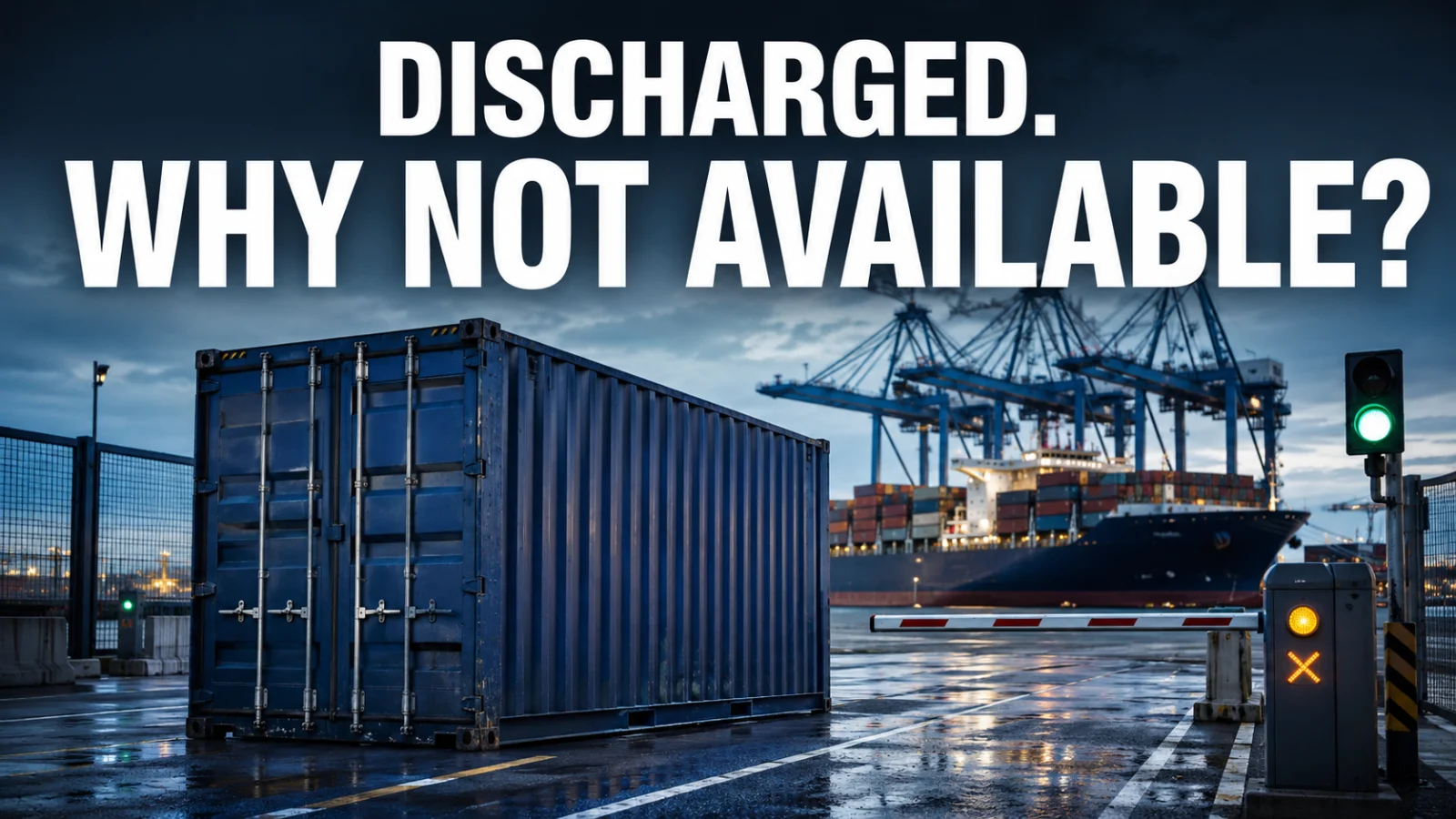
If your container discharged not available status appears after the vessel has arrived, the discharge event is only the first fact to establish. It normally means the box has been removed from the vessel. It does not by itself prove that customs has released the cargo, the carrier has cleared freight or documentation requirements, a delivery order has been issued, the terminal has recognized the release, or the container is ready for truck pickup.
Direct answer
Why can a discharged container still be unavailable?
Because physical discharge and cargo release are separate states. Check the transport-document status, customs or manifest status, outstanding freight or local charges, carrier release, delivery order, terminal release and final pickup or appointment requirement.
The exact names and order vary by carrier, terminal and jurisdiction, so identify the specific gate that is still pending instead of treating “discharged” as “ready for collection.”
Core distinction
Discharged ≠ available
A discharge event answers: Where is the box?
Availability answers: Can the consignee or haulier actually collect it now?
State 1
Discharged
The box is ashore, but its release status is still unknown.
State 2
Customs pending
Customs or manifest processing is still blocking release.
State 3
Carrier release pending
Documents, freight or carrier-side requirements remain incomplete.
State 4
Delivery order pending
Upstream conditions may be complete but delivery authorization has not yet been issued or processed.
State 5
Released, terminal pending
The carrier or customs status may be clear but the terminal has not made the unit available.
State 6
Ready for collection
Release and terminal conditions are clear; appointment, haulier or gate-out remains.
In this guide
- What a discharge event actually proves
- The release stack
- Check B/L and document status
- Check customs and manifest status
- Check freight and local charges
- Check carrier or freight release
- Check the delivery order
- Why the sequence is not universal
- Check terminal release and availability
- Check pickup or appointment requirements
- Decode carrier, customs and terminal holds
- What if everything says released?
- Release evidence ladder
- Watch, verify or escalate
- Worked example
- Charges boundary
- Related TPS shipping diagnostics
- Verification boundaries
- Limitations
- FAQs
A discharge event proves physical movement, not collection readiness
When a carrier or terminal records the container as discharged, the strongest safe conclusion is that the container has been removed from the vessel at that port.
Discharge event establishes
The container is no longer onboard that vessel at the discharge location.
Discharge event does not establish
Customs release, freight release, document surrender, delivery-order issuance, terminal availability or gate-out.
Do not collapse the milestones: vessel arrival ≠ berth arrival ≠ discharge ≠ cargo release ≠ terminal availability ≠ pickup.
If the vessel itself is still late or has not completed the port call, use the TPS vessel-delay diagnostic instead.
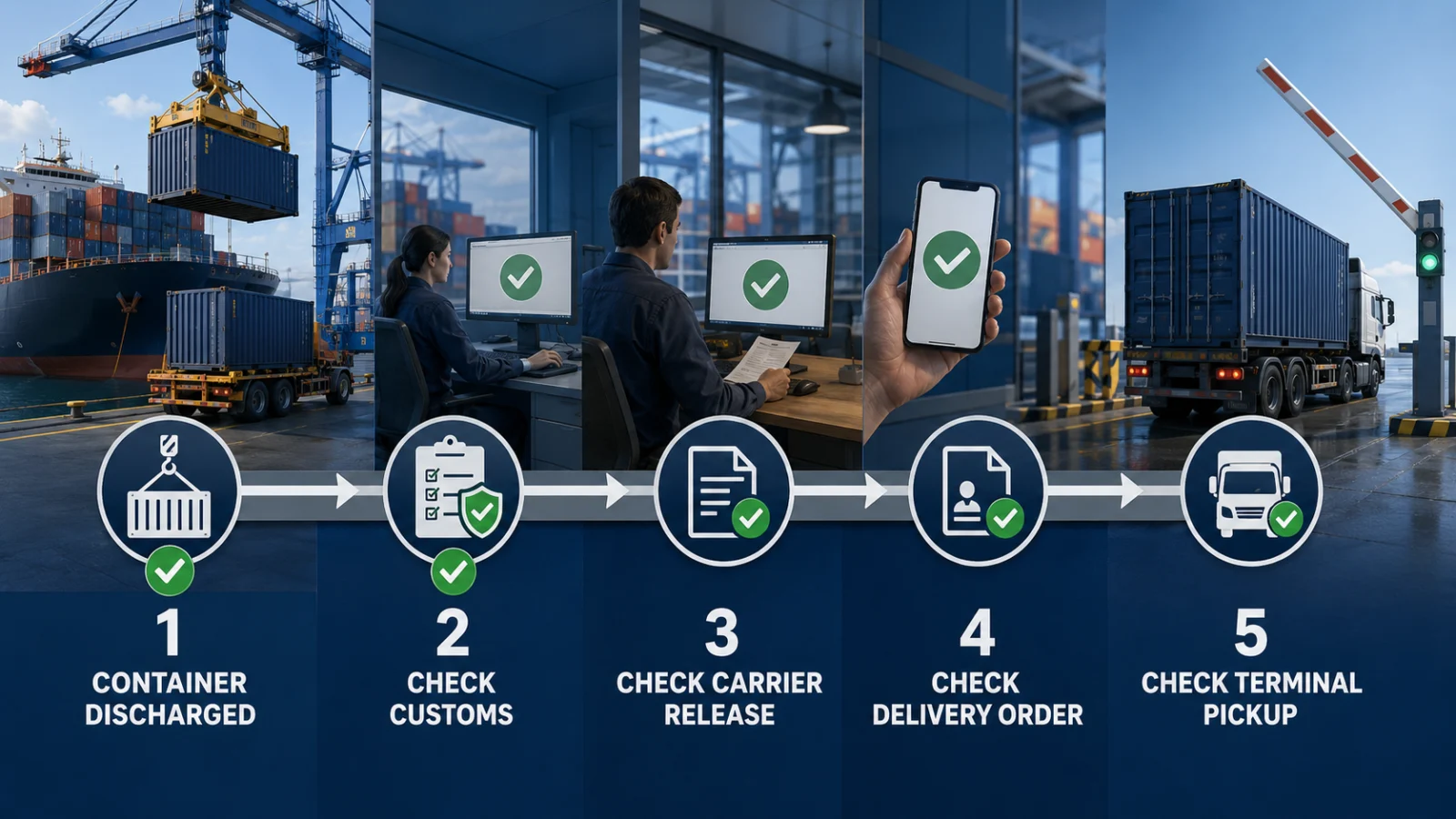
Treat import availability as a stack of separate release gates
Typical diagnostic sequence — not a universal legal sequence
Carrier documentation reviewed by TPS shows that import release can depend on multiple prerequisites rather than one universal “released” switch. Maersk separates customs and freight-release information and its import delivery-order workflow checks document, manifest and charge prerequisites. Hapag-Lloyd import guidance also ties delivery-order processing to documents and payments in local workflows.
TPS interpretation: when a container is discharged but not available, identify the first unresolved gate rather than repeatedly checking the discharge milestone.
Check the bill of lading, waybill or transport-document requirement
Carrier release can still depend on the applicable transport-document state. Depending on the shipment and local process, this may involve an original bill of lading, sea waybill, telex release or another documented release mechanism.
Check:
- whether the bill of lading or waybill has been issued correctly
- whether any required original document has been surrendered
- whether a telex or electronic release has been recognized
- whether consignee or authorization details are accepted
- whether the carrier portal shows a document hold.
Important: document requirements differ significantly by carrier, jurisdiction and bill-of-lading type. Do not assume an original B/L is always required or never required.
Check customs release separately from physical discharge
Customs clearance is a separate regulatory state from the container being physically removed from the vessel.
Discharged
The box is ashore.
Customs released
The applicable customs block has been cleared under the relevant system or procedure.
Still unavailable
Another carrier or terminal gate may remain even after customs clearance.
Depending on the country, useful checks can include customs filing status, manifest acceptance, examination or inspection requirements and customs-release messages.
If the carrier says “customs hold,” obtain the exact customs or filing status rather than assuming a generic port problem.
Check prepaid, collect and local charges
Outstanding carrier-side charges can prevent delivery-order or release processing in some workflows. Maersk’s documented import-delivery workflow separately checks prepaid and collect-charge status, while Hapag-Lloyd local import instructions have required applicable payments to be completed before delivery-order release.
Payment made ≠ payment recognized. If money has already been transferred, verify that the carrier has actually allocated and reconciled it against the correct bill of lading or shipment.
Possible categories can include ocean-freight balances, destination charges, documentation charges, detention or demurrage-related amounts, deposits or other locally applicable items. The exact charge structure is shipment-specific.
Check freight release or carrier release as its own state
Some carrier systems expose freight release separately from customs release. This is useful because it tells you whether the remaining obstacle belongs to the carrier’s commercial/document side or elsewhere.
Customs clear + freight pending
Focus on carrier documents, charges or another commercial-release requirement.
Freight clear + customs pending
Focus on customs, manifest, inspection or regulatory processing.
Do not use a generic “released” screenshot without identifying which release it represents.
Check whether the delivery order or equivalent authorization was actually issued
A delivery order or equivalent carrier authorization may be another distinct milestone. Maersk documents delivery-order processing as a separate step after relevant prerequisites are completed, while Hapag-Lloyd also operates delivery-order workflows with document and payment requirements.
Useful questions:
- Was the delivery-order request submitted?
- Was it accepted?
- Is it still processing?
- Was it rejected for documents or charges?
- What is its validity period?
- Has the terminal received or recognized the authorization?
Do not assume “DO issued” means “container physically available.” Delivery authorization and terminal readiness are separate operational states.
The order of these gates is not universal
This is one of the most important boundaries in the article.
A carrier can allow parts of the delivery-order process before vessel arrival in some jurisdictions. Hapag-Lloyd has also changed document requirements for delivery-order requests in specific markets over time. This proves that the release sequence and terminology are local-process dependent rather than universal.
Safe rule: treat physical discharge, customs release, carrier release, delivery authorization and terminal availability as separate states, but verify the actual order used by your carrier and port.
Check whether the terminal has received the release and made the box available
Even when carrier and customs requirements appear clear, the terminal may still need to process the release or physically position the container for collection.
Possible terminal-side states include:
- release message not yet received
- release received but not processed
- container in a stack not yet available for delivery
- inspection or operational hold
- terminal system mismatch
- appointment restriction
- equipment, yard or operational constraint.
Key diagnostic: ask whether the terminal sees the same customs/carrier release state that the carrier sees.
Availability and pickup appointment can still be different states
Some terminals require the haulier to obtain an appointment, time slot, truck authorization, PIN or other pickup credential after the release reaches the terminal.
Container available
The unit can be delivered subject to the terminal’s collection rules.
Pickup arranged
The haulier has completed the appointment or authorization required to actually collect it.
Hapag-Lloyd importer material provides examples where a delivery order reaches the terminal system and the customer then arranges terminal delivery or appointment activity.
Decode the holder instead of accepting the word “hold”
| Status you are told | What to ask next | Likely evidence |
|---|---|---|
| Carrier hold | Is it document, freight, payment, B/L or another carrier condition? | Carrier release screen, invoice status, documentation status |
| Customs hold | Which customs filing, inspection or release state is pending? | Customs or broker status, manifest/clearance reference |
| Terminal hold | Has the terminal received both carrier and customs release? | Terminal availability or hold code |
| Payment hold | Is payment merely sent or actually reconciled? | Carrier receipt, allocated invoice status |
| Documentation hold | Which exact document or authorization is missing? | B/L, SWB, telex-release or authorization status |
If everything says released but the container is still unavailable, compare systems
This is where many cases stop being a documentation problem and become a synchronization or terminal-readiness problem.
Verify:
- carrier release status
- customs release status
- delivery-order or equivalent authorization
- terminal’s own release view
- container availability timestamp
- pickup appointment or haulier authorization.
If the carrier says “released” but the terminal says “hold,” ask both sides for the exact release reference or status they see. Do not rely on a verbal “everything is clear.”
Use a release evidence ladder
| Evidence | What it proves | What it does not prove |
|---|---|---|
| Discharge event | Container removed from vessel | Customs or delivery readiness |
| B/L / waybill status | Document-release condition | Terminal availability |
| Manifest status | Carrier/customs filing progress | All customs requirements complete |
| Customs release | Applicable customs release status is clear | Carrier release or terminal readiness |
| Payment reconciled | Applicable carrier charge recognized as paid | Every other release gate |
| Freight/carrier release | Carrier-side release requirement clear | Customs or terminal availability |
| Delivery order | Applicable delivery authorization issued | Physical pickup readiness in every port |
| Terminal release | Terminal recognizes required release | Truck appointment already booked |
| Available for pickup | Container can proceed into collection workflow | Gate-out completed |
| Gate-out | Container physically left terminal | Empty-return obligations complete |
Watch, verify or escalate
1
WATCH
The box just discharged, the carrier shows normal release processing, customs is progressing and no contradictory hold is visible.
2
VERIFY
Discharge is confirmed but one release state is unclear, payment is unreconciled, the delivery order is pending or carrier and terminal views disagree.
3
ESCALATE
All documented prerequisites appear complete but the terminal still blocks delivery, contradictory holds persist, free-time exposure is increasing or release messages are not synchronizing.
Worked example: the container discharged yesterday but the terminal still shows unavailable
| Evidence | Interpretation |
|---|---|
| Carrier event: Discharged | Container is off the vessel. |
| Customs status: Released | Customs is not the current blocking state under the available status. |
| Carrier freight release: Pending | Carrier-side commercial or document requirement is still open. |
| Destination invoice: Payment sent | Not enough; payment reconciliation still needs confirmation. |
| Carrier later shows freight released | Carrier gate has cleared. |
| Delivery order issued | Delivery authorization now exists. |
| Terminal status remains hold | Release may not yet be processed or another terminal condition exists. |
| Terminal later shows available | The case moves to pickup/appointment rather than release diagnosis. |
The useful answer is not “the box has been discharged.” The useful answer is which remaining release layer is preventing collection now.
A release delay can create charge exposure, but do not guess which charge is running
Storage, demurrage, detention and other local charges can have different definitions, clocks and responsible parties. A container being unavailable does not by itself establish which charge is accruing.
Do not assume: unavailable container = demurrage, or terminal hold = free storage. Check the carrier and terminal tariff, free-time rules and the exact operational milestone that starts each clock.
TPS treats charge diagnosis as a separate problem so this article can remain focused on release-state identification.
Where post-discharge release fits in the TPS shipping cluster
Vessel late: AIS, schedule and port data
Use this before discharge when the same vessel remains behind schedule.
Container rollover
Use this when the box did not move on the expected vessel and was rebooked.
Container stuck at transshipment
Use this when the container reached an intermediate hub but the onward connection is unresolved.
Port disruption
Use this when a broader terminal or port event may be affecting the shipment.
Port omission
Use this when the vessel skipped the planned port and the new discharge location or routing must be confirmed.
Blank sailing
Use this when the sailing itself was cancelled and a replacement sailing is needed.
Verification notes: confirmed, service-specific, interpreted and not established
Confirmed
- Carrier import-release workflows can involve separate document, customs, payment and delivery-order requirements.
- Carrier systems can distinguish customs and freight release.
- Delivery-order processes can depend on local documents and payment conditions.
Service-specific
- Names of release states.
- Required documents.
- Timing of delivery-order issuance.
- Terminal appointment rules.
- Payment and reconciliation workflow.
TPS interpretation
- Discharge is a physical-state milestone.
- Availability is a multi-gate release state.
- The fastest diagnosis is to identify the first unresolved gate.
Not established by discharge alone
- Customs clearance.
- Carrier release.
- Delivery-order issuance.
- Terminal availability.
- Pickup readiness.
- Which delay charge is running.
Needs shipment-specific evidence
- Actual carrier portal status.
- Customs status.
- Invoice reconciliation.
- Delivery-order status.
- Terminal hold code.
- Appointment availability.
Sequence warning
The order and naming of these gates can differ by country, carrier and terminal. Do not impose one carrier’s workflow on another shipment.
Verification method
ThePulseSignal reviewed current Maersk import container-release and delivery-order guidance, including separate freight/customs release and document, manifest and charge prerequisites. TPS also reviewed Hapag-Lloyd import delivery-order and container-release material showing local document and payment requirements, and local carrier guidance demonstrating that delivery-order processes can change by jurisdiction.
The article therefore treats discharge, customs clearance, carrier release, delivery authorization, terminal availability and physical pickup as separate evidence states while explicitly avoiding a universal sequence.
Limitations and unresolved facts
No global article can determine why one discharged container is unavailable without the live carrier, customs and terminal statuses for that shipment.
- Import-release terminology varies by carrier and country.
- Customs systems and statuses vary by jurisdiction.
- Bill-of-lading requirements vary by document type and local process.
- Some carriers can process delivery orders before physical discharge or even before vessel arrival under specific workflows.
- Payment transfer does not prove carrier reconciliation.
- Carrier release does not always prove terminal release.
- Terminal release does not always mean an immediate pickup slot exists.
- A discharged container can be subject to inspection, operational or terminal holds not visible in the carrier portal.
- Charge exposure cannot be determined from discharge status alone.
- Local carrier and terminal instructions should override generalized sequencing in this guide.
Container discharged but not available: frequently asked questions
What does container discharged mean?
It normally means the container has been removed from the vessel at the discharge port. It does not by itself mean the cargo is ready for pickup.
Why is my container discharged but not available?
One or more later gates may still be pending, including document release, customs clearance, freight or carrier release, payment reconciliation, delivery-order processing, terminal release or pickup authorization.
Can customs release a container while the carrier still holds it?
Yes, those can be separate states. A customs release does not necessarily satisfy carrier documents, freight or other commercial requirements.
Can the carrier release the container while customs still holds it?
Carrier-side requirements can be complete while a customs or regulatory hold remains. Collection still depends on the applicable customs process.
Does a delivery order mean my container is ready for pickup?
Not universally. The terminal may still need to receive and process the release, and some terminals require an appointment or pickup authorization.
Why does the carrier say released while the terminal says hold?
The release message may not yet have reached or been processed by the terminal, or a separate terminal-side condition may exist. Ask both sides for the exact status or hold code.
Can a delivery order be issued before the container is discharged?
Yes in some carrier and jurisdiction-specific workflows. That is why delivery-order issuance should not be treated as universal proof of physical discharge or terminal availability.
Does payment immediately remove a carrier hold?
Not necessarily. The carrier may first need to receive, reconcile and allocate the payment against the correct shipment or invoice.
Does an unavailable container automatically mean demurrage is running?
No. Charge definitions, free time and starting milestones vary. Check the applicable carrier and terminal rules rather than inferring the charge from availability status alone.
Bottom line
If your container discharged not available status appears, stop checking whether the vessel arrived and start identifying the first unresolved release gate.
Best evidence chain: discharge event → transport-document status → customs/manifest status → charge reconciliation → carrier/freight release → delivery authorization → terminal release → container availability → pickup appointment → gate-out.
A discharge event proves physical movement off the vessel. It does not prove customs release, carrier release, delivery-order issuance, terminal availability or pickup readiness. Those are separate states, and their exact sequence depends on the carrier, terminal and jurisdiction.
Last verified: August 22, 2026. Carrier workflows and local customs or terminal requirements can change, so shipment-specific carrier and terminal status should be checked before acting.