






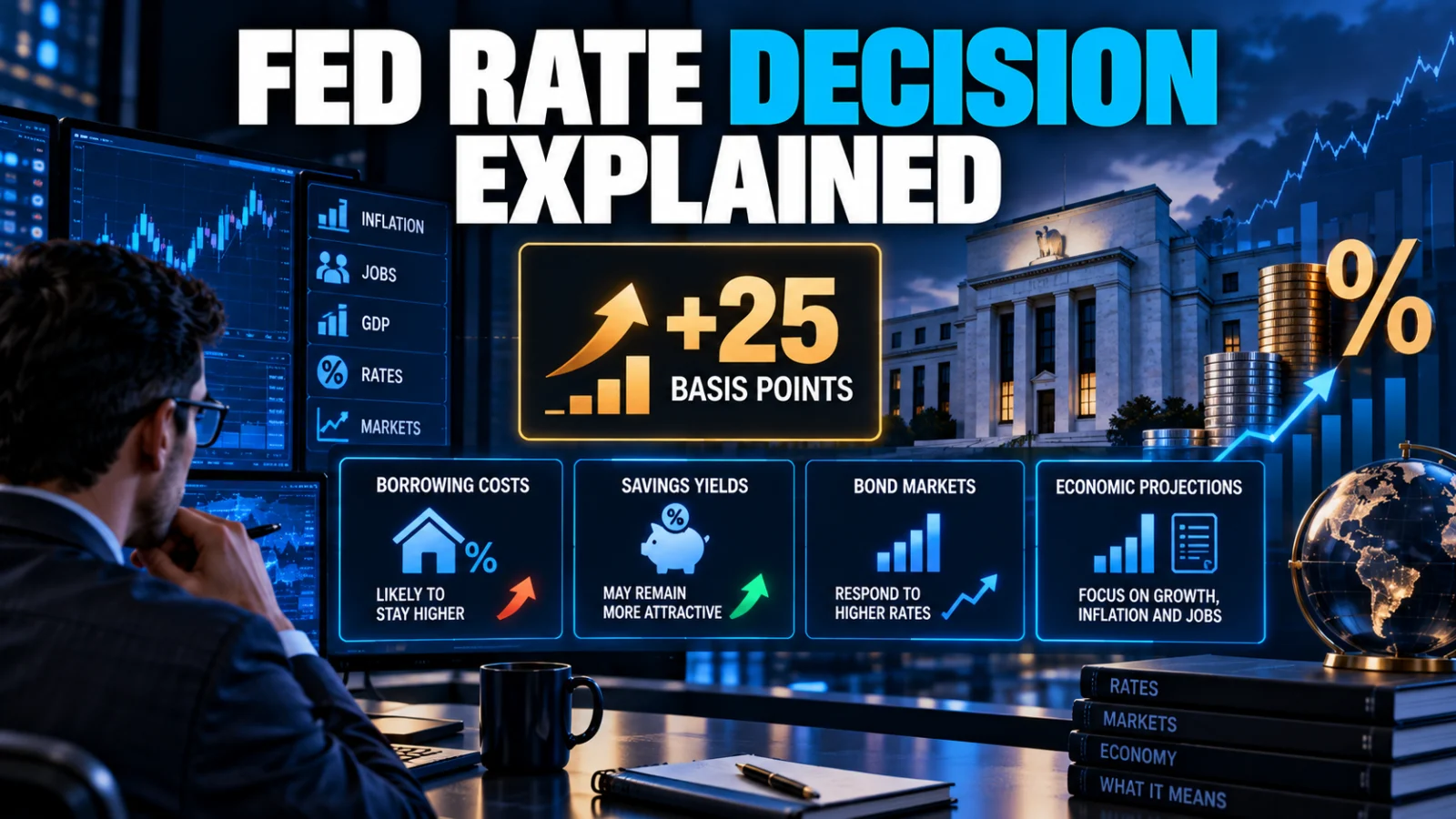
The Federal Reserve September 2026 rate decision raised the federal funds target range by 25 basis points to 3.75%–4.00%. The vote was unanimous, and the new range takes effect on September 17. The bigger signal for borrowers, savers and markets is that the Fed’s September projections also moved toward a higher expected policy-rate path than officials projected in June.
What changed at the September Fed meeting?
The Federal Open Market Committee raised its target range from 3.50%–3.75% to 3.75%–4.00%. The decision passed by a 12–0 vote. The September Summary of Economic Projections also raised the median projected year-end 2026 federal funds rate to 4.1%, compared with 3.8% in June. That indicates a firmer projected policy path, but it does not guarantee another rate increase.
Federal Reserve September 2026 rate decision: the confirmed numbers
| Item | Before / June | September 2026 |
|---|---|---|
| Federal funds target range | 3.50%–3.75% | 3.75%–4.00% |
| Rate decision | — | +25 basis points |
| FOMC vote | — | 12–0 |
| 2026 real GDP growth median | 2.2% | 2.3% |
| 2026 unemployment median | 4.3% | 4.1% |
| 2026 PCE inflation median | 3.6% | 3.7% |
| 2026 core PCE inflation median | 3.3% | 3.4% |
| 2026 year-end federal funds rate median | 3.8% | 4.1% |
| 2027 federal funds rate median | 3.6% | 4.1% |
| 2028 federal funds rate median | 3.4% | 3.9% |
What do the new Fed projections actually mean?
The September projections combine a slightly stronger growth outlook with a lower unemployment forecast, somewhat higher inflation estimates and a higher projected policy-rate path.
That is important because it suggests policymakers currently see room or need for monetary policy to remain relatively restrictive while inflation stays above the Fed’s 2% objective.
But the projections are not a schedule. Each participant submits an assessment of the policy rate they consider appropriate under their economic outlook. The median can change as inflation, employment, growth and financial conditions change.
What should borrowers and savers take from the decision?
Variable or prime-linked debt: check the repricing formula in your agreement. These products can react relatively directly when banks change their prime rates.
Fixed-rate mortgages: do not assume a 25-basis-point Fed hike means mortgage rates automatically rise by 25 basis points. Fixed mortgage pricing depends more heavily on longer-term Treasury yields, inflation expectations and mortgage-market conditions.
Savings accounts and CDs: higher short-term policy rates can support higher deposit yields, but each bank decides how much and how quickly to pass through.
Investments: treat immediate stock, bond and currency moves as observed market reactions, not guaranteed future consequences of the Fed decision.
What happens to credit-card and other prime-linked rates?
Many variable-rate credit products use the U.S. prime rate as part of their pricing formula. Major U.S. banks raised their prime rate from 6.75% to 7.00% after the Fed decision.
That can increase borrowing costs for products whose contracts reprice with prime, including many credit cards and some variable-rate business or consumer loans.
The exact change for an individual borrower still depends on the lender’s formula, adjustment timing, margin and contractual terms.
Does the Fed hike mean mortgage rates rise by 0.25 percentage point?
No. The federal funds rate is an overnight interbank policy rate. It is not the same thing as a 30-year fixed mortgage rate.
Fixed mortgage rates tend to respond more to longer-term Treasury yields, inflation expectations, economic growth expectations, mortgage-backed securities pricing and investor demand.
A Fed decision can influence those conditions, but the relationship is not mechanical. Mortgage rates can rise, fall or remain relatively stable around a Fed meeting depending on what markets had already expected and how investors interpret the new information.
What does the decision mean for savings accounts and CDs?
Higher short-term policy rates can help support higher yields on savings accounts, money-market deposit accounts and certificates of deposit.
However, banks are not required to raise deposit rates by the full 25 basis points, or to do so immediately. Competitive online banks may adjust differently from large traditional institutions.
Savers comparing products should therefore look at the current annual percentage yield rather than assuming their existing account will automatically receive the full Fed increase.
Does the 4.1% projection guarantee another Fed hike?
No. The September median projection for the federal funds rate is not a binding commitment by the FOMC.
It shows where the median participant currently believes the policy rate would be appropriate under their economic outlook. Incoming inflation, employment, growth and financial-market data can change that assessment before the next meeting.
The correct interpretation is that the September projections shifted toward a higher expected policy path—not that another specific rate move has already been decided.
Why did the projected policy path move higher?
The September projections show a combination of slightly stronger expected growth, lower projected unemployment and somewhat higher inflation compared with June.
That mix can support a firmer monetary-policy outlook because stronger activity and persistent inflation reduce the case for rapid easing.
This is an interpretation of the published projection changes, not a claim that any single forecast mechanically caused the rate decision.
What does this mean for stocks, Treasury yields and the dollar?
Financial markets can react quickly to both the rate decision and the difference between the Fed’s guidance and what investors expected before the announcement.
Stocks, Treasury yields and the dollar may move in response to the policy rate, the SEP, the Chair’s comments and changing expectations for future meetings.
Those immediate movements should not be turned into a guaranteed forecast. A higher policy rate does not establish where any specific stock index, Treasury yield or currency will trade next week or next month.
What did not change?
The Federal Reserve continues to describe its longer-run inflation objective as 2%. Future policy remains dependent on incoming data, the evolving economic outlook and the balance of risks rather than a predetermined sequence of rate moves.
What should readers check now?
- If you carry variable-rate debt, check whether the rate is tied to prime or another benchmark and when the next adjustment occurs.
- If you are considering a mortgage, compare current lender quotes rather than adding 0.25 percentage point to an older mortgage rate.
- If you hold savings or CDs, compare current APYs because deposit pass-through differs across institutions.
- If you follow markets, separate the confirmed Fed action from forecasts about future asset prices.
- If you are planning around future Fed moves, treat the SEP as a projection rather than a commitment.
What happens next?
The next scheduled material checkpoint is the release of the September FOMC meeting minutes on October 7, 2026. Those minutes can provide more detail about the Committee’s discussion and risk assessment, but they will not replace the September decision itself.
The next scheduled FOMC meeting is October 27–28, 2026. Any policy decision at that meeting would create a new current rate state and should trigger a same-URL review of this canonical if it continues to answer the same reader job.
Verification note
ThePulseSignal reviewed the Federal Reserve’s September FOMC statement, implementation note and Summary of Economic Projections, then reconciled those primary documents with current reporting on bank prime-rate changes and consumer borrowing and savings transmission.
Limitations and unresolved facts
The September decision does not determine future FOMC votes, future mortgage rates, future deposit yields or the path of stocks, bonds and currencies. The SEP is a projection set, not a binding policy schedule. Individual borrowing and savings products can also reprice differently depending on institution-specific terms and market conditions.
Bottom line
The Fed raised its target range by 25 basis points to 3.75%–4.00%, and the September projections moved toward a higher expected policy-rate path than officials showed in June. For borrowers and savers, the practical effect depends on the type of rate involved: prime-linked debt can reprice relatively directly, deposit rates may improve, and fixed mortgage rates remain driven by broader long-term market conditions rather than moving one-for-one with the Fed.