






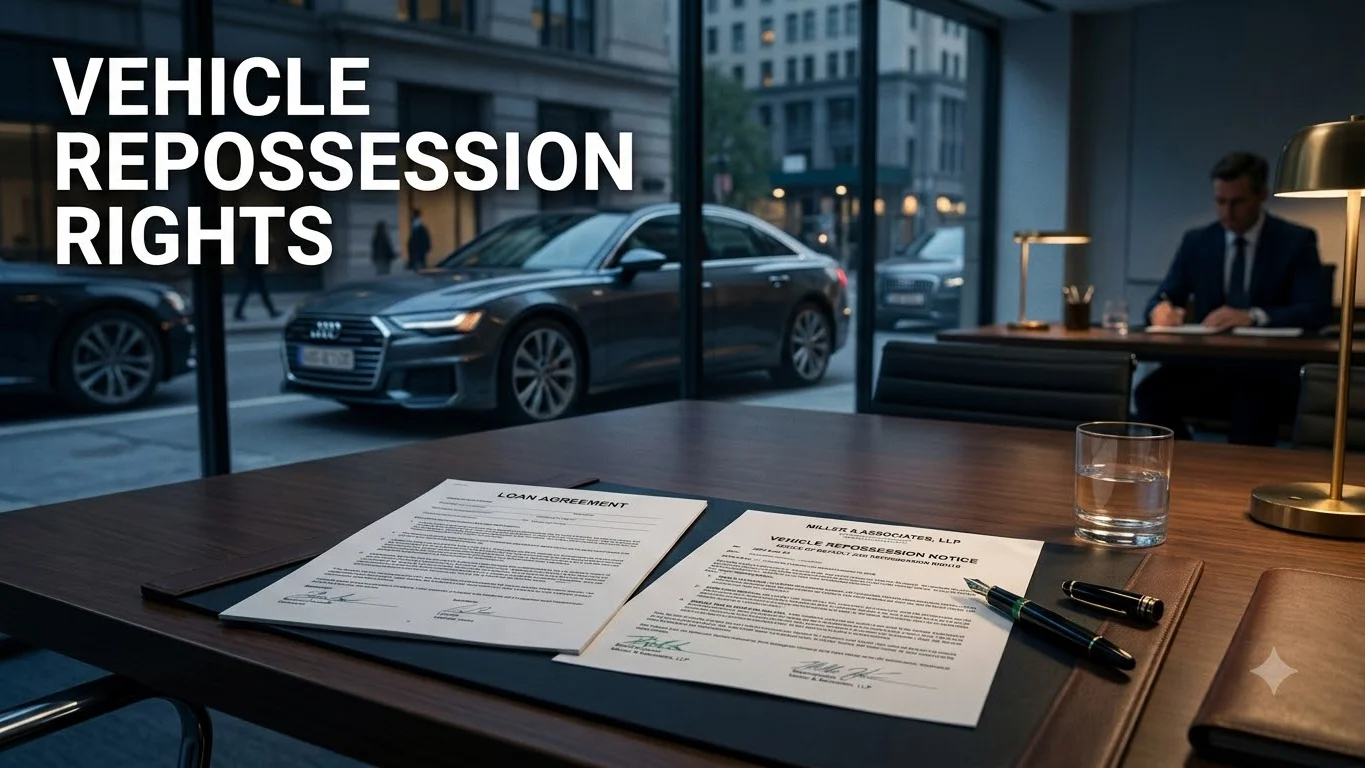
The Supreme Court vehicle repossession ruling does not ban banks or NBFCs from ever taking back a financed vehicle after loan default. Instead, the Court has reaffirmed that a lender’s contractual repossession right must be exercised lawfully. Force, stealth, harassment or methods that violate the loan agreement and applicable RBI recovery rules are not permitted.
What did the Supreme Court actually rule?
A valid finance agreement can give a lender a right to repossess a vehicle after default. But that right is not a licence to seize the vehicle by force, deception or outside the agreed recovery process. In Hari Dutta Sharma v. State of U.P. & Ors., 2026 INSC 998, the Supreme Court found the repossession before it unlawful because the contractual notice requirement had not been followed and the vehicle was taken in circumstances the Court treated as forcible and arbitrary.
Did the Supreme Court ban vehicle repossession after loan default?
No. This is the most important distinction in the judgment.
The Court recognised that a financier may have a contractual right of self-help repossession where the loan agreement permits it. The problem is how that right is exercised.
A lender cannot treat default as permission to use muscle power, intimidation, stealth or a recovery process that ignores the contract or applicable regulatory safeguards.
Why was the repossession in Hari Dutta Sharma held unlawful?
The Supreme Court focused on several facts in the case.
- The finance agreement required a seven-day notice before repossession, but the Court found that the required notice had not been given.
- The vehicle was taken at about 1 a.m..
- The steering lock was broken during the repossession.
- The possession memorandum did not bear the borrower’s signature.
Taken together, those facts supported the Court’s conclusion that the repossession was not a lawful exercise of contractual recovery rights.
Is seven days now a mandatory notice period for every vehicle loan?
No. The seven-day period in this case came from the specific loan agreement before the Supreme Court.
The broader rule is that lenders must comply with the notice and repossession process contained in the applicable agreement and regulatory framework. A different loan contract may contain a different notice period, subject to the law and applicable RBI requirements.
Borrowers should therefore read the actual repossession clause in their agreement instead of assuming that every lender must follow the same seven-day timeline.
What do RBI rules say about repossession and recovery agents?
RBI’s recovery and fair-practice framework already places important limits on how regulated lenders and their agents can collect overdue loans.
Recovery activity must not involve intimidation, harassment or muscle power. Repossession clauses should also be transparent about the process, including notice before possession, the manner in which possession may be taken, any final opportunity for repayment before sale, and the procedure for sale or auction of the asset where applicable.
The Supreme Court judgment reinforces those existing regulatory protections rather than creating a general rule that lenders lose all repossession rights after default.
If a financed vehicle is at risk of repossession, what should a borrower check?
1. Read the repossession clause: check what the agreement says about default, notice, possession and sale.
2. Verify whether notice was actually served: preserve letters, emails, SMS messages and other delivery records.
3. Record how possession occurred: keep photographs, CCTV, witness details, call records and copies of any possession memo where relevant.
4. Separate default from recovery conduct: being in default does not automatically make every recovery method lawful.
5. Escalate unlawful conduct: use the lender’s grievance process and applicable RBI/Ombudsman or legal remedies where the facts support a complaint.
Can recovery agents use force to take a vehicle?
The judgment and RBI framework do not support the use of force, intimidation or muscle power in loan recovery.
A recovery agent may act for a lender within lawful and contractual limits, but cannot convert a financial default into a licence for physical coercion or secret seizure.
This distinction is especially important because a borrower can owe money and still retain legal protection against unlawful recovery methods.
Can a lender sell a repossessed vehicle?
A lawful repossession process can include eventual sale of the financed asset where the contract and applicable rules permit it.
But the process matters. The lender must comply with the contract and relevant regulatory safeguards governing possession, any opportunity to repay before sale, valuation or sale procedure where applicable, and accounting of sale proceeds.
The Supreme Court ruling should therefore not be read as prohibiting every post-default sale. It instead reinforces that lenders must reach that stage through a lawful process.
What relief did the Supreme Court give in this case?
The Court granted substantial case-specific relief to the appellant.
- It directed closure of the loan account.
- It directed refund of Rs 4.5 lakh representing the vehicle’s sale proceeds, with 6% interest.
- It awarded Rs 10 lakh as compensation.
- It awarded Rs 50,000 as costs.
These amounts arose from the facts, conduct and findings in Hari Dutta Sharma. They are not automatic compensation amounts available to every borrower whose vehicle is repossessed.
Does every borrower now have a right to Rs 10 lakh compensation?
No. The Supreme Court did not create a fixed compensation tariff for repossession disputes.
Compensation depends on the facts, legal findings, harm suffered and relief considered appropriate in the individual case. A borrower should not assume that this judgment guarantees the same monetary award in another dispute.
What did the Supreme Court direct RBI to do?
The Court directed the Reserve Bank of India to take effective steps to secure genuine compliance by NBFCs and scheduled commercial banks with its guidelines, master circulars and clarifications governing recovery practices.
That direction is important because the case was not treated merely as a private disagreement between a borrower and financier. The Court also focused on whether the regulatory framework is being meaningfully followed in practice.
What did the judgment say about borrower rights?
The Court treated the manner of repossession in this case as a serious legal wrong and found that the conduct violated the appellant’s constitutional protections under Articles 14 and 21.
That finding should still be read in the context of the facts before the Court. TPS should not convert it into a claim that every contractual repossession automatically becomes a constitutional violation.
What should lenders and NBFCs take from the ruling?
Lenders should not assume that the existence of a repossession clause ends the legal analysis.
The operational questions are whether the clause itself is compliant, whether the required notice was issued, whether recovery agents followed permitted conduct, whether possession was peaceful and documented, and whether the later sale or recovery process followed the agreed and regulatory procedure.
The judgment increases the importance of evidence showing that each stage of repossession was actually carried out lawfully.
What remains unresolved?
The judgment directs RBI to secure genuine compliance, but TPS has not identified a dated new RBI circular or judgment-specific implementation notice issued after the ruling.
It also does not create a universal notice period, universal compensation amount or universal rule requiring a separate court order before every contractual vehicle repossession.
Verification note
ThePulseSignal reviewed the reportable Supreme Court judgment identified as Hari Dutta Sharma v. State of U.P. & Ors., 2026 INSC 998, and reconciled its holdings with RBI guidance on recovery agents and repossession practices. The judgment text was recovered through independent full-text legal repositories; an official Supreme Court website judgment URL was not located during the completed research.
Bottom line
The Supreme Court vehicle repossession ruling does not erase a lender’s valid contractual repossession right. It draws the line at how that right is exercised. A bank, NBFC or recovery agent cannot use force, stealth or a process that ignores the agreement and applicable RBI rules. Borrowers should check their own contract and evidence carefully, while lenders need to be able to prove that repossession was conducted lawfully from notice through possession and any later sale.