







SEC Rule 14a-8 rescission proposal is the key phrase for understanding the Securities and Exchange Commission’s September 2026 shareholder-proposal action: the SEC has proposed major changes, but it has not yet rescinded Rule 14a-8 or made the accompanying proxy reforms effective.
Did the SEC already repeal Rule 14a-8?
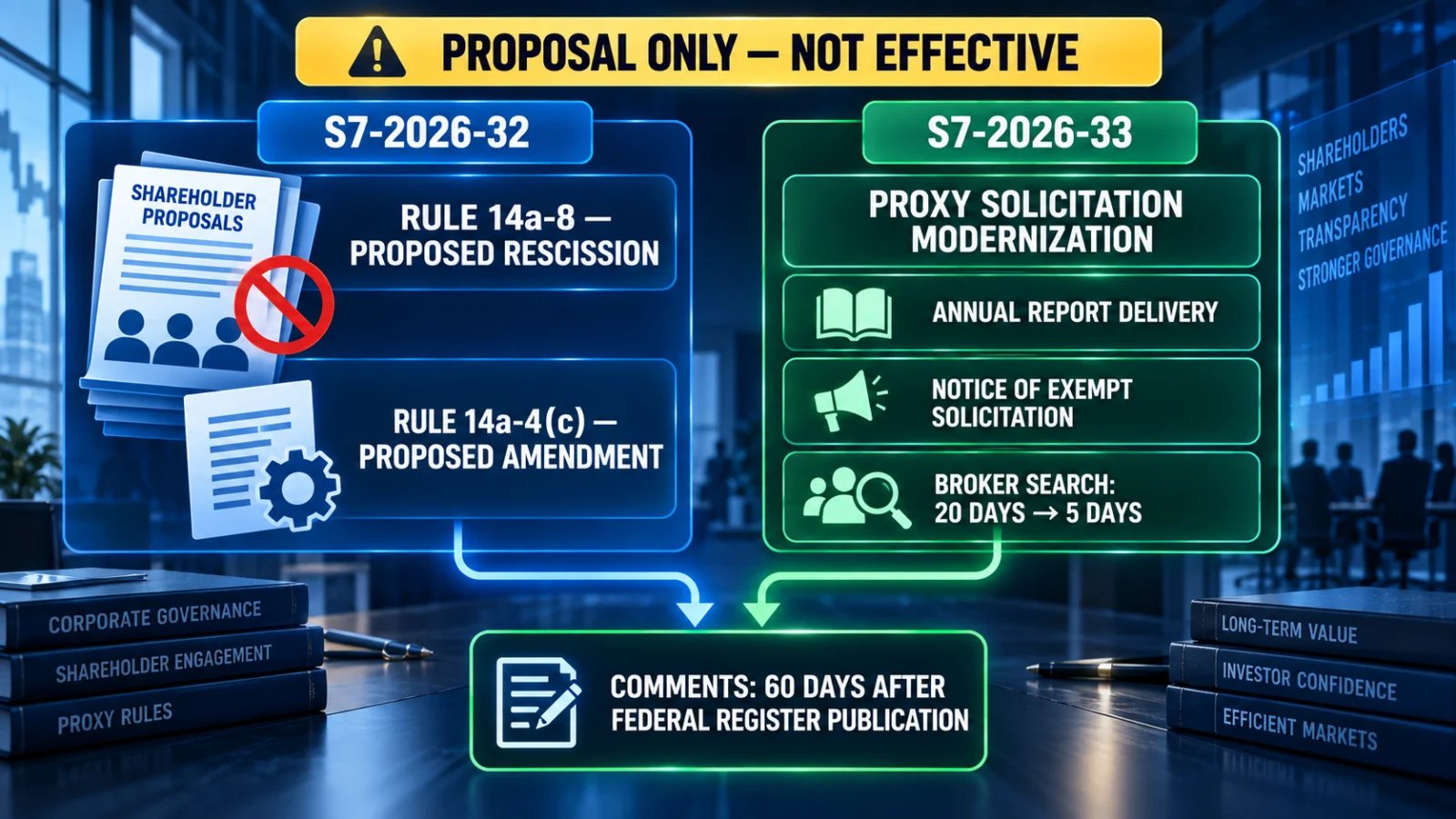
No. The SEC has issued a proposed rulemaking, identified as S7-2026-32, that would rescind Rule 14a-8 and amend Rule 14a-4(c). A separate proposal, S7-2026-33, would modernize other proxy-solicitation rules. Both remain proposals, so companies and shareholders should continue to distinguish current requirements from changes that would apply only if the SEC adopts final rules.
What does the SEC Rule 14a-8 rescission proposal change?
Rule 14a-8 is the federal framework governing when qualifying shareholder proposals must be included in a company’s proxy materials. Under the SEC’s proposal, that federal inclusion framework would be rescinded.
If the proposal becomes final, the role of shareholder proposals would instead depend more heavily on applicable state corporate law and company governing documents. That does not mean shareholder proposals themselves would disappear. It means the existing federal Rule 14a-8 mechanism for requiring inclusion in company proxy materials would be removed.
Is Rule 14a-8 still in force now?
Yes. The September action is a proposal, not a final rule. The SEC had already changed part of its staff process for Rule 14a-8 no-action requests earlier in 2026, but that staff-process change did not itself repeal Rule 14a-8.
The practical current-state answer is therefore straightforward: companies and shareholders should not behave as though Rule 14a-8 has already been rescinded solely because the SEC has proposed rescission.
What would change under Rule 14a-4(c)?
The same S7-2026-32 proposal would amend Rule 14a-4(c), which concerns discretionary voting authority over matters that are not included in company proxy materials.
The SEC proposes broadening the circumstances in which proxy holders could exercise discretionary authority on shareholder proposals that will be presented at a meeting but are not included in the company’s proxy materials.
This is a different issue from Rule 14a-8 itself. Rule 14a-8 primarily addresses whether a qualifying proposal must be included in company proxy materials, while Rule 14a-4(c) addresses how proxy authority may be exercised for matters outside those materials.
What is the separate proxy-solicitation modernization proposal?
The SEC issued a second proposal, S7-2026-33, alongside the Rule 14a-8 proposal. It should be treated as a separate rulemaking even though the SEC announced both on the same day.
| Current proxy-process area | What the SEC proposes |
|---|---|
| Annual reports to security holders | Eliminate the separate delivery requirement addressed by the proposal |
| Proxy statements incorporating information by reference | Eliminate the current timing requirement tied to delivery of the incorporated information |
| Notices of Exempt Solicitation | Eliminate the filing requirement and the ability to submit the notice under the proposed framework |
| Broker search | Reduce the minimum period from 20 business days to 5 business days |
None of those changes is effective merely because the proposal has been issued.
Would shareholder proposals disappear if Rule 14a-8 is rescinded?
No. The SEC proposal concerns the federal mechanism requiring qualifying shareholder proposals to be included in company proxy materials. Shareholder proposals can still exist under other legal and corporate-governance frameworks.
If the SEC ultimately rescinds Rule 14a-8, state corporate law and company governing documents would become more important in determining how shareholder proposals are handled. The exact practical consequences would depend on the final rule and the relevant jurisdiction and governing documents.
Who would be affected if the proposals become final?
Public companies and SEC registrants would face changes in shareholder-proposal handling and other proxy-process requirements.
Shareholder proponents, including individual and institutional investors, could face a substantially different route for seeking inclusion of proposals in company proxy materials if the federal Rule 14a-8 framework is removed.
Other shareholders could be affected by the proposed Rule 14a-4(c) changes because those provisions govern how granted proxies may be exercised in specified circumstances.
Investors conducting exempt solicitations would be affected by the proposed elimination of the Notice of Exempt Solicitation mechanism.
Brokers and intermediaries would be affected by the proposed reduction in the minimum broker-search period from 20 business days to 5 business days.
Security holders receiving proxy and annual-report materials could also see changes in how those materials are delivered or timed if the modernization proposal becomes final.
When are comments due?
The SEC currently states that comments on the proposals are due 60 days after publication in the Federal Register.
TPS did not establish an exact calendar comment deadline in the controlling SEC evidence reviewed on September 17 because the SEC proposal pages still describe the deadline relative to Federal Register publication. An exact calendar date should be added only when that publication establishes it.
What should companies and shareholders change today?
They should not treat the proposals as operative rules. Current controlling requirements remain the relevant baseline unless and until the SEC completes rulemaking and adopts final changes.
Affected companies, investors and governance teams can review the proposals and prepare comments, but compliance processes should not be rewritten on the assumption that the proposed outcomes are certain.
Why are there two SEC proposals instead of one?
The September 16 announcement combines two related but distinct regulatory projects.
S7-2026-32 addresses Rule 14a-8 rescission and related Rule 14a-4(c) amendments. S7-2026-33 addresses other proxy-solicitation modernization measures.
Keeping the two dockets separate helps prevent one proposal’s provisions from being incorrectly attributed to the other.
What happens next?
The next material step is Federal Register publication, which starts the 60-day comment period and allows an exact calendar deadline to be calculated.
After reviewing comments, the SEC could modify the proposals, adopt final rules, decline to proceed or take other rulemaking action. Final effective and compliance dates would depend on later SEC action and should not be inferred from the proposal stage.
Verification note
ThePulseSignal reviewed the SEC’s S7-2026-32 and S7-2026-33 rulemaking materials, the September 16 SEC announcement and the SEC’s current shareholder-proposal guidance. The article separates current law from proposed future changes and does not treat the relative comment period as an exact calendar deadline.
Limitations and unresolved facts
Federal Register publication had not established a verified calendar comment deadline in the evidence reviewed on September 17. Final rule text, final votes, effective dates, transition provisions and any later litigation or state-law responses remain unresolved.
Bottom line
The SEC Rule 14a-8 rescission proposal is a significant proposed change to the federal shareholder-proposal framework, but it is not yet an effective repeal. The SEC has also proposed separate proxy-solicitation reforms. For now, the correct reader action is to distinguish current rules from proposed future changes and watch for Federal Register publication, the exact comment deadline and later final SEC action.