





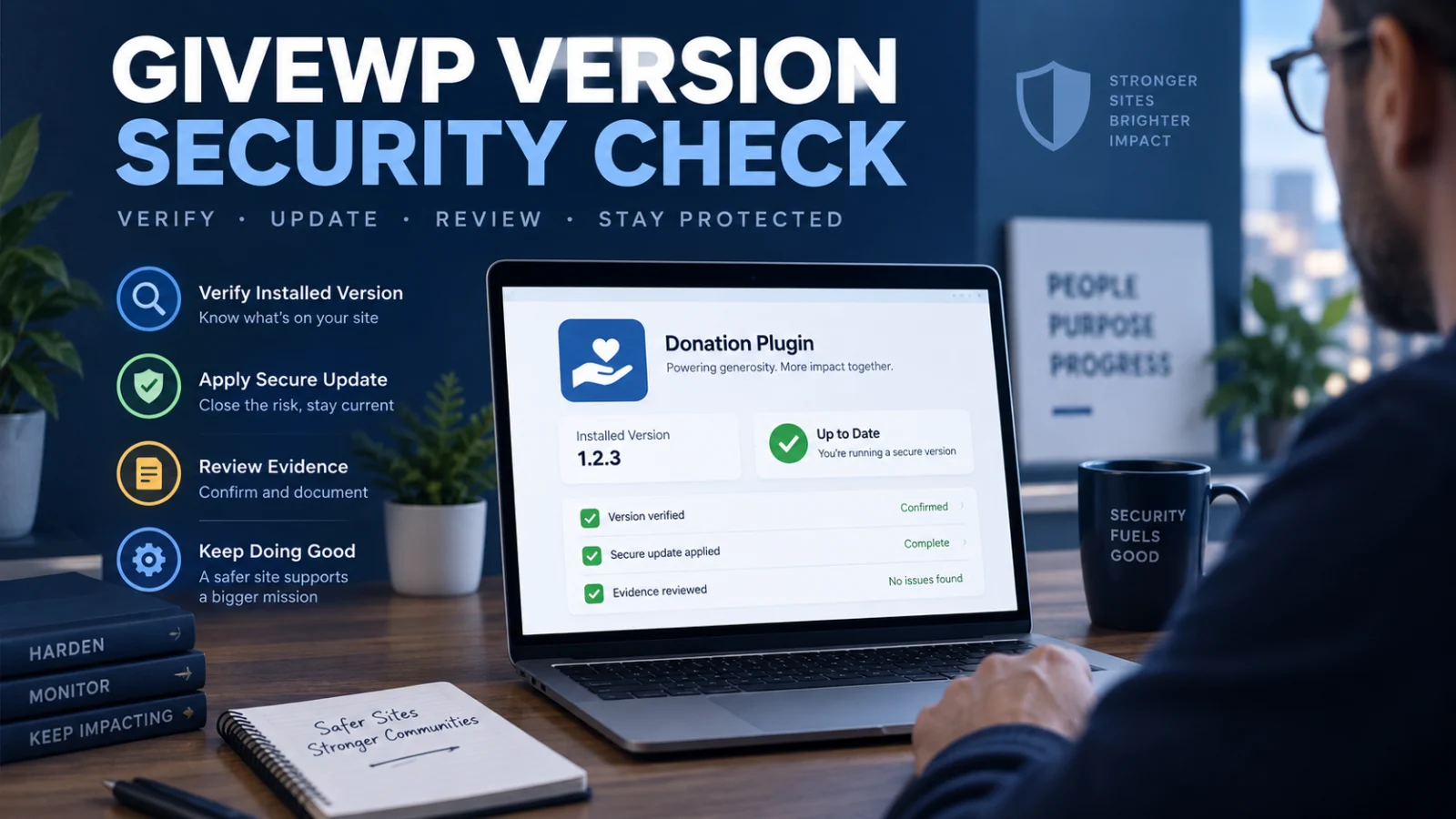
GiveWP CVE-2026-82222 affects GiveWP versions through 4.16.7.1. If your WordPress site is running an affected version, update to GiveWP 4.16.7.2 or a later current release. The vulnerability involves unsafe deserialization or PHP object injection and can lead to arbitrary code execution.
The immediate GiveWP-specific task is simple: identify the version actually deployed, update if it is within the affected range, and confirm the site is now running a fixed version. Active exploitation was not established in the evidence reviewed by ThePulseSignal, and no authoritative GiveWP-specific indicator-of-compromise checklist was recovered.
Check whether your GiveWP site is affected
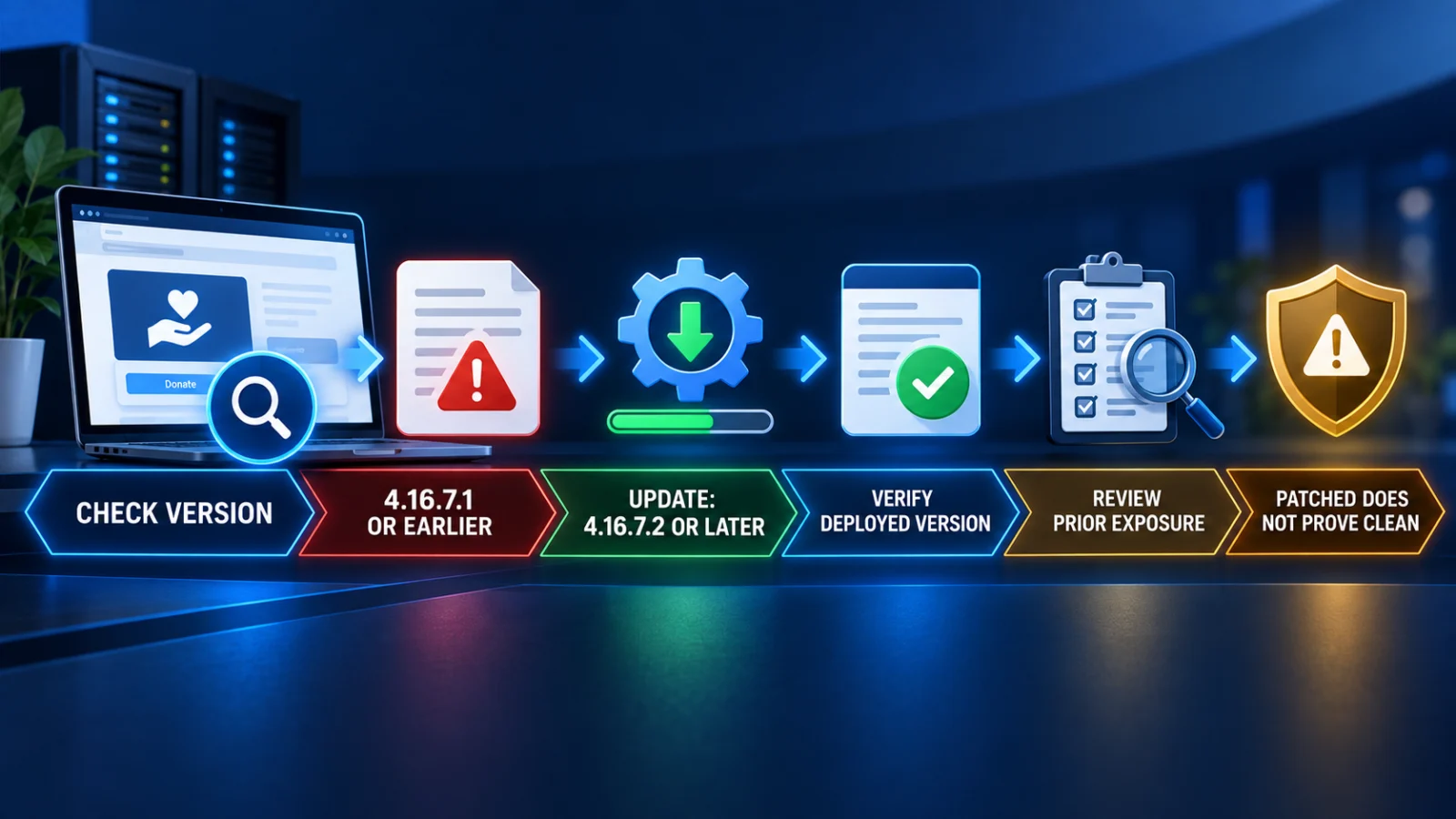
GiveWP 4.16.7.1 or earlier
Your installation is within the affected range for CVE-2026-82222. Update to GiveWP 4.16.7.2 or a later current release.
GiveWP 4.16.7.2 or later
Your installed version is outside the affected-version boundary identified in the reviewed CVE-2026-82222 evidence. Confirm that this is the version actually deployed on the live site.
Which GiveWP versions are affected by CVE-2026-82222?
The reviewed CERT-In and vulnerability records identify GiveWP versions through 4.16.7.1 as affected.
GiveWP 4.16.7.2 was released on August 27, 2026 with security hardening relevant to the vulnerable serialized-data handling. Administrators should therefore use 4.16.7.2 or a later current GiveWP release.
What does CVE-2026-82222 allow?
CERT-In describes the issue as unsafe deserialization or PHP object injection that can lead to arbitrary code execution. Wordfence separately characterizes the vulnerability as unauthenticated PHP Object Injection capable of leading to remote code execution under the vulnerable conditions.
The severity of the flaw makes the installed-version check important even when a GiveWP site appears to be operating normally.
What should you do if you run GiveWP 4.16.7.1 or earlier?
- Check the GiveWP version currently deployed on the WordPress site.
- If it is 4.16.7.1 or earlier, update to 4.16.7.2 or a later current release.
- After updating, confirm the deployed GiveWP version rather than assuming the update completed successfully.
- Continue using the current supported GiveWP release as later versions supersede the original 4.16.7.2 security-fix boundary.
The current GiveWP release can be checked on the official WordPress.org GiveWP plugin page.
Is GiveWP CVE-2026-82222 actively exploited?
Active exploitation is not established in the evidence reviewed for this article. TPS did not recover a CISA Known Exploited Vulnerabilities entry or another authoritative source confirming exploitation in the wild for CVE-2026-82222 during the final source review.
This should not be interpreted as proof that exploitation has never occurred. It means TPS does not currently have sufficient reviewed evidence to publish an active-exploitation claim.
What does updating establish?
Updating and verifying the deployed version establishes that the site is no longer running the GiveWP version range identified as vulnerable to CVE-2026-82222.
Whether a site experienced any earlier security incident is a separate question and cannot be determined from the GiveWP version alone. This article therefore does not attempt to duplicate a general WordPress compromise-assessment or post-patch verification workflow.
Are there GiveWP-specific indicators of compromise?
TPS did not recover an authoritative CVE-2026-82222-specific list of files, log entries or indicators of compromise from the reviewed sources.
For that reason, this article does not provide a fabricated GiveWP forensic checklist. Administrators with independent signs of a security incident should use their existing hosting or security-response process rather than treating this version guide as an incident-forensics procedure.
Limitations & unresolved facts
- Active exploitation of CVE-2026-82222 was not established in the reviewed evidence.
- No authoritative GiveWP-specific indicator-of-compromise checklist was recovered.
- Version information alone cannot determine whether a particular installation experienced earlier exploitation.
- The exact initial public-disclosure clock time was not established.
- Later GiveWP releases may supersede 4.16.7.2, so administrators should use the current supported release rather than treating 4.16.7.2 as a permanent target version.
Verification method
ThePulseSignal reviewed CERT-In’s CVE-2026-82222 advisory, GiveWP’s WordPress.org release state and supporting CVE and Wordfence vulnerability records. TPS reconciled the affected-version boundary, the fixed release and the vulnerability consequence separately from unverified active-exploitation or site-compromise claims.
Frequently asked questions
Is GiveWP 4.16.7.1 affected by CVE-2026-82222?
Yes. The reviewed evidence places GiveWP 4.16.7.1 within the affected range.
Which GiveWP version fixes CVE-2026-82222?
GiveWP 4.16.7.2 is the fixed-version boundary established in the reviewed evidence. Administrators should use 4.16.7.2 or a later current release.
Is GiveWP 4.16.7.2 affected?
It is outside the affected-version range identified for CVE-2026-82222 in the reviewed evidence.
Is CVE-2026-82222 being actively exploited?
TPS did not find reviewed authoritative evidence establishing active exploitation at the final source check.
Are there GiveWP-specific indicators of compromise?
TPS did not recover an authoritative CVE-2026-82222-specific indicator-of-compromise checklist from the reviewed sources.