






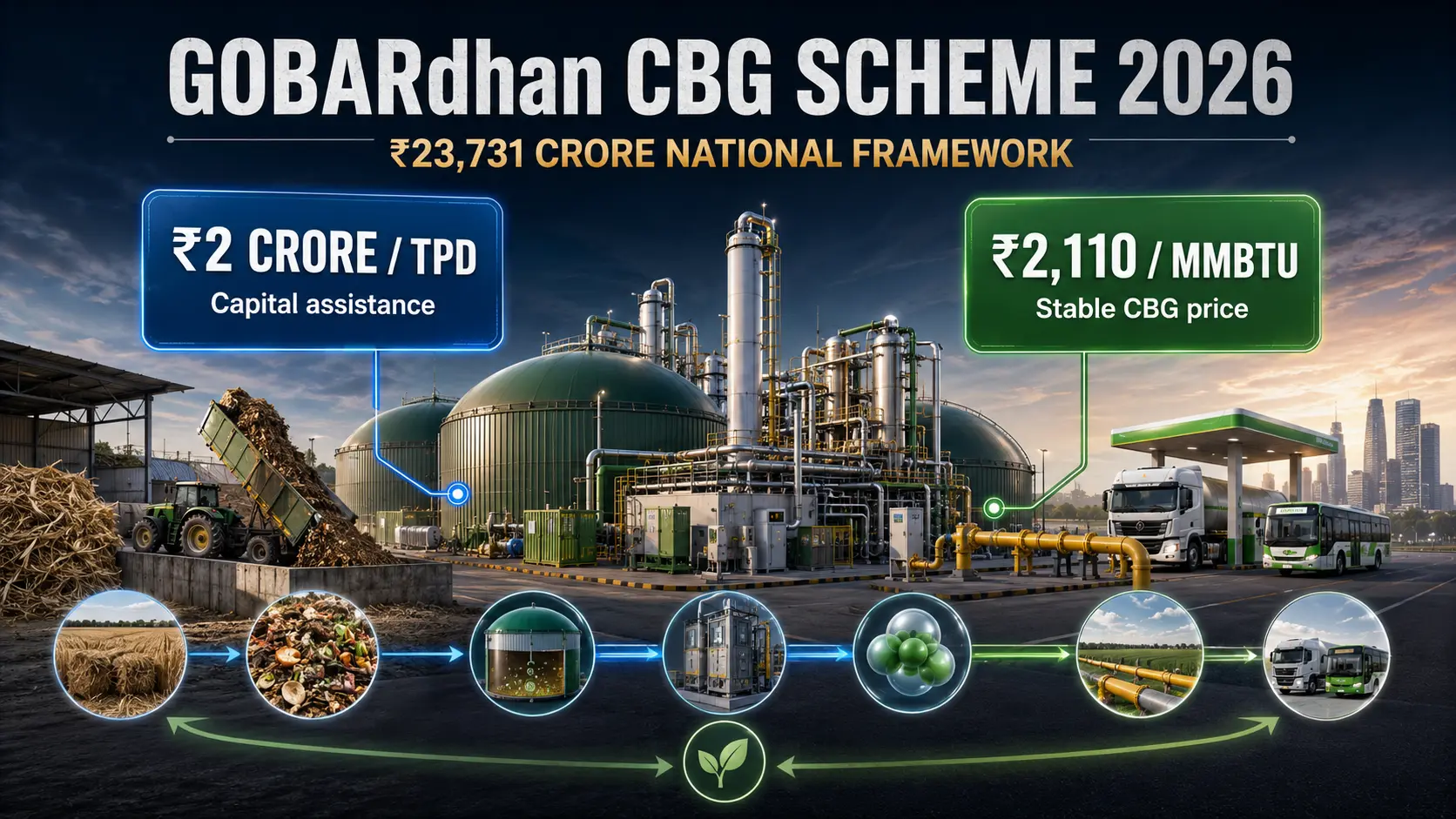
GOBARdhan CBG Scheme 2026 is India’s national compressed-biogas framework approved with a ₹23,731 crore outlay, assured offtake, a ₹2,110/MMBTU administered producer price and capital assistance for eligible projects. CBG/Bio-CNG plant registration is already available through the official GOBARdhan portal, but registration should not be treated as automatic approval for the new capital assistance or other financial benefits.
The official CBG portal continues to provide plant registration and existing component routes such as the Development of Pipeline Infrastructure scheme. The public circular register does not yet show a complete unified-scheme operating guideline or a distinct application window for every benefit announced under the new national framework.
Direct answer
Can you apply for the GOBARdhan CBG Scheme 2026 now?
You can register an existing or proposed CBG/Bio-CNG plant now. For the operational registration route, authorised-person setup, registration certificate and plant-status process, use ThePulseSignal’s GOBARdhan CBG registration guide.
Plant registration is separate from sanction of capital assistance. Applicants should use the relevant benefit-specific guideline or application portal before treating any announced financial support as approved for their project.
Current status
Scheme approved; some operating rules still pending
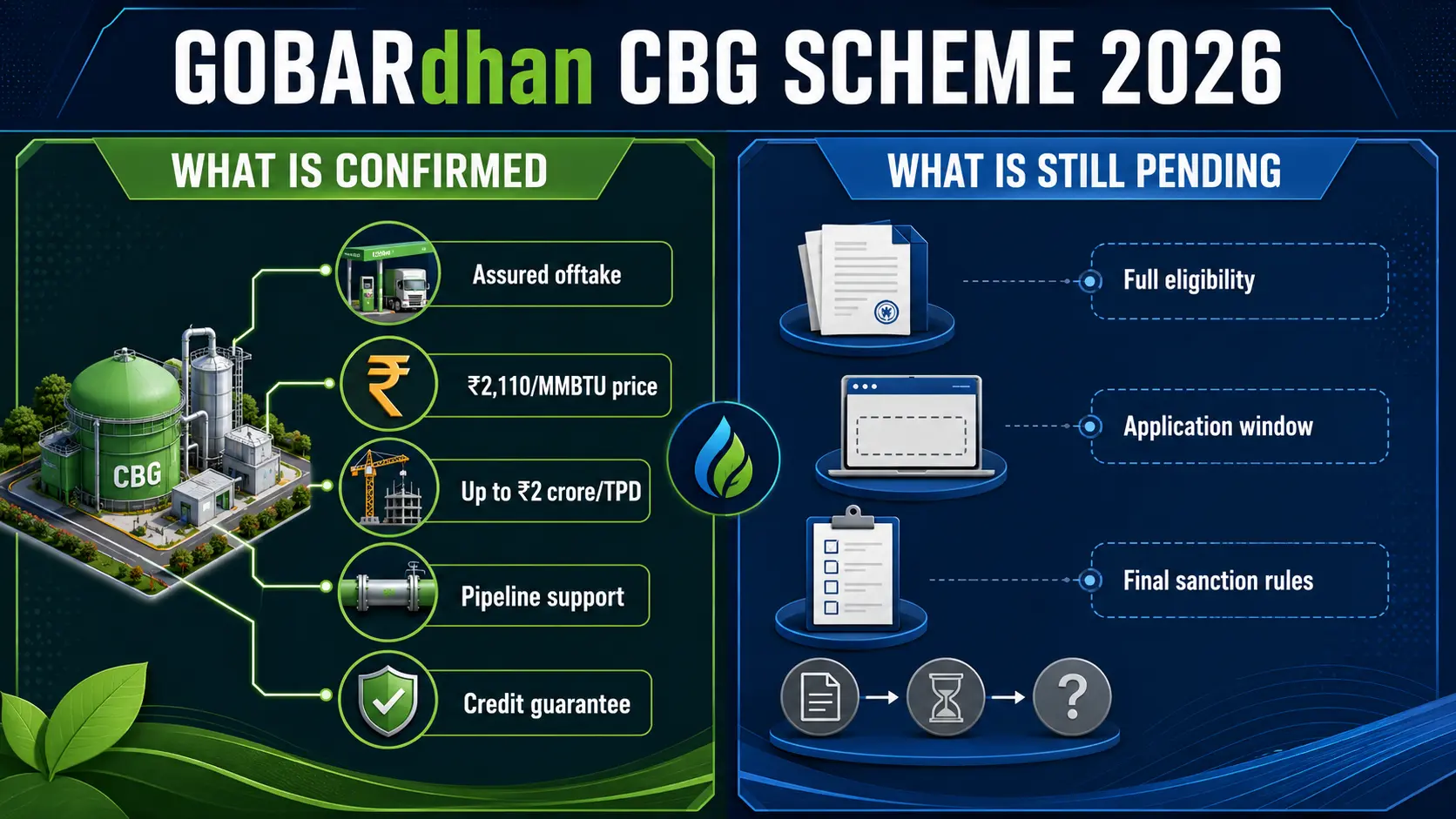
The national framework and its six support components are confirmed. Existing CBG registration and DPI functions remain available, but a complete public project-level rulebook for all benefits of the unified 2026 scheme is not yet visible in the official CBG circular register.
Confirmed
- Total scheme outlay: ₹23,731 crore.
- Implementation period: FY 2026-27 to FY 2035-36.
- Capital assistance up to ₹2 crore per TPD for eligible greenfield CBG projects.
- Brownfield capacity expansion is also covered at policy level.
- Administered CBG procurement price: ₹2,110/MMBTU.
- CBG obligation rises to 5% from FY 2028-29 onward.
- Existing CBG/Bio-CNG plant registration remains available on the official portal.
Not yet fully established
- Complete project-level eligibility rules for every component.
- A distinct unified-scheme capital-assistance application opening date.
- Any separate maximum assistance cap per project beyond the announced per-TPD support.
- Complete application-document requirements for the new capital-assistance component.
- Whether existing registered plants require any additional migration or enrolment step.
- Detailed component-wise allocation of the ₹23,731 crore outlay.
Table of contents
GOBARdhan CBG Scheme 2026: what exactly is new?
The 2026 Cabinet approval creates a national unified framework focused on expanding compressed biogas. GOBARdhan itself is older: the broader initiative began under Swachh Bharat Mission (Grameen) in 2018, and multiple ministries subsequently introduced separate CBG support mechanisms.
The national framework now brings six major support areas together: assured CBG offtake, administered pricing, capital assistance, pipeline connectivity, credit guarantees and a CBG Ecosystem Challenge Fund.
What that means commercially
The framework targets several project risks simultaneously: long-term demand, producer pricing, upfront capital cost, gas-network connectivity, financing access and technology development. It does not remove ordinary project risks such as feedstock availability, utilisation, financing cost or operating performance.
What benefits are confirmed under the GOBARdhan CBG Scheme 2026?
| Support area | What is confirmed | What still needs project-level verification |
|---|---|---|
| Offtake | Assured CBG offtake framework linked to the CBG obligation trajectory | Contracting mechanics for a specific producer and buyer |
| Price | Administered producer procurement price of ₹2,110/MMBTU | How a project’s other commercial terms affect realised economics |
| Capital assistance | Up to ₹2 crore per TPD for eligible greenfield projects; brownfield capacity expansion is also covered | Detailed eligibility, sanction conditions and application procedure |
| Pipeline | Support for connectivity to CGD or trunk gas networks | Project-specific sanction and technical requirements |
| Credit | Credit-guarantee support for eligible MSME-based CBG projects | Final lender and borrower eligibility conditions |
| Innovation | CBG Ecosystem Challenge Fund | Challenge topics, application cycle and award mechanics |
What does the ₹2,110/MMBTU CBG price mean?
The ₹2,110/MMBTU figure is the procurement price paid to CBG producers under the GOBARdhan framework. On August 29, the Ministry of Petroleum and Natural Gas clarified that it is not a price directly charged to CNG or household PNG consumers.
The Ministry said the earlier CBG pricing mechanism, linked to 85% of the retail selling price of CNG, worked out to about ₹1,478/MMBTU after the latest revision. The new ₹2,110/MMBTU producer price is therefore about 43% higher than that reference.
For a project developer, the administered price improves revenue visibility, but it should not be treated as guaranteed profit. Feedstock cost, plant utilisation, financing, compression, digestate economics, transport, downtime and network access can materially change the economics of an individual plant.
Consumer-price distinction: the ₹2,110/MMBTU figure describes CBG procurement from producers. It should not be presented as the retail price paid directly by a CNG vehicle user or household PNG customer.
How does the ₹2 crore per TPD capital assistance work?
The Cabinet-approved framework provides capital assistance of up to ₹2 crore per tonne-per-day of installed CBG capacity for eligible greenfield projects. Brownfield projects that expand production capacity are also included at policy level.
The assistance is not an automatic entitlement created merely by registering a plant. Project eligibility, supporting documents, sanction conditions and the applicable application route must be established through the controlling scheme-specific guidance.
Do not treat ₹2 crore/TPD as automatic
A GOBARdhan registration number establishes the project’s registration status; it does not by itself establish approval or payment of capital assistance.
Who can register a CBG/Bio-CNG plant today?
The existing GOBARdhan registration framework accepts information from government and private entities operating or intending to set up CBG/Bio-CNG plants. The CBG/Bio-CNG Unified Registration Portal is separate from the rural-biogas portal under SBM(G).
For the operational registration route, proposed versus commissioned status, authorised-person account setup and certificate lookup, see the GOBARdhan CBG registration guide.
Registration can be an important prerequisite for accessing participating ministry or department schemes, but the eligibility conditions of each financial-support component still apply separately.
Can you apply for the new GOBARdhan CBG benefits now?
The official CBG portal allows plant registration and continues to expose existing support mechanisms, but its public circular register does not yet show a complete operating guideline or one universal application window covering every benefit of the new ₹23,731 crore framework.
The portal currently says the DPI portal is open for new applications. That is a specific pipeline-infrastructure support route and should not automatically be treated as the application for the new capital-assistance component.
If your immediate task is plant registration, use the GOBARdhan CBG registration guide. If you are seeking financial assistance, verify the exact scheme component and its current application route before committing project expenditure on the assumption that support has been sanctioned.
Old GOBARdhan vs GOBARdhan CBG Scheme 2026
| Topic | Existing framework | 2026 national CBG framework |
|---|---|---|
| Origin | GOBARdhan began under SBM(G) in 2018 | National Circular Bioenergy Scheme approved in August 2026 |
| Main focus | Biogas, waste-to-wealth and multiple ministry programmes | Large-scale CBG production and investment support |
| Rural community biogas | Separate SBM(G) support | Should not be confused with the new CBG capital-assistance component |
| CBG plant registration | Already existed | Remains available and relevant |
| ₹2 crore/TPD capital assistance | Not a generic entitlement under old GOBARdhan | New support for eligible greenfield CBG capacity, with brownfield expansion also covered |
Which GOBARdhan support portals are active?
The GOBARdhan CBG portal currently provides plant registration, registration-certificate lookup, registered-plant information and links to participating ministry schemes. Its What’s New section says the DPI portal is open for new applications.
The public circular register also continues to list earlier BAM, DPI, fertiliser, state-policy and other CBG measures. These are distinct schemes or components and should not automatically be treated as one combined application for every benefit under the National Circular Bioenergy Scheme.
GOBARdhan CBG Scheme 2026 applicant checklist
Register the plant
Use the official CBG/Bio-CNG registration portal for an existing or proposed plant.
Identify the benefit
Separate capital assistance, DPI, credit support, BAM and other component schemes before applying.
Check eligibility
Use the controlling guideline for the component you intend to claim.
Model economics
Treat ₹2,110/MMBTU and announced assistance as policy inputs, not guaranteed profit.
Verify offtake and connectivity
Determine the intended CGD, pipeline or other approved offtake route.
Keep project evidence
Preserve registration, DPR, capacity, project-status and eligibility records required by the applicable scheme.
Official GOBARdhan and CBG sources
- Official GOBARdhan CBG / Bio-CNG Unified Registration Portal
- Official GOBARdhan CBG circulars and notifications
- Cabinet approval of GOBARdhan National Circular Bioenergy Scheme
- MoPNG clarification on the ₹2,110/MMBTU CBG procurement price
- GOBARdhan biogas portal under SBM(G)
- GOBARdhan registration overview
Related ThePulseSignal policy explainers
GOBARdhan CBG Registration
Operational guide to the CBG portal, plant registration, registration number and certificate lookup.
India’s E-commerce Export Framework
Explains another national framework where policy approval and operational registration are separate questions.
Aadhaar App Acceptance
Explains the distinction between an official framework and practical implementation requirements.
How this was verified
The official GOBARdhan CBG/Bio-CNG Unified Registration Portal continues to offer plant registration and lists the DPI portal as open for new applications. Its public circular register currently lists CBG circulars through August 1, 2026 and does not show a later complete operating guideline for all components of the new unified scheme.
The Cabinet’s August 6 announcement confirms the ₹23,731 crore outlay, FY 2026-27 to FY 2035-36 implementation period, assured offtake, ₹2,110/MMBTU administered producer price, capital assistance, pipeline support, credit guarantees and ecosystem challenge fund.
On August 29, the Ministry of Petroleum and Natural Gas further clarified that ₹2,110/MMBTU is the procurement price paid to CBG producers, not the price directly paid by CNG or household PNG consumers. The Ministry compared it with an approximately ₹1,478/MMBTU producer price under the existing pricing mechanism.
Last verified: September 1, 2026.
Limitations and unresolved facts
- A complete public operating guideline covering every project-level condition of the new unified scheme was not identified in the official CBG circular register.
- A distinct universal application window for the announced ₹2 crore/TPD capital-assistance component was not identified.
- Any separate maximum financial-assistance cap per project is not established by the evidence reviewed.
- Complete component-wise allocation of the ₹23,731 crore outlay was not established.
- Existing BAM and DPI routes should not automatically be treated as applications for every benefit under the new framework.
- Plant registration does not equal financial-sanction approval.
- Project profitability cannot be inferred from the administered producer price or capital assistance alone.
Frequently asked questions
What is the GOBARdhan CBG Scheme 2026?
It is the National Circular Bioenergy Scheme approved with a ₹23,731 crore outlay to support CBG through offtake, producer pricing, capital assistance, pipeline connectivity, credit support and innovation measures.
How much capital assistance is announced?
Up to ₹2 crore per TPD of installed capacity for eligible greenfield CBG projects, with brownfield capacity expansion also covered at policy level.
Is ₹2 crore/TPD automatic for every registered plant?
No. Registration and financial-sanction eligibility are separate.
What is the ₹2,110/MMBTU price?
It is the administered procurement price paid to CBG producers under the new framework. It is not the retail price directly paid by CNG vehicle users or household PNG consumers.
Can a private company register a CBG plant?
Yes. The official registration framework accepts information from private as well as government entities operating or intending to establish CBG/Bio-CNG plants.
Is the new capital-assistance application open?
A distinct universal application window for the new ₹2 crore/TPD capital-assistance component was not identified in the public official sources reviewed.
Is the DPI portal open?
Yes. The current official GOBARdhan CBG portal says the DPI portal is open for new applications.
Should a developer register now or wait?
Plant registration can be completed through the existing official portal. Financial-support eligibility should be checked separately against the controlling guideline for the specific benefit sought.