






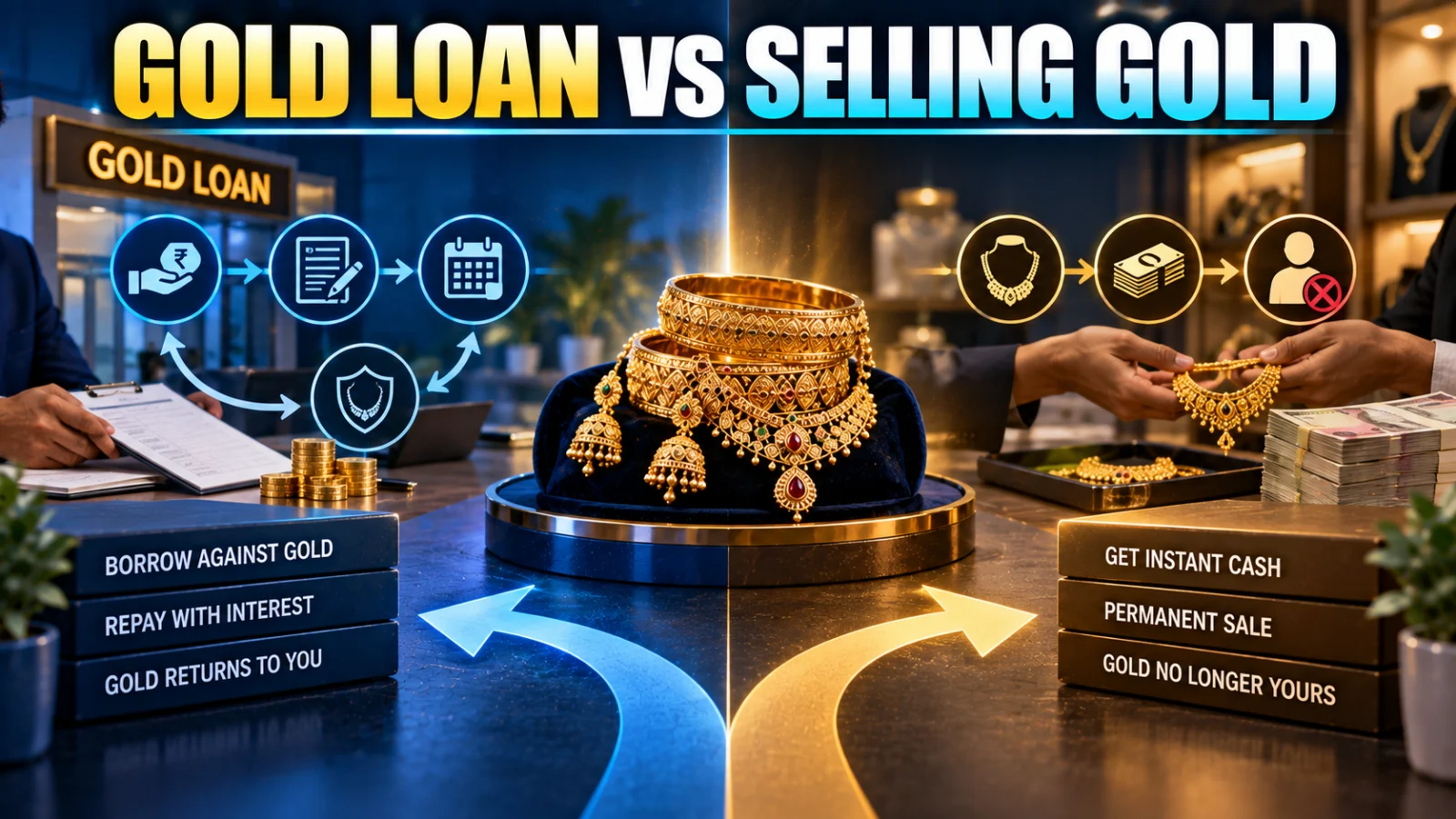
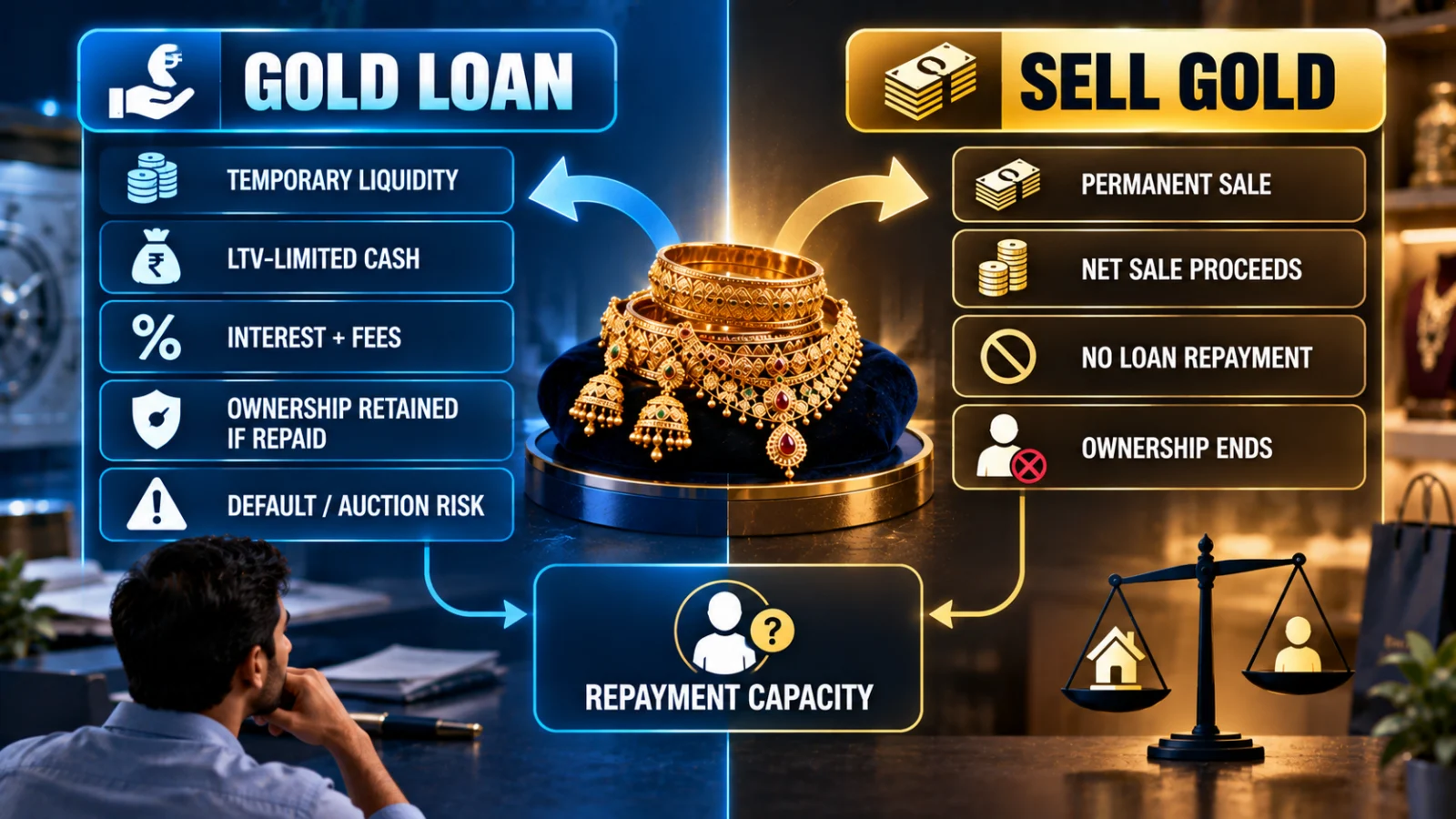
There is no universal winner in a gold loan vs selling gold decision. A gold loan can make sense when your cash need is temporary, you want the gold back and you have a credible way to repay the principal, interest and charges. Selling can make more sense when the need is permanent, repayment is uncertain or taking on debt would create a meaningful risk that the pledged gold could eventually be auctioned.
The biggest mistake is comparing only the loan interest rate with today’s gold price. The two options leave you in different end states: after a successfully repaid gold loan, you have paid financing costs and recovered the pledged gold; after a sale, you have no loan to repay but you no longer own that gold.
| Decision factor | Gold loan | Sell gold |
|---|---|---|
| Purpose | Temporary liquidity against pledged gold | Permanent conversion of gold into cash |
| Ownership outcome | You can recover the pledged gold after satisfying the loan obligations | Ownership is transferred permanently |
| Cash available | Limited by lender valuation, regulatory LTV ceiling and lender policy | Depends on the buyer’s net cash quote for the gold being sold |
| Ongoing cost | Interest plus applicable disclosed fees and possible overdue charges | No loan repayment, but the sale may create tax consequences and the buyer’s payout may be below a headline retail gold rate |
| Main financial risk | Repayment failure can lead to recovery action and eventual auction of pledged collateral under applicable rules and lender policy | You permanently give up the asset and any future gain or use of that particular gold |
| Best starting question | Can I repay this comfortably by the required date? | Am I genuinely willing to give up this gold permanently? |
RBI’s current gold-loan framework matters in 2026
Older articles often repeat a blanket 75% loan-to-value rule. That is no longer a safe assumption for every current consumption gold loan.
The Reserve Bank of India issued the Reserve Bank of India (Lending Against Gold and Silver Collateral) Directions, 2025 on June 6, 2025. Government information subsequently confirmed that the harmonised framework applies across regulated lenders from April 1, 2026.
For consumption loans against eligible gold or silver collateral, the current maximum permissible LTV is tiered:
- Up to ₹2.5 lakh: maximum 85% LTV.
- Above ₹2.5 lakh and up to ₹5 lakh: maximum 80% LTV.
- Above ₹5 lakh: maximum 75% LTV.
These percentages are regulatory ceilings, not promises that every lender will advance exactly that amount. Actual disbursal depends on the eligible collateral value, the lender’s product and credit process, and other applicable conditions.
The Government also told Parliament that detailed credit assessment, including assessment of repayment capacity, is required when the total loan amount against eligible collateral is above ₹2.5 lakh.
Why the quoted jewellery value is not automatically your loan amount
A lender does not simply multiply the jewellery shop’s retail price by the weight on your home scale.
Under the RBI framework, valuation is based on eligible gold content and purity using the prescribed reference-price methodology. Stones, gems and other non-gold components do not become gold collateral value merely because they were part of the original jewellery purchase price.
The practical sequence is therefore:
- The eligible pledged gold is assessed for purity and net gold content.
- A regulatory reference value is applied.
- The relevant maximum LTV ceiling is applied to the eligible collateral value.
- The lender then applies its own permitted product and credit terms.
This is why a ₹3 lakh jewellery purchase invoice does not establish that you can borrow ₹3 lakh against it.
The right loan-side number is total repayment, not the advertised interest rate
For the loan option, start with the amount that will actually reach you and the amount you must actually pay to close the loan and recover the gold.
A useful calculation is:
Loan financing cost = total amount paid to close the loan − net cash actually received.
The inputs can include interest, processing or appraisal charges, other disclosed charges and any overdue or penal charges that become applicable. Current lender terms also show why one generic gold-loan rate cannot be used for every borrower: the rate and charges can depend on the scheme and sanction terms.
Do not use a promotional starting rate alone. Read the current Key Facts Statement, sanction letter and repayment schedule for the exact loan being offered.
The sale-side number is net cash received, not the retail gold rate
For selling, compare the actual written cash quote for the specific jewellery or gold being sold.
A buyer may value the recoverable gold according to weight, purity and its own disclosed purchase terms. Stones and other non-gold components may not contribute to the gold payout. The making charges you paid when purchasing jewellery also do not automatically come back to you when you sell it.
TPS already has a separate guide to how to sell gold in India. For this decision, the important figure is simply the net amount you would actually receive today.
Selling can also create a tax consequence
Selling physical gold is a transfer of an asset, so a taxable capital gain can arise when the sale proceeds exceed the applicable tax cost after applying the current rules.
Current Income Tax Department guidance treats gold held for more than 24 months as a long-term capital asset. The general long-term capital-gains rate is currently 12.5% without indexation, while short-term gains are taxed at the applicable rates for the taxpayer.
That does not mean 12.5% of your entire sale proceeds is automatically tax. Capital-gains computation depends on the gain, acquisition cost and transaction facts. Gifts, inheritance and other acquisition histories can require additional tax analysis. Verify the current tax treatment for your facts rather than using a generic percentage as a sale deduction.
Pledging gold for a loan is not the same as selling it, so receiving the loan itself does not represent a sale of the pledged gold.
What happens if you cannot repay the gold loan?
This is the most important risk to test before choosing the loan route.
A gold loan preserves the possibility of keeping the asset only if the borrower can satisfy the loan obligations. If the debt remains unpaid, the lender can ultimately enforce against the pledged collateral in accordance with the RBI framework, the loan contract and its approved auction procedure.
The current regulatory framework contains borrower-protection requirements around lender auction policies, notices and auction processes. It also sets a reserve-price framework rather than allowing an arbitrary auction price. But those protections do not eliminate the basic consequence: persistent default can result in the pledged gold being sold to recover dues.
If the jewellery has strong family or sentimental value, that default risk deserves more weight than a small difference in headline interest rate.
Do not compare the loan amount directly with the sale proceeds
A sale can produce more cash upfront than a loan because a regulated gold loan is subject to an LTV ceiling below 100% of eligible collateral value. But that does not automatically mean selling is economically better.
The sale and loan create different balance sheets:
- Loan: you receive less than the full eligible collateral value, take on a repayment obligation and can regain the gold after satisfying the loan.
- Sale: you receive the buyer’s net sale proceeds, take on no loan repayment obligation and permanently give up the gold.
Therefore the cleanest comparison starts with the same question: How much cash do you actually need?
A practical five-number comparison
Before choosing, collect these five numbers rather than relying on general internet rates:
- Cash needed: the minimum amount required for your actual purpose.
- Net gold-loan disbursal: cash that will actually reach you after any permitted upfront deductions.
- Total loan closure amount: principal, interest and applicable charges if repaid on your realistic date.
- Net gold sale quote: actual cash a buyer will pay for the specific gold today.
- Estimated tax effect: only after checking acquisition cost, holding period and current tax rules.
If the gold loan does not cover your cash need, a low interest rate does not solve the liquidity problem. If it covers the need but the repayment source is uncertain, the risk of losing the pledged asset may outweigh the benefit of keeping ownership temporarily.
Gold loan or selling gold: a decision path
If the need is temporary and you can identify a credible repayment source: compare the exact lender’s total repayment cost with the value you place on retaining the gold. A gold loan may fit.
If repayment depends on uncertain future income: treat default and auction risk as a central cost, not a footnote. Do not assume that future gold-price appreciation will rescue an unaffordable loan.
If you need permanent funding and do not need to retain the asset: obtain more than one net sale quote and compare the tax effect. Selling may avoid taking on a new debt obligation.
If the gold has irreplaceable sentimental value: selling is irreversible, but an unaffordable loan can also put the same gold at risk. Repayment capacity should decide whether borrowing is genuinely protective.
If the cash need is close to the full value of the gold: check whether the LTV-limited loan can meet the requirement before comparing interest rates. Selling may provide a higher immediate cash amount, although the actual buyer quote still controls.
Example without guessing an interest rate
Suppose you need ₹2 lakh. Do not start by assuming a 10%, 15% or 20% gold-loan rate from an online article.
Instead, ask the lender for the exact net disbursal and the amount you would need to pay if you close the loan on your expected repayment date. Then obtain an actual sale quote for the same gold.
If the lender would disburse ₹2 lakh and your documented total closure amount on your realistic repayment date is ₹2.18 lakh, your financing cost for preserving the gold would be ₹18,000 in that quote. If a buyer would pay ₹2.55 lakh for the same gold, the sale gives more cash immediately but leaves you with no gold. Those figures would describe that specific pair of offers only; they are not market assumptions for other borrowers.
The decision is then clearer: is paying the documented financing cost worthwhile to preserve ownership, and can you reliably make the repayment? That is a more useful question than asking whether a gold loan is universally cheaper than selling.
When a gold loan is more defensible
- Your cash need is temporary.
- The loan amount actually covers that need.
- You have a credible repayment source within the agreed tenure.
- You materially value retaining the particular gold.
- The documented all-in financing cost is acceptable to you.
- You understand the default, renewal and auction terms before pledging.
When selling may be more defensible
- Your cash requirement is permanent rather than temporary.
- You do not have a reliable repayment source.
- You do not want another debt obligation.
- You are willing to permanently give up that gold.
- The net sale proceeds meet your need after considering any applicable tax consequence.
- The LTV-limited loan would not provide enough cash anyway.
Questions to ask the lender before pledging gold
- What purity and net gold weight did you assess?
- What collateral value did you calculate?
- Which LTV ceiling and lender margin apply to my loan?
- What amount will actually be disbursed to me?
- What interest rate and calculation method apply?
- What processing, appraisal or other charges apply?
- What will I owe on my realistic repayment date?
- What happens if I am late?
- When can the pledged gold be auctioned and what notices apply?
- How and when will my collateral be returned after full repayment?
Questions to ask before selling gold
- What purity and net gold weight are you using?
- What reference rate or buying rate is being applied?
- Which deductions are being made?
- What is the final cash or bank-transfer amount I will receive?
- Are stones or non-gold components being excluded?
- Do I have the purchase, gift or inheritance records needed to determine my tax position?
- Have I compared the final quote with another credible buyer?
Gold loan vs selling gold: the direct answer
A gold loan is not automatically cheaper, and selling is not automatically more expensive.
A gold loan buys you something that a sale does not: the possibility of retaining the asset. The price of that option is the financing cost and the obligation to repay. Selling removes the debt and auction risk but permanently transfers ownership and may create a capital-gains tax consequence.
The deciding variable is often not the gold price. It is repayment capacity. If repayment is comfortably supported by predictable cash flow, temporary borrowing can preserve an asset you still want. If repayment is doubtful, treating a secured loan as a harmless way to “keep the gold” can be misleading because the collateral itself is ultimately at risk.
Verification note
TPS reviewed the RBI’s 2025 gold-and-silver collateral framework, current Government confirmation of its April 2026 implementation, current Income Tax Department capital-gains guidance and a current lender’s published gold-loan terms. The current search results also show substantial existing 2026 coverage of the generic gold-loan-versus-sale question, so this guide focuses on the current regulatory framework and a decision method rather than another generic pros-and-cons list.