







The $103,265 H-1B fee is not currently in force. The U.S. Department of Homeland Security has proposed a new additional fee for H-1B cap-subject petitions, but the proposal still has to complete the federal rulemaking process before it could become a filing requirement.
Direct answer: employers do not currently owe the proposed $103,265 H-1B fee. If DHS finalizes the rule substantially as proposed, the additional fee would apply to H-1B cap-subject petitions, including petitions eligible for the 20,000 U.S. advanced-degree allocation. It would not apply to every H-1B petition.
The key question is therefore not simply whether a petition is an H-1B petition. The relevant question is whether the filing is cap-subject under the H-1B numerical-limit rules or falls into a cap-exempt or previously counted category.
What exactly has DHS proposed?
DHS published a proposed rule that would establish an additional $103,265 filing fee for H-1B cap-subject petitions.
As proposed, the fee would:
- apply to H-1B petitions subject to the annual numerical cap
- also apply to cap-subject petitions eligible for the 20,000 U.S. advanced-degree allocation
- be paid when the H-1B petition is filed
- be additional to other filing fees or payments that otherwise apply
- not apply to every H-1B petition
The proposal is a Notice of Proposed Rulemaking. It is not a final regulation and it does not currently create a $103,265 payment obligation.
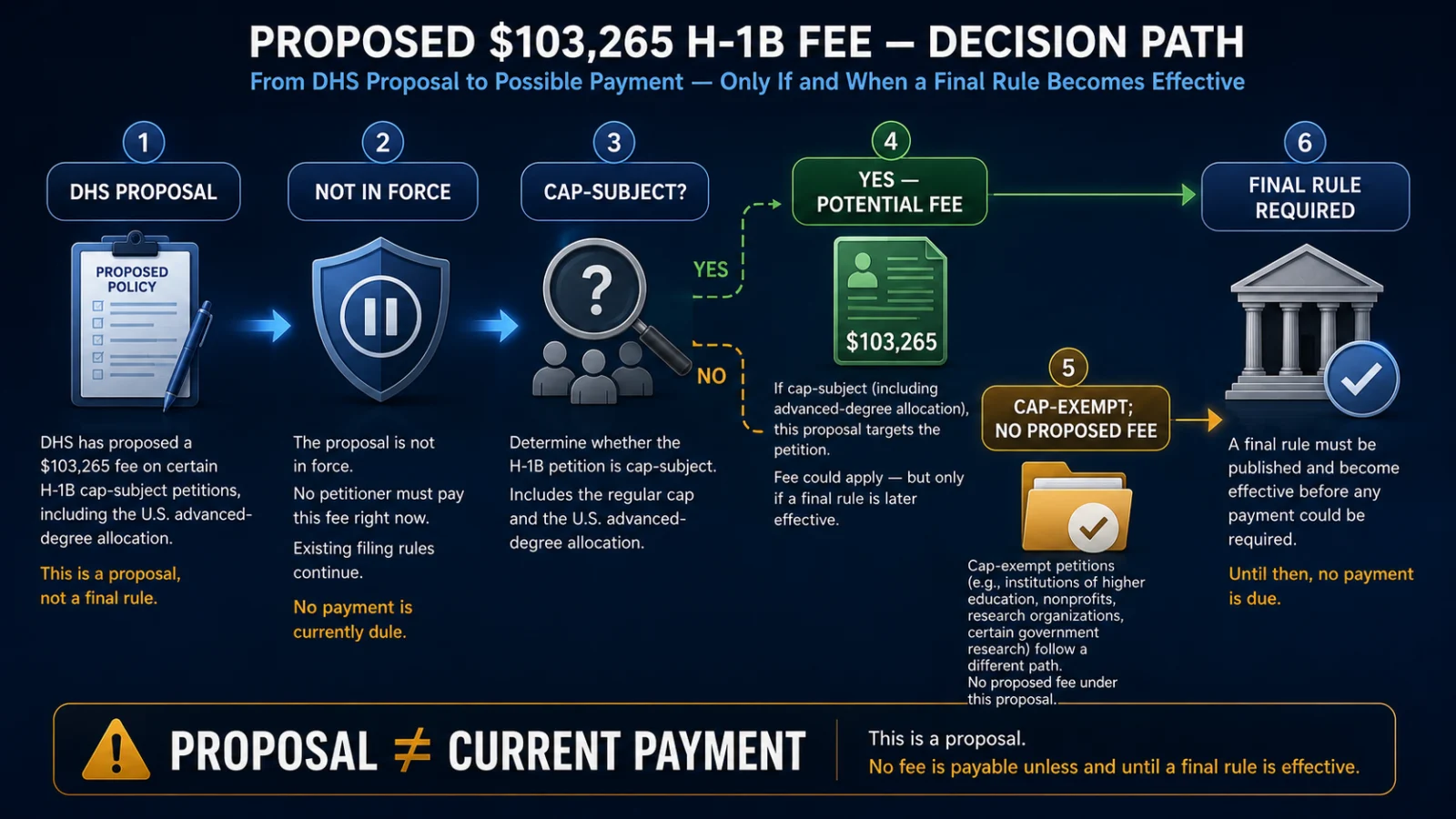
Is the $103,265 H-1B fee already effective?
No. DHS has proposed the fee, but no final rule or effective date currently makes the $103,265 amount payable under this rulemaking.
That distinction matters because a proposed federal rule can change before it becomes final. DHS may retain the proposal, revise the amount or scope, delay implementation or decide not to finalize the rule in its current form.
If you are filing today
Do not add $103,265 to a USCIS filing simply because you saw the proposal headline. Follow the current USCIS fee requirements in force for the petition being filed.
If you are planning a future cap filing
Treat the $103,265 figure as a potential future cost exposure, not as a finalized budget requirement.
If you already hold H-1B status
Determine whether the next filing is actually cap-subject before assuming the proposal would apply.
Which H-1B petitions would the proposal cover?
The proposed fee is tied specifically to cap-subject H-1B petitions.
The H-1B program has a regular annual numerical cap and a separate allocation for certain beneficiaries with qualifying U.S. advanced degrees. DHS expressly includes cap-subject petitions in both groups within the proposed fee.
This means a candidate selected under the U.S. advanced-degree allocation should not interpret the word “exemption” in that allocation as meaning the petition is exempt from the proposed fee.
Does the U.S. master’s-cap allocation avoid the proposed fee?
No. The proposal specifically includes cap-subject petitions eligible for the 20,000 U.S. advanced-degree allocation.
The advanced-degree allocation is a separate numerical allocation within the H-1B cap system. It is not the same thing as working for an employer whose H-1B petitions qualify as cap-exempt.
What H-1B petitions can be cap-exempt?
DHS’s rulemaking discussion identifies established cap exemptions under current H-1B law. Depending on the facts, cap-exempt filings can include petitions involving qualifying employment with:
- institutions of higher education
- certain nonprofit entities related to or affiliated with institutions of higher education
- nonprofit research organizations
- governmental research organizations
Some petitions for workers who have already been counted against the H-1B cap can also be outside the annual cap, depending on the worker’s status and filing circumstances.
Because the exemptions are legally specific, an employer should not classify a petition as cap-exempt merely because it is a university contractor, nonprofit organization or research-related business. The actual statutory and regulatory requirements still control.
Would every H-1B transfer have to pay $103,265?
No blanket rule supports that conclusion.
Many H-1B change-of-employer petitions involve beneficiaries who were already counted against the cap and can therefore be filed without using a new annual cap number. If such a petition is not cap-subject, the proposed $103,265 cap-subject fee would not apply as written.
However, a worker’s cap history and the specific petition circumstances matter. “H-1B transfer” by itself is not enough information to determine fee exposure.
Would every H-1B extension have to pay the proposed fee?
No. The proposal is not written as a universal extension fee.
Extensions for beneficiaries who remain exempt from a new cap count can fall outside the cap-subject category. The employer still has to determine the filing’s actual cap status rather than assume that every Form I-129 H-1B filing is covered.
Who would pay the proposed fee?
The proposed fee attaches to the H-1B petition at filing. In the H-1B process, the petitioner is normally the sponsoring U.S. employer.
That means the proposal is best understood as a potential employer-side petition filing cost, not as a new personal invoice automatically owed by every H-1B worker or beneficiary.
The proposal does not support telling an individual worker that they personally owe $103,265 to USCIS today.
Why did DHS choose $103,265?
DHS says it is seeking to recover approximately $8.777 billion in immigration-system costs through the proposed cap-subject H-1B fee.
Its calculation uses an estimated 85,000 annual cap-subject H-1B petition receipts. Dividing the projected amount by those estimated receipts produces approximately $103,264.57 per petition, which DHS rounded to $103,265.
That calculation also shows why the proposal should not be described as applying to every H-1B petition. DHS’s own estimate is based on the cap-subject filing population.
Is this the same as the earlier $100,000 H-1B payment?
No. The proposed $103,265 filing fee and the separate $100,000 payment associated with Presidential Proclamation 10973 arise from different legal mechanisms.
DHS says the new proposed fee is based on separate statutory authority and would be additional to other fees or payments that are applicable when the petition is filed.
The earlier proclamation-related implementation was vacated by a federal district court in June 2026, and the government’s appeal was still pending when DHS published this new proposed rule.
Readers should therefore not treat the new proposal as simply a renamed version of the earlier $100,000 mechanism.
When could the $103,265 fee actually become payable?
Only after the rulemaking process produces an effective final rule requiring the payment.
The current sequence is:
- DHS publishes the proposed rule
- the public comment period remains open
- DHS reviews submitted comments
- DHS decides whether to revise, finalize or abandon the proposal
- a final rule, if issued, establishes the controlling effective date and final requirements
No current effective date for the proposed $103,265 fee has been established.
When does the public comment period close?
Comments on the proposal are due by September 24, 2026.
DHS identifies the rulemaking as DHS Docket No. USCIS-2026-0298. Employers, organizations and affected individuals who want to participate in the rulemaking can use the official federal comment process.
An official submission can be made through Regulations.gov by locating the docket and following its submission instructions.
Will the final fee definitely remain $103,265?
No. The $103,265 figure is proposed, not guaranteed.
DHS can receive comments addressing the methodology, cost assumptions, legal authority, economic effects and proposed scope. The final rule, if one is issued, could therefore differ from the current proposal.
Employers making long-range sponsorship budgets can reasonably model the proposal as a risk scenario, but they should not treat the amount as a finalized USCIS fee until the rulemaking state changes.
What should employers do now?
- Do not pay or add a $103,265 fee to a current USCIS filing unless a later effective rule actually requires it
- Identify whether future H-1B filings are cap-subject or cap-exempt
- Separate the U.S. advanced-degree cap allocation from true cap-exempt petition categories
- Review the cap history of existing H-1B workers before assuming a transfer or extension is covered
- Model the proposed fee as a possible future sponsorship cost rather than a current liability
- Monitor DHS and USCIS for a final rule, scope change or implementation guidance
- Use the official comment process before September 24 if the organization intends to participate in the rulemaking
What should H-1B workers and prospective beneficiaries do now?
Workers do not need to treat the proposal as a personal $103,265 payment obligation.
If you are preparing for a future H-1B filing, the relevant questions are:
- Is the petition subject to the annual H-1B cap?
- Are you being filed under the regular cap or U.S. advanced-degree allocation?
- Are you already counted against the H-1B cap?
- Is the employer itself eligible to file cap-exempt petitions?
- Has DHS actually issued a final rule by the time the petition is filed?
Those questions determine whether the proposal is relevant to a particular future petition.
What remains unresolved?
- whether DHS will finalize the proposed rule
- whether the final amount will remain $103,265
- whether the final scope or exemptions will change
- when any final rule would become effective
- whether a final rule would face new litigation
- how USCIS would operationalize collection of the fee
- how strongly employers would change sponsorship or hiring decisions
- the eventual India-specific impact on workers and technology hiring
How this was verified
ThePulseSignal reviewed the DHS and USCIS proposed-rule material, the Federal Register publication and the current rulemaking status. The official proposal establishes the $103,265 amount, cap-subject scope, advanced-degree inclusion, additional-fee structure and September 24 public-comment deadline.
The proposal does not establish a current payment obligation or an effective date, so this article does not describe the fee as already active.
Last verified: August 27, 2026.
Frequently asked questions
Is the $103,265 H-1B fee active now?
No. It is part of a DHS proposed rule and is not currently payable under this rulemaking.
Would the proposed fee apply to every H-1B petition?
No. The proposal targets H-1B cap-subject petitions rather than every H-1B filing.
Would U.S. master’s-cap petitions be covered?
Yes. The proposal includes cap-subject petitions eligible for the 20,000 U.S. advanced-degree allocation.
Would universities always pay the proposed fee?
No. Qualifying higher-education and certain affiliated or research employers can file cap-exempt H-1B petitions. The precise exemption requirements still have to be satisfied.
Would an H-1B transfer automatically cost $103,265?
No. Many change-of-employer petitions for beneficiaries already counted against the cap are not new cap-subject filings. The worker’s actual cap status must be checked.
Would an H-1B extension automatically cost $103,265?
No. The proposal is tied to cap-subject petitions, not to every H-1B extension.
Who would pay the fee if it becomes final?
The proposed fee attaches to the H-1B petition filing, so the petitioner, normally the sponsoring employer, would be responsible for the filing payment.
When could the fee become effective?
Only after DHS completes rulemaking and an effective final rule requires the payment. No effective date is currently established.
When do comments close?
The public comment deadline is September 24, 2026.