






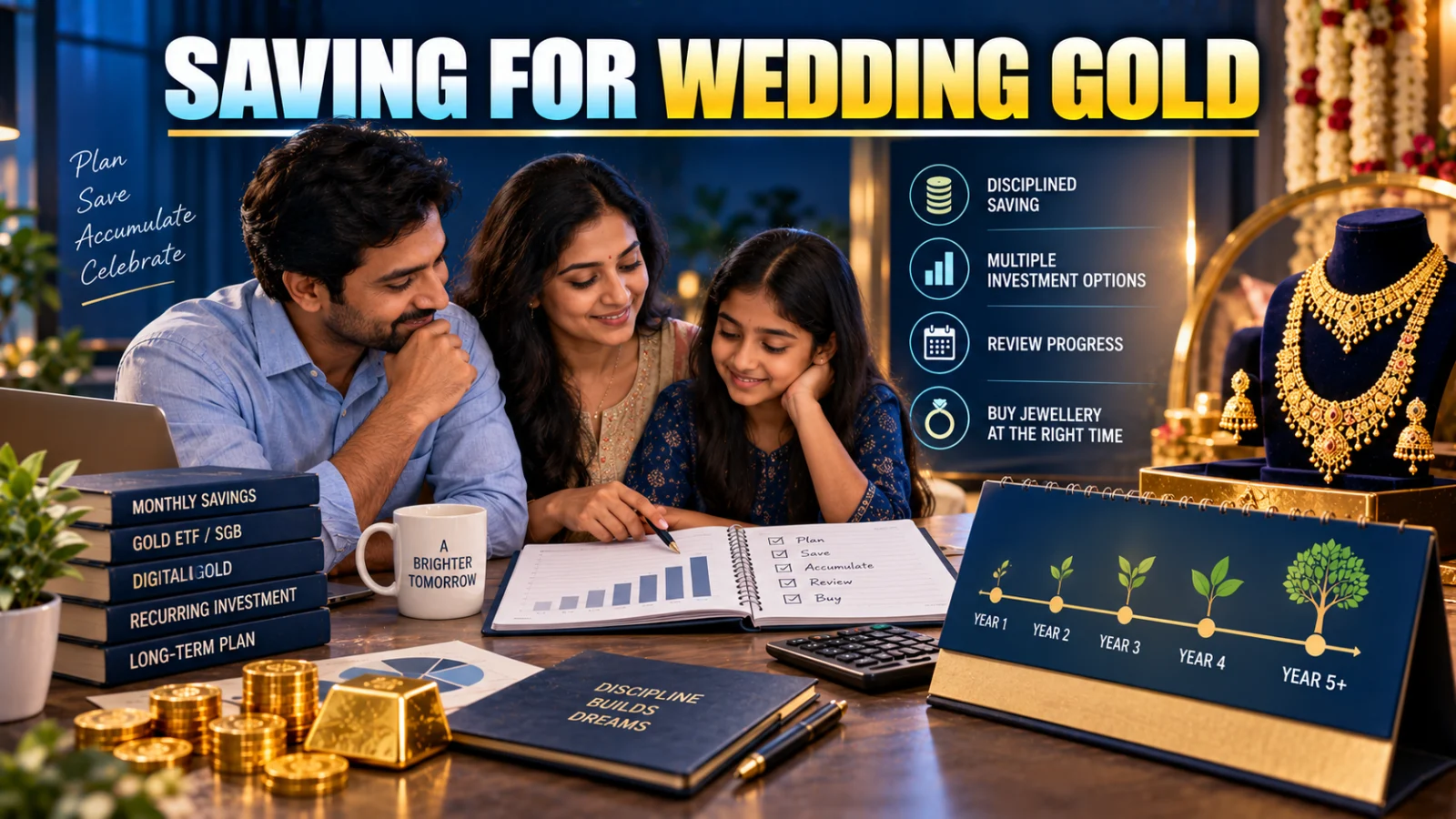
If you are deciding how to save for wedding gold several years before the wedding, the hardest part is that nobody knows what gold will cost on the date you finally need it. Waiting for the perfect buying opportunity can therefore create a different risk: reaching the wedding with most of the gold requirement still unfunded.
A more useful planning question is not, “Will gold be cheaper next year?” It is: How much future gold exposure do I want to build before the wedding, and how much purchase-date risk am I willing to leave until later?
Phased accumulation can spread purchases across several dates. It does not guarantee a cheaper average price than buying earlier in one lump sum. If gold keeps rising, buying earlier may work better. If prices fall, later phased purchases can acquire more gold for the same rupees. The objective is therefore risk management, not market prediction.
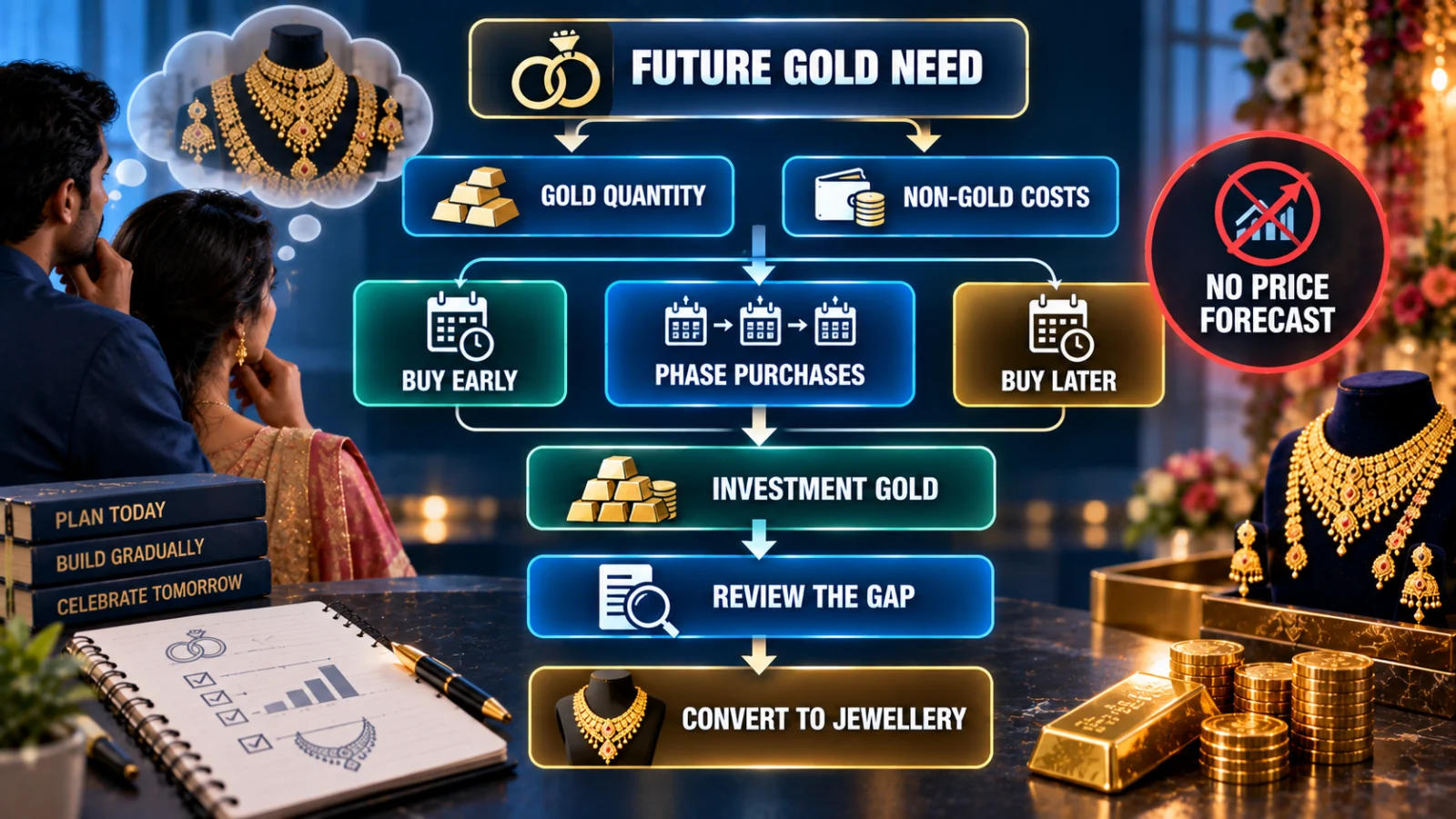
Wedding gold planning in one decision path
1. Define the future gold need
Estimate the part of the wedding requirement that is genuinely gold rather than treating the entire wedding budget as one rupee target.
2. Separate metal value from jewellery costs
Making charges, design, taxes and other retail costs are different from the underlying gold value and need their own funding buffer.
3. Decide how much timing risk to keep
You can buy early, phase purchases or leave more of the requirement for later. None of these paths is guaranteed to produce the lowest price.
4. Choose an accumulation vehicle
Depending on your constraints, that may be regulated investment gold, physical investment gold or actual jewellery purchased in advance.
5. Track progress in gold exposure as well as rupees
If the future liability is partly gold-denominated, a rupee-only target can hide how much of the actual gold requirement remains unfunded.
6. Re-estimate as the wedding gets closer
Update the expected quantity, purity and jewellery requirement, then plan the final conversion or purchase without assuming earlier estimates are still correct.
Why wedding gold is different from a normal rupee savings goal
Suppose a family expects to need jewellery several years from now. Part of that future bill is linked to the prevailing gold price, while another part comes from making, design, taxes and retailer-specific charges.
If the family saves only a fixed rupee amount while gold prices rise substantially, the same rupee corpus may later buy fewer grams. If gold prices fall, the opposite can happen.
That is why a wedding-gold plan can benefit from tracking two things separately:
- the expected gold quantity or gold-price exposure, and
- the separate rupee costs that are not represented by the metal itself.
This does not mean every wedding requires a fixed number of grams. The amount is personal, cultural and budget-specific. TPS does not recommend a universal wedding-gold quantity.
Wedding demand remains important, but buyers are adapting
World Gold Council research for India in 2026 found that wedding-related buying remained an important driver of jewellery demand even while high prices changed consumer behaviour. Buyers were becoming more value-conscious, including through lighter jewellery, lower-carat choices, smaller purchases, exchange offers and greater price comparison.
That matters for planning because the future wedding requirement itself may change. A family that assumes today that it will need a particular quantity, purity or design may make different choices several years later.
The goal should therefore be reviewed periodically rather than treated as a fixed promise made on day one.
Option 1: Buy most of the gold earlier
Buying the required gold exposure early removes much of the risk that a future price rise makes the metal more expensive in rupee terms.
But it introduces the opposite risk: if gold prices fall later, the family committed most of its money at the earlier, higher price.
Buying early also requires the money to be available immediately. If the family buys finished jewellery years in advance, it additionally commits to today’s design, purity, storage arrangements and retail making costs.
Early lump-sum buying is therefore not automatically right or wrong. It is simply one end of the timing-risk spectrum.
Option 2: Accumulate gold exposure gradually
A phased plan spreads purchases over several dates instead of relying on a single entry price.
This is sometimes described as averaging, but the important limitation is that averaging does not guarantee a better outcome.
| Possible gold-price path | Earlier lump sum | Phased accumulation |
|---|---|---|
| Gold keeps rising | Earlier purchase may secure more gold for the same rupees | Later instalments buy progressively less gold |
| Gold falls | The full earlier purchase bears the decline | Later instalments can buy more gold at lower prices |
| Gold moves up and down | Outcome depends heavily on the initial date | Entry prices are spread across several dates |
The defensible benefit of phasing is therefore diversification of purchase dates. It is not a promise of lower prices or superior returns.
Option 3: Wait and buy near the wedding
Waiting keeps the money available for other purposes and avoids buying gold before the final requirement is clear.
But if the wedding date becomes fixed while most of the gold remains unfunded, the family becomes increasingly dependent on whatever price is available near that date.
That is the exact timing concentration this planning framework is designed to expose.
A family can consciously choose to keep that exposure, but it should be a decision rather than the accidental result of postponing the problem.
Should you buy jewellery years in advance?
Finished jewellery gives certainty about the actual item you own, but it also brings several costs and constraints forward.
Jewellery value is not simply the market value of the gold inside it. The final invoice can include making or design charges and applicable taxes, while the chosen purity affects how much fine gold the item contains. Jewellery also has to be stored securely.
Buying jewellery early can make sense when the family genuinely wants that specific piece now. But buying finished jewellery years in advance solely to obtain gold-price exposure can be less flexible than holding investment gold and choosing the final jewellery later.
BIS hallmarking and HUID verification should be checked when the final jewellery purchase is made under the rules then in force.
Using a Gold ETF for a future wedding-gold goal
A Gold ETF can give regulated gold-price exposure without requiring the investor to buy and store finished jewellery immediately. ETF units trade on a stock exchange, so the investor needs the relevant trading and demat setup and should account for fund costs and exchange execution.
The practical advantage for a wedding goal is flexibility: the family can build investment exposure first and make the final jewellery decision later.
But a Gold ETF unit is not a piece of jewellery waiting to be collected. Near the goal, the investor will normally need to sell or otherwise realise the financial investment and then purchase the required jewellery through the normal retail route.
This means the plan must still reserve for jewellery-specific costs that the ETF does not represent.
Using a Gold Fund of Fund for periodic contributions
A Gold ETF Fund of Fund can provide another regulated route to gold exposure. Depending on the scheme, it can be operationally convenient for recurring mutual-fund contributions without requiring the investor to execute an ETF purchase on the exchange each time.
The trade-off is structure and cost. A fund-of-funds invests through another fund or ETF layer, so investors should verify the current expense structure, tracking behaviour, exit terms and scheme documents rather than assuming convenience is free.
If your broader question is how monthly gold investing works outside a wedding goal, TPS already covers that separately at Gold SIP and monthly investing in India.
What about physical bars and coins?
Coins and bars provide direct physical gold ownership and may feel closer to the eventual wedding requirement than a financial product.
However, they introduce storage and security considerations, purchase and resale spreads, purity verification and retailer-specific exchange terms.
A coin or bar should not be assumed to convert automatically into an equal-weight jewellery item without economic friction. A jeweller may apply its own purity testing, exchange, buyback or pricing rules, while the final jewellery also has making and retail costs.
Before using physical investment gold as the bridge to a future jewellery purchase, understand how you expect to monetise or exchange it.
Investment gold and wedding jewellery are not the same liability
This distinction is central to the plan.
If you have accumulated gold exposure worth a certain amount, that does not mean you can necessarily walk into a jeweller and obtain jewellery containing the same economic value without additional cost.
The final bill can depend on:
- the purity and weight of the chosen jewellery,
- making or design charges,
- applicable taxes,
- the retailer’s exchange or buyback terms,
- any difference between the form of gold you accumulated and the form the retailer accepts.
That is why the safest planning structure separates the metal-price component from the jewellery-conversion component.
Should you track the goal in grams or rupees?
For a genuinely gold-linked future obligation, tracking only rupees can hide useful information.
Suppose your investment corpus rises in rupee terms but gold rises even faster. You may feel that the portfolio has grown while still falling behind the gold quantity you eventually expect to need.
Conversely, if gold falls, the same rupee corpus can cover more grams than before.
A practical dashboard can therefore track:
- estimated future gold quantity or exposure,
- current accumulated gold-equivalent exposure,
- separate cash reserved for making, taxes and other wedding expenses, and
- the remaining unfunded portion.
This is a planning tool, not a forecast. The target should be updated when the family’s actual jewellery expectations change.
How often should the wedding-gold goal be reviewed?
There is no need to react to every daily gold-price move. The point of a long-horizon plan is to avoid turning the goal into continuous market speculation.
A review is useful when something material changes: the expected wedding timeline, required jewellery quantity, family budget, accumulation product, product cost, or the proportion of the goal already funded.
As the wedding approaches and the final jewellery requirement becomes clearer, reviews naturally become more practical: quantity, purity, design, purchase route, retailer terms and cash needed for non-metal costs.
What should happen as the wedding gets closer?
The closer the goal becomes, the less useful it is to think only about an abstract long-term gold allocation.
Re-estimate what is actually likely to be purchased. Compare that with the gold exposure already accumulated. If there is a substantial remaining shortfall, decide consciously whether to fund it gradually or leave it exposed to later prices.
If you hold Gold ETFs or a Gold FoF, check the time and process needed to sell or redeem and move the proceeds before the planned jewellery purchase. If you hold physical gold, check current retailer exchange or buyback terms rather than assuming an old policy still applies.
The objective is to avoid arriving at the final purchase with an unrecognised gap between the investment portfolio and the actual jewellery bill.
What if the wedding plan changes?
A goal may move by several years, the expected gold quantity may fall, or the family may decide to use less jewellery than originally expected.
That does not make the earlier planning useless. It means the target needs to be recalibrated.
One advantage of keeping at least part of the accumulation in an investment form rather than locking every rupee into finished jewellery early is that the plan can remain more adaptable when the final requirement changes.
A practical wedding-gold framework
Define
Estimate the likely gold component of the future wedding requirement and keep non-gold wedding expenses separate.
Choose the timing exposure
Decide whether to buy early, phase purchases or intentionally leave more of the gold requirement for later.
Select the holding structure
Compare regulated financial gold, physical investment gold and actual jewellery based on liquidity, storage, costs and flexibility.
Track the liability
Measure progress against the gold requirement, not only against an arbitrary rupee corpus.
Update the target
Revise quantity and jewellery assumptions when the wedding timeline or family preferences materially change.
Plan the final conversion
Before the wedding purchase, verify how investments will be realised and how much additional cash is required for the final jewellery transaction.
Bottom line
The purpose of learning how to save for wedding gold is not to predict the cheapest gold price three, five or ten years from now.
It is to prevent a known future gold requirement from becoming an uncontrolled last-minute market bet.
Buying early can outperform phased accumulation if gold keeps rising. Phased accumulation can help if later prices are lower and, more importantly, spreads the entry decision across time. Waiting preserves flexibility but leaves more of the eventual gold need exposed to future prices.
The most useful framework is therefore: define the gold need, separate jewellery costs, choose how much timing risk to retain, accumulate through an appropriate structure, track progress against the gold liability and reassess before the final jewellery purchase.