







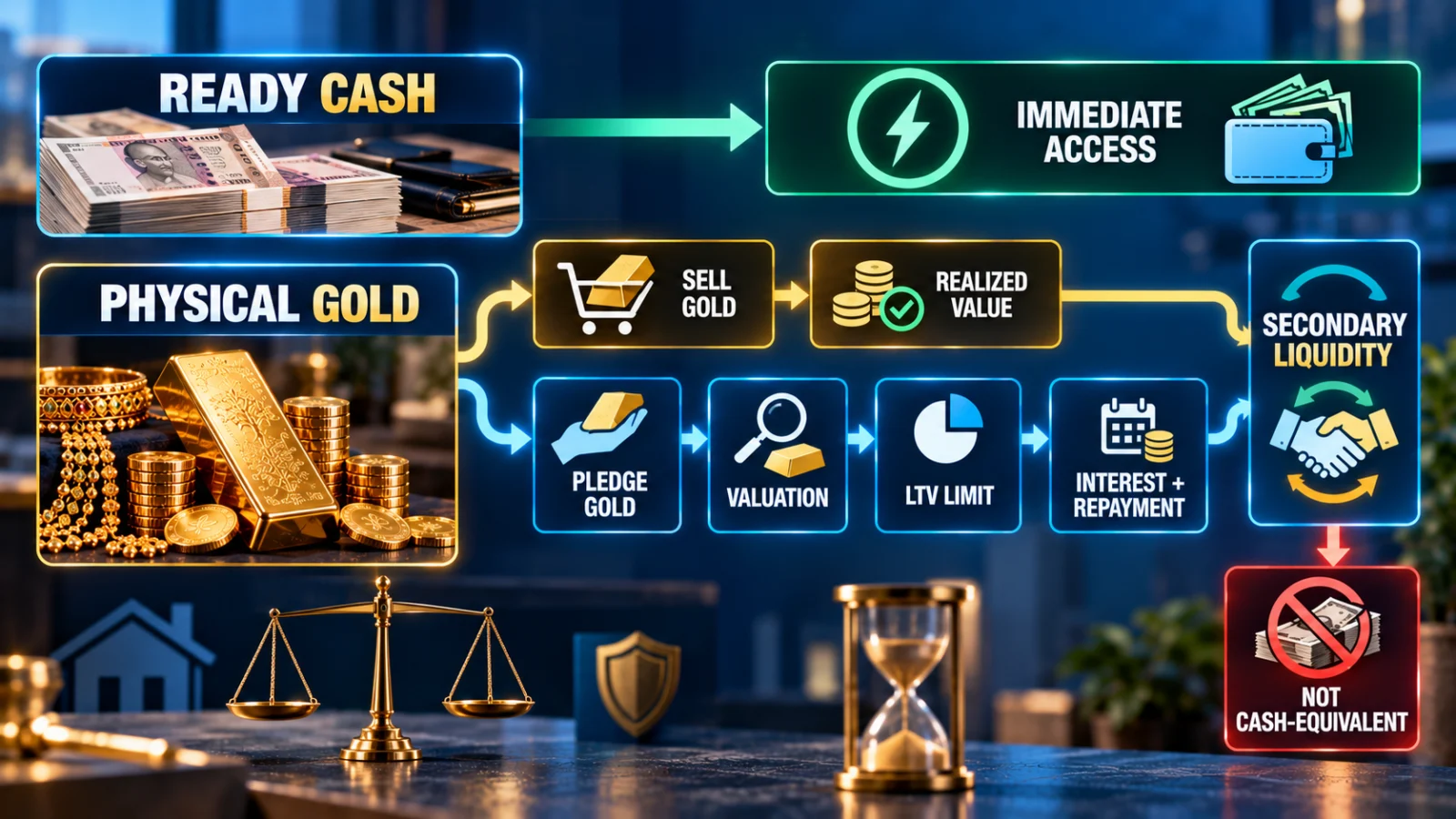
Is gold a good emergency fund? Gold can be highly liquid and still be different from an emergency cash reserve. A household can usually sell gold or pledge eligible gold for a loan, but the gold must first be converted into money. That can involve valuation, a buyer or lender, loan-to-value limits, interest, repayment obligations, sale terms and some execution time.
Cash already available in a bank account does not require that conversion step. That is the key distinction: liquidity means an asset can be turned into money; emergency cash is money already positioned for immediate use.
Where does gold fit in an emergency?
First-line emergency cash: money that is already accessible without selling an asset or creating a new debt.
Secondary liquidity: an asset such as physical gold that can be sold when more cash is needed.
Collateral liquidity: gold that can be pledged to obtain a loan, preserving ownership initially but creating interest and repayment obligations.
Decision test: count the money that can realistically be accessed after valuation, transaction terms and borrowing constraints, not simply the headline market or purchase value of the gold.
Is gold actually liquid?
Yes. World Gold Council research describes gold as a large and highly liquid global asset, with deep trading markets that can remain active even during financial stress.
That is an important strength of gold. Calling gold a poor emergency cash substitute does not mean calling gold illiquid.
The household-level question is different: how quickly, reliably and at what net value can the specific gold you own become spendable rupees when you need them?
Why liquidity is not the same as cash
Suppose a household owns jewellery worth several lakh rupees at current headline gold prices. That wealth may be substantial, but the household cannot normally pay an urgent hospital bill directly with the jewellery.
The owner must first choose a conversion route:
- sell the gold and accept the amount offered by the buyer;
- pledge eligible gold and borrow against its assessed value;
- or use already available cash and preserve the gold.
Each route has different costs and consequences. This is why the market liquidity of gold and the operational usefulness of an emergency cash reserve should not be treated as the same thing.
Indian households are already using gold as emergency liquidity
Current evidence shows that this is not merely theoretical.
In its India-focused Gold Demand Trends report for Q2 2026, the World Gold Council reported that gold sold back into the market as recycling fell to 19 tonnes, down 38% quarter-on-quarter and 17% year-on-year, while borrowing against gold jewellery accelerated.
At the end of May 2026, WGC reported outstanding retail gold loans of approximately ₹5.1 trillion at banks, up 105% year-on-year, and ₹3.3 trillion at NBFCs, up 70% year-on-year.
The pattern supports an important distinction: many households are monetising gold for liquidity without permanently selling it. But that liquidity is being obtained through a credit product, not because the jewellery itself has become cash.
Can gold help in an emergency?
Yes. Physical gold can be a valuable second line of financial defence because it can be converted into cash through sale or used as collateral for borrowing.
For a household that already owns meaningful gold, that optionality can improve resilience. It may reduce the need to sell other assets under pressure or use more expensive unsecured borrowing.
But the phrase backup emergency liquidity is more precise than automatically calling the entire gold holding an emergency fund.
Does ₹5 lakh of jewellery mean ₹5 lakh of emergency cash?
No.
The retail purchase price of jewellery can contain more than recoverable gold value. Making charges, design costs, stones and other components do not automatically convert into the same amount of cash when jewellery is sold or pledged.
For a sale, the realised amount depends on factors such as net gold content, purity and the buyer’s terms. For a gold loan, the lender values eligible collateral and then applies the applicable loan-to-value framework.
So the correct emergency-liquidity number is not the original jewellery invoice or an assumed retail replacement value. It is the net cash that can realistically be accessed through the chosen route.
How does a gold loan create emergency liquidity?
A gold loan allows eligible gold to be pledged as collateral. The lender assesses the collateral, determines the eligible value and applies regulatory and product-level lending limits before sanctioning the loan.
Under the current RBI framework, loan-to-value limits constrain how much can be advanced against the assessed collateral. Those regulatory percentages are ceilings rather than guaranteed sanctions, so an individual borrower may receive less depending on eligibility, valuation and lender terms.
This is another reason gold cannot be counted rupee-for-rupee as cash sitting in a bank account.
Why a gold loan is different from emergency savings
Emergency savings are your own money. Using them does not create a new repayment obligation.
A gold loan is debt. It can preserve ownership of the jewellery during the loan, but the borrower must pay interest and repay according to the agreed terms. If the borrower cannot meet the obligation, the pledged asset can ultimately be exposed to enforcement or auction under the applicable regulated process.
That does not make a gold loan inherently unsuitable in an emergency. It simply means borrowing capacity is not the same thing as cash already owned.
What if you sell the gold instead?
Selling avoids taking on a new debt, but it permanently converts part of the household’s gold holding into cash.
The realised amount can differ from the price a reader sees quoted for gold because jewellery must be assessed by actual recoverable metal value and purity. Making charges and non-gold components do not necessarily come back to the seller.
TPS covers the later decision between borrowing and selling separately in Gold Loan vs Selling Gold: Which Option Actually Costs More?. This page answers the earlier question of whether gold should be treated as the emergency reserve in the first place.
Should you use cash or gold first?
There is no universal answer for every household, but the distinction between the layers is useful.
If adequate cash is already available without penalties or disruption, using owned cash may avoid creating secured debt or forcing a gold sale merely to meet an ordinary short-term expense.
But using every rupee of available cash can also leave a household with no buffer for the next emergency. That is why TPS should not prescribe a universal sequence such as “always use cash first” or “always take a gold loan first.”
The better question is: what amount of ready cash can be used without leaving the household dangerously exposed, and what backup liquidity remains after that?
A practical emergency-liquidity decision path
Step 1 — Ready cash: Can the urgent expense be covered from immediately accessible money without destabilising essential household needs?
Step 2 — Saleable gold: If cash is insufficient, what net amount could the specific gold realistically realise after purity, weight and buyer terms?
Step 3 — Pledge option: If preserving ownership matters, what loan amount is actually available after valuation and LTV limits, and what interest and repayment obligation would follow?
Step 4 — Choose the least damaging route: Compare the true cash available, cost, debt burden, permanence of sale and importance of keeping the gold.
What if the jewellery has sentimental value?
Liquidity on paper can be different from liquidity a household is genuinely willing to use.
A family may own valuable wedding jewellery or inherited pieces but be unwilling to sell them even during financial stress. If so, the market value of that jewellery can overstate how much practical emergency liquidity the household really has.
Pledging can preserve ownership initially, but that solution still depends on successful repayment. Sentimental value therefore belongs in the decision alongside financial value.
What happens if gold prices fall?
Gold can remain liquid even when its price falls, but the amount available from a sale or collateral valuation can change.
If a household is relying heavily on gold as its emergency reserve, a lower gold price at the moment cash is needed can reduce the money available. Borrowing constraints can create another buffer between headline market value and actual loan proceeds.
Ready cash does not carry that same market-price conversion risk for a fixed rupee emergency expense.
Does the form of gold matter?
Yes, operationally.
Jewellery, coins, bars, Gold ETFs and gold funds do not all convert to cash through the same process. Physical jewellery introduces purity, net-weight, resale and collateral-assessment questions. Listed financial gold may have market-sale and settlement mechanics instead.
This article focuses on the household physical-gold question because that is where sale, pledge, sentimental value and emergency access most directly intersect.
What should count as your emergency reserve?
Rather than asking whether gold is simply “good” or “bad” as an emergency fund, classify your resources by how they become spendable:
- Ready cash: already available for the emergency.
- Secondary liquid assets: assets such as gold that can be sold to create more cash.
- Collateral liquidity: assets such as eligible gold that can support borrowing, creating both cash and a repayment obligation.
A household can benefit from all three layers. The mistake is treating them as economically identical.
Bottom line
Gold can be an important emergency asset without being the same thing as emergency cash.
It is liquid, widely monetisable and, in India, increasingly used as collateral for household borrowing. But accessing that value may require selling the asset or pledging it, accepting valuation and LTV constraints, paying interest or giving up ownership of the gold.
For emergency planning, count what is immediately accessible as cash first. Treat gold as a strong secondary source of liquidity whose usable value depends on the actual conversion route.