




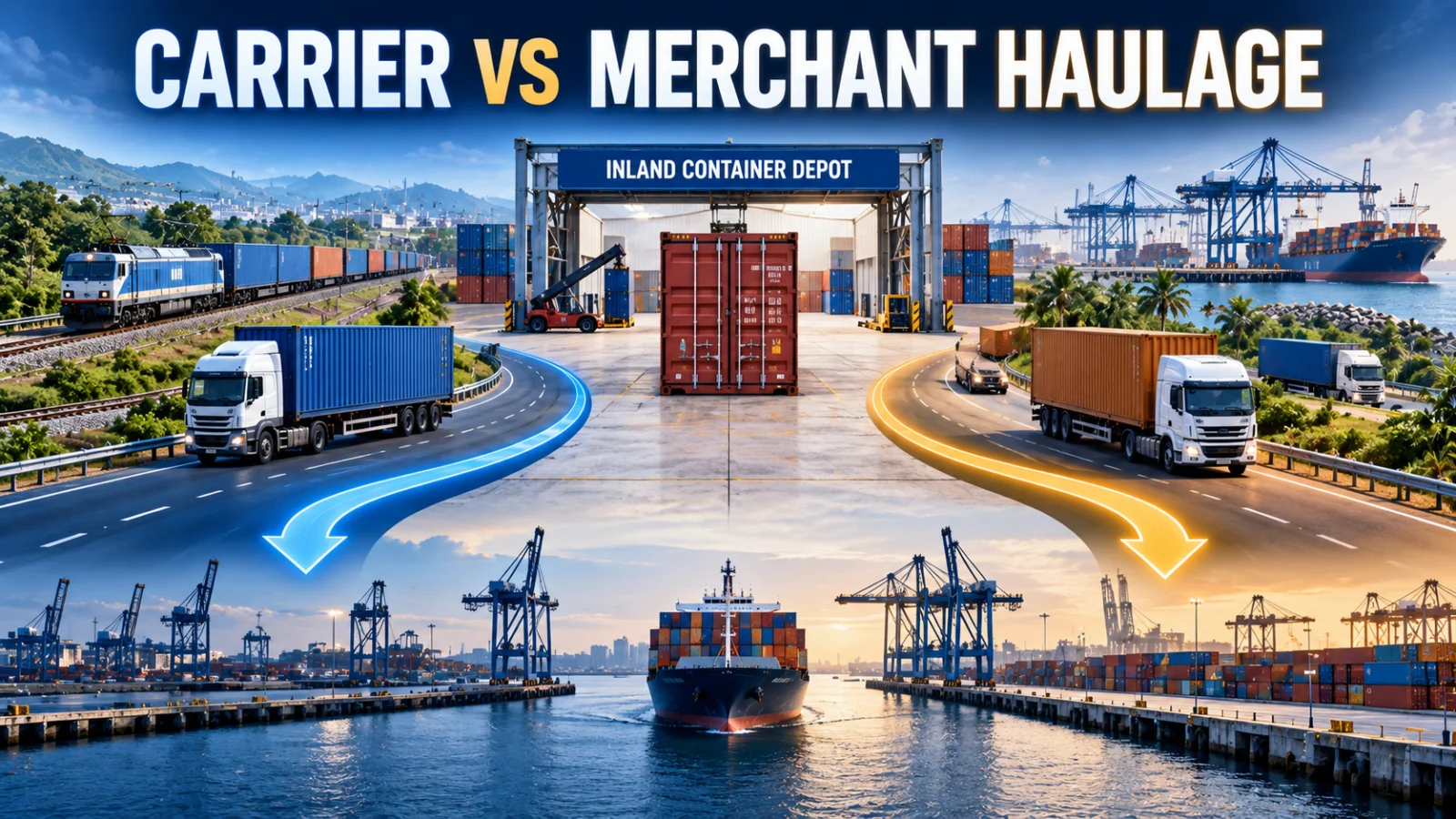
ONE India Export Carrier Haulage becomes effective from 20 September 2026, giving eligible exporters from Indian inland container depots a clearer choice between carrier haulage and merchant haulage. The choice affects who arranges the inland movement, what appears as the Bill of Lading Place of Receipt, which haulage charges apply and where export free-time risk sits.
ONE’s advisory does not make carrier haulage mandatory. Exporters can still choose merchant haulage, but the operating responsibility changes significantly between the two options.
What changes from September 20?
ONE says its Export Carrier Haulage framework for Indian ICD exports becomes effective on 20 September 2026. Where the empty container is picked up and the laden container is handed over at an eligible ICD, and that ICD is shown as the Bill of Lading Place of Receipt, ONE’s applicable carrier-haulage charges apply in addition to other local charges.
Under merchant haulage, the customer continues arranging the inland transport. ONE says the Bill of Lading Place of Receipt is then the Port of Loading, and the shipper remains responsible for getting the laden container to the port within the applicable export free time.
Carrier haulage vs merchant haulage
The shipment uses an eligible ICD, ONE has published the applicable service or tariff, the empty pickup and laden handover happen at the ICD, and you want ONE’s inland-haulage framework to cover the ICD-to-port movement.
You want to arrange the inland movement independently and retain responsibility for getting the laden container to the port within the applicable export free time.
What happens to the Bill of Lading Place of Receipt?
For eligible ONE Carrier Haulage shipments, the ICD is used as the Bill of Lading Place of Receipt. Under merchant haulage, ONE says the Place of Receipt becomes the Port of Loading.
This is more than a documentation detail because it reflects who controls the inland leg and where the carrier’s transport responsibility begins under the selected shipment arrangement.
Who arranges the inland container movement?
Under Carrier Haulage, ONE manages the applicable inland movement under its published service framework. Under Merchant Haulage, the customer arranges the inland transport independently and remains responsible for delivering the laden container to the port.
Which option is cheaper?
There is no evidence-backed universal answer. ONE’s haulage charges vary by ICD, container type, size, weight and service availability, while other local charges may also apply. A shipper comparing the two options must therefore check the current ONE tariff against the actual cost and risk of arranging merchant haulage independently.
TPS does not treat Carrier Haulage as automatically cheaper or more expensive than Merchant Haulage because the answer is shipment-specific.
What should reefer exporters check?
ONE says reefer Carrier Haulage is accepted only from facilities where corresponding carrier-haulage rates have been published. Exporters should not assume that every ICD supporting dry containers also supports reefer Carrier Haulage.
What risk remains under merchant haulage?
A merchant-haulage customer is responsible for arranging the empty pickup and inland movement and handing over the laden container at the port within ONE’s applicable export free time. ONE’s advisory states that delays can expose the shipment to applicable detention or ground-rent charges.
This means the merchant-haulage decision should consider not only the inland transport price but also the operational ability to reach the port within the required handover window.
What should exporters check before choosing?
Confirm that ONE currently offers Carrier Haulage from the shipment’s ICD.
Verify container type, size, weight and reefer eligibility where relevant because the applicable service and tariff can vary.
Confirm whether the shipment should use the ICD or Port of Loading as the Bill of Lading Place of Receipt under the chosen mode.
Decide whether ONE or the shipper will control the inland ICD-to-port movement and compare the corresponding costs and operational risk.
Merchant-haulage users should confirm that the laden container can reach the port within the applicable free-time window.
What about bookings that span September 20?
The reviewed advisory establishes the September 20 effective date but does not fully resolve every possible transition scenario for bookings created before the effective date and handed over afterward. For Merchant Haulage, ONE states that the applicable rate is based on the date the container is handed over at the port, but TPS does not infer a universal transition rule for every Carrier Haulage booking.
For a shipment that crosses the effective-date boundary, exporters should confirm the applicable treatment with ONE using the current booking and tariff guidance.
What happens next?
The next material checkpoint is 20 September 2026, when the new Carrier Haulage framework becomes effective. This same article should be updated if ONE changes participating ICDs, rates, reefer eligibility, Place of Receipt rules, free-time treatment or transition guidance.
Verification note: TPS reviewed ONE India’s direct Export Carrier Haulage advisory, related ONE service material and current specialist shipping coverage. The September 20 effective date, Carrier Haulage conditions, Merchant Haulage option, Place of Receipt distinction and free-time responsibility are supported by ONE. Shipment-specific tariff comparisons and some transition-booking cases remain unresolved.