






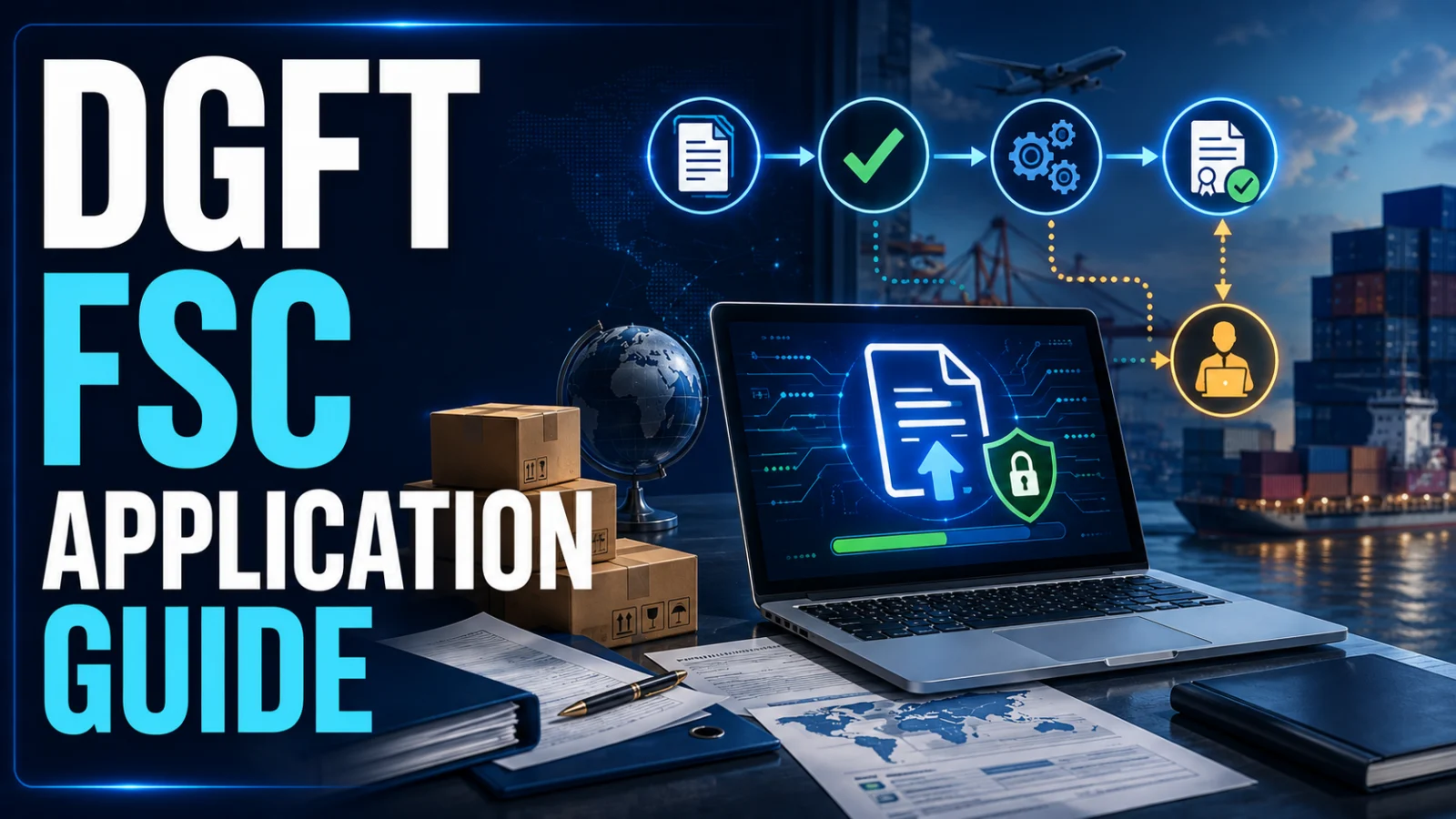
DGFT Free Sale and Commerce Certificate applications now have an automated-processing path, but that does not mean every eligible exporter receives an instant certificate. The exporter must still use the applicable FSC route, satisfy the product and applicant requirements, provide the required information and complete submission. Under DGFT Trade Notice No. 24/2026-2027, applications that satisfy the system’s automated-processing parameters may be issued without routine manual scrutiny, while cases requiring verification or falling outside those parameters can still be sent to the relevant Regional Authority.
The practical distinction is important: eligibility for a Free Sale and Commerce Certificate is not the same thing as guaranteed eligibility for automatic issuance. DGFT has not published the exact automation thresholds or rules reviewed for this article.
Direct answer
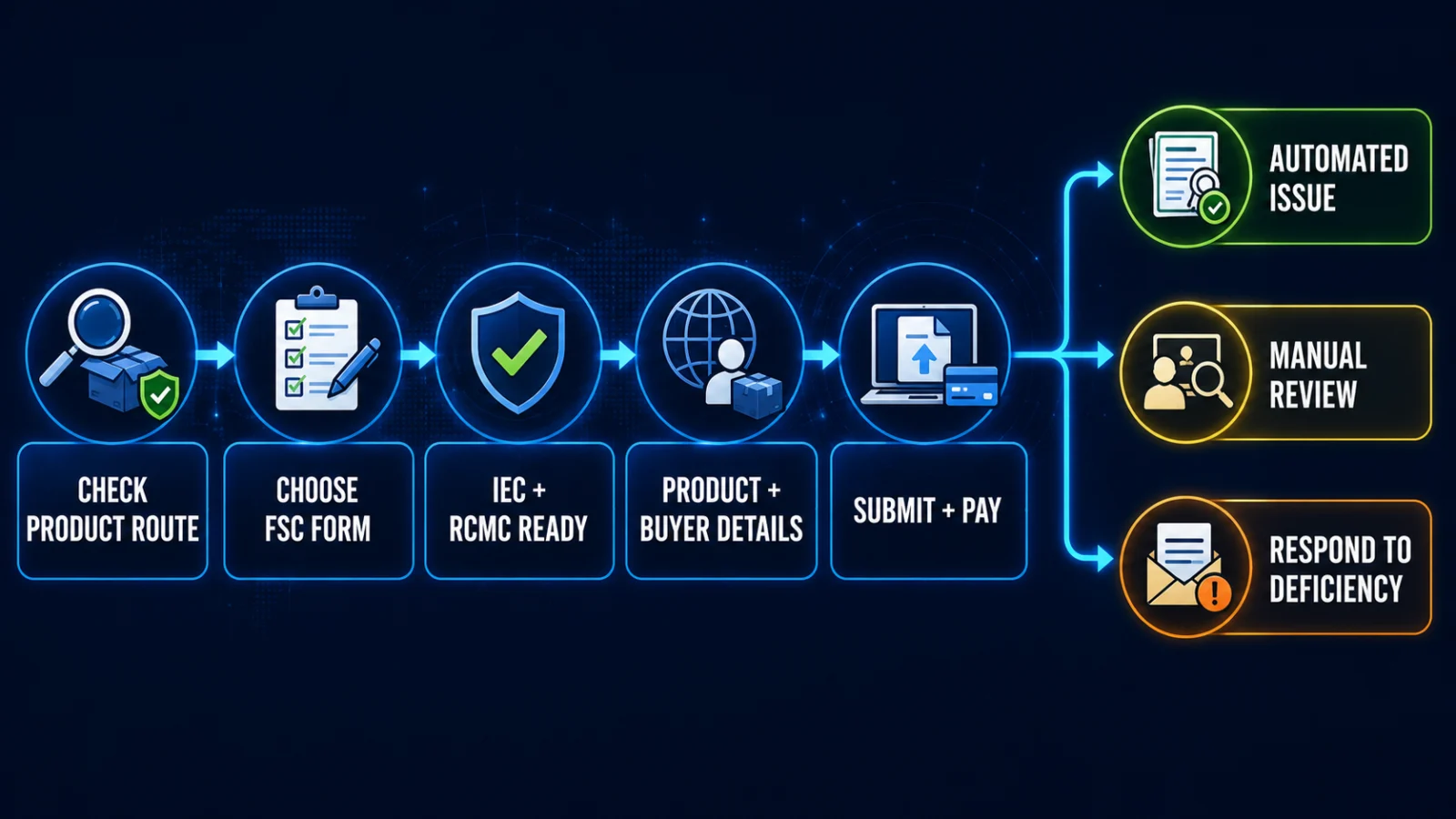
Before applying, confirm that the DGFT FSC route fits the product, choose the applicable form path, make sure the IEC-linked profile and other prerequisites are ready, prepare the product, manufacturer and foreign-buyer information, submit and pay through DGFT’s Certificate Management workflow, and then track whether the file is automatically issued, routed for verification or marked deficient. Do not assume that an otherwise valid application will necessarily bypass Regional Authority review.
What a Free Sale and Commerce Certificate actually proves
A Free Sale and Commerce Certificate is used to support the proposition that the listed product is freely sold or commercially available under the applicable framework. DGFT’s published FAQ also makes an important limitation clear: the certificate itself should not be treated as proof that the product has been independently evaluated for safety or efficacy.
That distinction matters when an overseas buyer or authority asks for an FSC. The certificate serves a specific trade-documentation purpose; it does not replace every product-specific licence, safety approval, regulatory registration or importing-country requirement.
Who can apply
DGFT’s published FSC guidance identifies both manufacturer exporters and merchant exporters as potential applicants. The exporter should first confirm that the product and transaction fit the DGFT FSC route rather than another certificate, licence or regulator-controlled process.
Which products fit the DGFT FSC route?
The published DGFT guidance frames the FSC route around eligible export items that are not restricted or prohibited and distinguishes products that fall outside separate Drugs and Cosmetics regulatory routes. Exporters should therefore check the product classification and applicable regulatory framework before starting the application.
A product being physically manufactured or commercially sold in India does not by itself establish that the DGFT FSC route is the correct certificate path. Restricted goods, prohibited goods, products requiring another statutory certificate and other specially controlled categories need their own controlling rules.
DGFT FSC decision path before you apply
- Confirm why the certificate is required. Identify the overseas buyer, authority or commercial purpose requesting evidence of free sale or commerce.
- Check the product’s regulatory route. Confirm that the product is not being routed through a different controlling certificate, restricted-item authorisation, prohibited-goods framework or Drugs and Cosmetics process.
- Choose the applicable FSC form path. DGFT’s current forms distinguish ANF-2H for the medical-device or instrument FSC route and ANF-2I for items other than medical devices or instruments.
- Check applicant readiness. Ensure the DGFT profile is linked to an active IEC and that the applicable RCMC, digital-signing and banking prerequisites reflected in DGFT’s published workflow are ready.
- Prepare product and party information. Compile the product description, ITC-HS information, manufacturer or supplier details, exporter information and foreign-buyer details required by the applicable application path.
- Attach supporting evidence. Add the product-related certificates and supporting documents required for the item, including applicable regulatory evidence where the DGFT form or FAQ calls for it.
- Sign, pay and submit. Complete the declaration, digital signing and electronic payment steps and confirm that DGFT generates a submitted file number.
- Track the processing state. The file may be automatically issued if it satisfies system parameters, routed to the Regional Authority for verification, or returned with a deficiency requiring a response.
ANF-2H vs ANF-2I
The form choice is a material part of the application. DGFT’s current published forms distinguish ANF-2H for the medical-device or instrument FSC route and ANF-2I for products outside that medical-device or instrument path.
Exporters should not choose a form only from the product’s marketing description. Check the current DGFT form title, product classification and applicable regulatory framework before submission.
What should be ready before filing?
The published DGFT FSC guidance and portal manual identify several applicant-side prerequisites. These include an active IEC linked to the DGFT profile, applicable RCMC information, digital-signing readiness and the firm’s banking information reflected in the online workflow.
The live portal remains the controlling filing surface. If a field or prerequisite displayed in the current portal differs from an older PDF manual, the applicant should verify the current DGFT instruction before proceeding rather than forcing an outdated workflow.
What information goes into the application?
DGFT’s published user manual shows that the FSC workflow can require IEC and branch information, RCMC details, the purpose of the certificate, product descriptions, ITC-HS details, manufacturer or supplier information, exporter details and foreign-buyer information.
The exact fields depend on the applicable form and portal state. Exporters should prepare the information before beginning the filing so that the application can be completed consistently and supporting documents match the entered product details.
What documents may be required?
DGFT’s published FAQ and forms require item-specific supporting information and can require relevant certificates for the product. The FAQ gives examples such as FSSAI-related evidence where applicable. The correct supporting document therefore depends on the product rather than one universal attachment list for every exporter.
Do not attach a certificate merely because another exporter used it for a different product. The evidence should correspond to the product and regulatory route being declared in the application.
What is the DGFT FSC application fee?
DGFT’s currently published FSC FAQ states an electronic application fee of ₹1,000 per application. That FAQ predates the August 2026 automation change, and the reviewed Trade Notice did not separately change the fee.
Because payment is consequential, verify the amount shown on the live DGFT payment screen before completing payment rather than relying only on an older PDF reference.
How long is the certificate valid?
DGFT’s published FSC FAQ and certificate form state a validity of two years from the date of issuance. The published FAQ also says the validity cannot be extended.
If the existing certificate no longer fits the required product or transaction state, verify whether a fresh application is needed rather than assuming the validity can be extended or the certificate freely modified.
What changed with automated issuance?
Before Trade Notice No. 24/2026-2027, the standard understanding was that submitted FSC applications were routed for Regional Authority analysis, verification and approval. The new framework adds a system-driven processing route under which eligible applications can be issued automatically.
This does not eliminate manual scrutiny. DGFT’s official explanation says applications requiring verification or not satisfying automated-processing parameters may still be routed to the relevant Regional Authority.
Is automatic issuance guaranteed?
No. The reviewed evidence does not establish that normal FSC eligibility automatically means system auto-approval. DGFT has not disclosed the exact automated-processing rules or thresholds reviewed for this article, and the applicant may not be able to determine before submission whether the application will bypass manual verification.
No guaranteed processing time for either the automated or manual route was established in the reviewed material. TPS therefore does not describe the process as instant, same-day or zero-touch.
Can DGFT review a certificate after automatic approval?
Yes. DGFT’s official explanation states that certain applications approved automatically may subsequently be flagged to the Regional Authority under risk-management parameters. Automatic issuance should therefore not be interpreted as immunity from later scrutiny.
Exporters should retain the evidence supporting the application and ensure that the information submitted remains internally consistent even when the certificate is generated automatically.
What if DGFT marks the application deficient?
DGFT’s published portal documentation provides a Respond to Deficiency route. The applicant can address the deficiency, update fields or attachments where permitted and resubmit under the same file number.
The deficiency itself should control the response. Do not create a new application merely because a file has been returned unless DGFT’s current instruction specifically requires a fresh filing.
What if payment is debited but the application stays in draft?
DGFT’s published FSC FAQ directs applicants to raise the issue through the DGFT helpdesk when payment has been debited but the file has not been successfully submitted. Preserve the payment and application details needed to support that service request.
Can one FSC include multiple products?
DGFT’s published FAQ states that multiple items can be included under one FSC for a single foreign buyer. The individual items still need to fit the applicable certificate route and be correctly identified in the filing.
Can an issued FSC be amended?
DGFT’s published FAQ says modification of an issued FSC is not permitted and directs the exporter toward a fresh application when a change is required. This makes accurate product and buyer information important before final submission.
What exporters should do before submitting
First determine whether the product belongs in the DGFT FSC route. Then confirm the applicable form, IEC and RCMC readiness, product classification, manufacturer or supplier details, foreign-buyer information and supporting evidence. Verify the fee on the live portal, submit the application and track the generated file rather than assuming that automation removes the need for monitoring.
If the application is automatically issued, retain the supporting evidence because risk-based review remains possible. If it is routed for manual verification or marked deficient, follow the current DGFT file-specific instruction rather than treating the automated system as a guaranteed approval mechanism.
What remains unresolved
DGFT has not published, in the evidence reviewed for this article, the exact system parameters that determine automatic issuance, a guaranteed automated or manual processing time, the frequency or detailed criteria for post-approval risk review, or a confirmed percentage of applications expected to clear automatically. Current portal behaviour may also evolve after the published V3.0 user manual.
Verification notes
ThePulseSignal reviewed DGFT’s Trade Notice register and the official government explanation of Trade Notice No. 24/2026-2027, then reconciled the automation change with DGFT’s published FSC FAQ, application forms and V3.0 user manual. Confirmed applicant requirements are separated from unresolved system-selection rules and processing-time claims.