






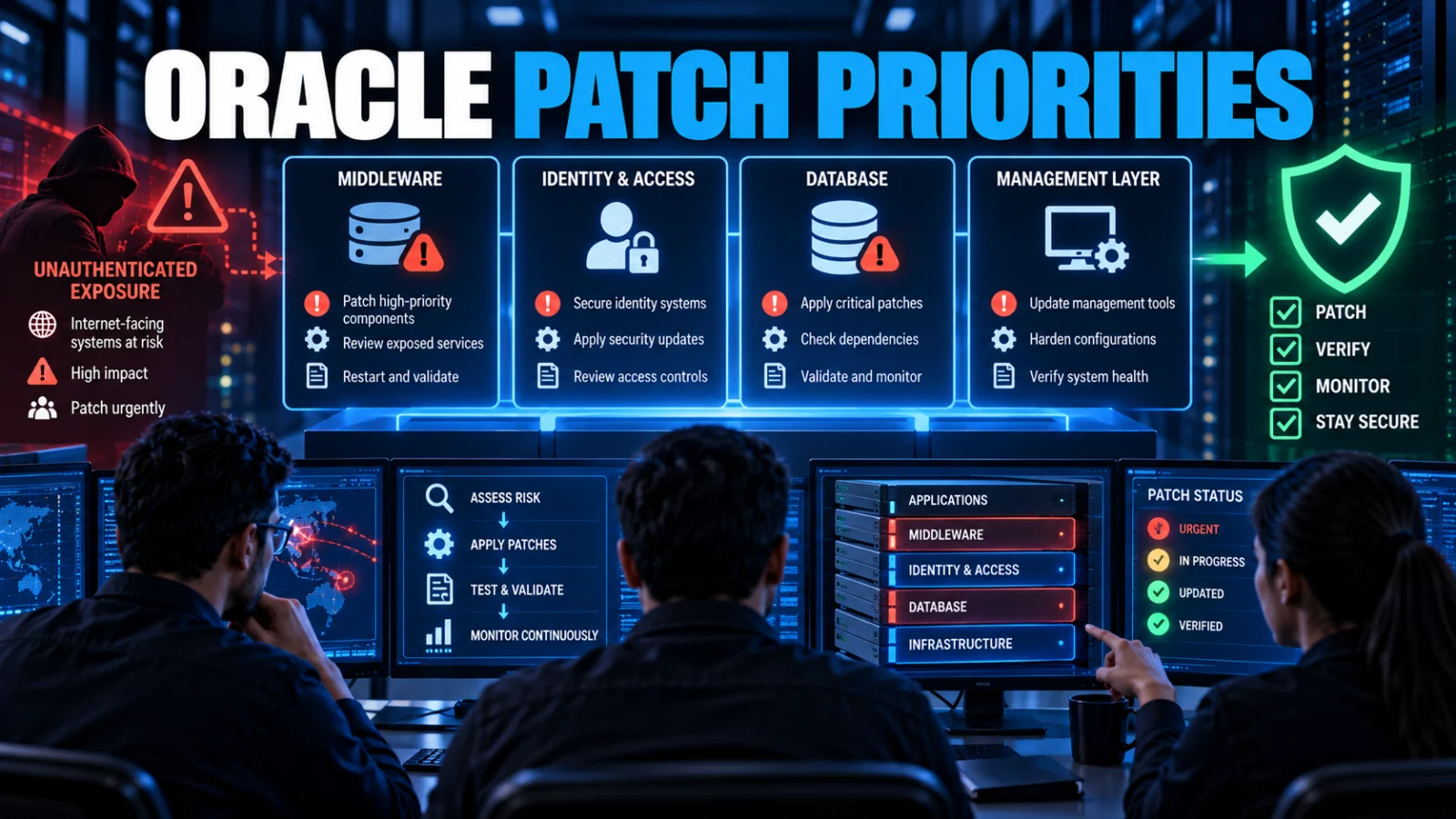
The Oracle September 2026 security patch update contains 673 new security patches, but enterprise teams should not treat all of them as equally urgent. Oracle’s own risk matrices show the strongest immediate concern in exposed Fusion Middleware deployments, where the September release includes 153 fixes, 78 vulnerabilities that Oracle says are remotely exploitable without authentication, and five unauthenticated issues scored at CVSS 10.0.
What should Oracle teams patch first?
Start with affected internet- or network-reachable Fusion Middleware systems. Then move quickly through exposed Hyperion, E-Business Suite, Enterprise Manager and Oracle Communications deployments where Oracle lists unauthenticated critical vulnerabilities. After those first-response systems, continue through Analytics, Commerce, Siebel CRM, Java/GraalVM, Database Server and the remaining affected products based on exact version, reachability and business criticality.
This ordering is ThePulseSignal’s evidence-based remediation synthesis from Oracle’s published matrices. It is not an Oracle-issued priority ranking.
Why the 673-patch headline is not enough
A raw patch count does not tell an administrator what should enter an emergency maintenance window first. Oracle’s September advisory spans multiple enterprise families with very different attack conditions.
The more useful questions are:
- Can the vulnerability be exploited remotely?
- Does exploitation require authentication?
- What is the maximum CVSS severity?
- Is the affected product exposed to untrusted networks or the internet?
- Does the affected component control identity, middleware, management or another high-value administrative plane?
- Does the application depend on separately affected Oracle Database or Fusion Middleware components?
Oracle explicitly provides its product risk matrices so customers can assess exposure based on the products and versions they actually use.
Tier 1: Fusion Middleware should be reviewed first
Fusion Middleware stands out in the September update because of the combination of patch volume, unauthenticated reachability and maximum severity.
- 153 new security patches.
- 78 vulnerabilities remotely exploitable without authentication.
- Five unauthenticated vulnerabilities rated CVSS 10.0.
The five CVSS 10.0 issues identified in Oracle’s matrix affect major middleware and identity components:
- CVE-2026-71133 — Oracle Access Manager.
- CVE-2026-83099 — Oracle Forms.
- CVE-2026-83059 — Oracle Internet Directory.
- CVE-2026-83020 — Oracle Platform Security for Java.
- CVE-2026-83021 — Oracle WebLogic Server.
If an affected version of any of these products is reachable from an untrusted network, it belongs at the top of the September remediation queue.
Tier 1: Hyperion has unusually high unauthenticated exposure
Oracle lists 102 September patches for Hyperion, with 50 remotely exploitable without authentication.
The family also includes CVE-2026-87230 in Hyperion Financial Management at CVSS 10.0. That combination of critical severity and unauthenticated exposure makes reachable Hyperion deployments another first-response candidate.
Tier 1: E-Business Suite needs application and dependency patching
Oracle E-Business Suite receives 159 new patches, including 19 that Oracle says are remotely exploitable without authentication.
Critical examples include CVE-2026-83327 in Oracle Application Framework and CVE-2026-83452 in Document Management, both rated CVSS 9.8. Current security research also highlights additional critical EBS issues in the September set.
EBS administrators should not stop after reviewing only the E-Business Suite matrix. Oracle specifically advises customers to apply relevant Database and Fusion Middleware fixes to components used by EBS. A nominally patched application tier can therefore remain exposed through an unpatched dependent layer.
Tier 1: Enterprise Manager has few fixes but high exposure density
Oracle Enterprise Manager receives only seven new fixes, but five are remotely exploitable without authentication.
That makes raw patch count especially misleading. Oracle lists critical issues including CVE-2026-41635 and CVE-2026-83355 at CVSS 9.8, along with CVE-2026-2332 at CVSS 9.1.
Enterprise Manager is also a management-plane product. Where affected versions are network-accessible, its combination of exposure and administrative importance justifies early remediation. Oracle additionally directs customers to relevant Database and Fusion Middleware patches used by Enterprise Manager.
Tier 1 or early Tier 2: Oracle Communications
Oracle Communications receives 31 patches, with 23 remotely exploitable without authentication.
Oracle’s matrix includes critical Unified Assurance vulnerabilities such as CVE-2026-44024 and CVE-2026-17544, both scored at CVSS 9.8. Organizations operating exposed Communications infrastructure should therefore review the exact affected versions early rather than waiting for the largest product families to be completed first.
What should come after the first-response products?
Once the highest-risk exposed Tier 1 systems are being remediated, administrators should continue through the remaining affected families using the same exploitability-and-exposure logic.
Oracle Analytics
Oracle lists 50 Analytics patches, including eight that are remotely exploitable without authentication. Notable issues include CVE-2026-83269 in BI Publisher at CVSS 9.8. A separate Analytics issue, CVE-2026-83282, scores 9.9 but requires low privileges, illustrating why CVSS alone should not determine the order.
Oracle Commerce
Oracle Commerce has 27 September fixes, including 16 remotely exploitable without authentication. The unauthenticated ratio makes internet-facing Commerce deployments worth early review even though the raw patch count is lower than EBS or Fusion Middleware.
Siebel CRM
Siebel CRM receives 63 fixes, including 26 unauthenticated remote vulnerabilities. Exposed customer-facing or externally reachable Siebel services should be prioritized ahead of lower-risk internal-only systems where the affected version and configuration match Oracle’s matrix.
Java SE and GraalVM
Oracle lists three September patches in this family, and all three are remotely exploitable without authentication. The highest severity in the reviewed matrix is lower than the CVSS 10.0 Fusion Middleware tier, but affected GraalVM deployments should still be patched promptly.
Oracle Database Server
Database Server remains important, but it should not automatically be placed ahead of exposed middleware merely because it is a database.
Oracle lists 11 September Database Server patches, including five that can be remotely exploited without authentication. The practical priority depends on network exposure, exact affected versions, client/server role and the importance of the data or applications relying on the deployment.
A practical Oracle September patch decision path
1. Inventory first: identify every Oracle product and exact version in scope.
2. Find exposed systems: separate internet-facing or broadly network-reachable systems from restricted internal deployments.
3. Move unauthenticated CVSS 10.0 and 9.8 systems to the front: especially Fusion Middleware, Hyperion, EBS, Enterprise Manager and Communications where the affected version matches.
4. Protect identity and management planes early: WebLogic, Access Manager, Internet Directory and Enterprise Manager can sit in strategically important parts of the environment.
5. Patch dependencies: EBS and Enterprise Manager can rely on Database and Fusion Middleware components that require their own September fixes.
6. Finish authenticated and lower-severity exposure: after the highest-risk reachable systems, continue through the remaining affected estate according to business criticality and tested maintenance windows.
Are the new September Oracle vulnerabilities actively exploited?
Oracle’s September advisory does not state that the newly patched CVEs are being actively exploited in the wild.
That distinction matters. Oracle confirms vulnerability severity, affected products, supported versions and exploit preconditions, but those facts are not the same as evidence of current exploitation.
If CISA later adds one of the September vulnerabilities to the Known Exploited Vulnerabilities catalog, Oracle publishes an emergency advisory, or credible exploitation evidence emerges, the remediation priority for that specific vulnerability may change immediately.
Does 673 mean 673 unique CVEs?
Not necessarily. Oracle describes the release as containing 673 new security patches. Tenable’s review counted 672 unique CVEs across 673 updates.
For remediation planning, the more important distinction is not the one-count difference but which products and versions are actually deployed and which vulnerabilities are reachable without authentication.
What if your Oracle version is no longer supported?
Oracle’s security updates are tied to supported product releases. Oracle says customers should move unsupported versions to supported releases because security patches may not be available for older software outside Premier or Extended Support coverage.
An unsupported deployment should therefore be treated as an upgrade-and-remediation problem, not as evidence that no September action is required.
Can firewall or protocol restrictions replace patching?
Oracle notes that blocking network protocols or removing privileges may reduce exposure to some vulnerabilities, but these workarounds can interfere with application functionality and are not a long-term substitute for applying the relevant security fixes.
Temporary compensating controls can be useful while testing or scheduling patches, but teams should not treat them as equivalent to reaching the supported patched state.
What should teams verify before deployment?
- Exact product and version against Oracle’s September matrix.
- Whether the vulnerable component is actually installed or enabled.
- Whether the affected service is reachable from the internet or other untrusted networks.
- Whether authentication or prior privileges are required for exploitation.
- Whether EBS, Enterprise Manager or another application relies on separately affected Database or Fusion Middleware components.
- Patch prerequisites and installation notes available through Oracle’s support documentation.
- Rollback and service-restoration procedures for the affected business application.
What happens next?
Oracle lists October 20, 2026 as its next quarterly Critical Patch Update. That is the next scheduled material checkpoint for this article.
A CISA KEV listing, verified exploitation report, Oracle advisory revision or emergency patch would justify an earlier same-URL update because it would materially change the remediation priority.
Verification note
ThePulseSignal reviewed Oracle’s September 2026 Critical Security Patch Update and product-specific risk matrices, then compared the product-family counts, unauthenticated exploitability, CVSS severity and dependency guidance with current analyses from Qualys, Tenable and SecurityWeek.
Limitations and unresolved facts
This article cannot determine whether any individual organization is vulnerable without knowing its exact Oracle products, versions, configurations and network exposure. Oracle’s advisory does not establish active exploitation of the newly patched September CVEs. Patch installation details can also depend on My Oracle Support documentation and product-specific prerequisites that are outside the public risk matrices.
Bottom line
The Oracle September 2026 security patch update is too large to prioritize by patch count alone. For most enterprise teams, the first question should be which affected systems are reachable without authentication and carry takeover-class severity. That places exposed Fusion Middleware at the front of the queue, followed closely by high-risk Hyperion, E-Business Suite, Enterprise Manager and Communications deployments. Patch the exact versions you run, include dependent Oracle components, and keep exploitation claims separate from Oracle’s confirmed vulnerability data.