






Rust crates.io maintainer attacks are now the subject of an official Rust Project warning after the project said it believes an ongoing social-engineering campaign is targeting rust-lang members and owners of popular crates. The reported objective is to compromise developer devices and accounts so trusted publishing access can ultimately be abused to distribute malware.
Current answer: the reviewed evidence does not show that crates.io infrastructure itself was breached, does not identify a crate confirmed to have been maliciously published by this specific campaign, and does not support attributing the current activity to DPRK actors. The immediate risk is targeted social engineering against people who hold valuable package-publishing access.
What Rust says is happening
The Rust Project says attackers are approaching rust-lang members and owners of popular crates with apparently legitimate job, project or contract opportunities. The outreach can be supported by convincing company identities, professional-looking profiles and LinkedIn presence designed to make the contact appear credible.
The interaction then moves toward a video call. During that call, the target may be told that some software, plugin or audio codec is required, or may be pressured to execute an attacker-supplied command. The security risk begins when a maintainer treats that unexpected installation or command request as a normal part of the call.
Is crates.io itself breached?
No crates.io infrastructure breach is established by the official warning reviewed for this article. The campaign described by Rust targets developers, their devices and their accounts rather than describing a direct compromise of the package registry itself.
That distinction matters. A maintainer can have legitimate permission to publish a crate. If an attacker gains control of that person’s workstation, account session or publishing credentials, the attacker may be able to abuse trusted access without compromising crates.io’s underlying infrastructure.
Has this campaign already published a malicious Rust crate?
The Rust Project warning reviewed by TPS does not identify a crate that was confirmed to have been maliciously published through this specific September campaign. The stated attacker objective is to compromise accounts and use them to publish malware, but an objective is not the same as a confirmed successful package release.
This boundary should remain explicit until Rust, crates.io, RustSec or another authoritative source identifies an affected account or malicious crate tied to the current campaign.
What should make an unexpected job or project call suspicious?
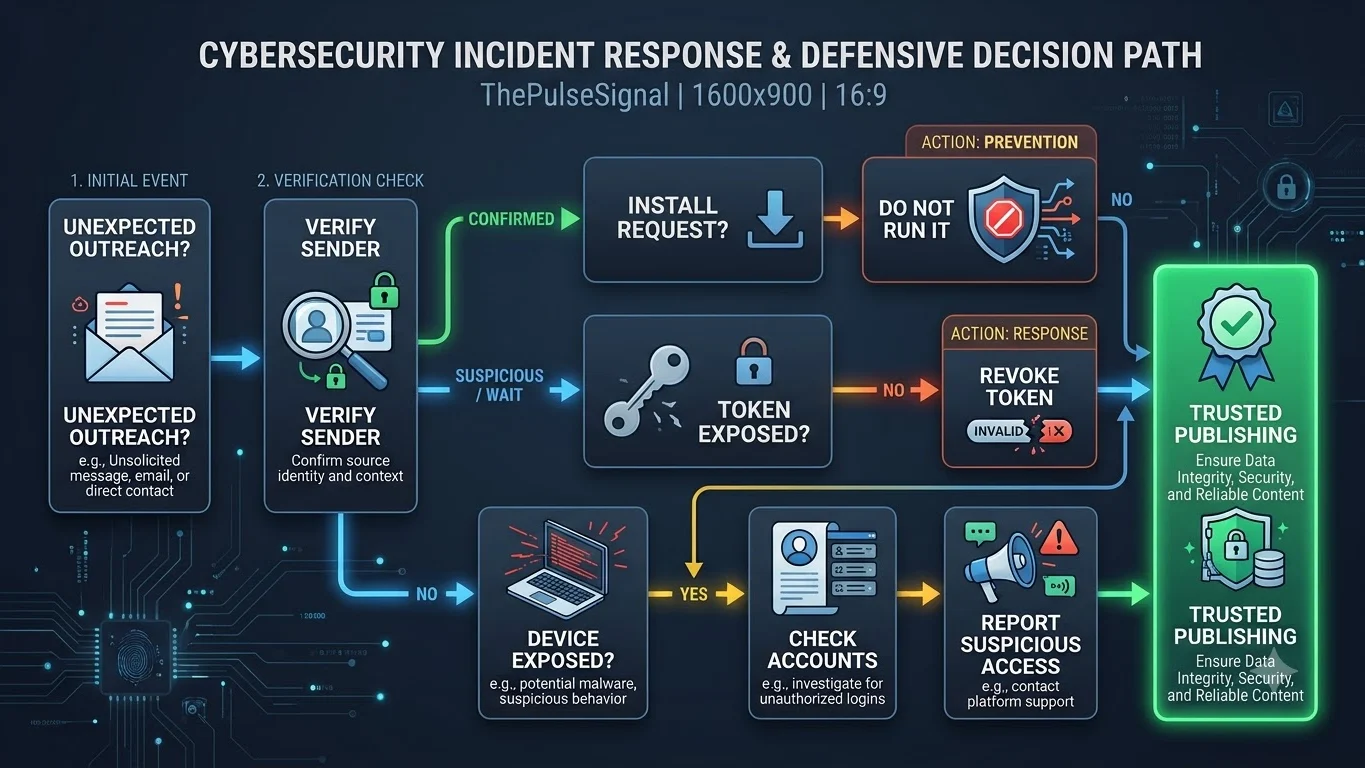
The current warning gives maintainers several useful signals. Unexpected recruiting, consulting or project outreach deserves additional verification when the sender is unfamiliar, the meeting platform is unusual, or participation suddenly requires installing software or executing a command supplied by the other party.
A professional-looking company website or social profile is not sufficient proof that the opportunity is genuine. Rust specifically warns that attackers can create plausible company and LinkedIn identities to support the pretext.
Is North Korea behind the Rust campaign?
The Rust Project does not attribute the current campaign to North Korea or any other actor in the reviewed warning. Some security reporting has noted that similar fake-job and developer-recruitment techniques have previously been associated with DPRK-linked operations, but similarity of technique is not attribution.
Until stronger evidence is available, the safe conclusion is that the attacker identity behind this Rust-specific campaign remains unresolved.
What should crate maintainers check now?
Verify the organization and contact independently before moving to a call or installing anything they provide.
Do not treat an unfamiliar installation request as a routine meeting requirement. End the interaction and verify the platform independently.
Treat the device as potentially compromised and begin your organization’s normal incident-response process. Review relevant developer, source-control and registry accounts for suspicious access.
Review account activity, confirm multi-factor authentication state and revoke any publishing token that may have been exposed.
Evaluate crates.io Trusted Publishing and Trusted Publishing Only where appropriate so routine publication does not depend on a reusable long-lived API token.
Why publishing credentials matter
Package-maintainer accounts are unusually valuable because they sit inside an established trust relationship. Developers and automated build systems routinely download new versions of packages from registries. If an attacker gains legitimate publishing authority, a malicious version can inherit much of the trust that users already place in the package name and maintainer history.
The current campaign warning should therefore be understood as a software-supply-chain issue even though the initial interaction looks like ordinary recruiting or project outreach.
What crates.io controls can reduce publishing risk?
crates.io supports Trusted Publishing, which allows supported CI environments to publish without relying on a traditional long-lived crates.io API token. The service has also introduced a Trusted Publishing Only mode that can prevent normal API-token publication for crates configured to use that model.
These controls do not make a compromised maintainer workstation harmless and are not a campaign-specific patch. They can, however, reduce one important route by which stolen reusable publishing credentials could be abused.
What if a crates.io API token may have leaked?
Cargo’s publishing documentation treats crates.io API tokens as secrets. If a maintainer has reason to believe a publishing token was exposed, it should be revoked rather than left active while the investigation continues.
Maintainers should also review the broader account state. A stolen token is only one possible consequence of a compromised developer machine; authenticated browser sessions, source-control credentials and other developer secrets may also require investigation according to the organization’s established incident-response process.
What if you already joined one of these calls?
Simply receiving outreach or joining a call does not prove compromise. The more important dividing line is whether the target installed untrusted software, executed an attacker-provided command, disclosed credentials or later observed unexpected account activity.
If suspicious activity involved crates.io, the Rust Project directs account concerns to the crates.io support team. Other Rust security concerns can be reported through the Rust security contact identified in the official warning.
Why a maintainer compromise can affect downstream users
The Rust ecosystem has recent evidence showing why trusted maintainer access matters. In August 2026, the Rust Security Response team disclosed malicious releases of established crates including arrayref, internment and append-only-vec, saying the maintainer’s computer or credentials were likely compromised.
That August incident is not evidence that the September maintainer-targeting campaign caused those malicious releases. It is relevant only as a documented example of the downstream consequence that becomes possible when trusted package-publishing access is compromised.
What would materially change the current story?
The next important evidence would be confirmation of a compromised maintainer account, identification of a malicious crate tied to this campaign, crates.io takedown activity, a RustSec advisory, infrastructure or indicators of compromise, stronger attribution evidence, or new account and publishing-security guidance from Rust or crates.io.
Those developments should update this same canonical article while the reader job remains understanding and responding to the current Rust maintainer-targeting campaign.
Verification note
TPS reviewed the Rust Project’s September 17 security warning, current crates.io publishing-security guidance, Cargo publishing documentation and current independent coverage. The campaign warning and recommended maintainer precautions are directly supported by Rust. A crates.io infrastructure breach, a confirmed malicious crate from this campaign and DPRK attribution were not established in the reviewed evidence.
Bottom line: the confirmed current risk is a targeted social-engineering campaign against Rust maintainers with valuable publishing access. Treat unexpected installation or command requests during recruiter or project calls as a serious warning sign, secure publishing credentials and account access, and do not assume that being targeted means a crate or crates.io itself has already been compromised.