







SEBI commodity derivatives early pay-in rules entered their revised operational phase on September 21, 2026. The framework allows certified goods to be deposited in a clearing-corporation-accredited warehouse against relevant commodity-derivatives contracts, and qualifying positions can receive margin relief under the clearing corporation’s risk framework.
The key limitation is equally important: SEBI does not require every margin to disappear. Mark-to-market margin must continue to be collected. The exact non-MTM benefit also depends on how the relevant clearing corporation implements the framework, so traders and clearing members should not assume one venue’s treatment automatically applies everywhere.
What changed on September 21
SEBI issued the underlying clarification on June 19, but specified September 21 as the effective date. That means the rule is no longer a future regulatory change. Clearing corporations and their members now need to apply the revised early-pay-in framework operationally.
The revised wording is broader than the earlier framework. The previous commodity-derivatives provision referred to certified goods deposited against relevant futures contracts sold. The updated provision refers to relevant derivatives contracts. SEBI’s preceding consultation specifically examined extending early-pay-in benefits beyond futures to options contracts.
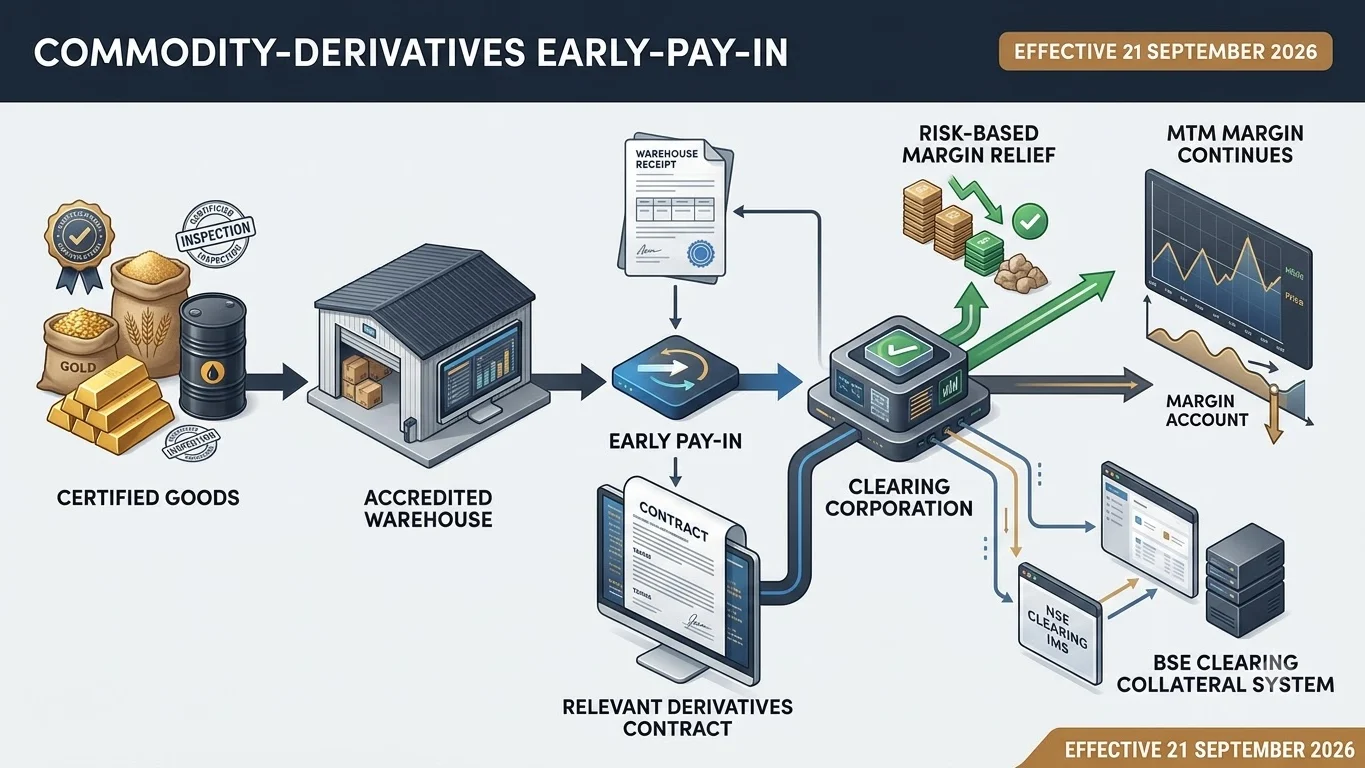
What early pay-in means under the revised framework
Early pay-in involves depositing certified goods in a warehouse accredited by the relevant clearing corporation against the applicable commodity-derivatives position. Once the clearing corporation recognises the early pay-in, it may provide relief from other margins based on its risk assessment.
This is not the same as saying that any commodity deposited at any warehouse automatically reduces margin. Eligibility depends on the certified goods, the relevant derivatives contract, the accredited warehouse and the clearing corporation’s operational process.
Which margins can change and which margin must remain
| Margin treatment | SEBI framework | What the participant should understand |
|---|---|---|
| Non-MTM margins | Clearing corporations may grant exemptions based on risk perception for qualifying early-pay-in positions | The benefit is risk-based and implementation-specific, not a universal automatic waiver |
| Mark-to-market margin | Must continue to be collected | Early pay-in does not remove MTM obligations |
This distinction is central to the September 21 change. A participant may receive meaningful collateral relief without receiving a blanket exemption from every margin requirement.
How NSE Clearing is implementing the benefit
NSE Clearing issued an implementation circular on September 18 for the September 21 start. Its notice says members and clients providing qualifying early pay-in through the Inventory Management System can receive exemption from applicable margins on open positions in relevant contracts for the underlying commodity.
That operational treatment should still be read alongside SEBI’s controlling requirement that mark-to-market margin continues to be collected.
How BSE Clearing is implementing the benefit
BSE Clearing also issued a September 18 implementation notice. Its process applies the early-pay-in benefit through the BSE Clearing Collateral System from September 21 for qualifying commodity-derivatives positions.
NSE Clearing and BSE Clearing therefore provide evidence that the regulatory change has moved into live clearing operations. Their individual system and margin instructions should not, however, be treated as proof that every other commodity clearing corporation uses identical procedures or exemptions.
Does the change apply only to commodity futures?
The final SEBI wording no longer uses the earlier futures-only formulation and instead refers to relevant derivatives contracts. That change followed a consultation in which SEBI specifically proposed extending the early-pay-in benefit available for futures positions to options contracts as well.
Participants should still verify the relevant clearing corporation’s current eligible contracts and operational circular rather than assuming that every commodity option or product automatically qualifies.
What commodity participants should check now
Confirm the commodity contract for which early pay-in is being considered and whether the clearing corporation recognises that position for the benefit.
The framework applies to certified goods connected to the relevant commodity-derivatives contract.
The goods must be deposited through a warehouse accredited by the relevant clearing corporation.
NSE Clearing uses its Inventory Management System for the implementation reviewed by TPS, while BSE Clearing refers to its Collateral System.
SEBI permits risk-based relief, but the exact treatment comes from the clearing corporation’s current margin and implementation rules.
SEBI’s framework expressly requires mark-to-market margin to continue even where other margin relief is given.
An exemption or workflow confirmed for one clearing corporation should not automatically be assumed for another.
What remains unresolved
TPS did not establish a complete current implementation matrix for MCXCCL or NCCL/NCDEX during this research pass. Broker-level collateral processes and any product-specific exceptions were also not established. Those points should remain separate from the confirmed SEBI rule and the confirmed NSE Clearing and BSE Clearing implementation notices.
This article should be updated on the same URL if other clearing corporations publish implementation circulars, exchanges issue operational FAQs, margin treatment changes, product eligibility is clarified or SEBI issues further interpretation or enforcement guidance.