






School bullying complaint in India should begin with one question: what is happening to your child, and is the child safe right now? An argument between classmates, repeated intimidation, cyberbullying, physical violence, staff misconduct and an immediate safety threat should not all be handled in the same way.
For many parents, the difficult part is deciding whether to keep working through the school, ask the education authority to intervene, approach a child-rights body or use a more urgent protection route.
Direct answer
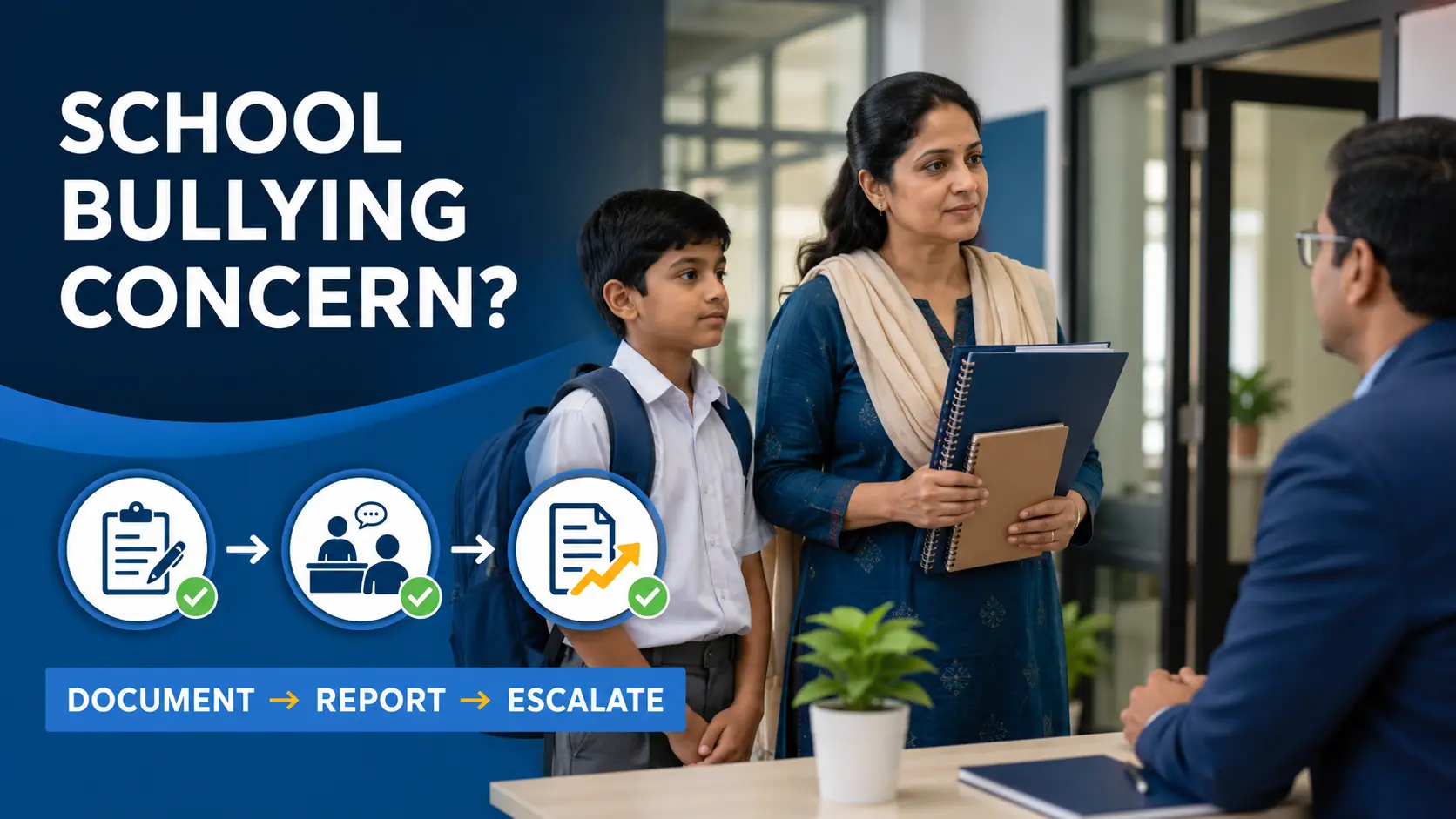
If your child reports bullying, first listen without forcing the child to repeatedly retell the incident, record the basic facts, preserve available evidence and notify the school in writing when it is safe and appropriate.
Ask the school what immediate protection it will put in place, who is handling the complaint and how the situation will be monitored. If the behaviour continues, the school fails to respond, or the facts indicate a serious child-rights or safety concern, use the appropriate external route rather than repeatedly restarting the complaint.
If you are unsure whether the problem belongs to the school, education department, child-rights system or another authority, use the India school complaint router.
Safety comes before complaint sequencing.
If the child faces immediate danger, serious physical violence, suspected sexual misconduct or another potentially criminal situation, do not wait merely to complete a normal school complaint ladder. The appropriate child-protection or law-enforcement route can become necessary depending on the facts.
A single peer conflict is not automatically the same thing as repeated bullying. Record what happened and watch whether there is a pattern, intimidation or power imbalance.
The behaviour keeps happening or your child is repeatedly being threatened, humiliated, isolated or targeted.
Messages, groups, images, posts or other online behaviour may extend the problem beyond the school campus.
A child has been hit, injured, threatened with serious violence or repeatedly subjected to physical aggression.
This is not simply peer bullying. Adult misconduct, humiliation, punishment or harassment should be separated from a student-to-student complaint.
The bullying problem may overlap with disability, inclusion or accommodation rights rather than being only a general peer-behaviour issue.
Preserve the original complaint and response rather than starting again with a disconnected allegation.
Serious violence, sexual conduct, coercion, blackmail or another potentially criminal allegation should not be reduced to an ordinary “bullying” label.
Seven steps parents can take for a school bullying complaint in India
Listen to the child and record the basic facts
Write down what happened, when it happened, where it occurred, who was involved and whether it has happened before.
Avoid turning the first conversation into an interrogation. The goal is to understand enough to protect the child and make a clear complaint.
Decide whether this is peer conflict, bullying or an urgent safety issue
Repeated intimidation, threats, humiliation, exclusion or physical aggression can require a more structured response than an isolated disagreement.
If the allegations indicate immediate danger or potentially criminal conduct, ordinary internal escalation may not be sufficient.
Preserve evidence without spreading it
Keep relevant messages, screenshots, school communications, incident dates, photographs or medical records where applicable.
Do not unnecessarily forward humiliating images, private messages or sensitive material to large groups of parents.
Complain to the school in writing when appropriate
State what happened and ask for a concrete response rather than only saying “please take action.”
Ask who is handling the complaint, what immediate protection will be provided and how recurrence will be monitored.
Keep the complaint acknowledgement and the school’s response
Preserve emails, portal references, meeting notes and any written action plan or response from the school.
This becomes important if the behaviour continues or you later approach an external authority.
Escalate if the school does not protect the child
If the problem continues or the school fails to respond meaningfully, identify the relevant state education or child-rights route instead of repeatedly submitting the same complaint internally.
Use the school complaint escalation India guide when an earlier complaint has already been ignored.
Use a separate protection route if the facts become more serious
A case involving serious violence, sexual misconduct, coercion or another potentially criminal allegation may require child-protection or law-enforcement involvement rather than being treated only as school discipline.
What should parents ask the school to do?
A useful written bullying complaint asks for concrete safety action rather than only punishment.
Protect the child now
Ask what immediate steps will reduce the child’s exposure to further intimidation, threats or violence.
Identify a responsible person
Ask who is handling the complaint so the parent and child are not redirected repeatedly between teachers and administrators.
Review what happened
Ask the school to examine the reported incidents, witnesses and available evidence rather than making assumptions from one conversation.
Prevent recurrence
Ask how the school will monitor the situation after the immediate complaint is addressed.
Protect confidentiality appropriately
Avoid unnecessarily circulating the child’s personal information or the allegations among unrelated parents and students.
Give a written response
A written record helps the parent understand what was investigated, what action was taken within permissible limits and what remains unresolved.
The goal is not simply “punish the other child.” The parent’s immediate objective is to make the environment safe, stop the behaviour, preserve the child’s education and establish whether the school’s response is working.
What is the difference between bullying and a normal peer conflict?
Parents do not need to make a perfect legal classification before asking the school for help.
But distinguishing the type of problem helps avoid both underreacting and overreacting.
| Situation | What it may look like | Useful first response | When escalation becomes more important |
|---|---|---|---|
| Ordinary peer conflict | Disagreement, argument or isolated incident between students | Document the incident and ask school to address the conflict | If threats, repetition or serious harm develops |
| Repeated bullying | Recurring intimidation, humiliation, exclusion or threats | Formal written complaint and safety plan | If behaviour continues or school response is ineffective |
| Cyberbullying | Messages, posts, group chats, images or online targeting | Preserve evidence; notify school where school relationships are involved | If threats, blackmail, sexual material or serious harm is involved |
| Physical violence | Hitting, injury, repeated physical aggression or serious threats | Protect child, document injury and notify school promptly | Where seriousness requires external protection or legal intervention |
| Adult misconduct | Teacher/staff humiliation, punishment, harassment or abuse | Separate from peer-bullying process | Use management, education, child-rights or other route based on facts |
| Potentially criminal / sexual conduct | Serious assault, sexual misconduct, coercion, blackmail or similar allegations | Prioritise protection | Do not rely only on an ordinary school discipline process |
Editorial interpretation: a parent does not need to win an argument over whether an incident meets somebody’s preferred definition of “bullying” before asking a school to protect a child. The practical first question is what happened and what risk remains.
What does NCPCR say about bullying in schools?
The National Commission for Protection of Child Rights publishes dedicated guidance titled Preventing Bullying and Cyberbullying Guidelines for Schools 2024.
NCPCR also publishes broader school-safety guidance covering the responsibilities of school management, principals, teachers, parents and other stakeholders for a safe school environment.
This makes bullying prevention and school safety part of a broader child-protection framework rather than only a private disagreement between two families.
But NCPCR should not be treated as the automatic first stop for every playground disagreement. Ordinary school conflict can often begin with a documented school response. Child-rights escalation becomes more relevant when the facts and seriousness justify it or when protection fails.
Can parents complain to NCPCR about school bullying?
NCPCR operates e-BaalNidan for child-rights complaints.
The complaint system asks for information about the complainant and child, state and district, complaint details and whether the case is already before another commission or court. Supporting files and relevant evidence can also form part of the complaint process.
If you are not sure whether NCPCR, an education authority or another body is appropriate, use the national school complaint router.
Does the RTE Act apply to bullying?
The Right to Education Act does not mean that every peer-bullying allegation is automatically an RTE Section 17 case.
Section 17 specifically states that no child shall be subjected to physical punishment or mental harassment, and provides for disciplinary action against a person contravening that prohibition.
This can be particularly relevant when the alleged conduct involves an adult such as a teacher or another person subject to service rules.
Do not blur the routes: peer bullying, staff mental harassment and physical punishment can overlap in how a child experiences harm, but they are not necessarily the same legal or disciplinary problem.
If the issue is actually an RTE grievance rather than ordinary peer bullying, continue with the predefined RTE school complaint India guide.
What if a teacher or staff member is bullying or humiliating the child?
Do not force an adult-misconduct allegation into a student-to-student bullying process.
A complaint involving a teacher or staff member may raise questions about:
- mental harassment;
- physical punishment;
- discriminatory treatment;
- inappropriate staff conduct;
- school-management supervision; or
- a more serious child-protection issue depending on the facts.
Use the dedicated page:
Teacher or Staff Misconduct School Complaint in India
What if bullying involves a child with disability or special needs?
The bullying itself may be only part of the problem.
A parent may also need to ask whether the school is providing appropriate support, inclusion or accommodation and whether the child’s disability or support need is part of why the child is being targeted.
Use the separate predefined route where applicable:
School Disability and Special-Needs Support Complaint in India
What evidence should parents preserve?
Incident timeline
Record dates, approximate times, locations and what the child reported.
School communication
Keep emails, complaint letters, meeting notes and replies from teachers or management.
Digital evidence
Preserve relevant screenshots, messages, posts or links without unnecessarily redistributing them.
Injury or health records
Where relevant, retain medical documents or photographs connected to an alleged physical incident.
Earlier complaint acknowledgement
Keep the date and proof of each complaint so recurrence can be shown clearly.
What protection was requested
Record what you asked the school to do and whether that protection was actually provided.
What if the school says it has handled the bullying but it continues?
The fact that a meeting happened does not necessarily mean the problem has been resolved.
Look at what happened after the complaint:
- Did the bullying stop?
- Does the child feel safe attending class?
- Were new threats or retaliation reported?
- Did the school provide a responsible contact?
- Was the parent told how recurrence would be monitored?
- Has the child begun avoiding school or particular spaces because of fear?
If the situation remains unresolved, move from the initial complaint into escalation rather than simply repeating the same conversation.
Next route: use School Complaint Escalation in India when the school or first authority has already been given an opportunity to address the complaint and the problem remains unresolved.
Where can parents escalate a school bullying complaint?
School management
If the first report was made only to a class teacher, a formal written complaint to the principal or management can create the proper institutional record.
State / district education authority
The relevant education authority can depend on the state, school type and issue. Do not assume the same officer title applies throughout India.
NCPCR / child-rights route
A serious or unresolved child-rights concern may justify approaching the competent child-rights mechanism, including e-BaalNidan where applicable.
RTE route
If the conduct is actually an RTE grievance, mental-harassment or physical-punishment issue within the statutory framework, use the relevant RTE route.
Teacher / staff route
If an adult rather than another student is responsible, use the misconduct route instead of treating the matter as ordinary peer bullying.
Complaint already ignored
If you already approached the school or authority and nothing meaningful happened, continue from that existing record.
Related school-problem guides
Bullying can overlap with another school problem. Use the page that owns the second issue instead of forcing every allegation into one complaint.
What parents should avoid doing
Confronting another child aggressively
Keep the focus on protecting your child and getting the school to manage the situation appropriately.
Starting a parent WhatsApp trial
Publicly circulating allegations can expose children and make factual investigation harder.
Calling every disagreement bullying
Record the facts first. A pattern, threat or serious incident can matter more than the label.
Waiting while serious danger continues
An urgent safety risk should not be delayed merely to complete a school meeting sequence.
Accepting only a verbal assurance
For a recurring problem, ask what protective action will be taken and preserve the response.
Demanding only punishment
The immediate parent objective should include safety, stopping recurrence and protecting the child’s education.
Verification notes: what is confirmed, variable and unresolved
Confirmed
NCPCR publishes dedicated bullying and cyberbullying guidance for schools and operates e-BaalNidan for child-rights complaints. The RTE Act separately prohibits physical punishment and mental harassment.
Depends on the facts
The appropriate external route depends on whether the issue is peer bullying, staff misconduct, cyberbullying, physical violence, an RTE grievance or another child-protection problem.
Not safe to generalise
Not every school disagreement should go directly to police, NCPCR or another national body, and not every allegation labelled “bullying” belongs to the same statutory process.
Parent takeaway
Protect the child, record what happened, ask the school for concrete action and escalate according to the seriousness and jurisdiction of the problem.
Editorial interpretation: the strongest parent response is not “school first at all costs” or “police immediately for everything.” It is a severity-based route: understand the incident, protect the child, preserve evidence, require an accountable school response and move outside the school when the facts or failed response justify it.
ThePulseSignal checked NCPCR’s current guidelines index for its 2024 bullying and cyberbullying guidance, NCPCR’s school-safety materials, the e-BaalNidan complaint system, Section 17 of the Right to Education Act and CBSE’s safety requirements for affiliated schools.
Sources checked
Limitations and unresolved facts
This is an India-level problem-resolution guide. The exact education authority and local escalation process can vary by state and school type.
- State education departments can have additional anti-bullying, school-safety or grievance procedures.
- The appropriate response depends on the seriousness and exact facts of the incident.
- Peer bullying should not automatically be treated as an RTE Section 17 disciplinary case.
- Staff misconduct should not be hidden inside a peer-bullying complaint.
- A potentially criminal or sexual allegation may require a separate statutory protection route.
- NCPCR’s complaint system should not be presented as the automatic first destination for every ordinary school disagreement.
- School disciplinary details involving another child may not necessarily be fully disclosable to the complainant parent.
School bullying complaint in India: FAQs
Where should I complain if my child is being bullied at school?
For a non-emergency peer-bullying complaint, a written complaint to the school is usually a practical starting point. If the problem remains unresolved or raises a serious child-rights concern, the appropriate education or child-rights route may become relevant. Use the India school complaint router if you are unsure.
What if the school ignores my bullying complaint?
Keep the original complaint, acknowledgement and response, then escalate with that same record rather than starting again. See the school complaint escalation India guide.
Can I complain to NCPCR about school bullying?
NCPCR operates e-BaalNidan for child-rights complaints. Whether it is the appropriate route depends on the seriousness and nature of the case and whether the issue remains within ordinary school resolution or has become a broader child-rights concern.
Should parents call police for school bullying?
Not for every ordinary peer disagreement. Police or another urgent protection route can become relevant where the underlying facts involve serious violence, immediate danger or potentially criminal conduct.
What if a teacher is bullying or humiliating my child?
Separate adult misconduct from peer bullying. Depending on the facts, the issue may involve mental harassment, physical punishment or another staff-conduct concern. Use the teacher misconduct school complaint guide.
What evidence should I keep?
Keep a basic incident timeline, school correspondence, complaint acknowledgements, relevant messages or screenshots and injury or health records where applicable.
What if bullying happens on WhatsApp or social media?
Preserve the evidence rather than repeatedly forwarding it. Where the students are connected through school and the online conduct affects the child’s school safety, notify the school. Serious threats, blackmail, sexual material or other potentially criminal conduct may require a separate protection route.
What if my child has special needs and is being targeted?
The case may involve both bullying and disability or inclusion support. Separate those issues and use the school disability support complaint guide where applicable.
Last primary-source review: August 12, 2026.