






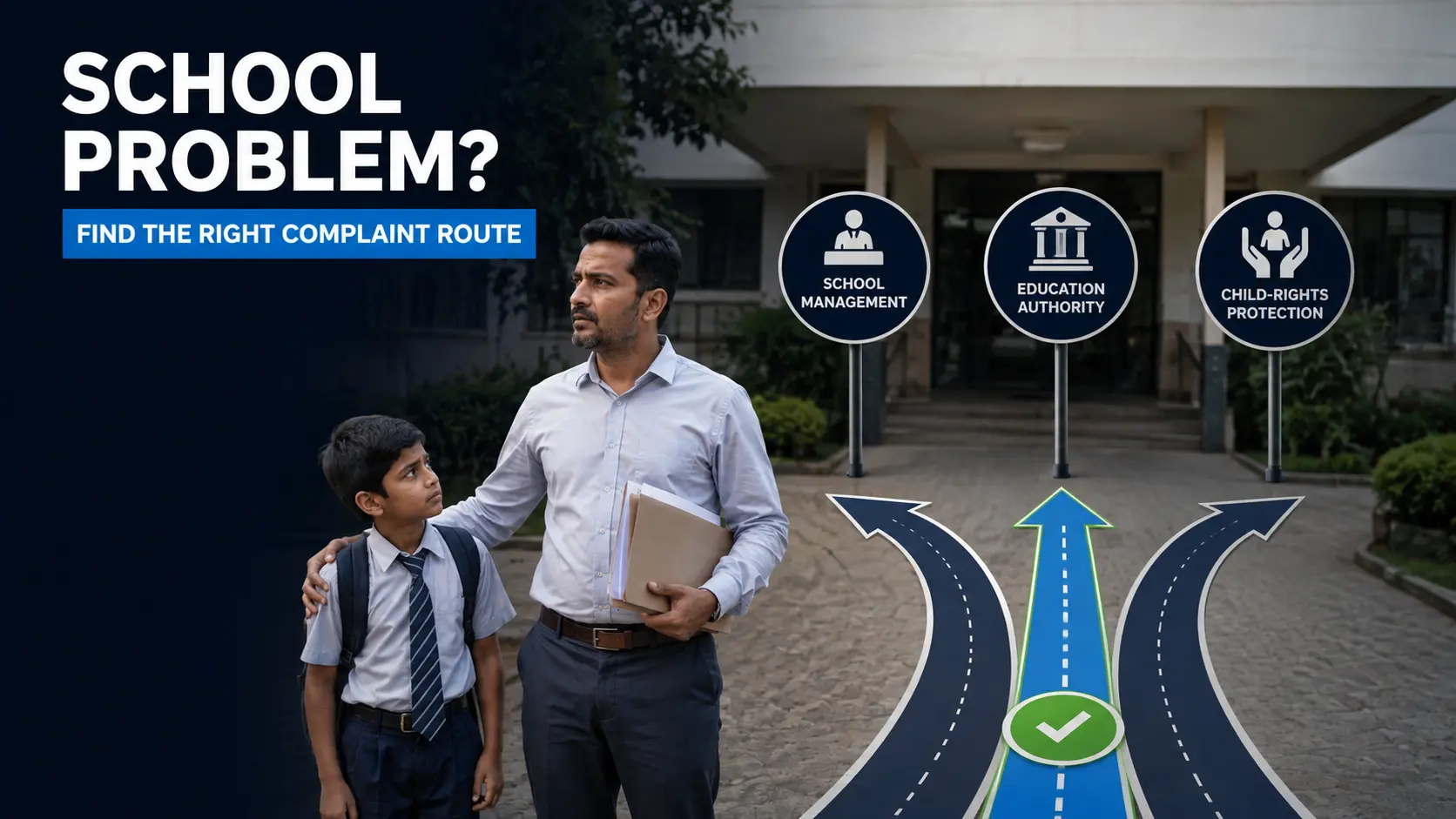
Where to complain against school in India depends on the problem you are trying to solve. A fee dispute, bullying complaint, RTE issue, withheld transfer certificate, affiliation concern and serious child-safety allegation can all involve the same school but require very different complaint routes.
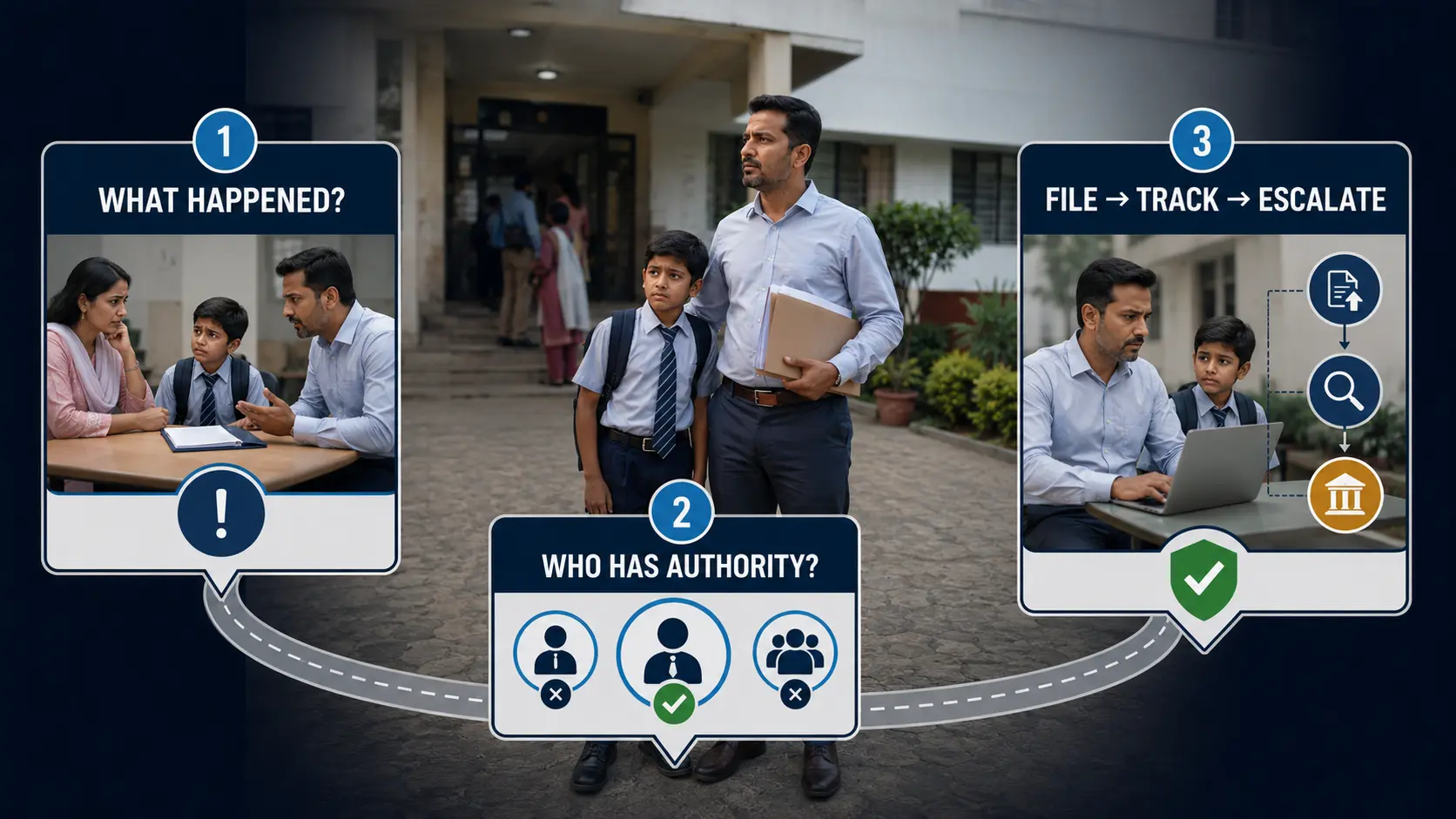
Parents can lose time when they start with the name of an authority instead of the nature of the problem. A better sequence is: identify what happened, preserve the evidence, find the authority that actually has jurisdiction, and then escalate if the problem remains unresolved.
Direct answer
For an ordinary school dispute, put the problem in writing and keep proof of what you submitted. The correct external complaint route then depends on the issue and, in many cases, the state where the school operates.
Child-rights matters may involve NCPCR or a State Commission for Protection of Child Rights. RTE grievances have a statutory grievance-redressal framework. Public-authority grievances may fit CPGRAMS. CBSE can be relevant for affiliation or Board-jurisdiction issues, but it is not the complaint authority for every problem at a CBSE-affiliated school.
Check whether this is a fee-regulation issue, disclosure problem, refund dispute or another charge-related complaint.
Find out what to document, when the school should be approached and when a child-rights or safety route may become necessary.
Keep the written request and the reason given by the school. The correct next route can depend on the state, school type and document involved.
RTE grievances should be separated from ordinary admission disagreements because the statutory route can be different.
Verify the school’s official recognition or affiliation before deciding where and how to complain.
Administrative misconduct, corporal punishment, harassment and potentially criminal conduct should not all be routed in the same way.
Disability, special-needs and inclusion problems can involve education and disability-rights protections beyond an ordinary school disagreement.
Do not restart the complaint from zero. Preserve the earlier acknowledgement and identify the correct next escalation authority.
Do not send the same complaint randomly to every authority. More recipients do not necessarily mean more authority. A parent can have a valid complaint but still lose time if it reaches an organisation that cannot provide the requested remedy.
What should a parent do first?
Write down exactly what happened
Record the date, people involved, what the school did or refused to do, and how the problem affected your child. Keep facts separate from assumptions or accusations.
Collect the documents connected to the problem
Fee notices, receipts, admission documents, emails, messages, school circulars, written requests, replies, photographs or medical records may matter depending on the issue.
Ask the school for a written response when appropriate
For an ordinary administrative problem, a written complaint to the principal or management creates a record and may solve the issue without external escalation.
Identify the authority that actually has jurisdiction
This may be a local or district education officer, state grievance mechanism, RTE authority, child-rights commission, Board affiliation branch or another statutory body.
Keep the acknowledgement and escalate with the same record
Save complaint numbers, emails and replies. If the matter remains unresolved, attach the earlier complaint and explain briefly what still needs to be resolved.
Exception for serious safety problems: if a child faces immediate danger, serious violence, sexual misconduct or another potentially criminal situation, protecting the child takes priority over completing an ordinary administrative complaint sequence.
Which authority handles which type of school complaint?
| Problem | Start with | Possible external route | Important boundary |
|---|---|---|---|
| Private-school fee dispute | School / management in writing | State or district education authority; fee-regulation body where one exists | Fee law differs materially by state. |
| RTE grievance | School / designated local route where appropriate | Authority designated under the state’s RTE grievance framework | Not every school dispute is an RTE case. |
| Bullying | Principal / school safeguarding route | Education authority or child-rights body if serious or unresolved | Serious violence may require an immediate safety response. |
| Physical punishment or mental harassment | Document the incident and notify management where safe | Education authority / child-rights commission; other statutory route depending on facts | Serious conduct should not be treated as a routine administrative disagreement. |
| TC / marksheet / certificate withheld | Written request to school | State or district education authority depending on the state and school type | Do not assume one national rule controls every case. |
| School recognition problem | Verify official recognition status | State education authority | Do not rely only on the school’s own brochure or website. |
| CBSE affiliation concern | Verify official CBSE affiliation | CBSE affiliation route where within Board jurisdiction | A CBSE school can still be subject to state-level regulation in other areas. |
| Government authority ignored complaint | Department escalation process | State grievance portal or CPGRAMS where applicable | CPGRAMS does not automatically decide the underlying private-school dispute. |
| Serious child-safety issue | Protect the child immediately | Child-rights / police / specialised statutory route depending on the facts | Do not delay urgent protection for administrative sequencing. |
Editorial interpretation: India’s school-complaint problem is often a jurisdiction problem. Parents may have a legitimate grievance but still lose time because it reaches a body that cannot grant the remedy they are asking for.
What evidence should parents keep?
You do not need to create a legal case file before asking the school a simple question. But once a dispute develops, preserving basic evidence can prevent later disagreement about what was said, requested or paid.
School documents
Keep fee circulars, invoices, admission forms, school notices, transport terms, handbooks or other material directly connected to the issue.
Communication
Keep relevant emails, letters and messages showing what you asked the school to do and how it responded.
Timeline
Record dates of incidents, meetings, requests, payments and earlier complaints.
Proof of submission
Keep portal IDs, acknowledgement numbers, email records, stamped copies or other evidence showing when the complaint was submitted.
Supporting evidence
Where relevant and lawful, preserve receipts, screenshots, photographs, medical records or other material connected to the complaint.
The remedy you want
Ask clearly for the outcome you need: explanation, correction, investigation, document release, refund review, safety action or another specific remedy.
Should you always complain to the school before going outside?
No. It depends on the problem.
For an ordinary fee explanation, document request or administrative disagreement, starting with the principal or management is usually practical because it creates a written record and gives the school an opportunity to respond.
But that should not become a rigid rule where the allegation involves immediate child safety, serious violence, sexual misconduct or another potentially criminal matter.
Useful distinction: “complain internally first” can be a sensible administrative strategy. It is not a universal safety rule.
Can NCPCR handle a complaint against a school?
The National Commission for Protection of Child Rights operates the e-BaalNidan complaint-management system for child-rights grievances.
The official complaint process collects details about the complainant, child, state, district and nature of the grievance and allows supporting material to be submitted.
This makes NCPCR a real national route for genuine child-rights concerns. However, a routine fee calculation, timetable dispute or ordinary school-administration disagreement should not automatically be reframed as a child-rights complaint.
If the underlying problem is bullying or school safety, teacher or staff conduct, or disability-related support, use that problem-specific guide first so the complaint is framed around the actual issue.
Can you use CPGRAMS for a school problem?
CPGRAMS is the Government of India’s grievance platform for grievances involving public authorities and service delivery.
It can become relevant where the unresolved problem concerns how a government department or public authority handled a school-related grievance.
If you have already complained to the school or an education authority and the matter is still unresolved, continue with the school complaint escalation India guide before choosing the next forum.
Important: filing on CPGRAMS does not automatically make CPGRAMS the authority that can decide the underlying merits of a private-school dispute.
Does CBSE handle every complaint against a CBSE school?
No.
CBSE has complaint and affiliation mechanisms, but the correct route depends on the nature of the issue and the Board’s jurisdiction.
If the problem concerns the school’s claimed CBSE affiliation, Board records and affiliation mechanisms may be directly relevant. A private-school fee dispute governed by state law can be a different issue even if the school is CBSE-affiliated.
For affiliation-number, recognition-status or “is this school really CBSE affiliated?” questions, use the school affiliation and recognition complaint India guide.
What is different about an RTE complaint?
The Right of Children to Free and Compulsory Education Act, 2009 contains a separate grievance-redressal framework under Section 32.
The RTE framework also addresses specific rights and obligations concerning elementary education. The practical complaint authority and implementation route can still vary by state.
For that reason, this India-wide guide does not assume that the same officer designation or portal applies throughout the country.
If your problem specifically concerns an RTE right, admission, Section 12 obligations, Transfer Certificate protection, physical punishment, mental harassment or recognition within the RTE framework, use the RTE school complaint in India guide.
What if the school ignores your complaint?
When escalating, do not send an entirely new complaint that forces the next authority to reconstruct the story from the beginning.
Include:
- the original problem;
- the date of your first written complaint;
- the school’s or authority’s response;
- the earlier acknowledgement or reference number;
- what remains unresolved; and
- the specific action you now want.
For a deeper escalation guide, see:
School Complaint Ignored? How to Escalate in India
What if an education authority also ignores the complaint?
The next step depends on the state and the authority involved.
Possible routes can include a higher education officer, state grievance portal, statutory commission or, where the unresolved grievance concerns a public authority, CPGRAMS.
There is no safe national shortcut such as “wait seven days and always complain to X.” Any official response deadline or appeal period must come from the applicable state or statutory framework.
Your state matters more than most generic school complaint guides suggest
This India guide can tell you how to classify the problem and which type of authority may be relevant. It cannot responsibly replace state-specific verification.
States can differ on:
- private-school fee regulation;
- names and powers of district education officers;
- RTE implementation;
- school-recognition systems;
- grievance portals;
- appeal and escalation hierarchy; and
- which authority can actually order a remedy.
TPS state-page rule: a state page should not be indexed until the current authority, portal, escalation path and relevant state rules have been verified.
Delhi school-fee complaint routes already available on TPS
For the India-level decision process before choosing a state route, start with the private school fee complaint India guide. The Delhi pages below then handle the more specific Delhi fee questions.
Is the Delhi fee hike or charge allowed?
Where can a Delhi parent complain?
Need reimbursement or financial help?
Other states
TPS is validating state complaint routes individually before indexing them so that one state’s legal or administrative structure is not copied into another.
Common mistakes parents should avoid
Sending the same complaint everywhere
A large recipient list does not replace choosing the authority that actually has jurisdiction.
Using another state’s rule
A fee cap, committee or grievance structure in one state may have no application in another.
Assuming CBSE controls everything
Board affiliation and state-level school regulation are not the same thing.
Using only phone calls
Important disputes become easier to escalate when the complaint and response exist in writing.
Calling every disagreement an emergency
Ordinary administrative disagreements should not be exaggerated into criminal or child-rights allegations without supporting facts.
Waiting during a genuine safety emergency
Serious danger to a child should not be delayed merely to complete an internal complaint process.
Verification notes: what is confirmed, reported and interpreted
Confirmed
NCPCR operates e-BaalNidan; the RTE Act contains a grievance-redressal framework; CPGRAMS handles grievances involving public authorities; and CBSE maintains complaint and affiliation routes with jurisdiction limits.
State-dependent
Private-school fee rules, district education hierarchy, recognition systems, state grievance portals and several escalation procedures vary across India.
Not established nationally
There is no single national authority or portal that should be presented as the decision-maker for every school complaint.
Parent takeaway
Classify the problem first, preserve the record, verify jurisdiction and escalate through the route that actually controls that issue.
Editorial interpretation: the practical problem for many parents is not simply that complaint systems do not exist. It is that those systems are fragmented, use different authority names and have different jurisdiction. A useful guide must therefore route the parent before it explains the law.
ThePulseSignal reviewed the current NCPCR e-BaalNidan complaint system, the National Commission for Protection of Child Rights website, the Government of India’s CPGRAMS portal, the Right of Children to Free and Compulsory Education Act on India Code, Ministry of Education RTE materials and CBSE complaint guidance. State-specific legal and administrative routes have deliberately not been generalised where a current state source was not established.
Sources checked
- NCPCR — e-BaalNidan complaint registration
- National Commission for Protection of Child Rights
- Government of India — CPGRAMS
- India Code — Right of Children to Free and Compulsory Education Act, 2009
- Ministry of Education — RTE Rules, Guidelines and Notifications
- CBSE — Complaint Guidance and Jurisdiction
Limitations and unresolved facts
This is a national routing guide, not a state-specific legal procedure.
- The exact education officer and escalation hierarchy differ by state.
- Private-school fee regulation varies materially across India.
- RTE implementation and designated grievance authorities require state-level verification.
- The existence of CBSE affiliation does not automatically make every school complaint a CBSE matter.
- CPGRAMS should not be described as an adjudicatory tribunal for every private-school dispute.
- Safety, criminal and child-rights routes depend on the seriousness and factual circumstances of the case.
- Community discussions were used to understand parent needs, not as legal evidence.
Where to complain against school in India: FAQs
Where should I complain first about a private school?
For an ordinary administrative dispute, a written complaint to the school or management is often a practical first step. The correct external authority depends on the problem and the state.
Can I complain directly to the Education Department?
Potentially, but the responsible officer varies by state and issue. Check the state’s current education hierarchy instead of assuming one officer designation applies throughout India.
Can NCPCR take complaints against schools?
NCPCR operates e-BaalNidan for child-rights complaints. It should be used for genuine child-rights concerns rather than as the default portal for every routine school disagreement.
Can I use CPGRAMS for a private-school complaint?
CPGRAMS is a grievance platform concerning public authorities and service delivery. It may help where a government authority’s handling of the matter is the grievance, but it should not be described as a universal private-school complaint tribunal.
Does CBSE handle all complaints against CBSE schools?
No. CBSE has jurisdiction over particular Board and affiliation matters. State education authorities may still regulate other aspects of a CBSE-affiliated private school. For a status or affiliation-number dispute, use the school affiliation and recognition guide.
What documents should I keep?
Keep material relevant to the dispute: notices, receipts, written requests, replies, complaint acknowledgements, screenshots and other evidence that establishes the facts and timeline.
What if I am worried the school will target my child after I complain?
Keep communications factual and written, preserve evidence of any subsequent treatment, and use the appropriate external route if the issue becomes one of child rights, discrimination, safety or retaliation. Record what actually happens rather than assuming retaliation in advance. If the treatment involves peer bullying, staff conduct or disability-related exclusion, continue with the corresponding bullying, teacher misconduct or disability-support guide.
Should I contact police for a school fee dispute?
Not merely because you disagree with the fee. A normal administrative or fee dispute should not automatically be treated as a criminal matter. Police involvement depends on the actual conduct alleged.
Last primary-source review: August 11, 2026.