






School refusing TC in India is not a single legal situation. A parent may be dealing with a Transfer Certificate, a school-issued report card, a CBSE Board marksheet, a migration certificate or another record — and the applicable rule can change with the child’s class, school type, Board and state.
The most important mistake is assuming that one rule found online applies to every school. The Right to Education Act gives specific transfer protection within its elementary-education framework, while Board and state rules can apply differently in other situations.
Direct answer
If a school is refusing to give a TC, marksheet or another record, first identify exactly which document is being withheld and why. Ask for the refusal or reason in writing, preserve your request, determine whether the document is issued by the school or by the Board, and then check the rule that applies to your child’s class and school.
If the child falls within the RTE Act’s applicable elementary-education transfer framework, Section 5 says the previous school should immediately issue the Transfer Certificate, and delay in producing the TC cannot be used to delay or deny admission in the new school. This should not be generalised into a blanket rule covering every student and every private school.
If you are unsure whether this is really a TC issue, fee dispute, RTE grievance or another school complaint, start with the India school complaint router.
You need the child formally transferred from the current school to another institution.
You need an internal academic record issued by the school rather than a Board-issued certificate.
The document may be issued by the examining Board, which can create options that do not depend entirely on collecting a paper copy from the school.
This is distinct from the school TC and can be issued through the Board’s document system in applicable cases.
This is a different dispute from issuing a fresh TC or academic record and may require separate state or school-rule verification.
Do not collapse the fee claim and the document dispute into one question. The school’s dues position and its ability to withhold a particular document may need separate analysis.
Seven checks when a school is refusing TC or marksheet in India
Name the exact document
Write “Transfer Certificate,” “Class X marksheet,” “report card,” “migration certificate” or the exact record you need. Different documents can have different issuers and rules.
Submit the request in writing
Ask the school to issue the document and keep proof of the request. If the school refuses, ask for the reason in writing rather than relying only on a verbal conversation.
Find out whether unpaid dues are the stated reason
If the school says fees or another amount remain unpaid, ask for a written statement showing what it considers outstanding.
If the fee itself is disputed, use the private school fee complaint India guide to separate the fee question from the document question.
Check whether RTE transfer protection applies
For a child within the applicable elementary-education transfer framework, Section 5 of the RTE Act provides specific protection for transfer and admission.
For the wider RTE grievance route, see the predefined RTE school complaint India guide.
Check the Board rule if the school is affiliated
CBSE and other Boards can have their own rules concerning transfer, admission and Board-issued academic documents. Do not treat a Board rule as identical to a state education rule.
If the dispute is actually about whether the school is genuinely recognised or affiliated, use the school affiliation and recognition complaint guide.
Check whether the Board document is already available digitally
For CBSE Class X and XII students, digital marksheet-cum-certificates and migration certificates are made available through DigiLocker in the Board’s digital-document process.
Escalate through the correct education route
If the document remains withheld after the applicable rule is checked, escalate with your written request, the school’s response, fee statement if relevant and evidence showing why the document is needed.
If you have already complained and nothing happened, move to the school complaint escalation India guide.
Do not rely on the sentence “a school can never withhold a TC for unpaid fees” as a universal India rule. The legal position can differ depending on whether the RTE transfer provision applies, the child’s class, the school type, the Board’s rules and state law.
What does the RTE Act say about a Transfer Certificate?
Section 5 of the Right of Children to Free and Compulsory Education Act deals with a child’s right to transfer to another school within the statutory elementary-education framework.
Where that provision applies, the head teacher or person in charge of the previous school is required to issue the Transfer Certificate immediately.
The section also says that delay in producing the Transfer Certificate should not be a ground for delaying or denying admission in the new school.
This is especially important because a parent may face two separate problems:
Important boundary: Section 5 has statutory scope and exceptions. It should not be rewritten as “every private school in India must issue every student’s TC immediately regardless of circumstances.”
If the dispute extends beyond the TC into an RTE admission or statutory grievance issue, continue with RTE School Complaint in India.
What does CBSE say about Transfer Certificates?
CBSE’s admission rules provide another important piece of the picture.
Its published admission procedure says that a student leaving a school at the end of a session, or who is permitted to leave during the session, receives an authenticated Transfer Certificate on payment of all dues.
CBSE also requires a Transfer Certificate in several transfer and admission situations and has maintained procedures concerning the authentication and use of TCs.
Editorial interpretation: this is precisely why parents should be cautious with absolute online advice. An RTE transfer protection and a CBSE byelaw concerning dues can both exist, but the first question is whether each provision applies to the child’s exact situation.
If the school is claiming CBSE affiliation but you are unsure whether that claim is valid, use the predefined school affiliation and recognition complaint guide.
School refusing marksheet: first identify who issued it
The phrase “school is refusing my marksheet” can describe different situations.
| Document | Likely issuer | What to check first | Possible alternative access |
|---|---|---|---|
| Internal report card | School | School/state rules and reason for refusal | Usually school-dependent |
| Class X/XII CBSE marksheet-cum-certificate | CBSE | Board document-access route | DigiLocker / Board duplicate-document process where applicable |
| Migration certificate | Board | Board process | Digital/duplicate document mechanism where applicable |
| Transfer Certificate | School | RTE applicability, Board rules, state rules and dues position | Not the same as a Board marksheet |
| Original admission documents | Originally supplied by parent/student | School’s custody basis and state/school rules | Depends on original issuer |
Can CBSE students get their marksheet without waiting for the school?
For Board-issued digital academic documents, potentially yes.
CBSE has an established DigiLocker process for Class X and XII students to access digital marksheet-cum-certificates and migration certificates. The Board’s examination circular archive has repeatedly published instructions for student DigiLocker access.
This distinction matters because a parent who needs a Board marksheet urgently for admission may have a digital-document route even while a separate disagreement with the school continues.
Do not confuse document access with resolving the school dispute. Getting a Board marksheet digitally may solve the immediate document-access problem, but it does not automatically resolve a separate TC, fee or school-record dispute.
What evidence should parents keep?
Written TC or document request
Keep the email, letter or application showing the date on which you asked for the document.
School’s refusal or response
Preserve any written explanation, especially where unpaid fees or another condition is cited.
Fee statement
If dues are disputed, retain the school’s statement and your receipts or payment records.
New-school admission evidence
If the missing TC is affecting another admission, keep the new school’s request, deadline or communication.
Student details
Keep the admission number, class, academic year, Board affiliation details and relevant school information.
Complaint acknowledgement
Preserve the reference number or proof when the matter is escalated to an education authority or Board.
Where should you complain if the school still refuses?
The route depends on the school, the document and the reason for refusal.
State / district education authority
For school-level TC, records and recognition-related disputes, the relevant state or district education authority may be the appropriate external route.
CBSE where Board jurisdiction is involved
If the matter genuinely concerns CBSE affiliation, Board rules or Board-issued academic documents, use the appropriate CBSE route rather than assuming every school dispute belongs to the Board.
RTE grievance route
If the child and dispute fall within the RTE statutory framework, use the state’s designated grievance-redressal route.
Complaint already ignored
If you already complained and the school or education authority has not acted, do not restart the case from zero.
What if the new school says admission is impossible without TC?
Do not assume the answer is always the same.
If the child falls within the RTE Act’s applicable transfer provision, Section 5 specifically says that delay in producing the TC should not be used to delay or deny admission in the new school.
Outside that specific statutory context, admission documentation can depend on the school, Board, class and applicable education rules. CBSE, for example, requires Transfer Certificates in specified admission situations.
Parent action: if admission is being blocked because of the TC, obtain the new school’s requirement in writing and use it when approaching the previous school or competent education authority.
If this has become an admission or RTE grievance rather than only a TC dispute, continue with RTE School Complaint in India.
What if the dispute is really about unpaid fees?
Separate these two questions:
1. Does the school have a valid fee claim?
2. Can the school withhold this particular document in this child’s circumstances?
Those questions should not be collapsed into one.
For the fee side of the dispute, use:
Private School Fee Complaint in India: 7 Checks Before You Pay, Challenge or Escalate
What if this is not really a TC or marksheet problem?
Sometimes a document dispute is only one part of a larger school problem.
What parents should avoid doing
Calling every document a marksheet
A TC, school report card, Board certificate and migration certificate are legally and operationally different records.
Assuming RTE covers every student
RTE Section 5 should be applied within its statutory scope, not quoted as a universal rule.
Ignoring the school’s stated reason
Get the refusal or dues position in writing so the external authority can see the actual dispute.
Waiting for a paper marksheet when a Board digital copy exists
For CBSE Board documents, check the official digital-document route if immediate access is the problem.
Assuming CBSE controls every school record dispute
State education law and Board jurisdiction can overlap but are not identical.
Making unsupported allegations
State which document was requested, when, why it was refused and what rule you believe applies.
Verification notes: what is confirmed, variable and unresolved
Confirmed
RTE Section 5 contains a specific TC and transfer protection within its statutory framework. CBSE also publishes admission rules concerning Transfer Certificates, and CBSE Board academic documents are available through official digital-document processes.
Depends on the case
The student’s class, school type, Board, state, reason for leaving and disputed dues can affect the applicable route.
Not safe to claim nationally
It is not responsible to say that every school in India can never withhold a TC for unpaid fees or that one authority controls all document disputes.
Parent takeaway
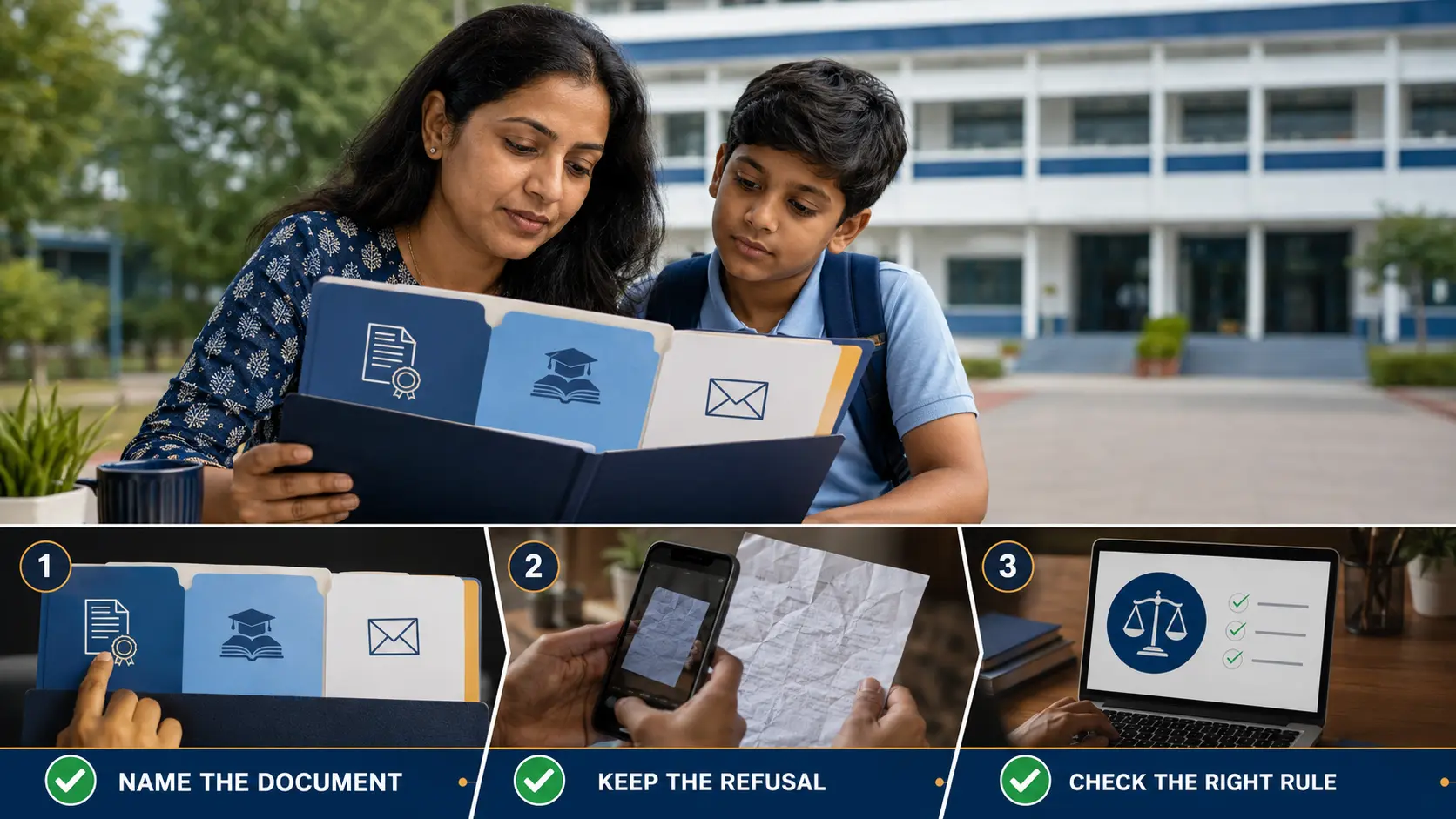
Name the document, preserve the refusal, identify the applicable rule and use the authority with jurisdiction over that exact issue.
Editorial interpretation: many online answers fail because they treat “TC withheld,” “marksheet withheld” and “fees unpaid” as one problem. They are better handled as separate questions that may intersect but can have different issuers, legal rules and solutions.
ThePulseSignal reviewed Section 5 of the Right of Children to Free and Compulsory Education Act through India Code, CBSE’s published admission procedure concerning Transfer Certificates, current CBSE examination-document resources and CBSE’s digital-document/DigiLocker framework. The national guide deliberately does not generalise state-specific school-record rules that require separate verification.
Sources checked
Limitations and unresolved facts
This is a national problem-resolution guide, not a declaration that one TC rule applies to every school in India.
- State education rules may create additional rights, obligations or complaint routes.
- The RTE transfer provision has statutory scope and should not be expanded beyond it.
- CBSE rules do not replace every state education requirement.
- A school-issued report card is different from a Board-issued marksheet-cum-certificate.
- Fee liability and the right to obtain a particular document may need to be analysed separately.
- Other Boards may have different digital-document or transfer procedures.
- The predefined TPS cluster pages linked above should be indexed only after their own verification and publication gate is completed.
School refusing TC or marksheet in India: FAQs
Can a school refuse to give a Transfer Certificate because fees are unpaid?
There is no safe one-line India-wide answer. CBSE’s published admission procedure refers to a leaving student receiving the TC on payment of all dues, while the RTE Act contains specific transfer protections where its Section 5 framework applies. The child’s class, school, Board and state therefore matter.
Can a new school deny admission because the TC is delayed?
Where RTE Section 5 applies, the Act says delay in producing the TC should not be a ground for delaying or denying admission. Outside that statutory context, check the applicable Board and state admission rules. If this becomes an RTE grievance, use the RTE school complaint India guide.
Can I get my CBSE marksheet from DigiLocker?
CBSE has an established DigiLocker process for Class X and XII digital marksheet-cum-certificates and migration certificates. Check the current Board instructions for your examination year.
Is a Transfer Certificate the same as a migration certificate?
No. A TC is generally issued by the school when a student leaves, while a migration certificate is a Board-related academic document used in applicable transitions.
Where can I complain if a private school refuses TC?
The correct external authority can depend on the state, school type, Board and whether RTE provisions apply. Preserve the written request and refusal, then use the India school complaint router if you are unsure which authority applies.
What if the school only refused verbally?
Send a written request and ask for a written response. This creates evidence of what document was requested and the reason, if any, for refusing it.
Can I complain to CBSE if my CBSE school refuses a document?
Potentially where the issue falls within CBSE’s jurisdiction, but not every school-record or fee dispute is exclusively a Board matter. If the problem concerns the school’s actual affiliation status, see the school affiliation and recognition complaint guide.
What should I do if another school’s admission deadline is approaching?
Keep the admission deadline or request in writing, identify whether the RTE transfer protection applies, and escalate promptly with the old-school request and the new-school requirement attached. If your earlier complaint has already been ignored, continue through the school complaint escalation guide.
Last primary-source review: August 11, 2026.