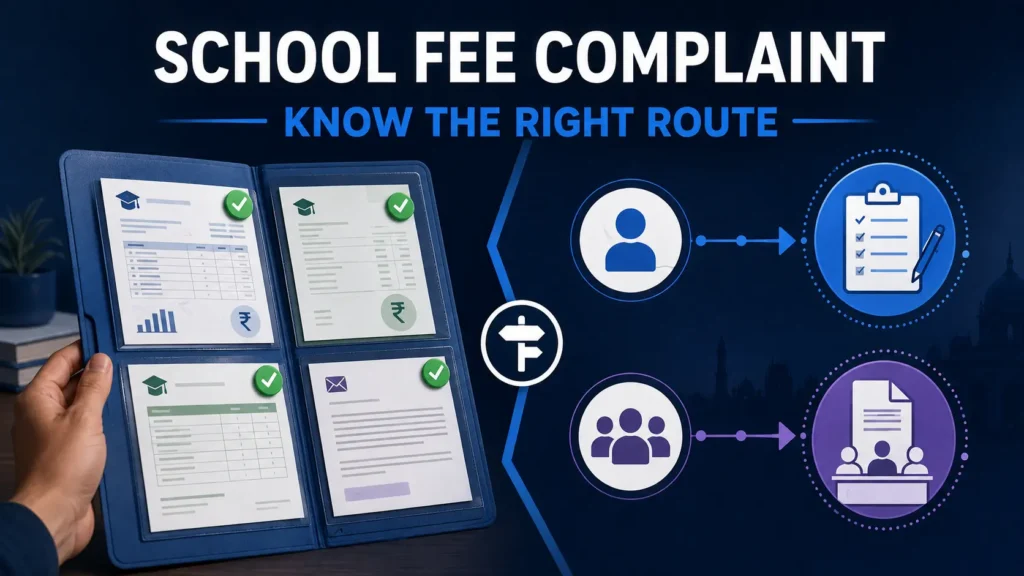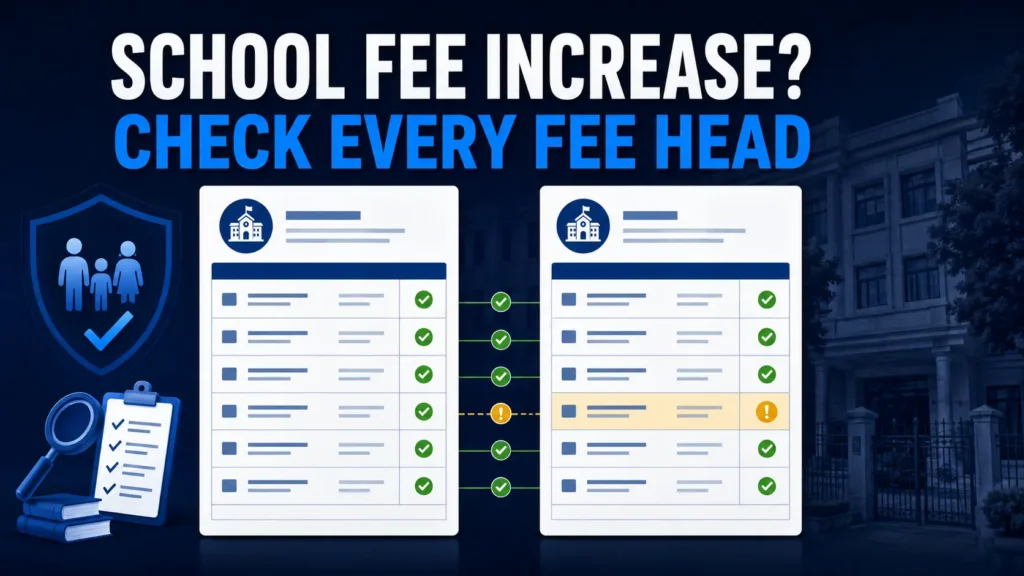





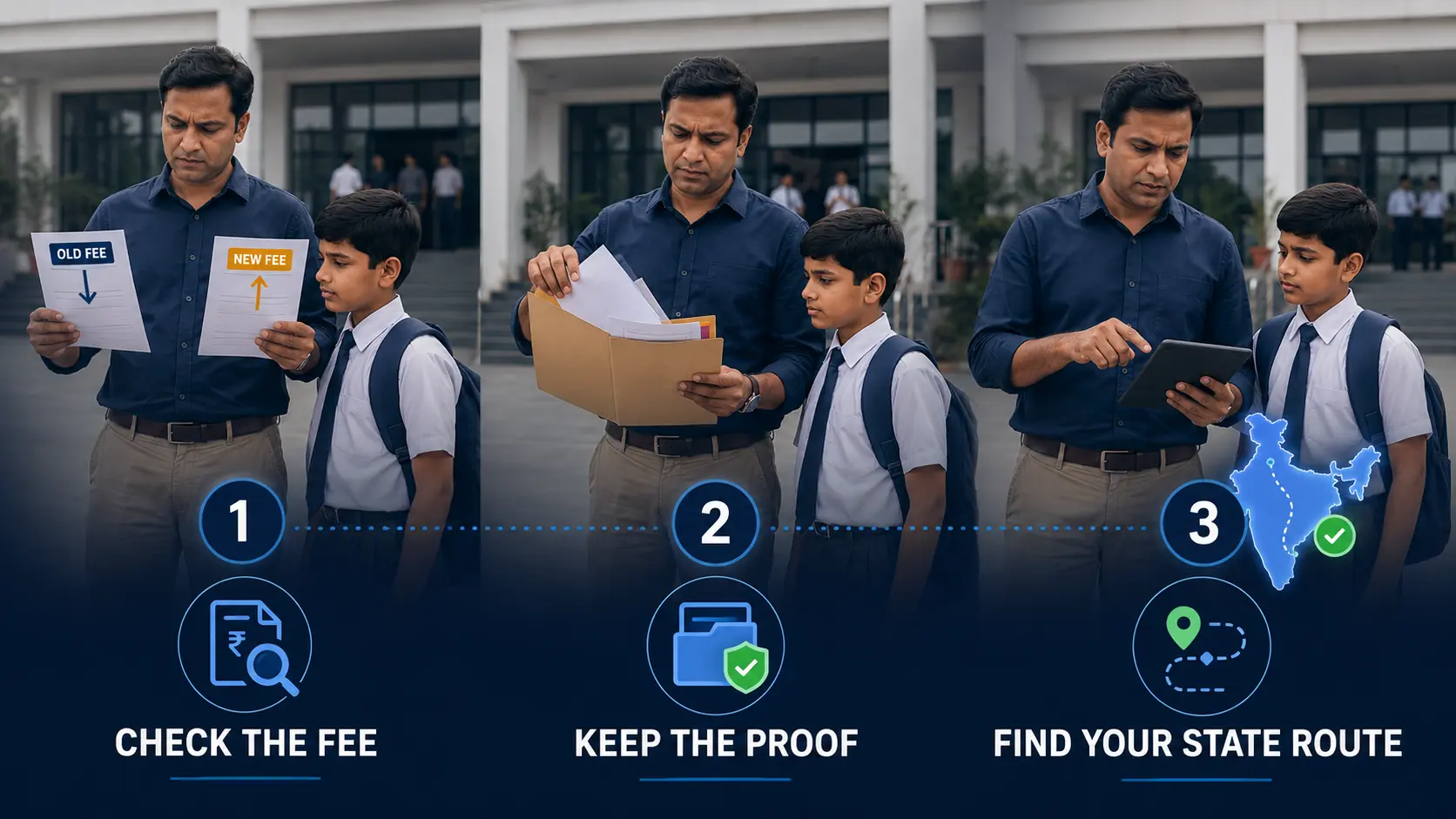
Private school fee complaint in India is not governed by one national complaint process. A fee hike that can be challenged through a statutory committee in one state may be handled differently in another. Before refusing a charge, demanding a refund or escalating a complaint, parents should first identify exactly what changed and which state rule applies.
The practical question is not simply, “Are private schools allowed to increase fees?” It is: what fee changed, what was disclosed, which law or school process applies, what evidence do you have, and which authority can actually review it?
Direct answer
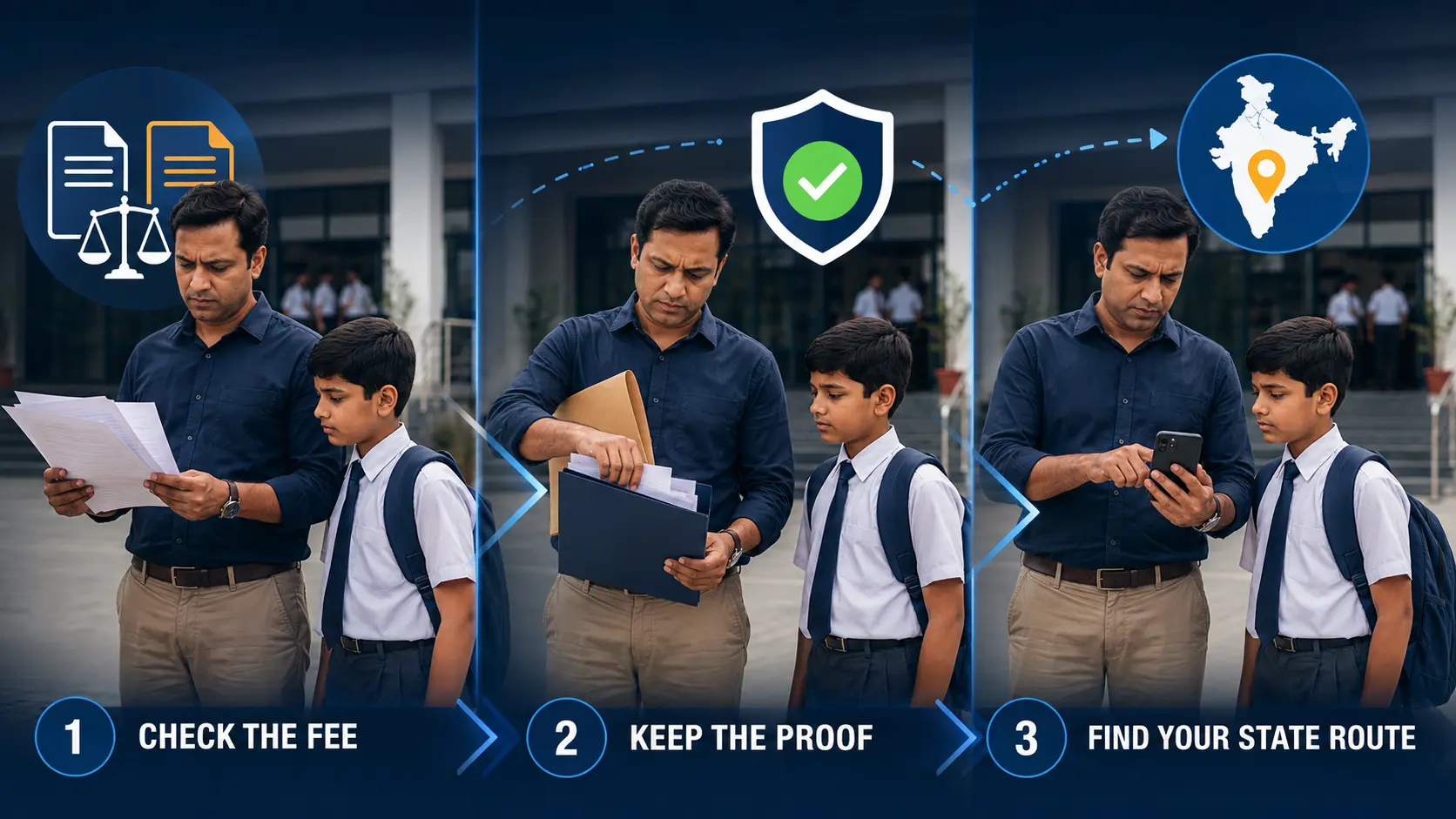
If you believe a private school fee is improper, do not begin by assuming every increase is illegal. Ask the school for the current fee structure and basis for the charge, compare it with earlier notices and receipts, preserve the documents, and then check the complaint mechanism that applies in your state.
Some states have statutory fee-regulation committees or authorities. Others rely more heavily on education-department oversight or different legal frameworks. This is why a Delhi, Maharashtra or Uttar Pradesh remedy should not automatically be copied to another state.
If you are unsure whether your problem is really a fee dispute, a document-withholding issue, an RTE grievance or a broader school complaint, start with the India school complaint router.
Compare the old and new fee structure and check whether your state imposes a process, disclosure requirement or regulatory review.
Identify whether it is tuition, annual, development, activity, transport, technology, examination or another separately described charge.
Preserve the admission communication, prospectus, offer letter and receipts before disputing the later amount.
A refund question is different from whether the original fee was lawfully fixed. Check what payment was made, why you want it returned and which state or school rule applies.
Separate the underlying fee dispute from any action allegedly taken against the child. The second issue may require a different complaint route.
The validity of the fee claim and the school’s ability to withhold a particular document should be analysed separately.
Seven checks before filing a private school fee complaint in India
Identify the exact charge you are challenging
Do not write only “school fees are too high.” Record the exact fee head, amount, academic year and whether it is new, increased or being collected differently.
Compare the previous and current fee structure
Keep the previous year’s notice or receipts alongside the current demand. This helps show whether the dispute concerns a new fee, an increase, arrears or another payment condition.
Ask the school for the basis of the fee in writing
A written reply can clarify whether the school considers the charge part of tuition, development, transport, an optional service or another approved head.
Check the law or fee-regulation system in your state
This is the most important legal step. India does not use one national private-school fee law.
Identify who is actually allowed to complain
Some state mechanisms operate through parents, Parent-Teacher Associations, district committees or specific statutory processes. Do not assume every parent can approach every committee in exactly the same way.
Preserve the complaint and acknowledgement
Keep the email, portal reference, stamped copy or other proof showing when the dispute was raised.
If the school or education authority has already ignored your complaint, preserve that first record and continue through the school complaint escalation India guide.
Ask for a specific remedy
State whether you want an explanation, correction of the fee demand, review by the competent authority, refund consideration or another clearly defined outcome.
Do not simply stop paying because an online article says a fee is illegal. Whether a fee is permitted, reviewable or refundable depends on the applicable state framework and facts of the case.
Private school fee rules are different across India
Several states have created specific statutory fee-regulation frameworks, but those frameworks are not identical.
| Example | What the official framework shows | Why parents should care |
|---|---|---|
| Delhi | Delhi operates its own private-school fee-regulation framework and has school-level and district-level mechanisms under its current regime. | A Delhi parent’s route should follow the current Delhi framework rather than generic India advice. |
| Maharashtra | The Maharashtra Educational Institutions (Regulation of Fee) Act provides for Parent-Teacher Associations, Divisional Fee Regulatory Committees and a revision structure. | The law creates a structured statutory process rather than a generic “complain to education department” route. |
| Uttar Pradesh | The Uttar Pradesh Self-Financed Independent Schools (Fee Regulation) Act provides for District Fee Regulatory Committees and a State appellate authority for schools covered by the Act. | Parents must check whether the school and fee fall within the Act’s scope before assuming the committee route applies. |
| Telangana | Current state fee-disclosure and school-education requirements need to be checked against the applicable academic-year directions. | Fee transparency can help establish what the school disclosed, but disclosure should not be confused with a national rule controlling every increase. |
| Karnataka | The complaint and regulatory route must be verified independently rather than copied from states with dedicated fee-regulation statutes. | A Maharashtra or Delhi process should not be presented as the Karnataka route without current state verification. |
Editorial interpretation: the phrase “private school fee complaint India” hides several different legal systems. The useful national answer is therefore not one regulator’s phone number. It is a decision process that gets the parent from the disputed charge to the correct state mechanism.
What documents should you collect before challenging a school fee?
Current fee notice
Preserve the document showing the amount currently being demanded and each fee head.
Previous fee structure
Keep last year’s notice, invoice or receipts to establish what changed.
Admission documents
Keep the prospectus, admission offer, declaration or fee information supplied when the child joined.
Payment receipts
Preserve receipts for disputed and earlier payments rather than relying only on memory or verbal explanations.
Written correspondence
Keep emails, letters and relevant messages asking the school to explain or review the charge.
Complaint acknowledgement
Save the portal ID, reference number, stamped copy or email proving that the complaint was submitted.
Is every private school fee hike illegal?
No.
The existence of a fee increase does not, by itself, prove that the school has violated the applicable law.
The real questions can include:
- whether the school followed the process required in that state;
- whether the relevant parent or fee-regulation mechanism was involved where required;
- whether the fee was properly disclosed;
- whether prohibited or excessive amounts are alleged;
- whether the school falls within the statute’s scope; and
- whether a regulator or committee has authority to review the dispute.
Can parents get excess school fees refunded?
Potentially, under some state frameworks — but there is no universal India-wide refund rule.
For example, Maharashtra’s statutory framework provides a formal fee-regulation mechanism with powers concerning fee disputes and remedies in circumstances covered by the Act.
That does not mean the same remedy or procedure exists automatically in every state.
Parent rule: ask separately: “Can this fee be challenged?” and “Can money already paid be refunded?” They are related questions, but they are not always legally identical.
What if the school withholds TC, marksheet or another document because of fees?
This is where two TPS problem pages should work together.
Do not collapse these into one question:
1. Is the school’s fee demand valid under the applicable framework?
2. Can the school withhold this particular document in this child’s circumstances?
A fee dispute does not automatically answer the document question.
Next route: if the school is withholding a Transfer Certificate, marksheet, migration record or another school document because of disputed dues, continue with the School Refusing TC or Marksheet in India guide.
What if the school pressures or targets your child because fees are disputed?
A dispute about the amount payable and an allegation about how a child is being treated should be recorded separately.
For example, a parent may dispute a fee but separately allege humiliation, exclusion, document withholding, classroom pressure or another action involving the child.
That second issue may require a different route from the fee-regulation mechanism.
If you are unsure which authority should handle that second issue, use:
Where to Complain Against School in India: Find the Right Route
If an earlier written complaint about the treatment of the child has already been ignored, use the school complaint escalation guide.
Where should parents complain first?
For an ordinary fee dispute, putting the issue to the school or management in writing is usually useful because it records:
- the fee being challenged;
- the parent’s reason;
- the school’s explanation; and
- whether the matter was resolved internally.
But the next external route should come from the state’s actual fee-regulation or education framework, not from a generic national complaint template.
If you do not know whether the matter belongs to a fee regulator, district education authority or another school complaint route, return to the national school complaint router.
What if the school or authority ignores your fee complaint?
Do not file disconnected complaints repeatedly.
Keep the first complaint, acknowledgement and any response, then show the next authority:
- what fee you challenged;
- when you challenged it;
- which documents you submitted;
- what the school or authority replied;
- what remains unresolved; and
- what remedy you are requesting now.
Already complained? Continue with the predefined School Complaint Escalation in India guide instead of restarting from zero.
State fee complaint guides
Delhi
TPS already has a verified Delhi fee complaint guide covering the Delhi-specific process.
Karnataka
Predefined state page. TPS will validate Karnataka’s current legal and administrative route before indexing it.
Maharashtra
Predefined page for Maharashtra’s statutory fee-regulation and complaint process.
Telangana
Predefined page for Telangana fee disclosure, complaint and escalation rules.
Uttar Pradesh
Predefined page for District Fee Regulatory Committee and state-appellate routes where applicable.
Tamil Nadu
Predefined page. Current state fee-fixation and complaint procedures must be independently verified before indexing.
Gujarat
Predefined page for Gujarat’s state fee-regulation structure after current-source validation.
Other states
TPS will add state routes only after verifying the current regulator, legal scope, complaint process and escalation mechanism.
Cluster status: predefined state links are part of the planned school-resolution architecture. They should be indexed only after the underlying state route is verified and the page provides substantial standalone value.
Related school-problem guides
A fee dispute can overlap with another school problem. Use the page that owns the second problem rather than forcing everything into the fee complaint.
What should parents avoid doing?
Assuming “high fee” means “illegal fee”
Affordability and legal compliance are different questions.
Using another state’s fee cap
A percentage or committee rule from Delhi, Uttar Pradesh or Maharashtra should not be applied nationally.
Challenging without documents
A fee notice and old/new comparison are far more useful than a complaint that says only “fees increased too much.”
Ignoring statutory scope
Some fee laws apply only to particular schools, fee levels or categories.
Confusing complaint with refund
An authority capable of reviewing a fee may have different powers concerning money already paid.
Turning a fee dispute into unsupported accusations
State the amount, documents and process problem. Avoid alleging fraud or criminality without evidence.
Verification notes: what is confirmed, state-specific and unresolved
Confirmed
India does not operate one uniform private-school fee complaint regime. States can use materially different statutory or administrative structures.
State-specific
Who can complain, which schools are covered, how fees are determined, committee powers, appeal routes and refund mechanisms can differ materially.
Not safe to generalise
There is no one national fee cap, one national complaint portal or one universal rule allowing parents to stop payment.
Parent takeaway
Identify the exact charge, preserve the documents and use the law and complaint route of the state where the school operates.
Editorial interpretation: the strongest national guidance is not a single legal answer. It is a repeatable verification workflow that helps parents move from “this fee feels wrong” to “this is the exact charge, this is what changed, and this is the state authority that can review it.”
ThePulseSignal reviewed state-law and official-source material showing materially different private-school fee-regulation structures, including the Maharashtra Educational Institutions (Regulation of Fee) Act, the Uttar Pradesh Self-Financed Independent Schools (Fee Regulation) Act and Delhi education-department fee complaint material. State-specific claims should be rechecked immediately before the cluster is published and indexed.
Sources checked
Limitations and unresolved facts
This article is an India-level routing guide. It does not replace verification of the current law in the state where the school operates.
- Private-school fee laws differ by state.
- Some statutory fee frameworks apply only to defined categories of schools or fee levels.
- The legal meaning of “excess,” “permitted,” “approved” or “regulated” fee depends on the applicable statute and facts.
- Refund powers differ between state mechanisms.
- Complaint procedures and appeal routes can change through amendments, rules, orders or court decisions.
- A parent’s inability to afford a fee does not by itself establish that the fee is unlawful.
- A fee dispute, document dispute and alleged mistreatment of a child may require separate complaint routes even when they arise from the same underlying disagreement.
Private school fee complaint in India: FAQs
Where can I complain about high private school fees?
The external route depends on your state. Some states have statutory fee-regulation committees or authorities, while others use different education-department mechanisms. If you do not know which authority applies, start with the India school complaint router.
Can a private school increase fees every year?
There is no one India-wide rule answering that question. The permitted process, frequency and regulatory controls depend on the applicable state law and school category.
Can I refuse to pay an increased school fee?
Do not assume that filing a complaint automatically suspends the amount demanded. Check the applicable state law, any interim protection available and the terms governing the fee before taking that step.
Can parents get excess school fees refunded?
Some state frameworks can provide refund-related remedies in specified circumstances, but there is no universal India-wide refund procedure.
Can a school hold my child’s TC because fees are disputed?
Do not treat the fee question and the TC question as automatically identical. The applicable rule can depend on the child’s class, school, Board and state. See the school refusing TC or marksheet India guide.
Should I complain to CBSE about a fee hike?
Not automatically. Fee regulation can remain a state-level matter even where a school is CBSE-affiliated. Identify whether the dispute is actually within CBSE’s jurisdiction before choosing that route.
What documents should I attach to a fee complaint?
Usually the most useful evidence includes the current fee demand, previous fee structure, receipts, admission documents, written questions to the school and any response received.
What if my fee complaint has already been ignored?
Keep your earlier complaint and acknowledgement and continue through the correct higher authority rather than filing disconnected complaints. Use the school complaint escalation India guide.
What if my child is being targeted because I challenged fees?
Record the fee issue and the alleged treatment of the child separately. If the conduct becomes a safety, discrimination or child-rights concern, use the appropriate school-complaint route rather than treating it only as a fee calculation dispute. Start with the national school complaint router if you are unsure where it belongs.
Last primary-source review: August 11, 2026.