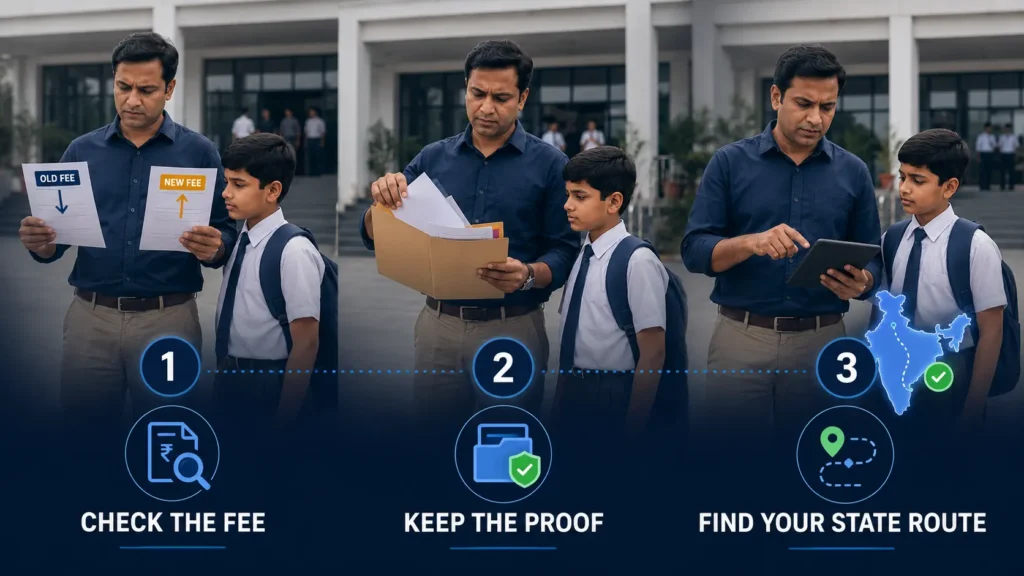





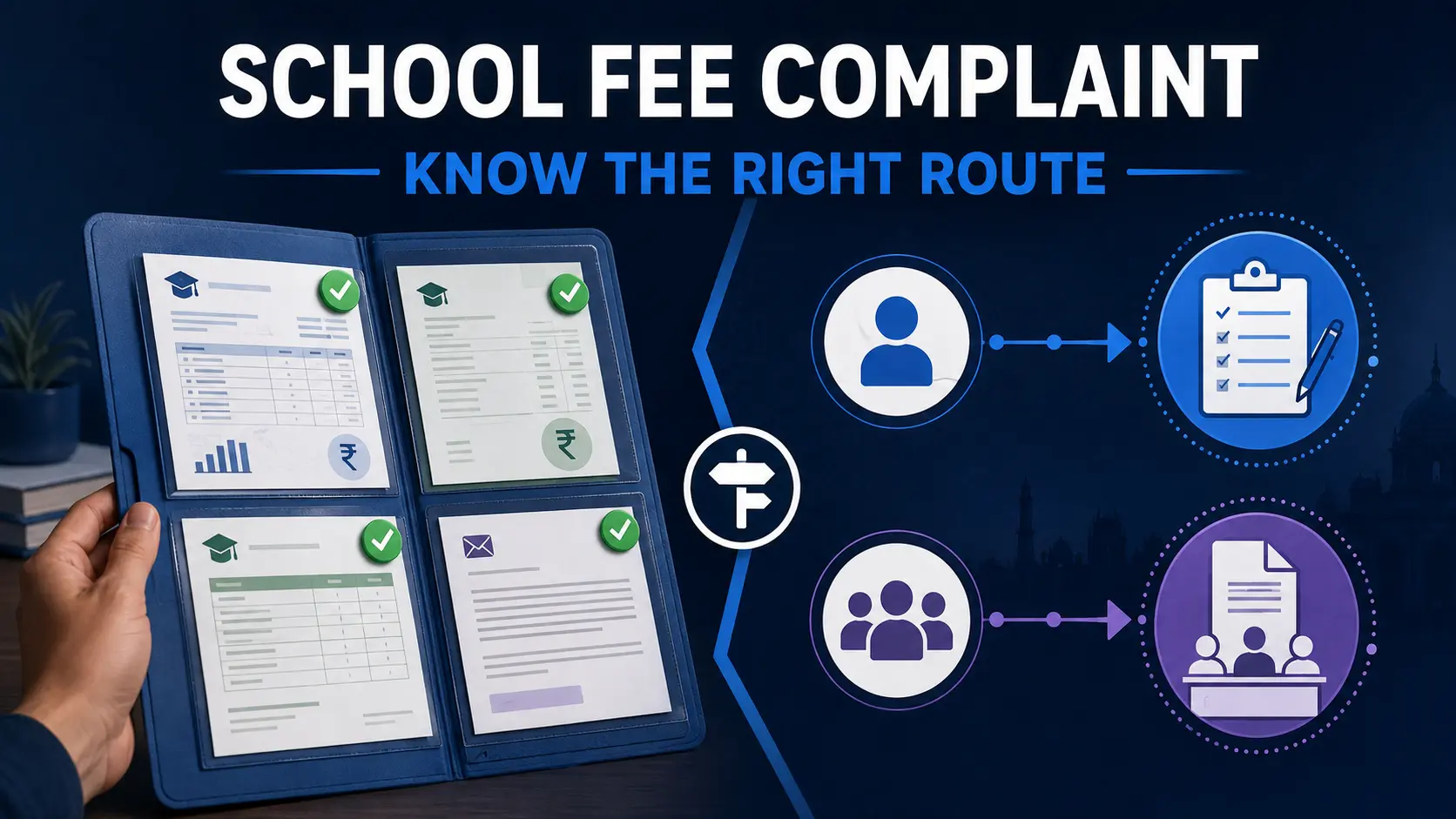
Delhi school fee complaint options depend on what exactly you are challenging. An individual parent can currently send a school-fee-hike concern through the Delhi Education Department’s official Fee Review Committee feedback form, while a formal statutory appeal against a School-Level Fee Regulation Committee decision has a different rule: the Delhi fee law defines an eligible aggrieved parents group as at least 15% of the affected parents and gives that group 30 days to appeal.
Parents should therefore avoid treating every email, complaint form and statutory appeal as the same process. This guide shows which route fits which problem, what evidence to preserve, how refund and rollback powers work, and what a school cannot do to a student when the fee involved was not determined according to the Act.
Direct answer
You do not always need 15% of parents just to report a concern
Delhi’s Education Department currently provides a fee-hike feedback form for parents. The 15% threshold belongs to the separate statutory definition of an “aggrieved parents group” that can appeal an SLFRC decision.
Confirmed from the Act
Formal SLFRC appeal: 30 days
An eligible aggrieved parents group can appeal an SLFRC decision to the District Fee Appellate Committee within 30 days in the prescribed manner.
Potential remedy
Rollback and refund are possible
If the Director of Education finds that a school has levied fee contrary to the Act and Rules, the Act provides for rollback and refund of excess fee within 20 working days or earlier.
Do not assume
A disputed bill is not automatically cancelled
Submitting a complaint does not by itself establish that a fee is unlawful or mean a parent should simply stop paying every disputed amount. The applicable fee structure and correct remedy route still matter.
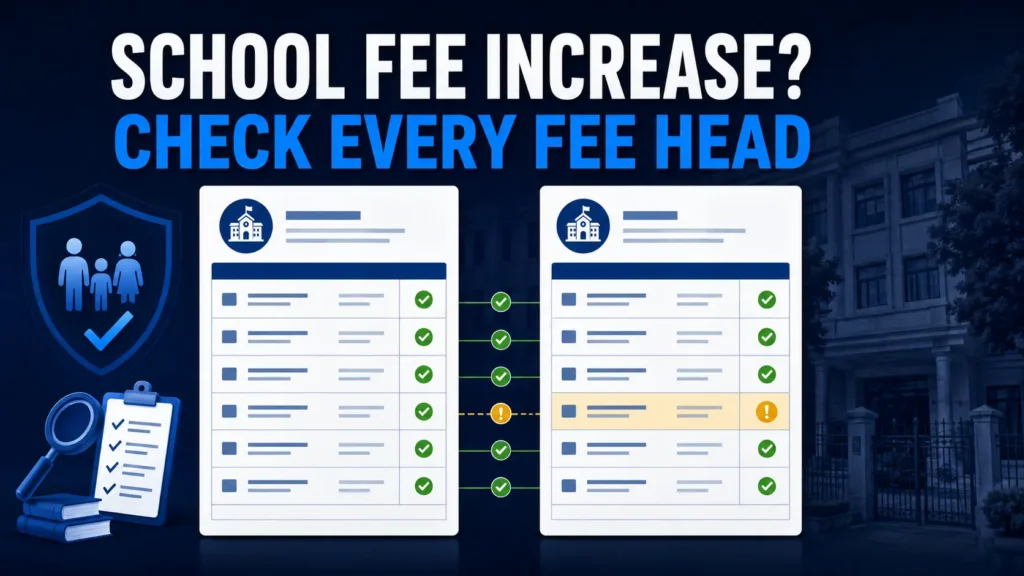
Before filing a Delhi school fee complaint, check what is actually wrong
A complaint becomes much stronger when it identifies the precise mismatch.
Before choosing a portal or appeal route, compare the school’s demand with the fee structure that applies to the school.
Ask:
- Which fee head is being charged?
- Is the amount compulsory?
- Does that fee head appear in the approved fee structure?
- Has the amount increased?
- Is the school collecting more than the amount approved?
- Is the school asking for a newly named compulsory charge?
- Has the school published its approved fee details?
Start here if you have not checked the bill yet: read Delhi Private School Fee Hike: What Schools Can Charge and What Parents Can Challenge. That guide owns the fee-legality and fee-head check; this article owns the complaint, appeal and remedy process.
There are different routes — do not treat all of them as the same complaint
| Your situation | Possible route | Important distinction |
|---|---|---|
| You are one parent concerned about an apparent fee hike | Delhi Education Department Fee Review Committee feedback form | You do not need to label this a statutory 15% parent-group appeal. |
| You want to challenge an SLFRC fee decision under the Act | District Fee Appellate Committee | The Act gives this appeal to an eligible “aggrieved parents group.” |
| The district committee has decided and you remain aggrieved | Revision Committee | The Act provides another 30-day appeal window from the district decision. |
| You allege fee is being collected contrary to the Act | Directorate / statutory regulatory process | The Director has special supervisory and enforcement powers under the Act. |
| You are facing another school grievance outside this exact fee process | General Directorate of Education grievance system may be relevant | Do not substitute a generic grievance for a statutory fee appeal where the Act requires a particular route. |
Can one parent report a private-school fee hike?
Yes, Delhi’s Education Department currently provides an official online form titled “Feedback Regarding School Fee Hike.”
The form sits under the Education Department’s Fee Review Committee system and is addressed to the Justice Anil Dev Singh Committee for review of school fees.
The form asks for information including the subject, the parent’s feedback and contact-related details.
Official fee-hike feedback form: Delhi Education Department — Feedback Regarding School Fee Hike.
This is useful when an individual parent wants to place a fee-hike concern before the current review mechanism.
But it should not be confused with the separate statutory appeal against an SLFRC decision.
Key distinction: “I want to report this fee hike” and “I am formally appealing an SLFRC decision under Section 5” are not necessarily the same legal step.
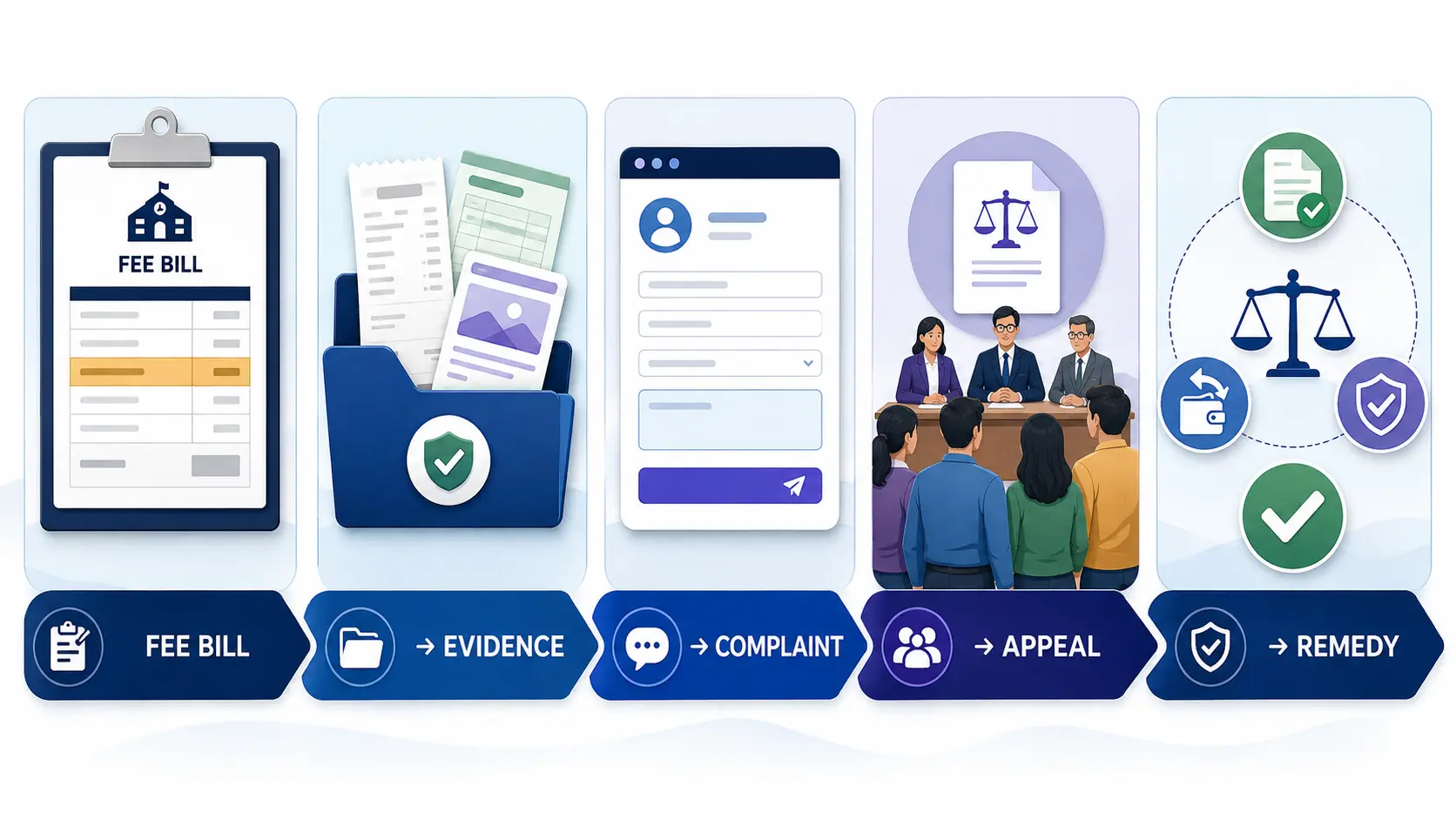
What documents should parents save before complaining?
Do not rely only on a phone call or verbal conversation.
Preserve:
- the latest fee circular;
- the fee invoice or demand notice;
- previous fee receipts for comparison;
- the approved fee structure published by the school, if available;
- screenshots of the school’s fee page;
- emails, WhatsApp messages or portal notices describing the increase;
- payment receipt if you already paid the disputed amount;
- communication showing that a supposedly optional charge was compulsory;
- any SLFRC decision you want to challenge;
- the date on which that decision was communicated;
- communications relating to threats to results, classes or continued enrolment.
The date of the SLFRC decision is particularly important because the statutory appeal window is time-limited.
When does the 15% parent rule apply?
This is where parents can easily misunderstand the law.
The Delhi School Education (Transparency in Fixation and Regulation of Fees) Act, 2025 defines an “aggrieved parents group” as a group of parents comprising not less than 15% of the total parents of students in the affected class or school, as applicable, who are aggrieved by a decision under the Act.
Section 5 then provides that an aggrieved parents group may appeal the decision of the School-Level Fee Regulation Committee to the District Fee Appellate Committee within 30 days.
Therefore: the 15% rule is crucial for the statutory parent-group appeal. It should not be rewritten as “a single parent cannot complain about school fees.” Delhi currently has a separate fee-hike feedback channel that an individual parent can use.
How does the District Fee Appellate Committee route work?
The District Fee Appellate Committee is not simply a school grievance inbox.
Under the Act, it adjudicates fee disputes involving an aggrieved parents group, school management or the Parent-Teacher Association.
The statutory committee includes:
- the Deputy Director of Education of the district as chairperson;
- Deputy Director of Education (Zone) as member secretary;
- a chartered accountant;
- a zonal or district accounts officer;
- two representatives of schools; and
- two parent representatives.
The committee also has significant inquiry powers. For specified purposes, the Act gives it powers comparable to those of a civil court, including summoning witnesses, requiring documents and receiving evidence on affidavit.
How quickly should the district committee decide?
The Act says the District Fee Appellate Committee should communicate its fee-determination decision within 30 days of receiving the appeal and not later than 45 days in the same academic year.
If that does not happen within the statutory period, the matter is to be automatically referred to the Revision Committee.
Can parents challenge the District Fee Appellate Committee decision?
Yes, the Act provides a further revision route.
An aggrieved parents group, management or PTA that is dissatisfied with a District Fee Appellate Committee decision may appeal to the Revision Committee within 30 days of that decision, following the prescribed procedure.
The Act says the Revision Committee’s decision is final and binding on the parties for three academic years, and the committee is to endeavour to determine the fee within 45 days of receiving the appeal.
Do not wait casually: both the SLFRC-to-district appeal and district-to-revision appeal contain 30-day statutory windows. Parents considering those routes should preserve the exact decision date and obtain the prescribed procedure/form applicable at that time.
I already paid the increased fee. Can I get a refund?
A refund is possible under the Act, but it is not automatic merely because a parent disputes the charge.
Section 12 provides that where a school is found to be collecting fee not determined in accordance with the Act and Rules, the Director of Education shall direct the school to roll back such fee with immediate effect and refund the excess fee to the student or students within 20 working days or earlier.
The Act also provides financial penalties:
| Situation | Potential consequence under the Act |
|---|---|
| Fee found not determined according to the Act/Rules | Immediate rollback and refund of excess fee within 20 working days or earlier. |
| First violation | Penalty of at least ₹1 lakh, which may extend to ₹5 lakh. |
| Second or subsequent violation | Penalty of at least ₹2 lakh, which may extend to ₹10 lakh. |
| Failure to comply with rollback/refund direction | The Act provides escalating consequences for continued non-compliance. |
What this means for a parent: keep the payment receipt. If the fee is later found to have been levied contrary to the statutory framework and refund is ordered, proof of what you paid becomes important.
Can a school stop classes, withhold results or remove a child’s name over disputed fees?
The Act contains a specific prohibition on fee recovery through coercive means.
Section 13 says a school shall not harass or coerce a student for non-payment or delayed payment of fees through measures including:
- striking the student’s name from the rolls for non-payment of fees not determined according to the Act;
- withholding examination results;
- denying access to education, classes or activities; or
- public humiliation or psychological harassment.
The Act provides a penalty of ₹50,000 per violation for every affected student, subject to the statutory opportunity-of-hearing process.
Important qualification: the statutory wording matters. Parents should not convert Section 13 into a general claim that no school can ever act on any legitimately due fee. The protection must be read in the context of the Act and the particular fee dispute.
What should you save if a child is being pressured?
- written notices from the school;
- emails or portal messages;
- screenshots relating to results or classroom access;
- any notice threatening removal from rolls;
- dates and details of verbal incidents;
- the disputed fee bill and applicable fee structure.
If there is an immediate issue affecting the child’s education, the parent should state that clearly in the grievance rather than filing only a generic “fee too high” complaint.
Delhi school fee complaint: 7-step parent workflow
-
Check the charge before complaining
Compare each compulsory fee head with the applicable approved fee structure. If you have not done that, use the Delhi private school fee-hike checker. -
Save the evidence
Download or photograph the fee circular, current bill, old bill, approved fee structure, payment receipt and relevant school communications. -
Write the problem precisely
State which fee head changed, the old amount, new amount, why you believe it does not match the approved structure and what remedy you are asking for. -
Use the appropriate immediate channel
For an individual school-fee-hike concern, Delhi currently provides the official Fee Review Committee feedback form. -
If challenging an SLFRC decision, check the 15% and 30-day requirements
A statutory appeal to the District Fee Appellate Committee belongs to the eligible aggrieved parents-group route described in the Act. -
Keep proof of submission and track dates
Save the complaint text, screenshots, acknowledgement number or copy of the appeal, and note every statutory deadline. -
Escalate through the statutory route where applicable
If the District Fee Appellate Committee decision remains disputed, the Act provides a further appeal to the Revision Committee within 30 days, subject to the prescribed procedure.
What if the school fee is lawful but you cannot afford it?
A complaint is not the right tool merely because a valid school fee is financially difficult for the family.
That is an affordability problem rather than necessarily a fee-regulation violation.
Delhi fee reimbursement and scholarships
Use the cluster’s financial-help guide to check school-level tuition-fee reimbursement, pre-matric support and the official application portals relevant to eligible Delhi students.
Check whether the fee itself is compliant
If you are unsure whether annual, development, activity or another compulsory charge matches the approved fee structure, return to the fee-legality guide.
Keep the three questions separate:
Is this charge allowed? → fee-hike checker.
How do I challenge it? → this complaint guide.
The fee is valid but I cannot afford it → reimbursement and scholarship guide.
Verification notes: what is confirmed, reported and interpreted
Confirmed
15% parent-group definition
The official Delhi Act defines an aggrieved parents group as at least 15% of affected parents for the statutory route described in the Act.
Confirmed
30-day statutory appeal
The Act permits an eligible aggrieved parents group to appeal an SLFRC decision to the District Fee Appellate Committee within 30 days.
Confirmed
Official individual feedback form exists
The Delhi Education Department currently publishes an official “Feedback Regarding School Fee Hike” form under its Fee Review Committee system.
Confirmed
Refund and student protections
The Act contains rollback/refund provisions and a separate prohibition on specified coercive fee-recovery practices.
Editorial interpretation: the biggest practical mistake for parents is treating the 15% statutory appeal rule as though it means an individual parent cannot report a fee-hike concern. Delhi currently provides an individual fee-hike feedback channel, while the formal appeal against an SLFRC decision is a separate statutory process with its own standing and deadline requirements.
Verification method: ThePulseSignal checked the official Delhi Gazette Act for the definition of aggrieved parents group, SLFRC appeal, District Fee Appellate Committee, Revision Committee, Director of Education powers, refund provisions and coercive-recovery protections. The current Delhi Education Department homepage and official fee-hike feedback form were separately checked to verify that the individual fee-feedback channel is currently available.
Sources checked
- Government of NCT of Delhi — Delhi School Education (Transparency in Fixation and Regulation of Fees) Act, 2025
- Delhi Education Department — official website and Fee Review Committee entry
- Delhi Education Department — Feedback Regarding School Fee Hike
- Delhi Education Department — general online complaint and grievance registration
Limitations and unresolved facts
- This guide cannot determine whether a specific school’s fee demand is unlawful without reviewing that school’s approved structure and facts.
- The official fee-hike feedback form and a statutory appeal under the 2025 Act are different mechanisms; using one does not necessarily substitute for the other.
- The exact prescribed form and procedural requirements for a statutory District Fee Appellate Committee appeal should be checked at the time the parent files.
- The article does not advise parents to stop payment merely because a complaint has been submitted.
- The 20-working-day refund provision applies when the statutory finding and direction described in the Act are made; it is not an automatic refund triggered by a parent’s complaint.
- Section 13’s coercive-recovery protections must be read using the Act’s exact context and should not be turned into a blanket rule about every legitimately due school payment.
- The fee-regulation framework has been subject to litigation and implementation changes during 2026, so subsequent court or Directorate orders may change particular procedures.
Delhi school fee complaint: frequently asked questions
Where can one parent complain about a Delhi private-school fee hike?
The Delhi Education Department currently provides an official “Feedback Regarding School Fee Hike” form through its Fee Review Committee system. This is distinct from the formal 15% parent-group appeal route under the Act.
Do I need 15% of parents to file any complaint?
No. The 15% figure is part of the Act’s definition of an aggrieved parents group for the statutory appeal mechanism. An individual fee-hike feedback form is separately available through the Delhi Education Department.
How many parents are needed to appeal an SLFRC decision?
The Act defines the relevant aggrieved parents group as not less than 15% of the affected parents of the class or school, as applicable.
How long do parents have to appeal an SLFRC fee decision?
The Act provides a 30-day window for an eligible aggrieved parents group to appeal an SLFRC decision to the District Fee Appellate Committee.
Can parents appeal again after the District Fee Appellate Committee?
Yes. The Act provides a further appeal to the Revision Committee within 30 days of the district committee’s decision, subject to the prescribed procedure.
Can I get back a fee I already paid?
If authorities find that a school collected fee contrary to the Act and Rules, the Director of Education can direct rollback and refund of excess fees within 20 working days or earlier. A complaint alone does not automatically create a refund.
Can the school withhold my child’s result because of the disputed fee?
Section 13 lists withholding examination results among the prohibited coercive measures in the fee-recovery context covered by the Act.
Can the school stop my child from attending classes?
The Act lists denial of access to education, classes or activities among prohibited coercive means in the circumstances covered by Section 13.
What if I cannot afford the fee but it is legally approved?
Use the separate Delhi school fee reimbursement and scholarships guide. Financial hardship and an unlawful fee demand are different issues.