





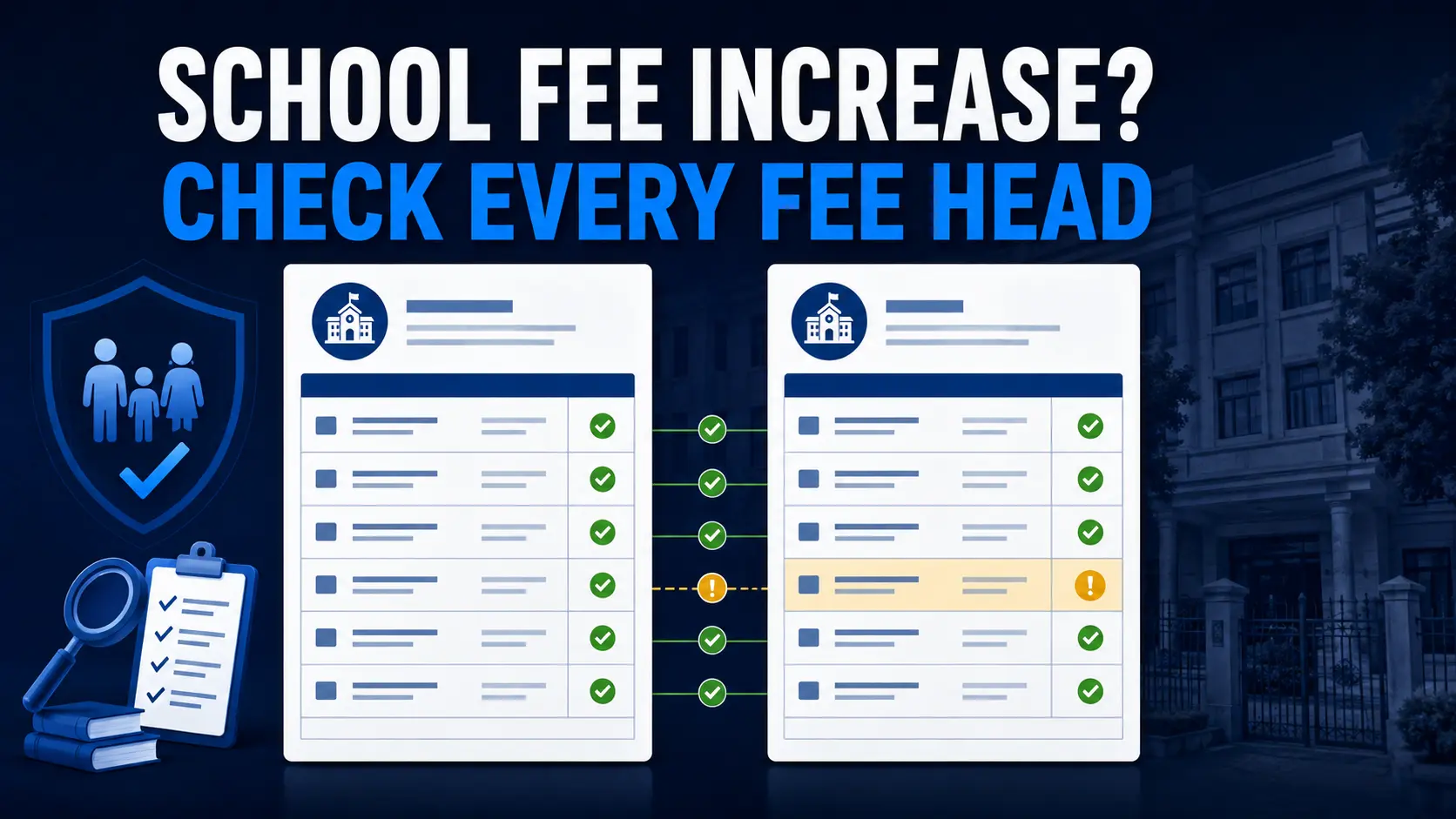
Delhi private school fee hike rules do not become irrelevant simply because a new compulsory amount is called an annual charge, development charge, activity fee or something other than tuition. Under Delhi’s fee-regulation law, schools cannot collect fees above the amount fixed or approved under the statutory process, and the approved structure must identify the different heads under which fees are levied.
That does not mean every extra item on a school bill is automatically unlawful. Parents should first compare the charge with the school’s approved fee structure, determine whether it is compulsory or genuinely optional, and check the current regulatory and court position before treating a disputed amount as illegal.
Direct answer
A renamed compulsory charge is not automatically outside fee regulation
The important question is not only what the school calls the amount. Parents should check whether the charge appears under the approved fee heads and whether the amount matches the fee structure that applies to the school.
Confirmed from Delhi Act
Approved fee must identify different heads
The School-Level Fee Regulation Committee is required to indicate the different heads under which the fee is levied, and the approved fee is binding for three academic years.
Fresh 2026 implementation
Fresh increases remain subject to the new approval process
Fresh reporting says Delhi has again tightened implementation and restricted fresh fee increases until the next structure is formally approved.
Important limitation
Implementation remains legally contested
Private-school associations have continued litigation over the fee-regulation framework and committee directions. Parents should therefore distinguish the statutory protections from the precise procedural position in a particular pending dispute.
1. First check the school’s approved fee structure
The first question should not be simply, “Did tuition fee increase?”
Ask instead:
“Does this amount appear in the fee structure that applies to my school, under the fee head and amount being collected?”
Section 3 of the Delhi School Education (Transparency in Fixation and Regulation of Fees) Act, 2025 says a school cannot collect a fee in excess of the fee fixed or approved under the Act.
The Act also requires the approved fee details to be displayed on the school notice board and, where the school has a website, on that website.
Parent check: keep the latest fee circular or invoice open beside the approved fee structure. Compare the name and amount of every compulsory charge rather than looking only at the tuition-fee line.
2. The law does not talk only about tuition fee
This is an important distinction.
The Act requires the School-Level Fee Regulation Committee to indicate the different heads under which fee shall be levied.
So parents should not assume that a fee-regulation question disappears merely because a school labels an amount:
- annual charge;
- development charge;
- activity charge;
- technology or smart-class charge;
- laboratory or computer charge;
- examination charge;
- another compulsory school fee head.
Those examples do not mean every such charge is prohibited. They mean the parent should identify the relevant fee head and compare it with the applicable approved structure.
Do not use the name of a charge as the legal test. A charge called “activity fee” is not automatically lawful, and it is not automatically unlawful. The relevant question is whether the amount and fee head are supported by the applicable fee structure and rules.
3. What if tuition did not rise, but the school added another compulsory fee?
This is one of the most useful checks for parents.
Imagine a school keeps the tuition-fee line unchanged but introduces or sharply increases another compulsory amount.
Do not jump directly to either conclusion.
The Act’s structure matters because approved decisions are supposed to specify the fee heads. A new compulsory amount therefore deserves comparison with that approved structure rather than being treated as automatically outside the regulation merely because its label is different.
4. Separate compulsory school fees from genuinely optional services
Not every payment connected with school life is necessarily the same type of regulated fee.
For example, a parent may encounter charges relating to transport, books, uniforms, trips, events or other services.
The correct approach is to ask:
- Is the payment compulsory for every student?
- Is it part of the school’s approved fee structure?
- Can the student genuinely opt out?
- Is the service provided separately?
- Is the school making participation in ordinary education conditional on paying it?
Do not assume: this article does not declare transport, books, uniforms, trips or every optional service automatically covered or prohibited. Their treatment can depend on the exact charge, applicable rule, school arrangement and whether the payment is truly optional.
5. Compare the old amount with the new amount
A useful parent record is a simple before-and-after comparison.
| What to record | Previous bill | New bill | What to check |
|---|---|---|---|
| Tuition fee | Write previous amount | Write new amount | Does it match the applicable approved structure? |
| Annual / development fee | Write previous amount | Write new amount | Is the fee head approved and is the amount correct? |
| Activity / technology / other compulsory fee | Write previous amount | Write new amount | Was this fee head already approved or newly introduced? |
| Optional service | Write previous amount | Write new amount | Is opting out actually possible without affecting ordinary education? |
This comparison gives parents something concrete to use if they later need to raise a concern.
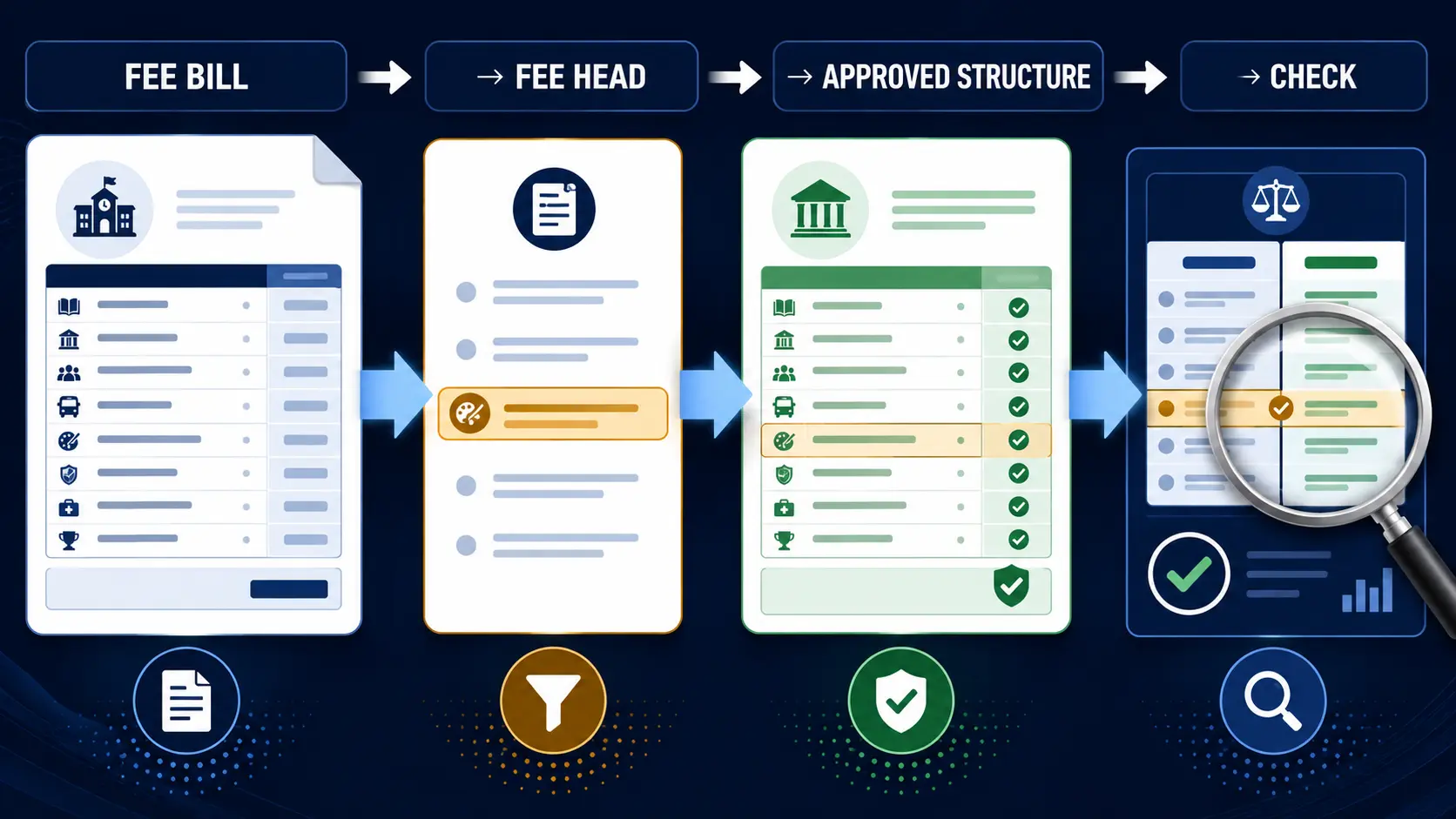
6. Check the notice board and school website
The Act says the approved fee details must be displayed on the school notice board in Hindi, English and the respective medium of the school. If the school has its own website, the approved details must also be displayed there.
The Act additionally requires the list of the School-Level Fee Regulation Committee chairperson and members to be displayed on the notice board and website within the prescribed period after its formation.
Check the fee page
Look for the fee structure applying to the current academic block and compare it against the amount being demanded.
Check the committee information
Look for the SLFRC membership list and any published decision or fee approval relevant to the school.
7. Save evidence before you challenge a fee
Before making a complaint, save documents that show what actually happened.
- school fee circular;
- invoice or fee demand;
- previous year’s comparable fee receipt;
- current approved fee structure, if published;
- screenshot or PDF from the school’s website;
- messages or emails describing the new charge;
- payment receipt if the amount has already been paid;
- any communication showing the charge is compulsory.
This matters because the legal question is easier to examine when the parent can show both the approved structure and the actual demand.
So what can a Delhi private school actually charge?
The safe answer is:
A school may levy the fee determined through the applicable statutory process under the relevant fee heads. The Act does not create one universal rupee fee table for every Delhi school.
The amount can depend on factors such as the school’s location, infrastructure, educational standard, administration and maintenance costs, staff salary components, expenditure on students and reasonable revenue surplus.
The School-Level Fee Regulation Committee can decide the amount afresh when approving the management’s proposal, but under the Act its approved amount cannot exceed the fee proposed by management.
| Parent question | Best answer |
|---|---|
| Can a school charge tuition fee? | Yes, subject to the applicable approved fee structure and law. |
| Can a school have different fee heads? | Yes. The Act expressly contemplates different fee heads, but the applicable structure should identify them. |
| Can the school simply rename an increase? | A different label does not by itself resolve compliance. Compare the compulsory charge with the approved fee heads and amount. |
| Is every new charge automatically illegal? | No. Its nature, approval and applicable rules must be checked. |
| Is every school allowed the same fee? | No. The Act requires school-specific fee determination using prescribed factors. |
What if the school is charging more than the approved structure?
This article’s job is to help you identify the mismatch. The complaint, appeal, refund and child-protection process is covered separately so parents have a step-by-step action page rather than an overloaded legal explainer.
Next step if the charge looks wrong: use ThePulseSignal’s Delhi school fee complaint guide. It covers the parent-group appeal route, District Fee Appellate Committee, refund/rollback powers and protections against coercive fee recovery.
The Act provides significant remedies where a school is found to be levying fee contrary to the statutory process. The Director of Education can order an immediate rollback and refund of excess fees within 20 working days or earlier. It also prohibits specified coercive practices in relation to fees not determined under the Act, including withholding examination results or denying access to education or classes.
Those protections should not be confused with a parent unilaterally deciding that every disputed fee may simply be ignored. The correct complaint and appeal route matters.
What if the fee is valid but your family cannot afford it?
That is a different problem.
A lawful fee and an unaffordable fee are not the same question.
Some Delhi students may qualify for official tuition-fee reimbursement, pre-matric scholarships or other financial-assistance schemes depending on category, class, income and scheme-specific conditions.
Financial-help route: see the predefined Delhi school fee reimbursement and scholarships guide for official application portals, eligibility and exactly what each scheme covers.
A reimbursement scheme should not be treated as permission for a school to levy a fee that is otherwise contrary to the applicable rules. The two questions are separate:
Is the fee lawful? → this article.
How do I challenge it? → Delhi school fee complaint guide.
How can I afford a valid fee? → Delhi school fee reimbursement and scholarships guide.
Other Delhi assistance and scholarship guides
Parents searching for school-fee help may also be looking for broader financial-support schemes. These are separate from the private-school fee-regulation law, but they may be relevant depending on the family’s eligibility.
Delhi Lakshmi Yojana
For families checking eligibility or application status for the Delhi Lakshmi Yojana, see the dedicated TPS guide.
Pink Saheli Card
If the parent or eligible household member is also checking Delhi’s Pink Saheli Card application or deadline status, use the separate guide.
Azim Premji Scholarship
Students and families looking for broader education-support options can also check the eligibility criteria for the Azim Premji Scholarship.
Delhi school fee reimbursement
For school-level tuition-fee reimbursement, pre-matric support and relevant official application portals, use the dedicated Delhi school-fee support hub.
Important: these schemes do not determine whether a private school’s fee demand is lawful. A family may qualify for financial assistance even when the fee itself is valid, while an unlawful fee demand should still be challenged through the appropriate school-fee complaint route.
Current court and implementation status
Delhi’s fee-regulation framework has faced continuing legal challenges from private-school associations.
Earlier in 2026, the Delhi High Court deferred aspects of the SLFRC implementation while challenges were pending. The Directorate later issued fresh directions, and litigation continued in July around those renewed directions.
Fresh August reporting says Delhi has again moved to enforce a timetable for fee committees and restrict fresh increases until the new structure is approved.
Why this matters: the 2025 Act remains the primary statutory source for the rights and fee-regulation framework described here, while the exact procedural effect of individual implementation directions may depend on subsequent court orders. ThePulseSignal will update this page if a controlling Delhi High Court, Supreme Court or Directorate order changes the position.
Verification notes: confirmed, reported and interpreted
Confirmed
The Act regulates fee collection
No school may collect fee above the amount fixed or approved under the Act. Approved fee decisions must identify the different fee heads.
Confirmed
Approved fee must be published
The approved fee must be displayed on the notice board and, where a school has a website, on that website.
Reported current implementation
Fresh increases restricted pending approval
August 2026 reporting describes a renewed Delhi implementation timetable and a restriction on fresh increases until the new fee structure is fixed.
Unresolved / legally dynamic
Exact effect of pending litigation
The fee-regulation framework and SLFRC implementation have been challenged in court. Later court orders may affect particular procedural directions.
Editorial interpretation: for a parent checking a bill, the useful legal distinction is not “tuition fee versus everything else.” The Act regulates the approved fee structure and expressly requires identification of different fee heads. A parent should therefore compare every compulsory fee demand with the applicable approved structure before deciding whether it appears compliant.
Verification method: ThePulseSignal used the official Delhi Gazette text of the 2025 Act for the underlying fee rules, fee-head requirement, approval process, refund and coercive-recovery protections. Fresh 2026 implementation and litigation were kept separately attributed because the exact current procedural position has evolved through government directions and court proceedings.
Sources checked
Limitations and unresolved facts
- The article does not determine whether an individual school’s specific charge is lawful without reviewing that school’s approved structure and circumstances.
- The Act does not provide one universal rupee fee schedule for every Delhi private school.
- The article does not treat every transport, uniform, book, excursion or optional-service payment as automatically covered by the same fee head.
- The precise legal effect of current SLFRC implementation directions remains subject to evolving court proceedings.
- The fresh August implementation order has been reported by major media, but the exact current order was not independently recovered as a directly accessible DoE document during this verification pass.
- Parents should not stop paying a disputed amount solely because of this explainer; the statutory complaint and appeal route should be considered where a charge appears inconsistent with the applicable structure.
- The Delhi Lakshmi Yojana, Pink Saheli Card and Azim Premji Scholarship links above are separate assistance resources. They are not part of the Delhi private-school fee-regulation mechanism and should not be interpreted as fee-waiver rights under the Act.
Delhi private school fee hike: FAQs
Can a Delhi private school increase tuition fee in 2026?
A school cannot simply treat a new increase as unrestricted. The amount must comply with the applicable fee-regulation process and current implementation position.
What if tuition remains the same but the annual charge increases?
Check whether the annual charge is an approved fee head and whether the amount matches the structure applying to the school. The fee-regulation framework is not limited only to the word “tuition.”
Can a school create a new “activity fee” or “technology fee”?
Do not assume that a new label makes a compulsory charge lawful or unlawful. Compare it with the approved fee heads, amount and applicable rules.
Where can I see my school’s approved fee structure?
The Act requires approved fee details to be displayed on the school notice board and, where the school has a website, on the website.
What if I already paid an excess fee?
If authorities find that a school levied fee contrary to the Act, the Director of Education can order rollback and refund of excess fee. See the separate Delhi school fee complaint and refund guide for the action process.
Can school stop classes or withhold results over a disputed fee?
The Act prohibits specified coercive practices in relation to fees not determined under the Act, including withholding examination results and denying access to education or classes. The exact complaint process is covered in the companion action guide.
Can I get government help to pay school fees?
Some students may qualify for tuition-fee reimbursement or scholarships depending on scheme-specific eligibility. Use the Delhi school fee reimbursement and scholarships guide.
Are there other Delhi financial-support schemes I should check?
Depending on eligibility, families may also want to review the Delhi Lakshmi Yojana application guide, the Pink Saheli Card update and the Azim Premji Scholarship eligibility guide. These are separate from the school-fee legality rules.