




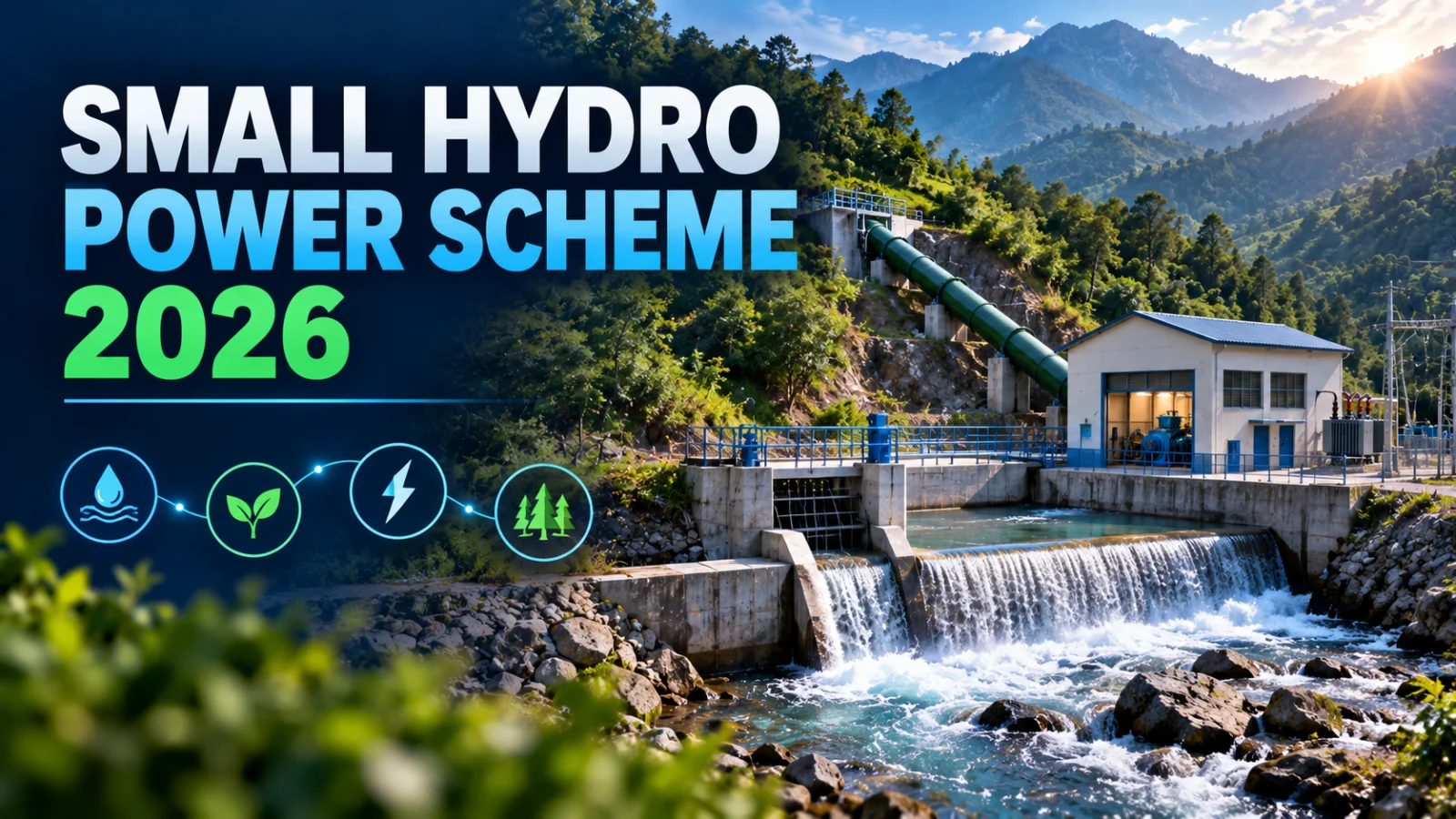
Small Hydro Power Scheme 2026 is India’s current central support framework for eligible small hydro projects in the 1 MW to 25 MW range. The scheme runs from FY 2026–27 to FY 2030–31 and combines project-level Central Financial Assistance, support for project preparation and an online application route through the Ministry of New and Renewable Energy’s Small Hydro Power portal.
The central question for a developer is not simply whether India has untapped hydro potential. It is whether a specific project falls within the scheme, which CFA band applies to its location, what PPA conditions must be met and whether the application can be completed before the current cutoff.
India has an assessed small hydro potential of about 21,133.61 MW across 7,133 identified sites. Around 5,171 MW had been harnessed by early 2026, leaving a substantial portion of assessed potential undeveloped. The 2026–31 scheme is intended to support further development, with approximately 1,500 MW of additional capacity targeted under the programme.
What projects qualify as Small Hydro Power?
For this scheme, a Small Hydro Power project is an eligible hydroelectric project with installed capacity from 1 MW to 25 MW. Projects outside that range should not assume they qualify under this particular support framework.
The national programme is being implemented through the Ministry of New and Renewable Energy, with the Solar Energy Corporation of India acting as the national programme implementing agency.
How much CFA is available?
| Project location | Current CFA basis | Maximum support |
|---|---|---|
| North-Eastern States and international-border districts | 30% of the applicable normative or actual project cost basis, whichever is lower | ₹30 crore |
| Other eligible locations | 20% of the applicable normative or actual project cost basis, whichever is lower | ₹20 crore |
The Cabinet announcement also described the support structure in per-MW terms of up to ₹3.6 crore per MW for projects in North-Eastern States and international-border districts and up to ₹2.4 crore per MW elsewhere, subject to the applicable percentage and overall project caps.
Developers should therefore not calculate support from installed capacity alone. The applicable project-cost basis, geographic category and scheme ceiling all matter.
Does location change the financial assistance?
Yes. The scheme provides a higher support band for projects in North-Eastern States and international-border districts than for eligible projects in other parts of India.
This means the project’s actual geographic classification is a material eligibility and financial-assistance factor. A project should not assume that the higher CFA band applies merely because it is in a hilly region or a state with hydro potential; the controlling scheme location criteria must be checked.
Is a PPA required?
Yes. MNRE’s current scheme FAQ states that a valid Power Purchase Agreement with the State Government or a DISCOM is required for release of the first CFA instalment.
The current FAQ also specifies a minimum PPA tenure of 15 years. Developers therefore need to treat the PPA as a core project-readiness requirement rather than something that can necessarily be arranged only after central assistance is approved.
Who can apply?
The scheme supports eligible Small Hydro Power development through recognised project developers and government-linked implementing structures, subject to the detailed scheme conditions. Government departments, public-sector organisations, State and Union Territory nodal agencies and other eligible entities may also have roles under specific scheme components.
Applicant status alone does not establish project eligibility. The project must also satisfy the scheme’s capacity, location, documentation, PPA and other approval requirements.
Is support available for preparing a DPR?
Yes. The scheme includes support for preparation of Detailed Project Reports for eligible projects through specified government and institutional applicants.
Projects up to 15 MW
DPR support can be up to ₹10 lakh per project.
Projects above 15 MW
An additional ₹50,000 per MW can apply above 15 MW, subject to an overall DPR-support ceiling of ₹15 lakh.
Current official guidance identifies Central and State Government departments, government organisations and PSUs, and State or Union Territory nodal agencies among the entities that can seek this DPR-related support, subject to scheme conditions.
Where are applications submitted?
MNRE operates a dedicated Small Hydro Power portal for the scheme. Applicants should use the current portal and scheme guidance rather than relying on older SHP programme procedures or third-party application claims.
The portal and official FAQ should be checked together because the scheme’s operational requirements can include applicant classification, project documents, undertakings or bank guarantees where applicable, PPA evidence and other project-specific material.
What is the application deadline?
The current MNRE FAQ states that fresh applications under the scheme can be submitted until December 31, 2030.
That is the current fresh-application cutoff, not a guarantee that every application submitted before the date will receive CFA. Project eligibility, available scheme provisions, documentation, appraisal and approval remain separate questions.
Why does the 21 GW potential figure matter?
India’s assessed Small Hydro Power potential of about 21.13 GW is much larger than the roughly 5.17 GW already harnessed. That difference helps explain the policy rationale for another multi-year development programme.
However, assessed potential does not mean all remaining capacity is immediately commercially viable, approved, grid-connected or eligible for central assistance. Individual sites still depend on technical, environmental, commercial, land, water, grid, PPA and regulatory conditions.
What the scheme does not automatically guarantee
- A project is not eligible merely because its capacity is below 25 MW.
- The maximum CFA cap is not automatically the amount every approved project receives.
- The higher North-East or border-district CFA band does not apply to every hilly or remote project.
- Submitting an application does not itself establish approval or release of financial assistance.
- The national SHP scheme does not replace project-specific State, DISCOM, land, water, environmental or other regulatory requirements.
What a developer should verify before applying
Before committing project-development expenditure, verify the proposed project’s installed capacity, exact location category, applicant eligibility, applicable project-cost basis, PPA status and tenure, required project documents and the current version of the MNRE scheme guidance.
A developer should also distinguish central CFA eligibility from the broader commercial viability of the project. Tariff, evacuation infrastructure, hydrology, construction cost, land and water rights, local approvals and financing can affect viability even when the project falls within the central scheme’s nominal scope.
What could change later?
The scheme remains active through FY 2030–31, so MNRE or SECI may issue clarifications, portal changes, project sanctions or implementation guidance during its life. State agencies and DISCOMs may also publish project-specific or jurisdiction-specific requirements.
ThePulseSignal will treat material changes to the national eligibility, CFA, PPA, application or deadline rules as updates to this same canonical page rather than creating a new URL for the same reader task.
Verification note: ThePulseSignal reviewed the Cabinet approval and PIB scheme material together with the current MNRE Small Hydro Power portal and applicant FAQ to reconcile the scheme scope, CFA structure, PPA requirement, DPR support and application cutoff.