






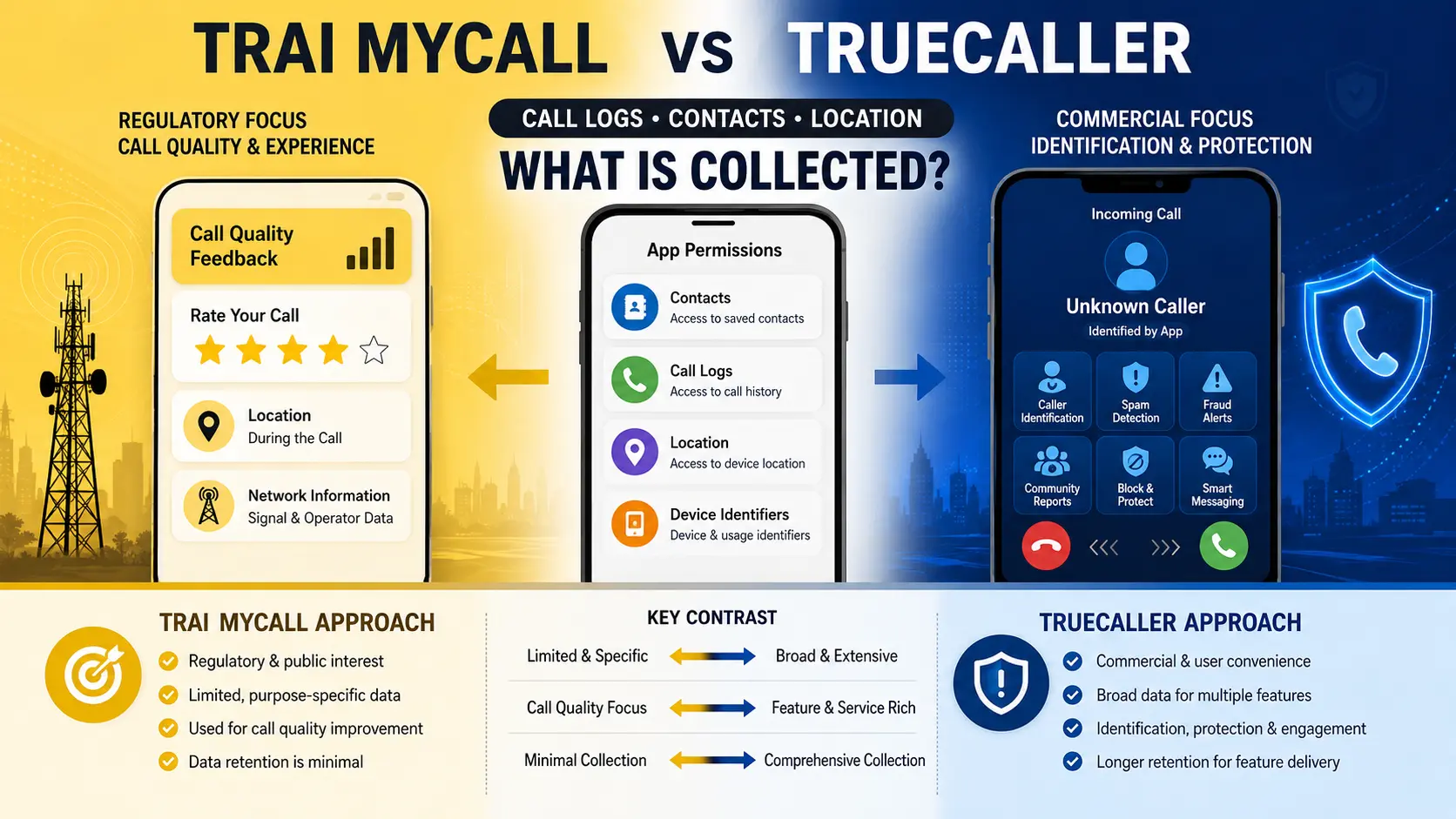
TRAI MyCall vs Truecaller is not a direct comparison between two competing apps. TRAI MyCall is designed to collect crowdsourced feedback about cellular voice-call quality, while Truecaller primarily provides caller identification, spam protection and commercial communication tools.
The comparison still matters because both apps may request access to sensitive areas of a phone, including call-related information, contacts or location. The relevant question is not simply which app requests more permissions, but why the access is requested, what the developer says is collected or shared, and what control the user retains afterward.
Direct answer
MyCall presents a narrower regulatory purpose and declares no third-party data sharing, but its Google Play disclosure says collected data cannot be deleted and its official workflow encourages optional background location access.
Truecaller says its current app-store versions do not upload the user’s phonebook for caller identification, but its disclosed collection, advertising, analytics and sharing framework is substantially broader. Truecaller’s Play listing says users can request deletion.
Neither app should be treated as a replacement for the formal complaint process of a telecom provider.
Key findings
- TRAI launched the revamped MyCall app on August 3, 2026.
- MyCall records call-quality ratings and can link them with network and location context.
- The official workflow shows requests relating to phone calls, call logs, contact names and location.
- MyCall separately encourages all-the-time background location for enhanced automatic network-quality collection.
- Google Play says MyCall shares no data with third parties but does not provide a way to request deletion of collected data.
- Truecaller’s Google Play disclosure covers many more categories, including personal information, app activity, contacts, messages, location and device identifiers.
- Truecaller says users can request data deletion and describes an independent security review.
- No reviewed evidence proves that either app sells the user’s complete contact list.
- A MyCall rating is feedback for network assessment, not a formal individual complaint.
What changed with the revamped TRAI MyCall app?
TRAI announced the revamped MyCall application on August 3, 2026 as a tool through which telecom consumers can assess and report their voice-calling experience.
The official announcement says consumer feedback and associated network information are intended to help TRAI and telecom service providers identify poorly performing locations and take targeted corrective measures.
The official Play Store listing and trailer show functions including:
- a one-to-five-star call-quality rating;
- rating recent incoming and outgoing cellular calls;
- marking the call context as indoor, outdoor or travelling;
- rating history;
- map-based feedback views;
- configurable rating reminders;
- reporting dropped calls or poor network experience;
- multilingual onboarding.
The app is therefore a crowdsourced measurement and feedback tool. Its published workflow does not show an individual grievance docket, operator-response commitment or complaint-resolution timeline.
What permissions does TRAI MyCall request?
The official Play Store trailer supplied for this review shows an onboarding screen describing access to:
- SIM and network information;
- contact names for calls;
- recent call history;
- device location.
The Android permission prompts shown in the trailer include requests to:
- make and manage phone calls;
- access phone call logs;
- access device location.
The app explains that call-log access allows recent calls to be displayed for rating, while contact access allows saved names to appear beside those calls.
Access does not automatically prove uploading.
The screenshots establish that the app reads or requests access to call-related information on the device. They do not independently establish that a complete contact list or raw call log is uploaded to TRAI’s servers.
Does MyCall require background location?
The first Android location prompt allows the user to choose precise or approximate location and to grant access while using the app, only once or not at all.
After onboarding, the official trailer shows a separate prompt encouraging the user to enable “Allow all the time” location access. The app says this enables network-quality information to be collected automatically even when the app is not open.
This means background location should be treated as an enhanced collection option rather than silently described as a basic requirement for every manual rating.
Privacy distinction: A permission may be optional at the operating-system level while still being strongly encouraged by the app for enhanced functionality.
What does Google Play say MyCall collects and shares?
The MyCall Google Play Data Safety panel supplied for this review says:
- no data is shared with third parties;
- the app may collect precise location;
- the app may collect a phone number;
- the app may collect device or other identifiers;
- data is encrypted in transit;
- the developer does not provide a way to request deletion of collected data.
The listing marks precise location and phone number as optional and associates them with app functionality and analytics.
Google Play’s Data Safety information is submitted by the developer. It is an important transparency record, but it is not equivalent to an independent technical audit of every network transmission or database.
Does MyCall collect or store personal details?
The official onboarding screen says:
MyCall does not collect or store your personal details.
At the same time, the Google Play disclosure says the app may collect a phone number, precise location and device identifiers.
These statements may rely on different definitions. For example, TRAI may mean that contact names and raw call-log identities are not attached to submitted feedback, while Google Play requires disclosure of technical or optional identifiers processed elsewhere in the workflow.
However, that distinction is not clearly explained to an ordinary user in the reviewed screens.
This is a disclosure ambiguity, not proof of wrongdoing.
The reviewed evidence does not establish that TRAI secretly stores contacts or misuses call logs. It shows that the plain-language onboarding claim needs clearer reconciliation with the broader Play Store declaration.
Can MyCall data be deleted?
Google Play’s current Data Safety panel says the developer does not provide a way for users to request deletion of collected data.
The official trailer shows a rating-history screen and individual rating details, but no edit, withdrawal or deletion control is visible in the reviewed workflow.
This creates unresolved questions:
- How long are submitted ratings retained?
- Can a user withdraw an inaccurate rating?
- Can a user request deletion directly from TRAI outside the app?
- Does uninstalling the app affect already submitted feedback?
- Are phone number, device identifiers and ratings retained for the same period?
Does MyCall send contacts or call logs to telecom operators?
The current official MyCall listing says feedback is stored in the backend anonymously and without reference to contacts or call logs.
TRAI’s launch announcement says anonymised feedback is made available to TRAI and telecom service providers for network-quality assessment.
The safest conclusion is therefore:
- the app accesses call logs and contact names to support call selection and identification on the phone;
- TRAI says submitted feedback is stored without contact or call-log references;
- anonymised feedback and relevant network information may be used by TRAI and operators;
- the reviewed material does not provide a complete field-by-field description of every transmitted parameter.
Is MyCall a formal telecom complaint?
No.
Submitting a low rating or dropped-call report helps build crowdsourced evidence about network performance. It does not necessarily:
- create a complaint docket;
- require the operator to contact the subscriber;
- guarantee repair at a particular location;
- produce an individual resolution deadline;
- replace the operator’s grievance procedure.
TRAI’s formal grievance guidance directs a subscriber first to the telecom service provider’s complaint centre. When the complaint is not satisfactorily resolved, the subscriber can escalate it to the provider’s Appellate Authority.
Use the correct route
- Poor call quality or dropped-call feedback: TRAI MyCall.
- Individual billing, activation, recharge, SIM or service failure: telecom provider complaint centre.
- Provider complaint unresolved: provider’s Appellate Authority.
- Slow mobile-data performance: TRAI MySpeed or another appropriate test.
- Spam calls or messages: recognised DND/UCC complaint route.
- Caller identification or spam screening: caller-ID service such as Truecaller.
- Cyber fraud or payment theft: official cybercrime, telecom and banking-reporting channels.
TRAI MyCall vs Truecaller: what is the fundamental difference?
TRAI MyCall
- Government regulatory application
- Designed for cellular voice-quality feedback
- Uses call context and network location
- Feeds crowdsourced network assessment
- No advertising model identified in the reviewed app material
- Does not create a formal complaint
Truecaller
- Private commercial application
- Designed for caller identification and spam protection
- Supports reverse lookup and call-management features
- Uses advertising and premium subscription models
- Processes broader account, activity and device information
- Does not resolve a telecom provider complaint
What does Truecaller’s Google Play disclosure cover?
The Truecaller Data Safety screens supplied for this comparison list a broader set of possible data categories, including:
- name, email address, phone number, user IDs, address and other personal information;
- purchase history;
- app interactions and in-app search history;
- installed applications and other app-activity information;
- contacts;
- photos and videos;
- SMS or MMS and other in-app messages;
- approximate and precise location;
- device or other identifiers;
- crash logs, diagnostics and other performance information;
- optional voice or sound recordings.
The listing also says:
- device or other identifiers may be shared with third parties;
- data is encrypted in transit;
- users can request deletion;
- the application has undergone an independent security review.
Not every category is necessarily collected from every user. Collection can depend on platform, settings, permissions, region and which features are enabled.
Does Truecaller upload or sell the user’s contact list?
The reviewed evidence does not support a claim that Truecaller sells a user’s complete contact list.
Truecaller says its current Google Play and App Store versions process the address book locally and do not upload the user’s phonebook to make it publicly searchable.
That statement is narrower than saying Truecaller processes no contact-related information. Its broader privacy materials still describe substantial processing of:
- profile information;
- phone numbers;
- device identifiers;
- service activity;
- search and interaction information;
- location where applicable;
- advertising and analytics information.
Do not reduce privacy to one question.
An app may keep the phonebook on the device while still collecting other extensive account, behavioural, location or advertising-related information.
How do the privacy models compare?
Purpose
MyCall: regulatory voice-quality crowdsourcing.
Truecaller: commercial caller identification, spam protection and communication services.
Contacts
MyCall: uses contact names to help identify recent calls selected for rating.
Truecaller: says current app-store versions process the phonebook locally and do not upload it for caller identification.
Call-related access
MyCall: recent calls are displayed so users can submit call-quality feedback.
Truecaller: call-related access supports caller identification, spam blocking and call-management features.
Location
MyCall: links network experience to location and encourages optional background collection.
Truecaller: approximate and precise location may be processed for functionality, analytics, advertising or personalisation depending on use.
Third-party sharing
MyCall: Google Play says no data is shared with third parties; TRAI separately says anonymised feedback is available to operators.
Truecaller: Google Play says device identifiers may be shared, while the privacy policy describes service-provider and other specified disclosures.
Advertising
MyCall: no advertising model was identified in the reviewed material.
Truecaller: operates commercial advertising and premium subscription models.
Deletion
MyCall: Google Play says deletion cannot be requested.
Truecaller: Google Play says users can request deletion.
Formal telecom complaint
MyCall: no.
Truecaller: no.
Which app collects more data?
Based on the current Google Play disclosures, Truecaller identifies a much broader range of potential data categories than MyCall.
However, counting categories alone does not completely determine privacy quality. A useful assessment also asks:
- Is each category necessary for the app’s stated function?
- Is the data processed locally or sent to a server?
- Is the user clearly told when collection occurs?
- Can the user deny optional access and retain basic functionality?
- Is the data used for advertising or profiling?
- Can the data be corrected, withdrawn or deleted?
- How long is it retained?
- Who receives it?
MyCall appears narrower in purpose and commercial use, but its inability to offer deletion and its background-location prompt are significant concerns. Truecaller’s footprint is broader, but its published controls include a deletion request route.
Why does TRAI list a Gmail support address?
The reviewed Google Play listing identifies:
- Support email: traiapps@gmail.com
- Developer contact: apps-developer@trai.gov.in
The presence of a Gmail support address does not make the app unofficial. The developer is identified as TRAI, and TRAI’s own website links to the application.
It does create unanswered governance questions, including:
- whether the Gmail account is institutionally administered;
- whether employees, contractors or vendors can access it;
- what retention policy applies to support messages;
- whether users are warned not to email screenshots containing personal data;
- why an official government-domain address is not used as the primary support route.
The evidence does not show that app telemetry is sent to Gmail.
The Gmail address is shown as the user-support contact. Users should avoid emailing UANs, passwords, OTPs, full call logs, contact lists, identification documents or other sensitive information unless an authorised process explicitly requires it.
Which route should a telecom user choose?
Poor cellular voice quality or dropped calls
Use TRAI MyCall to submit network-quality feedback.
Slow mobile-data speed
Use TRAI MySpeed or another appropriate network-speed testing route.
Unknown callers and spam identification
Use a caller-identification and spam-filtering service such as Truecaller, subject to its privacy trade-offs.
Spam call or commercial message complaint
Use the recognised DND or UCC complaint route rather than MyCall.
Billing, recharge, SIM, activation or individual coverage problem
Register a formal complaint with the telecom provider and preserve the docket number.
Provider complaint remains unresolved
Escalate through the provider’s Appellate Authority.
Frequently asked questions
Is TRAI MyCall the same as Truecaller?
No. MyCall collects voice-call-quality feedback. Truecaller provides caller identification, spam protection and commercial communication features.
Does MyCall create a formal telecom complaint?
No formal complaint docket or individual resolution process is shown. Individual complaints must be registered with the telecom provider.
Why does MyCall need access to call logs?
The app uses recent call records to display calls that can be selected and rated.
Why does MyCall need contacts?
The official explanation says contacts are used to display saved names beside recent calls so users can identify which call they are rating.
Does MyCall upload my entire contact list?
The reviewed evidence does not establish that it uploads the complete contact list. The listing says submitted feedback is stored without reference to contacts or call logs.
Can MyCall track location in the background?
The official trailer shows an optional request for all-the-time location access so network-quality information can be collected when the app is not open.
Can MyCall data be deleted?
Google Play currently says the developer does not provide a way to request deletion of collected data.
Does Truecaller upload my phonebook?
Truecaller says its current app-store versions process the phonebook locally and do not upload it for caller identification. Its broader privacy framework still covers many other categories of information.
Does Truecaller sell contacts?
The reviewed evidence does not support a claim that Truecaller sells a user’s complete contact list.
Which app has the broader data disclosure?
Truecaller’s Google Play disclosure lists substantially more categories. MyCall is narrower but says collected data cannot be deleted.
Which app is safer?
There is no universal answer. MyCall has a narrower public-interest purpose and declares no third-party sharing, while Truecaller offers broader functionality and deletion controls but operates under a wider commercial data framework.
Official sources
- PIB and TRAI announcement of the revamped MyCall app
- Official TRAI MyCall Google Play listing
- TRAI application privacy information
- TRAI grievance-redressal mechanism
- Official Truecaller Google Play listing
- Truecaller privacy policy
Verification notes to readers
ThePulseSignal reviewed TRAI’s August 3 launch announcement, the official MyCall Play Store listing, the MyCall Data Safety declaration, TRAI’s application privacy page and TRAI’s grievance-redressal guidance.
ThePulseSignal also reviewed screenshots from the official MyCall Play Store trailer showing onboarding, permission requests, recent-call rating, background-location prompts, rating history, map view and application settings.
For the comparison, ThePulseSignal reviewed Truecaller’s official Play Store listing, Data Safety declaration and privacy policy dated July 2026.
Google Play Data Safety declarations are supplied by app developers. They are transparency disclosures and were not independently verified through source-code review, network interception or backend inspection.
No evidence reviewed for this article established that either app sells a user’s complete contact list.
Article last verified: August 3, 2026.
Limitations and unresolved facts
- The MyCall app was not independently installed and tested on a separate laboratory device for this review.
- The workflow evidence came from the official Play Store trailer and developer disclosures.
- The exact MyCall fields transmitted to TRAI and telecom operators were not independently captured.
- It remains unclear whether raw call numbers, contact names or complete call-log entries ever leave the phone.
- MyCall’s data-retention periods were not identified.
- An external deletion route for MyCall was not confirmed.
- The governance and records controls for the listed Gmail support account were not confirmed.
- Truecaller’s data processing may vary by feature, platform, account, region and permission settings.
- A Data Safety category does not prove that every user supplies every listed data type.
- No independent source-code or network-traffic audit was performed for either app.