






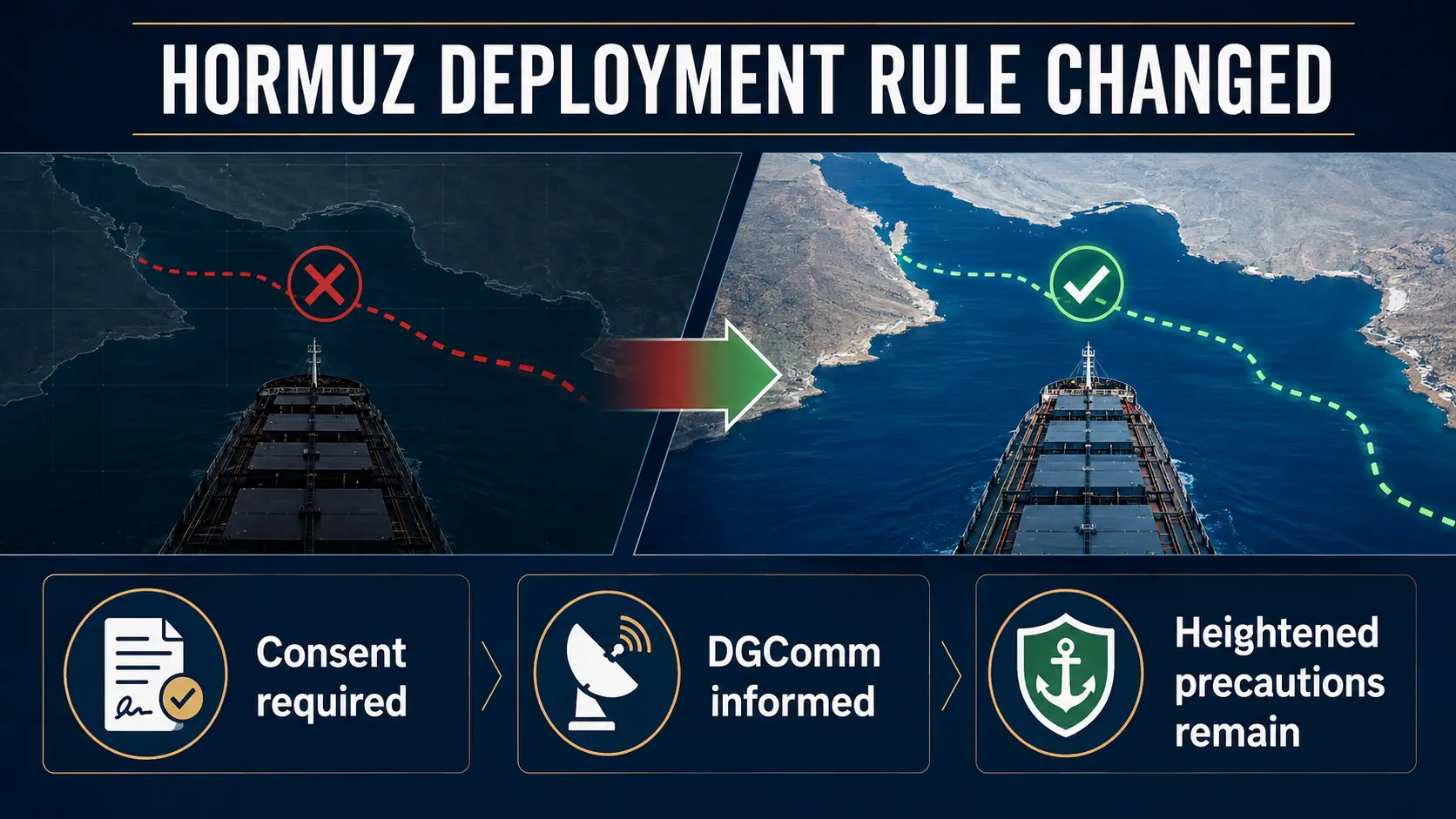
Indian seafarer Strait of Hormuz rules changed on August 5, 2026, when DGMA Circular 47 superseded Circular 36. The earlier instruction told shipowners, ship managers and RPSL companies to avoid deploying Indian seafarers on vessels passing through the Strait until further orders. Circular 47 removes that blanket avoidance direction and instead requires adequate precaution, DG Communication Centre notification and individual seafarer consent.
This is not a declaration that the Strait is safe. Circular 47 itself cites continuing attacks on merchant vessels, casualties among Indian seafarers and an ongoing conflict-affected security environment. The new Indian seafarer Strait of Hormuz framework changes the deployment rule while keeping heightened security obligations in place.
Direct answer
Can Indian seafarers now be deployed through Hormuz?
Yes, subject to Circular 47. Operators intending to deploy Indian seafarers through the Strait of Hormuz must exercise adequate precaution, keep DGComm informed of the transit and obtain consent from the individual seafarer.
Current status
Circular 47 is now controlling
Circular 47 of 2026, dated August 5, expressly says it is issued in supersession of Circular 36 dated July 15. The old “avoid deployment until further orders” instruction is no longer the current operating rule.
Confirmed
- Circular 47 supersedes Circular 36.
- Individual seafarer consent is required.
- DGComm should be kept informed of Hormuz transit.
- Masters must maintain heightened security vigilance.
- The circular covers the Persian Gulf, Strait of Hormuz and adjoining waters.
Not confirmed by Circular 47
- Whether consent must be written.
- Whether consent can later be withdrawn.
- Whether refusal can affect wages, joining, future contracts or repatriation.
- Whether DGComm acknowledgement is required before transit.
- Whether a prescribed DGComm notification form exists.
August 12 operational update
Reuters reported that Kpler tracked eight Hormuz transits on Tuesday, compared with a recent 10-day average of about 12 and roughly 130–140 vessels per day before the war. LSEG separately counted 11 transits, down from 14 the previous day. This shipping update does not create a new Indian seafarer deployment rule. Circular 47 remains the specific TPS-verified Hormuz deployment instruction unless DGMA/DG Shipping issues a later superseding direction.
Table of contents
Indian seafarer Strait of Hormuz rules: what changed under Circular 47?
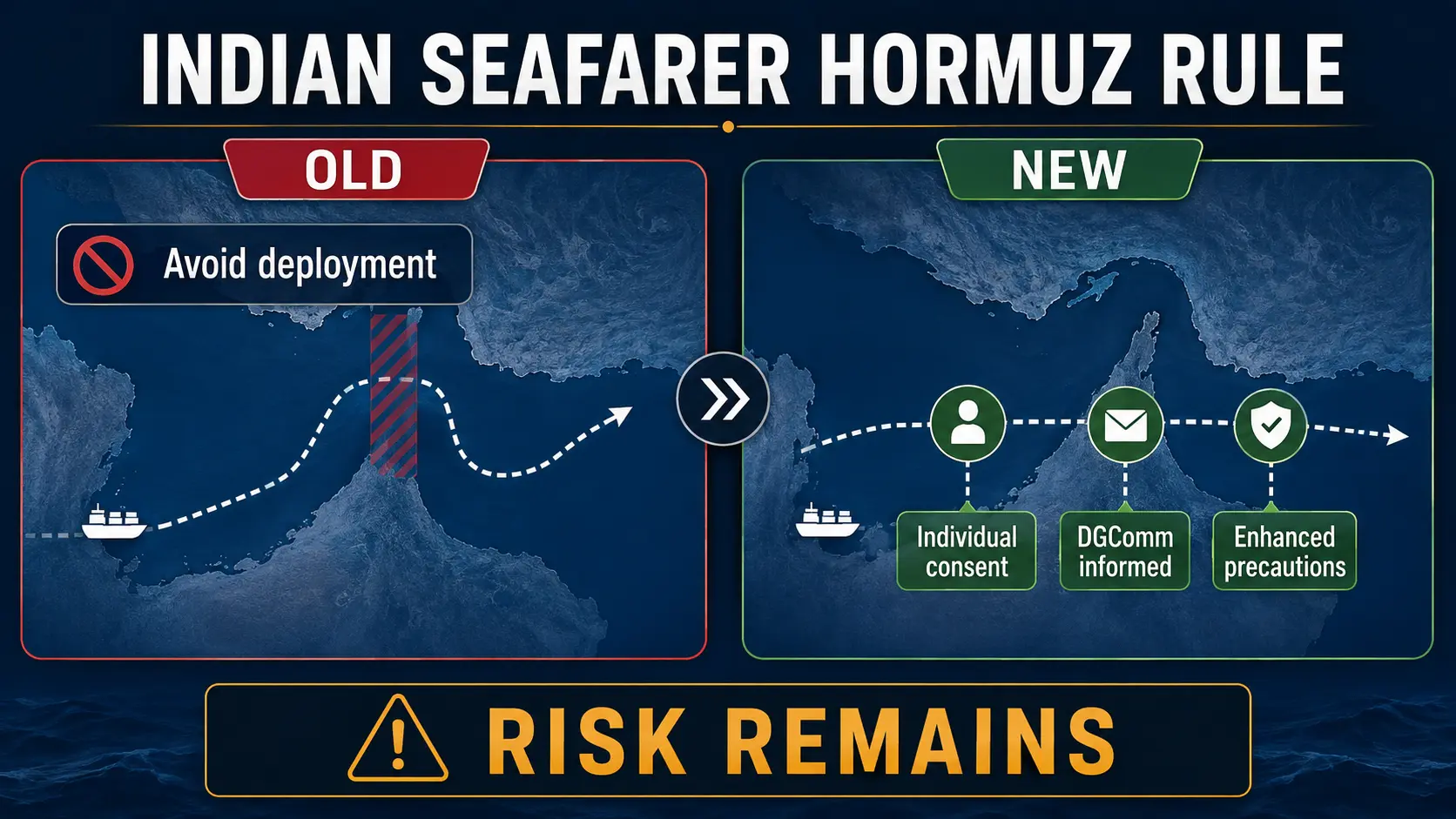
DGMA Circular 47 of 2026 is dated August 5 and states on its face that it is issued “in supersession” of Circular 36 of 2026 dated July 15. Circular 36 had directed shipowners, ship managers and RPSL companies to avoid deploying Indian seafarers on vessels undertaking voyages involving passage through the Strait of Hormuz until further orders.
Circular 47 replaces that instruction with a conditional deployment framework. Shipowners, managers and RPSL companies engaging or deploying Indian seafarers on vessels intending to undertake Hormuz voyages must exercise adequate precaution and ensure that DGComm is kept informed of the transit and that individual seafarer consent is obtained.
Editorial interpretation
The regulator has moved from a broad avoidance instruction to a risk-managed, consent-based deployment model. Calling this simply “India lifts Hormuz ban” would be too broad because Circular 47 simultaneously retains heightened security requirements and describes continuing conflict risks.
Indian seafarer Strait of Hormuz: Circular 36 vs Circular 47
| Issue | Circular 36 — July 15 | Circular 47 — August 5 |
|---|---|---|
| Deployment | Avoid deployment through Hormuz until further orders | Deployment may occur with adequate precaution and the new conditions |
| Individual consent | Not the controlling deployment mechanism | Consent shall be obtained from each Indian seafarer |
| DGComm | Emergency-contact role | Should be kept informed of transit plus emergency role |
| Security posture | Heightened vigilance | Heightened vigilance continues |
| Status | Superseded | Current controlling advisory |
What does individual consent mean for an Indian seafarer Strait of Hormuz voyage?
The confirmed rule is specific: Circular 47 says consent from the individual Indian seafarer shall be obtained for such voyages. In practical terms, Hormuz deployment is no longer just an internal company routing decision once an Indian seafarer is being assigned to the voyage.
Do not overstate the consent clause
The circular does not say that giving consent waives shipowner safety duties, compensation obligations, insurance rights or other contractual/statutory protections. It also does not define the legal effect of consent beyond requiring that it be obtained.
Can an Indian seafarer refuse a Strait of Hormuz voyage?
Circular 47 makes individual consent necessary, so the seafarer’s agreement is expressly part of the deployment instruction. But the circular itself does not explain what happens if the seafarer refuses.
It does not state whether refusal can affect joining, wages, future contracts, repatriation, disciplinary action or placement through an RPSL company. Those questions need separate maritime-employment and contract analysis and should not be answered by stretching Circular 47 beyond its text.
Unresolved employment issue
“Consent required” is confirmed. “Refusal has no employment consequence” is not confirmed. Circular 47 also does not give employers a blanket right to penalise refusal.
Must Indian seafarer Strait of Hormuz consent be written?
The circular does not specify the form of consent. It does not say whether consent must be signed on paper, recorded electronically, incorporated into an employment document or captured through another process.
That means ThePulseSignal should not describe “written consent” as a confirmed legal requirement. A seafarer should nevertheless preserve whatever route disclosure, consent request and acknowledgement the employer or RPSL company provides.
Is the Indian seafarer Strait of Hormuz route now considered safe?
No. Circular 47 says recent attacks on merchant vessels, casualties among Indian seafarers and continuing attacks during the ongoing conflict require enhanced precautions. Masters operating in the Persian Gulf, Strait of Hormuz and adjoining waters must maintain heightened security vigilance, continuously monitor navigational warnings and security advisories, and implement applicable ship and company security measures.
The regulatory change concerns how Indian seafarers may be deployed. It is not evidence that the regional security threat has ended.
What companies must do under the Indian seafarer Strait of Hormuz rule
Identify the Hormuz voyage
Confirm whether the vessel intends to transit the Strait of Hormuz.
Exercise adequate precaution
The deployment clause expressly begins with adequate precaution.
Obtain individual consent
Consent must be obtained from the Indian seafarer being deployed.
Inform DGComm
The DG Communication Centre should be kept informed of the transit.
Maintain heightened vigilance
Masters must monitor warnings and apply relevant security procedures.
Escalate emergencies
Use DGComm and IFC-IOR emergency contacts where needed.
Indian seafarer Strait of Hormuz pre-voyage checklist
| Question | Why it matters | Evidence position |
|---|---|---|
| Will the vessel transit Hormuz? | The consent requirement is voyage-specific | Confirmed relevance |
| What route information has been provided? | You need to know what voyage you are being asked to consent to | Prudent check; disclosure format not defined by Circular 47 |
| How is consent recorded? | May matter if a later dispute arises | Form not specified |
| Has DGComm been informed? | Circular 47 says DGComm should be kept informed | Confirmed requirement |
| What security precautions apply? | Heightened vigilance remains mandatory | General requirement confirmed |
| What happens if I refuse? | Potential employment impact | Not clarified by Circular 47 |
Indian seafarer Strait of Hormuz emergency contacts
DG Communication Centre
WhatsApp / Call: +91 86575 49760
Alternate: +91 22 22613606
Alternate: +91 86575 49752
Email: dgcommcentre-dgs@nic.in
IFC-IOR
Phone: +91 124 2208385
Email: ifc-ior.gurugram@navy.gov.in
How does the DGMA Maritime Security Risk Area SOP affect Circular 47?
DGMA now publishes a consolidated Standard Operating Procedure for Indian Vessels and Seafarers in the Maritime Security Risk Area. It applies to Indian-flag vessels, foreign-flag vessels employing Indian seafarers through Indian RPSL companies, shipowners, Masters, RPSL companies and security officers operating in the designated risk area.
The SOP adds a broader operational framework covering voyage risk assessment, ship reporting, crew protection, emergency communication, GNSS jamming and spoofing precautions, family emergency contacts, incident response and post-incident welfare.
What the SOP clearly adds
- documented risk assessment before operating in the Maritime Security Risk Area;
- daily online ship reporting through the IFC-IOR process referenced by DGMA;
- updated Indian seafarer records and family emergency contacts for RPSL companies;
- continuous lookout and enhanced security vigilance;
- specific precautions for GNSS jamming, spoofing and AIS anomalies;
- mandatory incident-reporting and emergency coordination procedures;
- post-incident medical, welfare and repatriation measures.
How TPS reads Circular 47 with the SOP
The current DGMA SOP is a broad consolidated maritime-security framework. The version reviewed by TPS does not itself reproduce Circular 47’s individual-consent wording, and its published consolidated-circular list does not expressly identify Circular 47. The SOP also says RPSL companies should communicate the SOP and all applicable DGS circulars to shipowners and managers. TPS therefore does not treat the SOP as silently cancelling Circular 47’s specific Hormuz consent condition.
Important unresolved point
DGMA should be treated as the controlling authority if it later publishes a revised SOP, circular or order that expressly changes the Circular 47 deployment or consent rule. Until that happens, TPS reads the specific Circular 47 Hormuz deployment conditions together with the wider MSRA SOP.
Official DG Shipping / DGMA sources
- DGMA Circular 47 of 2026 — current Strait of Hormuz seafarer advisory
- DGMA Circular 36 of 2026 — superseded July 15 deployment instruction
- DGMA — SOP for Indian Vessels and Seafarers in the Maritime Security Risk Area
- DGMA Maritime Security — official advisories and circulars
Where can an Indian seafarer raise a grievance?
For non-emergency grievances, use ThePulseSignal’s e-Navik seafarer grievance guide to understand the complaint route and what evidence to preserve.
For registration/profile problems, see the eSamudra seafarer registration guide. For the wider strategic and economic context, see Why Strait of Hormuz Matters to India.
How this was verified
ThePulseSignal rechecked DGMA Circular 47 of 2026 dated August 5, 2026. The circular says it is issued in supersession of Circular 36 dated July 15. It requires heightened security vigilance, says DGComm should be kept informed of Hormuz transit, and states that individual Indian seafarer consent shall be obtained for such voyages.
Circular 36 was separately rechecked as the superseded baseline. It directed shipowners, ship managers and RPSL companies to avoid deploying Indian seafarers on vessels undertaking voyages involving passage through the Strait of Hormuz until further orders.
The article deliberately separates confirmed text from unresolved employment questions. It does not claim that the Strait is safe, that consent must be written, that refusal is consequence-free, or that consent waives compensation, insurance or safety rights.
TPS also reviewed DGMA’s current Maritime Security Risk Area SOP. The SOP is treated as the wider operational-security framework, while Circular 47 remains the specific verified source for individual consent and Hormuz deployment conditions because the reviewed SOP does not expressly reproduce or supersede that consent clause.
The August 12 Reuters shipping update was used only to describe the current operating environment. It was not used to infer a new Indian deployment rule.
Last verified: August 12, 2026, approximately 11:37 AM IST.
Limitations and unresolved facts
- Circular 47 does not prescribe the form in which individual consent must be recorded.
- It does not state whether consent may be withdrawn after joining but before entering Hormuz.
- It does not define the employment consequences of refusing consent.
- It does not say whether DGComm acknowledgement is required before transit or whether notification alone is sufficient.
- No prescribed DGComm notification form is identified in the circular.
- The exact mechanics for foreign-flagged ships carrying Indian seafarers are not separately explained in the one-page circular.
- This article does not disclose vessel-specific routes, security tactics or operational vulnerabilities.
- The reviewed DGMA MSRA SOP does not expressly reproduce Circular 47’s individual-consent clause; TPS therefore reads the SOP and Circular 47 together rather than assuming one silently cancels the other.
- The August 12 Kpler/LSEG traffic counts describe the operating environment and do not themselves amend Circular 47.
Frequently asked questions
Has India lifted the earlier Hormuz deployment restriction?
Circular 47 supersedes Circular 36 and replaces the blanket avoidance instruction with conditional deployment requirements.
Is individual Indian seafarer consent mandatory?
Yes. Circular 47 says consent from the individual Indian seafarer shall be obtained.
Must consent be written?
The circular does not specify the form of consent.
Can a seafarer refuse?
The circular requires individual consent but does not explain the employment consequences of refusal.
Has India declared Hormuz safe?
No. Circular 47 explicitly cites continuing attacks, casualties and heightened security risk.
Does consent remove shipowner safety obligations?
Circular 47 does not say that consent waives safety obligations.
Does DGComm have to approve each voyage?
The circular says DGComm should be kept informed. It does not state that DGComm must approve every transit.
Who should be contacted in an emergency?
Circular 47 lists DGComm and IFC-IOR emergency contacts.
Is Circular 36 still current?
No. Circular 47 expressly supersedes Circular 36.
Did the August 12 fall in Hormuz traffic change India’s seafarer rule?
No new Indian deployment rule is established by the shipping data. Circular 47 remains the specific TPS-verified Hormuz deployment instruction unless DGMA/DG Shipping issues a later superseding direction.
Does the new DGMA Maritime Security Risk Area SOP cancel Circular 47 consent?
The reviewed SOP does not expressly say that. It provides a broader operational-security framework and says applicable DGS circulars should also be communicated. TPS therefore continues to treat Circular 47’s individual-consent rule as applicable unless DGMA expressly changes it.
Does the new rule cover the Red Sea or Bab-el-Mandeb?
Circular 47 specifically addresses the Persian Gulf, Strait of Hormuz and adjoining waters. Separate advisories should be checked for other regions.