






Is a 1601 number safe? A 1601 number has a stronger identity signal than an ordinary unknown number because TRAI requires eligible entities to be verified by their telecom service provider before the number is assigned. But that verification does not mean you should blindly trust every request made during the call.
The safest interpretation is: 1601 helps identify the caller category, but the content of the conversation still needs normal fraud checks.
What is verified
TRAI says 1601 numbers are allocated directly to eligible non-BFSI and non-government entities after verification by the telecom service provider.
Phase I covers utilities, courier and logistics, and the assigned number must be used for service and transactional voice calls rather than promotional calls.
What is not guaranteed
A 1601 prefix does not mean you should reveal an OTP, UPI PIN, card PIN, password or other confidential authentication information.
It also does not prove that every claim made during a conversation is correct.
Good identity signal
The entity must be eligible and verified by its TSP before receiving the number.
Still verify the request
Ask whether the call matches an electricity, gas, LPG, water, parcel or logistics interaction you actually have.
Never surrender secrets
A prefix does not justify disclosing OTPs, passwords, UPI PINs, card PINs or similar credentials.
In this 1601 safety guide
- Is 1601 safe?
- What TRAI verification means
- What the prefix does not guarantee
- Seven checks before trusting the caller
- Should you share OTP or PIN?
- What if the caller asks for payment?
- Courier and parcel calls
- Utility and LPG calls
- What if the call is promotional?
- What about normal 10-digit numbers?
- How to report a suspicious call
- What if money was already lost?
- Verification method
- Limitations
- FAQs
Is a 1601 number safe to answer?
A 1601 call is intended to be easier to identify as a legitimate service or transactional call because the number is allocated directly to an eligible entity after TSP verification.
That makes the prefix a useful caller-identity signal.
But “verified number allocation” and “every request made during the call is safe” are not the same claim.
What TRAI confirms: 1601 numbers are assigned after eligibility verification, are allocated directly to eligible entities rather than intermediaries or aggregators, and are intended to help consumers identify legitimate service and transactional calls.
What TPS will not claim: that the number creates a blanket guarantee that you can safely disclose secrets, approve payments or install software simply because 1601 appears on screen.
What does TRAI verification of a 1601 number actually mean?
The August 10, 2026 TRAI direction requires telecom service providers to verify the eligibility of an entity before assigning a 1601-series number.
The TSP must also obtain an undertaking that the assigned number will be used exclusively for service and transactional voice calls.
TRAI says the numbers are allocated directly to eligible entities and not to intermediaries or aggregators.
| TRAI safeguard | What it helps establish | What it does not establish |
|---|---|---|
| Eligibility verification | The entity must qualify before the TSP assigns a 1601 number. | That every statement made by every person using the organisation’s calling process is automatically correct. |
| Direct allocation | The number is assigned directly to the eligible entity rather than an intermediary or aggregator. | That consumers can ignore all normal verification practices. |
| Service/transactional undertaking | The number is intended for non-promotional service or transaction communication. | That the caller is entitled to ask for secret authentication credentials. |
| Distinct numbering identity | Consumers get a recognisable signal that differs from an ordinary unknown 10-digit number. | A universal guarantee against every form of social engineering or misuse. |
Why a verified prefix is not the same as unlimited trust
Phone fraud often depends on persuading the victim to take an action, not merely on displaying a number.
A caller can create urgency, request confidential information, ask the user to transfer money or push the user toward a link or application.
That is why the content of the request still matters even when the number itself has a stronger identity signal.
Useful mental model: the prefix helps answer “who is this number intended to belong to?” It does not automatically answer “should I do everything this caller asks?”
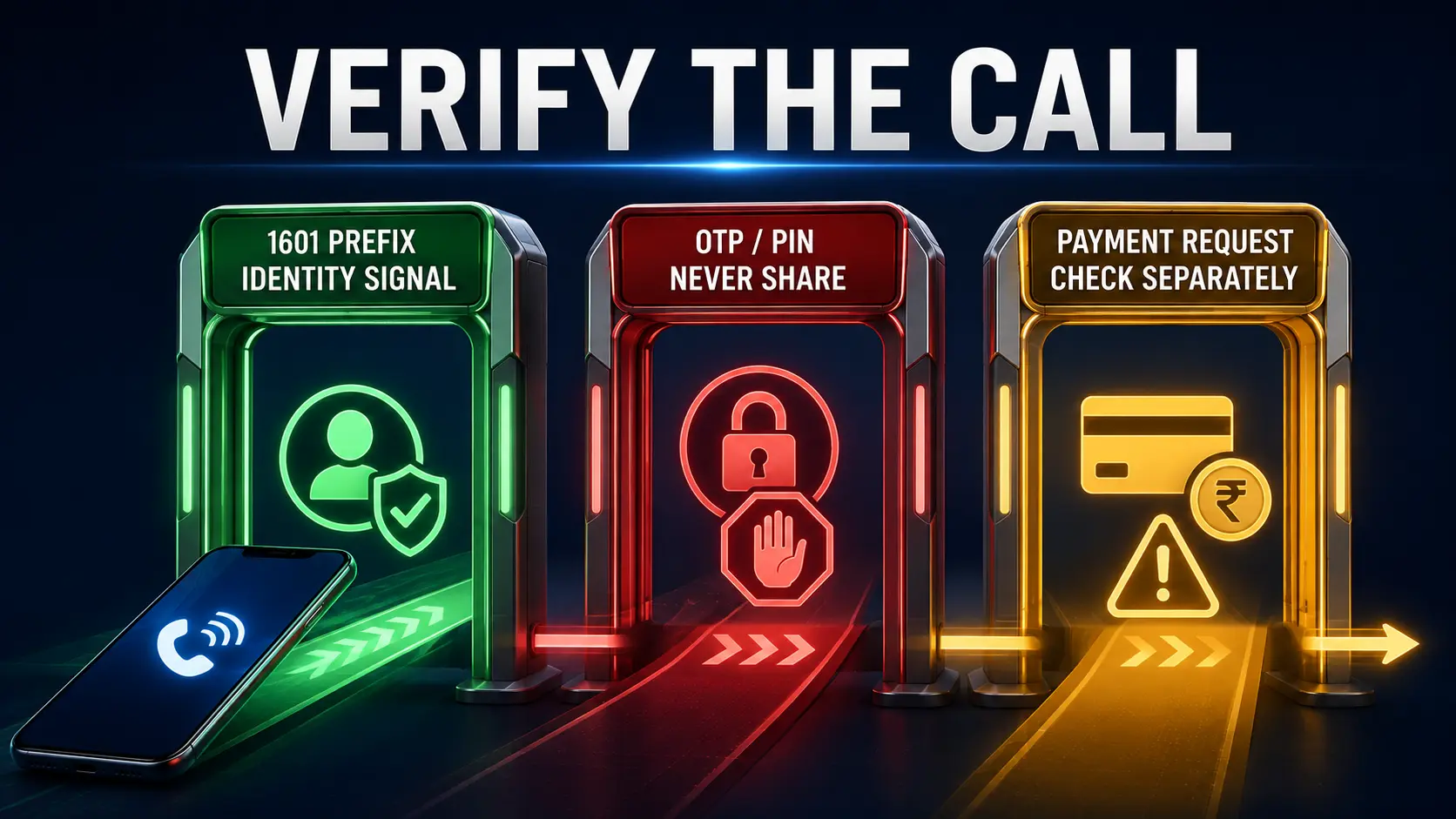
7 checks before you trust a 1601 caller
Check whether the call matches a real service
If the caller mentions a parcel, LPG connection, electricity account, water service or gas connection, first ask whether that service or transaction actually exists in your life.
Separate identity from the request
The 1601 number helps identify the caller category. Evaluate the request itself separately before sharing information or taking action.
Never reveal authentication secrets
Do not disclose OTPs, UPI PINs, card PINs, banking passwords or similar confidential credentials merely because the prefix appears legitimate.
Independently verify unusual payment requests
If the caller unexpectedly asks you to transfer money, end the call and verify through the organisation’s official app, website or published customer-care route.
Watch for pressure and threats
Claims such as immediate disconnection, parcel seizure or account suspension deserve independent verification before you act.
Do not install remote-access software
A legitimate-looking number does not itself justify giving a caller remote access to your device.
Preserve evidence if something looks wrong
Keep the displayed number, time of call, screenshots, messages, payment request and other details before reporting the communication.
Should you share an OTP, PIN or password with a 1601 caller?
No.
RBI consumer-safety guidance says users should not share passwords, PINs, OTPs or other confidential financial information.
The National Cyber Crime Reporting Portal describes vishing as a fraud technique in which callers seek information such as customer IDs, net-banking passwords, ATM PINs, OTPs, card expiry dates and CVV numbers.
A trusted-looking caller ID does not turn a secret credential into shareable information.
What if a 1601 caller asks you to make a payment?
The 1601 framework covers service and transactional calls, so a call can relate to a real service or transaction.
But the official TRAI release does not say that every payment request received during a 1601 call should be accepted without separate verification.
If a payment request is unexpected:
- end or pause the call;
- open the organisation’s official application or website yourself;
- check whether the bill, parcel charge or service amount actually appears there;
- use a published customer-care number if further confirmation is needed;
- avoid payment links or accounts that you cannot independently verify.
Is a 1601 courier or parcel call genuine?
Courier companies, express-logistics companies, parcel-delivery service providers and freight/logistics providers are included in Phase I of TRAI’s 1601 rollout.
So a 1601 call relating to a genuine parcel can fit the intended framework.
Still ask basic questions:
- Are you actually expecting a parcel?
- Does the courier name match your order?
- Does the official tracking page show the same delivery status?
- Is an unexpected fee being demanded?
- Is the caller creating unusual urgency?
Do not let the prefix override contradictory facts. If you have no parcel and the caller claims a package requires immediate payment or confidential information, verify independently.
What about electricity, LPG, gas or water calls?
Phase I also includes electricity distribution companies, water utilities, city-gas distribution companies, LPG distribution entities and similar utility service providers.
That means service-related 1601 calls can eventually relate to bills, service requests, deliveries or other legitimate utility communication.
But the 90-day migration period means not every genuine utility caller will necessarily use 1601 immediately.
For the complete rollout explanation, read 1601 Number Meaning in India.
What if a 1601 number gives you a promotional sales pitch?
That would not match the use TRAI describes for the assigned 1601 number.
The August 2026 direction says assigned 1601-series numbers shall not be used for promotional voice calls.
If you believe you have received unsolicited commercial communication or spam, TRAI allows consumers to complain or report it through their telecom service provider. A complaint made within three days can qualify for investigation under the UCC complaint process.
For the full complaint workflow, see How to Complain About Spam Calls in India.
Is a courier or utility call from a normal 10-digit number automatically fake now?
No.
TRAI has given telecom service providers 90 days from the August 10 order to migrate and onboard eligible Phase-I entities.
That means the rollout is transitional.
During the 90-day transition: “not 1601” does not automatically mean “fraud.” Verify the call using the organisation’s official channels.
The distinction between 1600, 1601 and 140 is explained separately in 1600 vs 1601 vs 140 Numbers in India.
How do you report a suspicious 1601 call?
There are different routes depending on what happened.
| Situation | Appropriate route | What to preserve |
|---|---|---|
| Unsolicited promotional or spam communication | TRAI/TSP complaint or report route, including 1909 or the applicable DND mechanism. | Caller number, date/time, communication category and description. |
| Suspected fraudulent communication but no financial loss yet | Chakshu facility on Sanchar Saathi. | Number, call/message details and supporting evidence. |
| Financial cyber fraud has already occurred | National Cyber Crime Reporting Portal / financial-fraud helpline 1930. | Transaction details, bank information, number used, screenshots and timestamps. |
TRAI’s UCC portal states that complaints made within three days can be investigated as complaints, while later submissions are treated as reports that help identify spam trends.
What if you already transferred money or shared credentials?
If an unauthorised financial transaction or cyber fraud has already occurred, act quickly rather than treating it only as a spam-call complaint.
RBI guidance says customers should notify their bank immediately about fraudulent or unauthorised electronic banking transactions.
The National Cyber Crime Reporting Portal provides the financial-fraud reporting route, including helpline 1930.
Once money or credentials are involved, this is no longer merely a question of whether the caller ID looked genuine. Contact the relevant bank/payment provider and use the official cyber-fraud reporting route immediately.
160-series trusted-call cluster
- 1601 Number Meaning in India — who can use the new series and what the 90-day rollout means.
- 1600 vs 1601 vs 140 Numbers in India — compare BFSI/government, utility/delivery and promotional calling.
- How to Complain About Spam Calls in India — 1909, DND and complaint procedure.
- CERT-In Cyber Threats 2026 — broader current cyber-risk context.
How this 1601 safety guide was verified
Verification method
ThePulseSignal separated two different questions: whether the 1601 numbering identity itself is verified, and whether every action requested during a call should automatically be trusted.
TRAI’s August 10, 2026 release was used to verify that:
- 1601 is for eligible non-BFSI/non-government service and transactional callers;
- Phase I covers utilities, courier and logistics;
- the TSP must verify entity eligibility before assignment;
- numbers are allocated directly to eligible entities;
- intermediaries and aggregators do not receive the allocation;
- TSPs have 90 days for Phase-I onboarding/migration;
- 1601 numbers cannot be used for promotional voice calls.
RBI and the National Cyber Crime Reporting Portal were used independently for the safety rule around OTPs, PINs, passwords and vishing. That safety advice is not inferred from TRAI’s number-series release.
TRAI’s current UCC complaint guidance was used for the complaint/report distinction and the three-day complaint window.
Official sources reviewed
Limitations and unresolved facts
- TRAI describes 1601 as a trusted numbering identity and expects it to help identify legitimate calls; it does not provide a blanket consumer guarantee covering every interaction made from an assigned number.
- The reviewed official material does not establish that a 1601 number can never be spoofed, compromised, misused internally or involved in some future fraud technique.
- No public searchable list of every assigned 1601 number was identified in the reviewed sources.
- Phase-I migration is still underway and TSPs have 90 days from the August 10 order.
- The absence of a 1601 prefix during rollout does not alone establish that a utility or courier caller is fraudulent.
- The safety rules concerning OTPs, PINs and passwords come from RBI/I4C fraud guidance, not from an assumption about the 1601 release.
- TRAI may expand 1601 to additional industries in later phases.
- No validated Google search-volume figure for “is 1601 number safe” was established before publication.
Is a 1601 number safe? Frequently asked questions
Is a 1601 number safe?
A 1601 number is assigned only after TSP eligibility verification and provides a stronger caller-identity signal. That does not mean you should automatically comply with every request made during the call.
Is a 1601 number a scam number?
No. TRAI introduced 1601 specifically for eligible service and transactional calls from non-BFSI and non-government sectors, beginning with utilities, courier and logistics.
Can fraudsters get a 1601 number?
TRAI requires TSPs to verify entity eligibility before assignment and says numbers are allocated directly to eligible entities, not intermediaries or aggregators. The reviewed official release does not, however, claim that every possible form of future misuse is impossible.
Can I share an OTP with a 1601 caller?
No. RBI consumer guidance says OTPs, PINs, passwords and similar confidential banking credentials should not be shared.
Can a 1601 caller ask for payment?
A call can relate to a real service or transaction, but an unexpected payment request should be independently verified through the organisation’s official app, website or customer-care channel before you act.
Can 1601 numbers make promotional calls?
No. TRAI’s August 2026 direction says assigned 1601 numbers shall not be used for promotional voice calls.
Is a 1601 courier call genuine?
Courier and logistics companies are included in Phase I, so such a call can fit the intended framework. You should still check whether the parcel or transaction actually exists.
Why is my courier calling from a normal number instead?
The rollout includes a 90-day migration/onboarding period. A normal number during that transition is not automatically proof of fraud.
Where can I report a suspicious 1601 call?
UCC/spam can be reported through the TRAI/TSP complaint mechanism. Suspected fraud communication can be reported through Chakshu on Sanchar Saathi. If financial cyber fraud has already occurred, use the National Cyber Crime Reporting Portal and the 1930 financial-fraud helpline.
What is the difference between 1600 and 1601?
Covered BFSI and government service/transactional communications use the 1600 framework, while 1601 is now being introduced for other sectors beginning with utilities, courier and logistics.
Last verified: August 10, 2026.