




Teacher misconduct school complaint in India should begin by identifying exactly what the teacher or staff member is alleged to have done. A disagreement over teaching, an unfair classroom decision, repeated humiliation, physical punishment, discriminatory treatment and a serious child-protection allegation should not all be described or escalated in the same way.
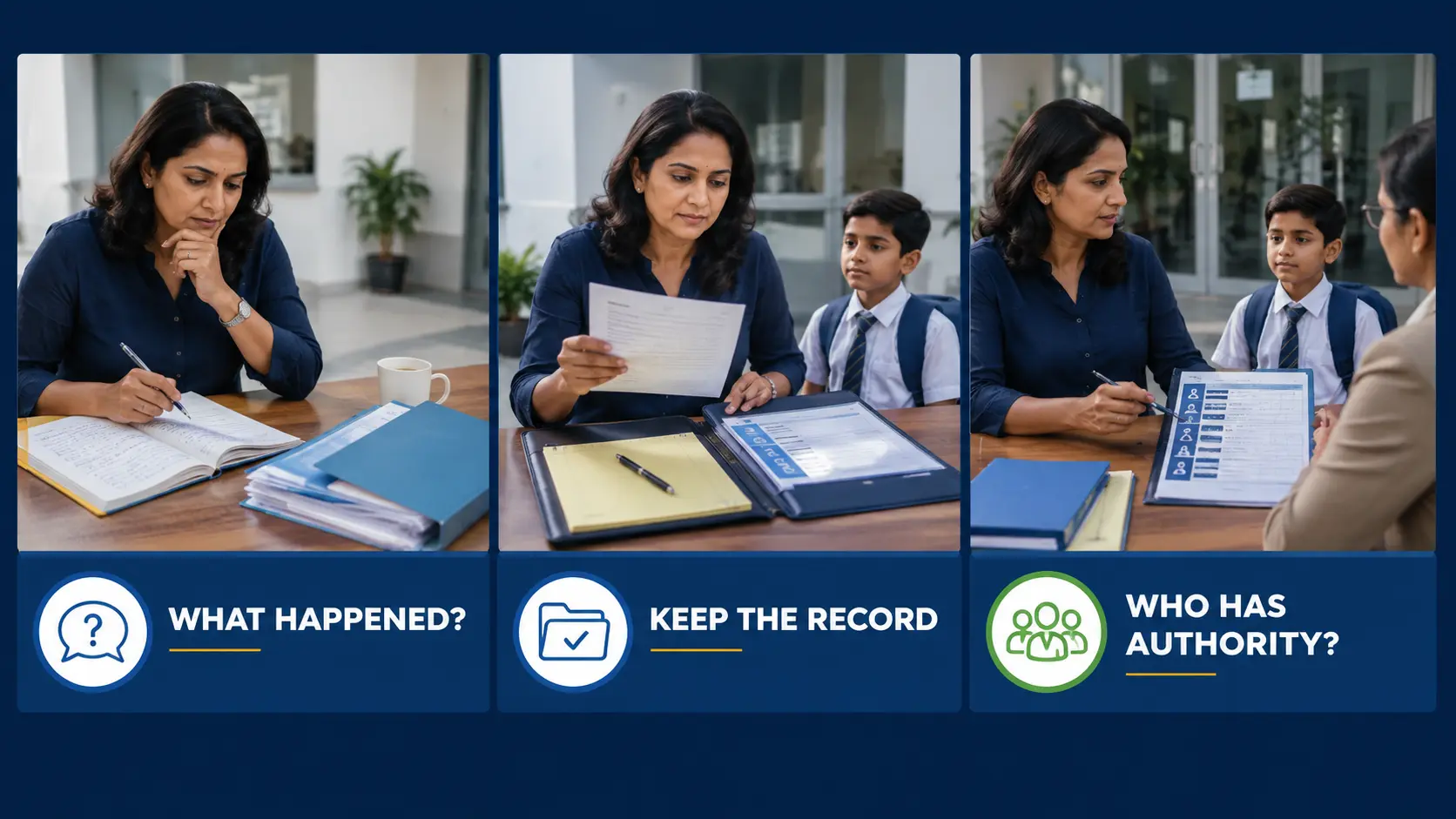
The practical parent question is: what happened, is the child safe, what evidence exists, who inside the school has authority over the staff member, and when does the matter need to move outside the school?
Direct answer
If you believe a teacher or staff member behaved improperly, record the specific conduct, preserve relevant evidence and complain to the appropriate school authority in writing when that is safe and suitable.
Ask for the complaint to be reviewed by someone with authority over the staff member, and keep the acknowledgement and response. If the conduct involves physical punishment or mental harassment, RTE Section 17 can become relevant within its statutory scope. If the allegation is substantially more serious, an ordinary internal disciplinary complaint may not be enough.
If you are unsure whether this is staff misconduct, bullying, an RTE issue or another school problem, start with the India school complaint router.
Serious child-protection concerns require different handling.
If the allegation involves suspected sexual misconduct, serious violence, coercion or another potentially criminal act involving a child, do not reduce the matter to an ordinary “teacher complaint.” The appropriate child-protection or legal route may be necessary depending on the facts.
A disagreement about teaching style, marks, classroom management or an isolated rude interaction should first be described factually without automatically alleging abuse.
Record the words or conduct, frequency, witnesses where known and any effect on the child rather than relying only on a broad label such as “mental torture.”
Physical punishment is specifically addressed under RTE Section 17 within the Act’s scope.
Section 17 also prohibits mental harassment, but the facts and applicable statutory framework still need to be established.
If the alleged actor is a peer rather than a staff member, use the bullying/safety page rather than this adult-misconduct route.
If the conduct concerns disability, accommodation, inclusion or special-needs support, a separate rights issue may also exist.
Preserve the first complaint and response before moving to the next competent authority.
Do not wait for an ordinary school grievance process merely to complete internal sequencing where the facts indicate a serious protection issue.
Seven steps for a teacher misconduct school complaint in India
Record the exact conduct
Write what happened, when, where and who was involved. Avoid replacing facts with legal labels you have not yet established.
Check whether the child is safe now
If the situation is continuing, ask what practical protection is needed while the complaint is reviewed.
Preserve relevant evidence
Keep school messages, written communication, incident dates, relevant photographs or medical documents where applicable, and any earlier complaint record.
Complain to someone who supervises the staff member
For an ordinary non-emergency complaint, approach the principal, management or designated school authority rather than sending the complaint only to the person you are complaining about.
Ask what interim action will protect the child
Do not focus only on the eventual disciplinary outcome. Ask who the child can approach, whether supervision or scheduling needs to change, and how further incidents will be prevented while the complaint is pending.
Keep the written response and complaint acknowledgement
Preserve the school’s acknowledgement, investigation response or decision. If there is no response, record that accurately.
Escalate according to the nature of the conduct
A routine staff grievance, RTE Section 17 allegation, child-rights concern and potentially criminal allegation can require different external routes.
If the school has already failed to act, continue through the school complaint escalation India guide.
Do not label every disagreement with a teacher as “harassment,” “abuse” or a criminal offence. Strong complaints describe the conduct first and then connect it to the correct rule or protection where supported.
What does RTE Section 17 say?
The Right of Children to Free and Compulsory Education Act states in Section 17 that no child shall be subjected to physical punishment or mental harassment. The section also provides for disciplinary action under the service rules applicable to a person who contravenes that prohibition.
This creates a clear national statutory anchor for physical punishment and mental harassment within the Act’s applicable framework.
Important boundary: Section 17 does not mean every criticism, disagreement, poor classroom experience or disciplinary decision is automatically unlawful mental harassment.
For the broader RTE grievance framework, use:
RTE School Complaint in India: 7 Checks Before You Escalate
What is the difference between poor behaviour and serious misconduct?
Parents do not need to make a final legal determination before raising a concern, but severity matters for routing.
| Situation | What to document | Likely first route | When a different route may be needed |
|---|---|---|---|
| Rude / unfair interaction | Exact words or decision, date, context | Teacher supervisor / principal | If repeated, discriminatory or materially harmful |
| Repeated humiliation | Pattern, statements, witnesses where known | Principal / management | If mental-harassment or child-rights concern emerges |
| Physical punishment | Incident details, injury evidence where relevant | School management plus applicable statutory route | Where seriousness requires external protection or legal intervention |
| Discriminatory treatment | Conduct, comparison, school response | Management / competent education or rights authority | If disability or another protected-rights framework applies |
| Possible sexual misconduct | Preserve relevant information without repeatedly questioning the child | Protection-focused route | Do not rely solely on internal school discipline |
| Complaint already ignored | Original complaint, acknowledgement and response | Next competent authority | Use issue-specific escalation |
Editorial interpretation: a useful parent complaint separates three questions: what the staff member allegedly did, what protection the child needs now, and which authority has power to investigate or correct that conduct.
What evidence should parents keep?
Incident chronology
Record dates, times where known, locations and what was reported.
Written school communication
Keep emails, letters, school-app messages and responses.
Earlier complaint record
Preserve any earlier complaint and acknowledgement if the conduct is repeated.
Medical or injury record
Where relevant, preserve medical documents or photographs connected to an alleged physical incident.
Relevant witnesses
Record who may have observed the event without pressuring children to coordinate versions of what happened.
Requested remedy
State what you want the school to do: investigate, protect the child, change supervision, stop the conduct or take another appropriate action.
What should parents ask the school to do?
Acknowledge the complaint
Ask the school to confirm that the complaint has been received.
Identify the reviewer
The complaint should be reviewed by someone with authority over the staff member.
Protect the child meanwhile
Ask how the child will be protected from recurrence or retaliation while the matter is examined.
Preserve confidentiality
Ask the school to handle sensitive child information carefully and avoid unnecessary circulation.
Review the facts
Ask for the available evidence and relevant accounts to be considered rather than accepting an automatic conclusion from either side.
Give a written outcome
Ask what was decided and what action was taken to address the child’s safety or educational environment, subject to legitimate confidentiality limits.
What if the school says it cannot tell you what happened to the teacher?
The parent’s legitimate concern is whether the complaint was examined and whether the child is protected.
That does not necessarily mean a school can disclose every personnel or disciplinary detail involving an employee.
Ask for the outcome relevant to your child: whether the complaint was reviewed, what protection or corrective action applies to the child’s environment, and what the parent should do if the conduct recurs.
What if the teacher is from a CBSE-affiliated school?
CBSE affiliation does not make every employment or classroom complaint exclusively a CBSE matter.
However, CBSE’s affiliation framework requires schools to follow specified child-safety guidance, including the NCPCR manual on safety and security of children in schools.
If the underlying issue is whether the school is genuinely CBSE-affiliated rather than the staff conduct itself, use:
School Affiliation and Recognition Complaint in India
What if the teacher’s conduct is actually bullying or humiliation?
The word “bullying” is often used broadly, but it helps to distinguish the actor.
If another student is repeatedly targeting the child, use the peer-bullying page:
School Bullying Complaint in India
If the alleged actor is a teacher or staff member, keep the complaint in the adult-misconduct route and separately consider whether RTE Section 17, child-rights or another protection framework applies.
What if the issue involves disability or special needs?
If a teacher is allegedly denying support, humiliating a child because of disability or refusing an accommodation, the problem may involve both staff conduct and disability-support rights.
Use the predefined child page:
School Disability Support Complaint in India
What if the allegation involves possible sexual misconduct?
A possible sexual-harm allegation involving a child should not be treated only as an internal teacher-discipline dispute.
NCPCR maintains a POCSO e-Box interface specifically for reporting child sexual-harm concerns, including incidents associated with school or tuition settings.
Do not repeatedly question the child merely to produce a more detailed school complaint. Where the facts indicate a serious child-protection concern, prioritise the appropriate protection process.
Where can parents escalate a teacher misconduct complaint?
Principal / school management
For an ordinary non-emergency complaint, begin with someone who has supervisory authority over the staff member.
State / district education authority
The appropriate education officer or administrative authority depends on the state, school type and issue.
RTE grievance route
Where physical punishment or mental harassment falls within the RTE framework, the RTE grievance route can become relevant.
Child-rights route
A serious child-rights concern may justify escalation to the competent child-rights authority depending on the facts.
Serious child-protection route
Potentially criminal or sexual conduct should not be handled solely as an internal HR or school-discipline matter.
Complaint already ignored
If the school or first authority has already failed to act, preserve the existing record and escalate from there.
Related school-problem guides
This page owns complaints where the alleged actor is a teacher or school employee. Use the neighbouring canonical when the primary problem is different.
Common mistakes parents should avoid
Using criminal labels before establishing facts
Describe the conduct first and use the correct statutory label only where supported.
Complaining only to the accused staff member
A complaint should reach someone with authority to review the staff member’s conduct.
Ignoring the child’s immediate safety
The eventual disciplinary outcome is separate from what protection the child needs now.
Publishing allegations publicly
Keep the complaint process focused and avoid unnecessarily exposing children or unverified allegations.
Treating peer bullying as staff misconduct
Identify who is alleged to have acted before choosing the route.
Restarting after the school ignores you
Keep the first complaint and escalate the existing record.
Verification notes: what is confirmed, variable and unresolved
Confirmed
RTE Section 17 prohibits physical punishment and mental harassment and provides for disciplinary action under applicable service rules. NCPCR publishes current school-safety guidance, and CBSE requires affiliated schools to follow specified child-safety guidance.
Depends on the conduct
The appropriate route can change depending on whether the allegation concerns ordinary staff behaviour, physical punishment, mental harassment, disability-related treatment or a serious child-protection issue.
Not safe to generalise
Not every complaint against a teacher is an RTE violation, child-rights case or criminal matter, and there is no one national employee-disciplinary authority for every school.
Parent takeaway
Describe the conduct, protect the child, preserve evidence and escalate according to seriousness and jurisdiction.
Editorial interpretation: the strongest complaint does not begin with the harshest label. It begins with a precise factual record and then routes the case according to the conduct: school supervision for ordinary misconduct, statutory or child-rights escalation for protected-rights concerns, and a separate protection route for potentially criminal conduct.
ThePulseSignal reviewed the current RTE Section 17 text on India Code, NCPCR’s current school-safety guidance index, CBSE’s child-safety requirements for affiliated schools and NCPCR’s POCSO e-Box surface. State-specific staff disciplinary procedures have deliberately not been generalised.
Sources checked
Limitations and unresolved facts
This is a national routing guide, not a universal teacher-disciplinary procedure for every school in India.
- Staff service rules and disciplinary procedures vary by employer, school type and state.
- RTE Section 17 has a statutory scope and should not be applied to every classroom disagreement.
- Serious child-protection allegations can trigger processes beyond ordinary school discipline.
- CBSE affiliation does not make every teacher-employment dispute exclusively a CBSE matter.
- A parent may not be entitled to every confidential personnel detail arising from an internal staff proceeding.
- Disability-related treatment may require a separate rights-based analysis.
- State-specific education authorities must be separately verified.
Teacher misconduct school complaint in India: FAQs
Where should I complain about a teacher in a private school?
For an ordinary non-emergency complaint, approach the principal, management or another person with supervisory authority over the staff member. If the matter remains unresolved, identify the appropriate state education or statutory route through the India school complaint router.
Is physical punishment by a teacher allowed under the RTE Act?
RTE Section 17 states that no child shall be subjected to physical punishment or mental harassment. Where that statutory framework applies, disciplinary action may follow under the applicable service rules.
Can I complain if a teacher repeatedly humiliates my child?
Yes, you can document the specific conduct and raise it with the school. Whether the conduct legally amounts to mental harassment or another rights violation depends on the facts and applicable framework.
What if the school ignores my teacher complaint?
Keep the original complaint, acknowledgement and response, then use the school complaint escalation India guide.
What if another student, not a teacher, is harassing my child?
Use the school bullying complaint India guide because peer bullying and adult misconduct require different routing.
Can I complain to CBSE about a teacher?
A CBSE-affiliated school must follow Board affiliation and child-safety requirements, but not every teacher-employment or disciplinary issue is exclusively within CBSE’s jurisdiction. State and school-management routes may also be relevant.
What if the allegation involves possible sexual misconduct?
Do not treat it merely as a routine internal staff complaint. A serious child-protection route may be required. NCPCR maintains a POCSO e-Box reporting surface that includes school and tuition contexts.
What evidence should I keep?
Keep an incident chronology, written school communication, complaint acknowledgements and relevant supporting evidence such as medical or injury records where applicable.
Last primary-source review: August 12, 2026.