






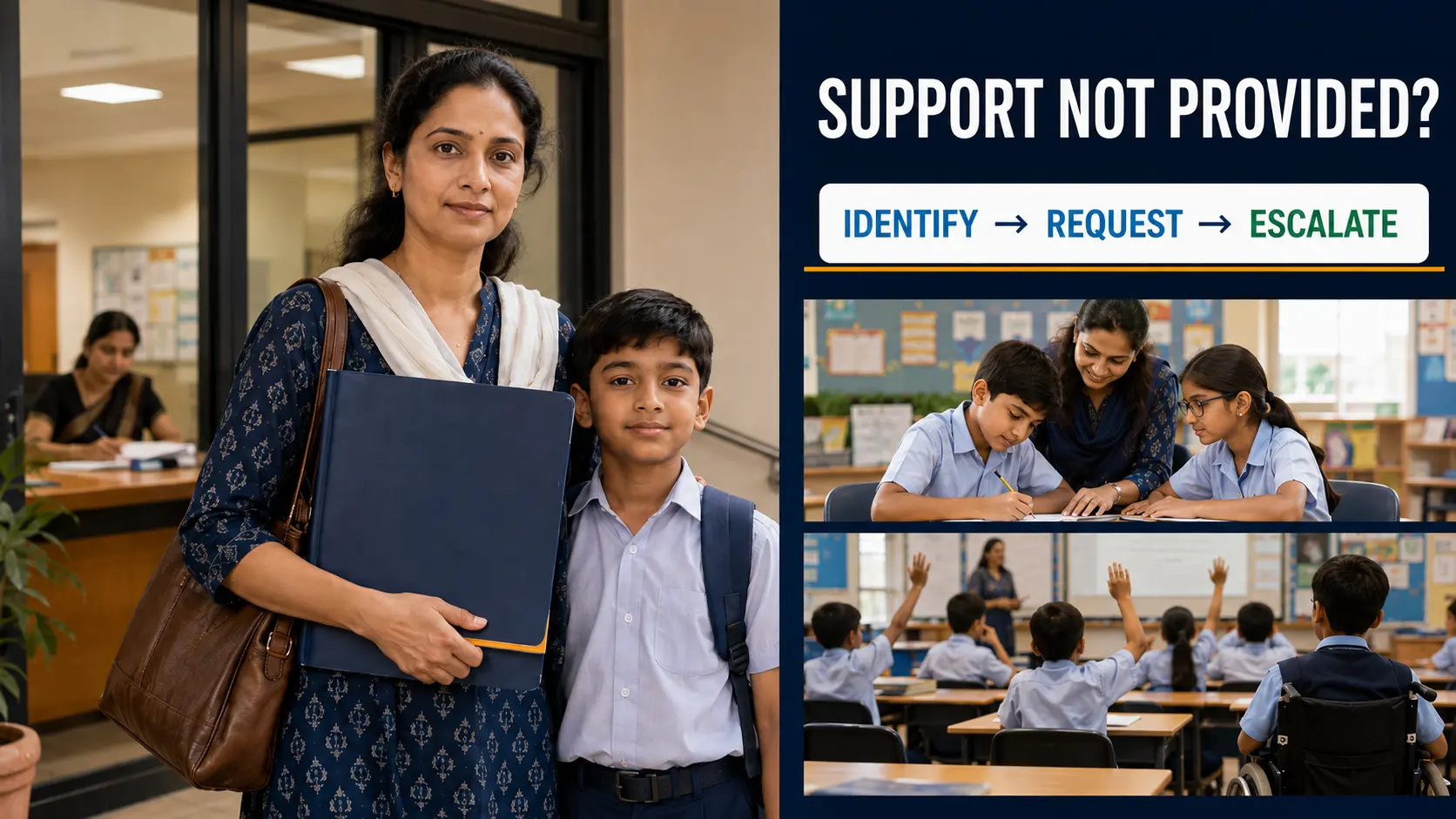
School disability support complaint in India should begin by identifying exactly what support, access or accommodation the child is being denied. Admission discrimination, an inaccessible campus, refusal of reasonable accommodation, lack of individualised support, specific-learning-disability needs and exclusion from activities can involve different duties under the Rights of Persons with Disabilities Act, 2016.
The useful parent question is not only, “My child has a disability — can I complain?” It is: what support does the child need, what did the school provide or refuse, which legal duty may apply, and which authority has jurisdiction over the school?
Direct answer
If a school is refusing disability-related support, first identify the exact barrier and request the support or accommodation in writing.
Keep the child’s relevant disability documentation, the school’s response, the requested accommodation or support and evidence of how the barrier affects participation or education. Where the school is covered by the RPwD Act’s education provisions, Section 16 provides a strong national framework for inclusive education, accessibility, reasonable accommodation and individualised support.
If you are unsure whether this is primarily a disability-support issue, bullying complaint, staff-conduct issue, RTE matter or another school problem, start with the India school complaint router.
Record the reason given by the school and check whether the institution is covered by the applicable non-discrimination and inclusive-education duties.
Accessibility may involve classrooms, entrances, toilets, circulation areas or other facilities depending on the child’s needs and the applicable requirements.
Identify the specific adjustment requested and why it is required for the child’s participation or education.
Section 16 refers to necessary individualised or other support in environments that maximise academic and social development consistent with full inclusion.
Section 16 also refers to early detection of specific learning disabilities and suitable pedagogical and other measures.
The case may involve both disability support and peer bullying. Separate the two problems.
Adult conduct should be separately documented from the underlying accommodation or support issue.
Keep the support request, school response and first complaint before moving to the next competent authority.
Seven checks before filing a school disability support complaint in India
Name the exact barrier
Write whether the problem concerns admission, access, classroom participation, reasonable accommodation, examination support, transport, communication, learning support or another identifiable need.
Identify what support is actually being requested
A complaint is stronger when it states the specific adjustment or support the child needs rather than only saying the school is “not inclusive.”
Keep the relevant disability documentation
Preserve the disability certificate or other relevant professional documentation where applicable, but share only what is necessary for the support request and complaint.
Ask the school in writing
State the barrier, requested support and how it affects the child’s ability to access or participate in education.
Ask for the school’s written response
If the school says the support is impossible, unavailable or unnecessary, ask for the reason and any alternative it proposes.
Identify the competent disability and education authority
The correct route can depend on whether the school or authority is controlled by the Central Government, State Government or another recognised education system.
Escalate the existing record if nothing changes
Keep the support request, school response, complaint acknowledgement and evidence of the continuing barrier.
If you already complained, use the school complaint escalation India guide.
Do not assume every child with a learning difficulty or educational support need automatically falls within every provision of the RPwD Act. The child’s disability status, documentation, requested support and applicable legal framework still matter.
What does the RPwD Act say about inclusive education?
Section 16 of the Rights of Persons with Disabilities Act sets out duties relating to inclusive education for educational institutions funded or recognised by the appropriate Government or local authorities.
The provision includes several distinct elements that matter directly to parents.
| Section 16 area | What parents should examine | Possible complaint evidence |
|---|---|---|
| Admission without discrimination | Was the child refused or treated differently because of disability? | Admission application, written reason, school communication |
| Accessible buildings and facilities | Can the child physically and practically access the school environment? | Specific inaccessible location, requested modification, school response |
| Reasonable accommodation | What individual adjustment was requested? | Written request, relevant documentation, refusal or alternative offered |
| Individualised support | What support is needed for academic and social participation? | Support request, educational plan, correspondence |
| Specific learning disabilities | Has the school responded to identified learning needs with suitable measures? | Assessment, pedagogical request, school response |
| Participation and progress | Is the child’s participation, progress and completion being appropriately monitored? | School records and support communications |
Editorial interpretation: “inclusive education” is not one single service. The Act separates admission, physical accessibility, accommodation, communication, individual support, learning-disability measures and participation. A parent complaint should identify which one is failing.
What is reasonable accommodation in a school context?
The practical question is what adjustment is required for this particular child to participate in education on an equal basis.
The answer should therefore be child-specific rather than based on a generic checklist.
A parent may need to describe:
- the barrier the child experiences;
- the adjustment requested;
- why the adjustment is needed;
- the relevant documentation supporting the request;
- what the school currently provides; and
- what alternative the school offered, if any.
A complaint should not begin with “the school provides no accommodation” if some support exists. State exactly what is missing, inadequate or refused.
What if the school refuses admission because of disability?
Section 16 includes a duty relating to admission without discrimination for educational institutions within its scope.
Parents should preserve:
- the admission application;
- the child’s relevant disability documentation;
- any written or recorded reason for refusal;
- the school’s eligibility criteria;
- any alternative placement suggested; and
- the exact remedy requested.
If the admission dispute is also an RTE matter, keep the two legal questions separate and use the dedicated RTE school complaint India guide.
What if the school building is not accessible?
Section 16 specifically refers to making the building, campus and various facilities accessible.
CBSE’s current affiliation conditions also include disability-access provisions. Its published infrastructure requirements refer to facilities such as ramps in toilets for wheelchair users and other accessibility measures under the RPwD framework. :contentReference[oaicite:4]{index=4}
For a useful complaint, identify the exact barrier rather than writing only “school is inaccessible.”
What if the child has a specific learning disability?
Section 16 expressly includes early detection of specific learning disabilities and suitable pedagogical and other measures to address them. :contentReference[oaicite:5]{index=5}
That does not mean every academic difficulty should automatically be labelled a specific learning disability.
Where a diagnosed or formally identified learning disability exists, parents should preserve relevant assessment material and make the requested classroom or academic support clear.
What if the child needs individualised support?
Section 16 refers to necessary support — individualised or otherwise — in environments that maximise academic and social development consistent with full inclusion. :contentReference[oaicite:6]{index=6}
A useful complaint should therefore identify what support is required and what part of the child’s participation is currently affected.
Avoid vague requests such as “give special care.” Ask for the specific support, adjustment, communication method, supervision or classroom measure the child needs.
What about children with benchmark disabilities?
Section 31 of the RPwD Act provides an additional education right for children with benchmark disabilities between six and eighteen years of age: free education in a neighbourhood school or a special school of their choice, with the appropriate Government and local authorities required to ensure access to free education in an appropriate environment until age eighteen. :contentReference[oaicite:7]{index=7}
Do not confuse “person with disability” and “person with benchmark disability” when a specific statutory benefit depends on benchmark-disability status.
What evidence should parents keep?
Support request
Keep the written request stating the exact accommodation or support required.
Relevant disability documentation
Preserve the disability certificate, assessment or other relevant records where applicable.
School response
Keep the school’s acceptance, refusal, explanation or alternative proposal.
Barrier evidence
Document the inaccessible facility, excluded activity, denied accommodation or other practical barrier.
Education impact
Record how the barrier affects attendance, participation, assessment, learning or access.
Complaint acknowledgement
Keep the complaint number, email or written acknowledgement if the issue is escalated.
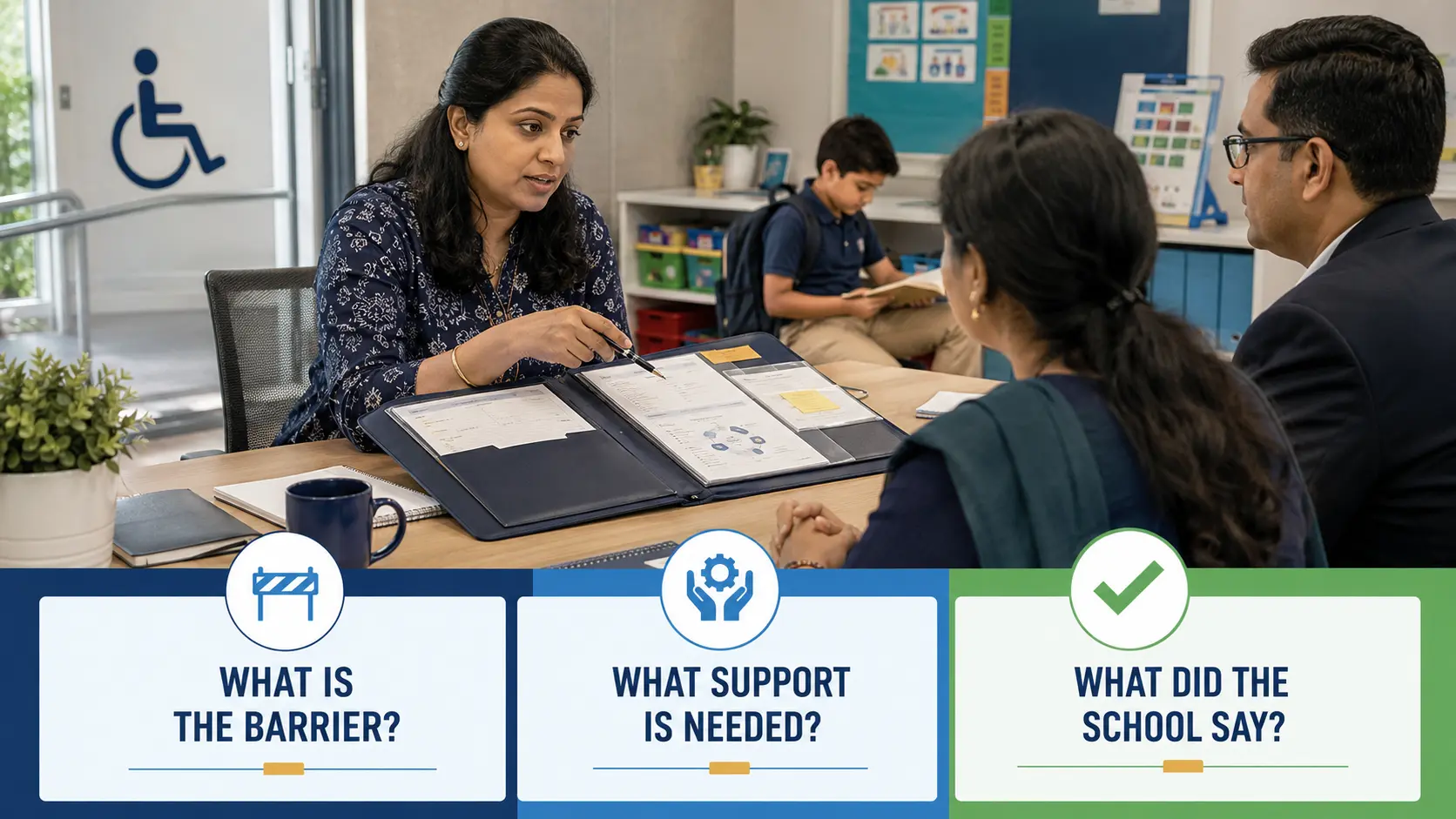
What if disability-related bullying is the problem?
Separate two questions:
1. Is another student bullying or targeting the child?
2. Is the school also failing to provide disability-related support, inclusion or protection?
Both can exist at the same time.
Use the bullying-specific route for the peer-conduct part:
School Bullying Complaint in India
What if a teacher humiliates the child because of disability?
Again, separate the staff-conduct issue from the underlying accommodation or inclusion issue.
If the alleged conduct is by a teacher or staff member, use:
Teacher Misconduct School Complaint in India
If the problem also involves reasonable accommodation, accessibility or inclusion, keep that disability-support complaint alive separately.
Who should parents complain to?
The complaint route depends on the institution and the authority responsible for it.
School / management
For a non-emergency support problem, a written accommodation or support request can create the first record.
State education authority
Education-department oversight can remain relevant depending on the school type and state.
State Commissioner for Persons with Disabilities
For matters involving State Government departments, institutions, local authorities or state-controlled bodies, the relevant State Commissioner can be the disability-rights complaint route.
Chief Commissioner for Persons with Disabilities
For complaints against bodies controlled or aided by the Government of India, the Office of the Chief Commissioner provides an online, post and email complaint route.
RTE route
If the issue also concerns a right under the RTE Act, use the RTE-specific route rather than assuming the RPwD framework replaces it.
Complaint already ignored
If the first complaint exists, preserve it and continue through the next competent authority.
Can parents complain to the Chief Commissioner for Persons with Disabilities?
The Office of the Chief Commissioner provides a complaint process under the RPwD framework, but jurisdiction matters.
Its current guidance says a complaint against a Ministry, Department, institution, organisation or authority controlled or aided by the Government of India may be filed before the Chief Commissioner. Complaints relating to State Government bodies, local authorities or state-controlled entities belong before the State Commissioner for Persons with Disabilities of the relevant State or Union Territory. :contentReference[oaicite:8]{index=8}
The current CCPD complaint guidance asks for the facts of the complaint, supporting documents and the relief sought; it also says a disability certificate is required for complaints filed there. :contentReference[oaicite:9]{index=9}
Do not send every private-school support dispute directly to the Chief Commissioner. First identify the institution, the appropriate Government and whether Central or State disability jurisdiction applies.
What if the school is CBSE affiliated?
CBSE affiliation does not replace the RPwD Act or state disability jurisdiction.
However, CBSE’s published Affiliation Bye-Laws include disability-related requirements. The Board’s current materials say affiliated schools should provide disability-access facilities and promote inclusion of students with special needs. :contentReference[oaicite:10]{index=10}
If the dispute is actually about whether the school is genuinely CBSE-affiliated, use:
School Affiliation and Recognition Complaint in India
What if the school already ignored the support request?
Do not restart from zero.
Keep:
- the original support or accommodation request;
- the child’s relevant documentation;
- the school’s response;
- the first complaint;
- the acknowledgement; and
- the exact barrier that remains unresolved.
Then continue with:
School Complaint Escalation in India
Related school-problem guides
This page owns disability-related support, accessibility and accommodation problems. Use the neighbouring canonical when another problem overlaps.
Common mistakes parents should avoid
Requesting only “special treatment”
Identify the exact support or accommodation needed.
Mixing bullying and accommodation into one allegation
Both issues may exist, but each should be documented clearly.
Assuming CBSE is the only authority
Board affiliation, disability rights and state education jurisdiction are different questions.
Sending every case to the Chief Commissioner
Central and State disability jurisdiction must be distinguished.
Sharing unnecessary medical information
Provide the relevant documentation required for the support or complaint, not unrelated sensitive details.
Starting over after no response
Keep the first support request and escalate the same record.
Verification notes: what is confirmed, variable and unresolved
Confirmed
RPwD Section 16 includes duties concerning non-discriminatory admission, accessibility, reasonable accommodation, individualised support, specific learning disabilities and participation. Section 31 separately provides free-education rights for children with benchmark disabilities aged six to eighteen.
Depends on jurisdiction
The competent education and disability authority can depend on the school’s management, recognition status and whether the appropriate Government is Central or State.
Not safe to generalise
Not every support request is legally identical, and not every disability-related school complaint belongs directly before the Chief Commissioner or CBSE.
Parent takeaway
Identify the barrier, ask for the exact support, preserve the response and use the authority with jurisdiction over that school and right.
Editorial interpretation: the strongest disability-support complaint is specific: “this is the barrier, this is the adjustment required, this is the evidence, this is what the school refused, and this is the effect on the child’s access or participation.”
ThePulseSignal reviewed the Rights of Persons with Disabilities Act through India Code, including Sections 16 and 31; CBSE’s current disability-access and inclusion provisions for affiliated schools; and the Office of the Chief Commissioner for Persons with Disabilities’ current complaint and jurisdiction guidance.
Sources checked
- India Code — Rights of Persons with Disabilities Act, 2016
- India Code — RPwD Act Section 16: Duty of Educational Institutions
- India Code — RPwD Act Section 31: Free Education for Children with Benchmark Disabilities
- CBSE — Affiliation Bye-Laws and Rights of Persons with Disabilities Provisions
- Chief Commissioner for Persons with Disabilities — How to Register a Complaint
- Chief Commissioner for Persons with Disabilities — Complaint Jurisdiction FAQs
Limitations and unresolved facts
This is a national disability-support routing guide, not a substitute for the exact state education and disability complaint framework.
- The appropriate authority depends on the school and whether Central or State jurisdiction applies.
- Not every educational need establishes a disability-rights claim under the RPwD Act.
- Specific benefits can depend on benchmark-disability status.
- The exact accommodation required is child-specific.
- CBSE affiliation does not replace state education or disability-rights jurisdiction.
- Bullying and staff misconduct should be separately documented where they overlap with disability support.
- State Commissioner complaint processes must be separately verified state by state.
School disability support complaint in India: FAQs
Can a school refuse admission because my child has a disability?
Section 16 of the RPwD Act includes non-discriminatory admission within the inclusive-education duties for educational institutions covered by the provision. The school’s status, facts and applicable jurisdiction still need to be checked.
Does a school have to provide reasonable accommodation?
Section 16 expressly includes reasonable accommodation according to the individual’s requirements for educational institutions within its scope.
What if my child has dyslexia or another specific learning disability?
Section 16 refers to early detection of specific learning disabilities and suitable pedagogical and other measures. Keep relevant assessment documentation and ask for the specific educational support required.
Can I complain if the school building is inaccessible?
Section 16 includes accessibility of the building, campus and facilities. CBSE’s affiliation requirements also include disability-access measures for affiliated schools.
Can I complain to the Chief Commissioner for Persons with Disabilities?
Potentially where the complaint falls within the Chief Commissioner’s jurisdiction over Central Government-controlled or aided bodies. State Government and local-authority matters generally belong before the relevant State Commissioner. :contentReference[oaicite:11]{index=11}
What if my child is being bullied because of disability?
Keep both issues separate. Use the school bullying complaint guide for peer conduct while separately documenting any failure to provide disability support or protection.
What if a teacher humiliates my child because of disability?
Use the teacher misconduct school complaint guide for the adult-conduct issue while preserving the disability-support complaint separately.
What if the school ignores my disability-support complaint?
Keep the original request, response and complaint acknowledgement, then use the school complaint escalation India guide.
Last primary-source review: August 12, 2026.