






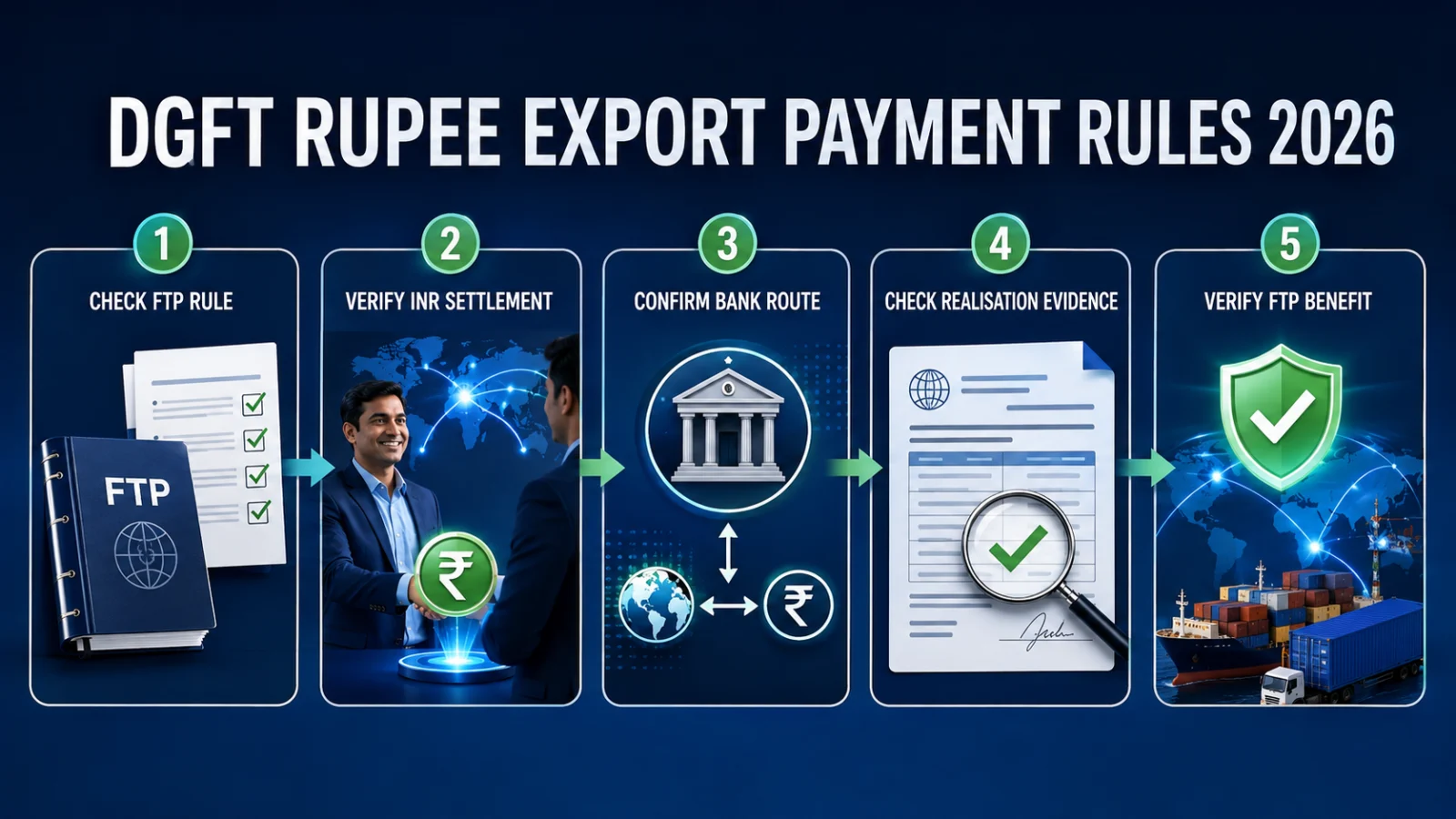
DGFT Notification No. 30/2026-27 has materially broadened how the Foreign Trade Policy treats export contracts and export proceeds received in Indian rupees. The amendment, dated August 20, 2026, replaces Paragraphs 2.52 and 2.53 of FTP 2023 and takes effect immediately.
For exporters, the most important change is that the rule is no longer framed mainly around the earlier Special Rupee Vostro mechanism. The revised policy permits wider INR denomination and realisation, while Paragraph 2.53 now gives qualifying INR export proceeds broader parity with foreign-currency export earnings for FTP benefits, incentives and fulfilment of export obligations.
Direct answer: an INR export receipt does not qualify merely because the buyer paid in rupees. The transaction must follow the applicable country-specific rule and permitted banking channel. For most countries other than Nepal and Bhutan, INR proceeds can qualify for FTP treatment when credited through the permitted Indian-rupee accounts of persons resident outside India under the applicable FEMA deposit regulations.
What exactly changed in DGFT Paragraph 2.52?
The revised Paragraph 2.52 separates exporters into three broad country groups.
1. Countries outside the Asian Clearing Union
For export contracts and invoices not involving Asian Clearing Union member countries, the revised rule permits denomination in either a foreign currency or Indian rupees.
The export proceeds may also be realised in either a foreign currency or Indian rupees.
This is broader than the earlier wording, which generally required realisation in freely convertible currency while providing specific exceptions for INR receipts.
2. Asian Clearing Union countries other than Nepal and Bhutan
For ACU member countries other than Nepal and Bhutan, contracts are to be denominated in a currency determined by the Asian Clearing Union.
However, denomination and settlement may also follow directions issued by the Reserve Bank of India from time to time.
3. Nepal and Bhutan
For Nepal and Bhutan, export contracts are to be denominated and settled in Indian rupees or in accordance with RBI directions.
The revised paragraph also retains the ability to denominate export contracts and invoices under EXIM Bank or Government of India Lines of Credit in Indian rupees.
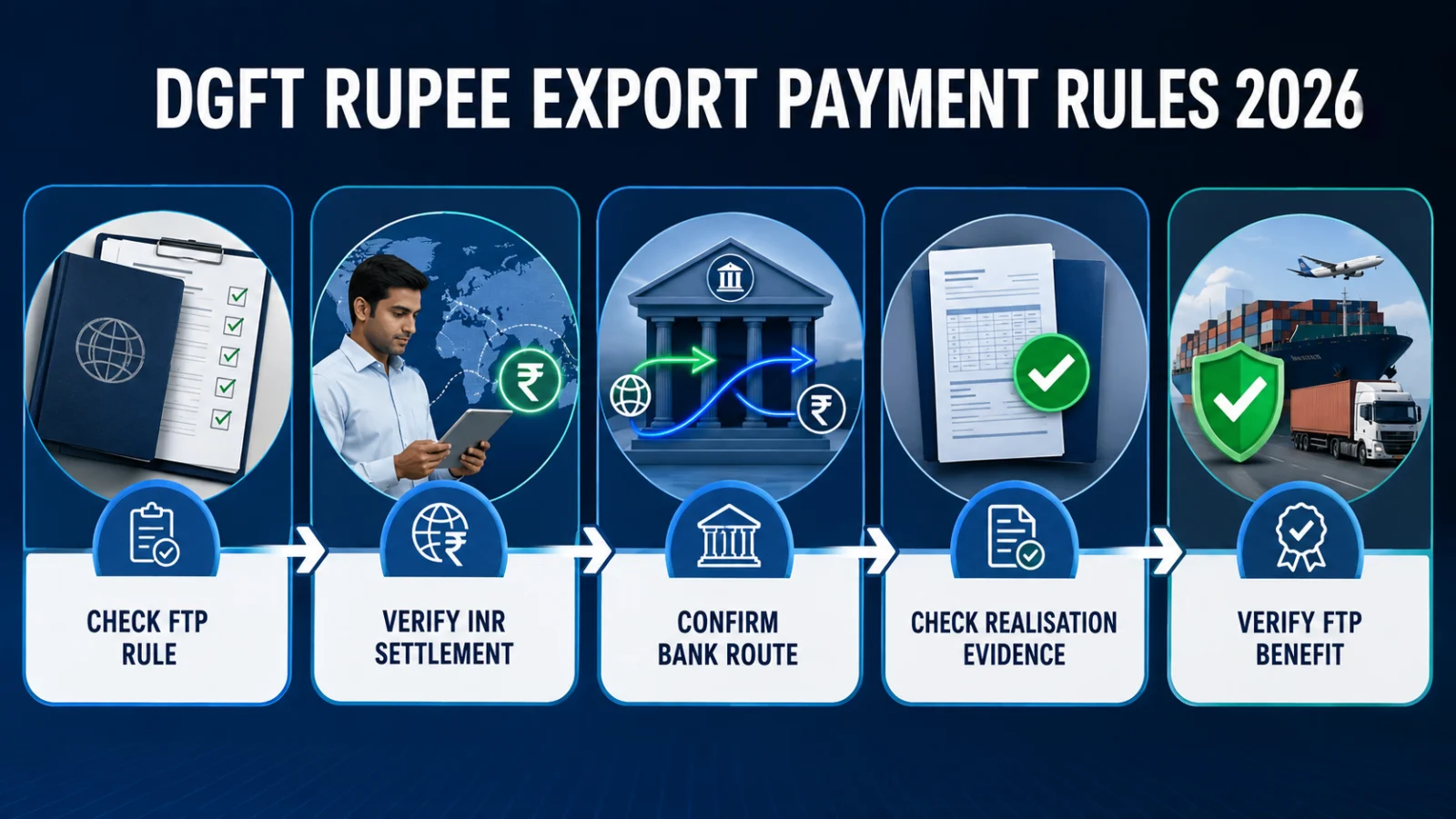
What changed in Paragraph 2.53 on FTP benefits?
This is the most important part for exporters relying on incentives or export-obligation fulfilment.
Under the revised Paragraph 2.53, exports to any country other than Nepal and Bhutan can receive FTP benefits and incentives, and can count toward fulfilment of export obligations, when:
- the export proceeds are realised in Indian rupees
- the payment moves through banking channels
- the amount is credited to an Indian Rupee account of a person resident outside India
- that account is opened in accordance with the Foreign Exchange Management (Deposit) Regulations, as amended from time to time
When those conditions apply, the revised FTP says the INR-realised export can receive FTP treatment at par with exports realised in foreign currency.
Important: this is broader than saying only a Special Rupee Vostro Account transaction can qualify. The amended Paragraph 2.53 is framed around qualifying rupee accounts of persons resident outside India and the applicable FEMA deposit rules.
Does this mean the Special Rupee Vostro requirement has been removed?
The revised Paragraph 2.52 no longer reproduces the earlier dedicated sub-clause that described INR settlement specifically through a designated Special Rupee Vostro Account under RBI’s July 11, 2022 framework.
Instead, the amended FTP uses broader currency and country-specific rules and aligns the policy with the Foreign Exchange Management framework.
That does not mean exporters should assume that any informal rupee payment route is acceptable. The receiving account and banking channel must still comply with RBI and FEMA requirements applicable to the transaction.
An exporter should therefore ask its authorised dealer bank exactly which permitted non-resident rupee account or settlement structure is being used.
Were rupee export receipts already eligible before this amendment?
Yes, but under a narrower framework.
Before Notification No. 30/2026-27, FTP 2023 already allowed specified INR settlement arrangements. The earlier Paragraph 2.53 also allowed qualifying INR export realisations under Paragraph 2.52(d)(ii) to receive FTP benefits, incentives and export-obligation treatment.
The August 2026 amendment therefore does not create INR export settlement from zero. It broadens and restructures the framework and places qualifying INR realisations on a clearer footing with foreign-currency receipts.
What does the revised rule mean for exports to Iran?
Iran remains subject to an additional condition.
The revised Paragraph 2.53 says the broader INR treatment also applies to exports to Iran, but only subject to compliance with Paragraph 2.19 of the Foreign Trade Policy.
Exporters dealing with Iran should therefore not rely on the general INR rule alone. The Iran-specific FTP restrictions and compliance requirements must also be checked.
Why are Nepal and Bhutan excluded from the general Paragraph 2.53 rule?
Nepal and Bhutan have their own treatment under revised Paragraph 2.52. Their export contracts are to be denominated and settled in Indian rupees or according to RBI directions.
Because those countries are handled separately, exporters should not apply the general Paragraph 2.53 wording for other countries without checking the Nepal- or Bhutan-specific RBI framework.
What about Asian Clearing Union countries?
The revised policy does not treat every destination identically.
For ACU members other than Nepal and Bhutan, the contract currency follows the currency determined by the ACU, while RBI directions can govern alternative denomination and settlement.
That means an exporter dealing with an ACU member should verify both the current ACU framework and RBI instructions rather than assuming the general non-ACU INR rule applies unchanged.
Can INR receipts now count toward Advance Authorisation or EPCG obligations?
Paragraph 2.53 now states generally that qualifying INR export realisations are eligible for export benefits and incentives and for fulfilment of export obligations under the FTP.
Government material on the earlier INR settlement framework had already identified export-obligation mechanisms such as Advance Authorisation and EPCG as areas where qualifying rupee realisations could matter.
However, exporters should still verify the conditions of the specific authorisation or scheme. The new Paragraph 2.53 does not remove unrelated conditions such as export period, product coverage, value addition, documentation or authorisation-specific requirements.
What should an exporter verify before accepting an INR payment?
- Identify the destination country: determine whether it is outside the ACU, an ACU member, Nepal, Bhutan or Iran
- Check invoice denomination: make sure the contract and invoice currency comply with revised Paragraph 2.52
- Confirm the banking channel: ask the authorised dealer bank which RBI- and FEMA-compliant account structure will receive the rupees
- Confirm non-resident account eligibility: where Paragraph 2.53 is being relied upon, confirm that the Indian Rupee account of the non-resident is opened under the applicable Foreign Exchange Management deposit regulations
- Confirm export realisation evidence: verify how the bank will report the receipt and what e-BRC or equivalent record will support the export
- Identify the FTP benefit or obligation: check the conditions of the specific scheme, authorisation or export obligation
- Check Iran-specific rules where applicable: Paragraph 2.19 remains relevant to exports to Iran
Does receiving rupees automatically make an export eligible for FTP benefits?
No.
The revised policy broadens the eligible INR framework, but currency alone does not establish entitlement.
The exporter still needs a permitted banking route and must satisfy the conditions attached to the specific FTP benefit, incentive or export obligation.
Product restrictions, licensing requirements, sanctions-related conditions, customs rules and other DGFT controls also remain separate compliance questions.
What documents should exporters keep aligned?
For an INR-settled transaction, the commercial and banking evidence should support the same export.
- export contract
- commercial invoice
- packing list where applicable
- Shipping Bill or Bill of Export
- transport document
- bank realisation record
- e-BRC or other applicable realisation evidence
- authorisation or scheme records where an FTP benefit or export obligation is involved
For businesses using more complex exporter structures, ThePulseSignal’s Exporter on Record registration guide covers ANF-9A documentation, warehouses and compliance requirements.
For the registration procedure itself, see the ANF-9A registration guide for Exporter-on-Record in India.
What does this mean for e-commerce exporters?
E-commerce exporters can potentially benefit from broader INR settlement flexibility, but the amendment does not replace customs, shipping, banking or export-realisation requirements.
ThePulseSignal’s India e-commerce export framework guide covers the wider compliance framework for platforms and sellers.
Does the INR settlement rule override other DGFT restrictions?
No. Payment settlement and trade-control compliance are separate issues.
A transaction that satisfies Paragraphs 2.52 and 2.53 can still be subject to licensing conditions, product restrictions, destination controls or other DGFT measures.
For example, ThePulseSignal’s India forced labour import ban guide explains a separate DGFT compliance framework that is not displaced by the currency used for payment.
What is now clear from Notification No. 30/2026-27?
- The amendment is dated August 20, 2026 and takes effect immediately
- Paragraphs 2.52 and 2.53 have been replaced
- For non-ACU countries, export contracts and invoices may be denominated in foreign currency or INR
- For those transactions, export proceeds may also be realised in foreign currency or INR
- ACU countries have separate currency treatment
- Nepal and Bhutan have separate INR or RBI-directed treatment
- Qualifying INR realisations for countries other than Nepal and Bhutan can receive FTP benefits and fulfil export obligations at par with foreign-currency realisations
- Iran remains subject to Paragraph 2.19
- The amendment aligns FTP treatment with the applicable Foreign Exchange Management framework
What exporters should not conclude
- Not every rupee payment automatically qualifies for an FTP benefit
- The amendment does not remove RBI or FEMA banking requirements
- It does not remove scheme-specific conditions
- It does not override product or destination restrictions
- Nepal, Bhutan and ACU transactions should not be treated identically to ordinary non-ACU exports
- Iran transactions still require Paragraph 2.19 compliance
Why did DGFT make this change?
The notification states that the purpose is to align the FTP provisions on export-contract denomination and eligibility for benefits on INR export realisations with the Foreign Exchange Management (Manner of Receipt and Payment) Regulations, 2023.
The broader policy direction also supports increased use of the Indian rupee in international trade settlement. Reuters reported that the change is intended to place qualifying rupee export earnings on a broader footing with foreign-currency earnings and encourage wider INR trade settlement.
Official and supporting sources
- APEDA — DoC/DGFT Notifications, including Notification No. 30/2026-27
- Gazette of India — Notification No. 30/2026-27, dated August 20, 2026
- DGFT Foreign Trade Policy 2023 — Chapter 2
- Reuters — India eases rules for rupee export payments
How the current rule was verified
Notification No. 30/2026-27 is now directly listed in APEDA’s Government of India DoC/DGFT notification repository with the August 20 publication date and downloadable notification file. The notification text confirms the replacement of Paragraphs 2.52 and 2.53 and the immediate-effect rule.
The revised wording confirms the broader treatment of INR denomination and realisation, the separate rules for ACU members, Nepal and Bhutan, and the eligibility of qualifying INR proceeds for FTP benefits and export-obligation fulfilment.
The existing DGFT FTP Chapter 2 provides the pre-amendment framework needed to understand what changed, while RBI’s non-resident-account guidance remains relevant when exporters and authorised dealer banks determine the permitted rupee-account structure for a specific transaction.
Last verified: September 7, 2026.
Limitations and unresolved implementation questions
- The notification establishes the FTP rule, but exporters should still verify the current RBI and FEMA requirements for the exact non-resident rupee account used by their authorised dealer bank
- The amendment itself does not explain every scheme-specific operational consequence
- Any future DGFT or RBI clarification on e-BRC, bank reporting or implementation should be checked separately
- Transaction-specific eligibility can depend on destination, banking route, scheme conditions and other trade controls
- The general rule does not replace Nepal-, Bhutan-, ACU- or Iran-specific requirements
Frequently asked questions
Can Indian exporters invoice overseas buyers in rupees?
Yes. Under revised Paragraph 2.52, contracts and invoices for countries outside the Asian Clearing Union may be denominated in foreign currency or Indian rupees. ACU members, Nepal and Bhutan have separate rules.
Can Indian exporters receive export proceeds in rupees?
Yes, subject to the applicable country category, banking channel and RBI or FEMA rules.
Can INR export proceeds qualify for FTP benefits?
Yes. Revised Paragraph 2.53 provides broader eligibility for exports to countries other than Nepal and Bhutan when the INR proceeds are realised through permitted banking channels into qualifying Indian-rupee accounts of persons resident outside India.
Do INR proceeds count toward export obligations?
Qualifying INR export proceeds covered by revised Paragraph 2.53 can count toward fulfilment of export obligations under the FTP, subject to the requirements of the relevant authorisation or scheme.
Is a Special Rupee Vostro Account still the only route?
The revised FTP no longer frames Paragraphs 2.52 and 2.53 solely around the earlier Special Rupee Vostro clause. The current rule uses broader FEMA-aligned account and banking-channel language. Exporters should confirm the permitted route with their authorised dealer bank.
Do the same rules apply to Nepal and Bhutan?
No. Nepal and Bhutan have separate treatment under Paragraph 2.52 and are excluded from the general Paragraph 2.53 eligibility wording for other countries.
What about exports to Iran?
INR treatment can apply, but exports to Iran remain subject to compliance with Paragraph 2.19 of the FTP.
Should an exporter change settlement currency immediately?
Not without checking the contract, counterparty, authorised dealer bank, destination-country treatment, FEMA requirements, documentation and the specific FTP benefit or export obligation involved.