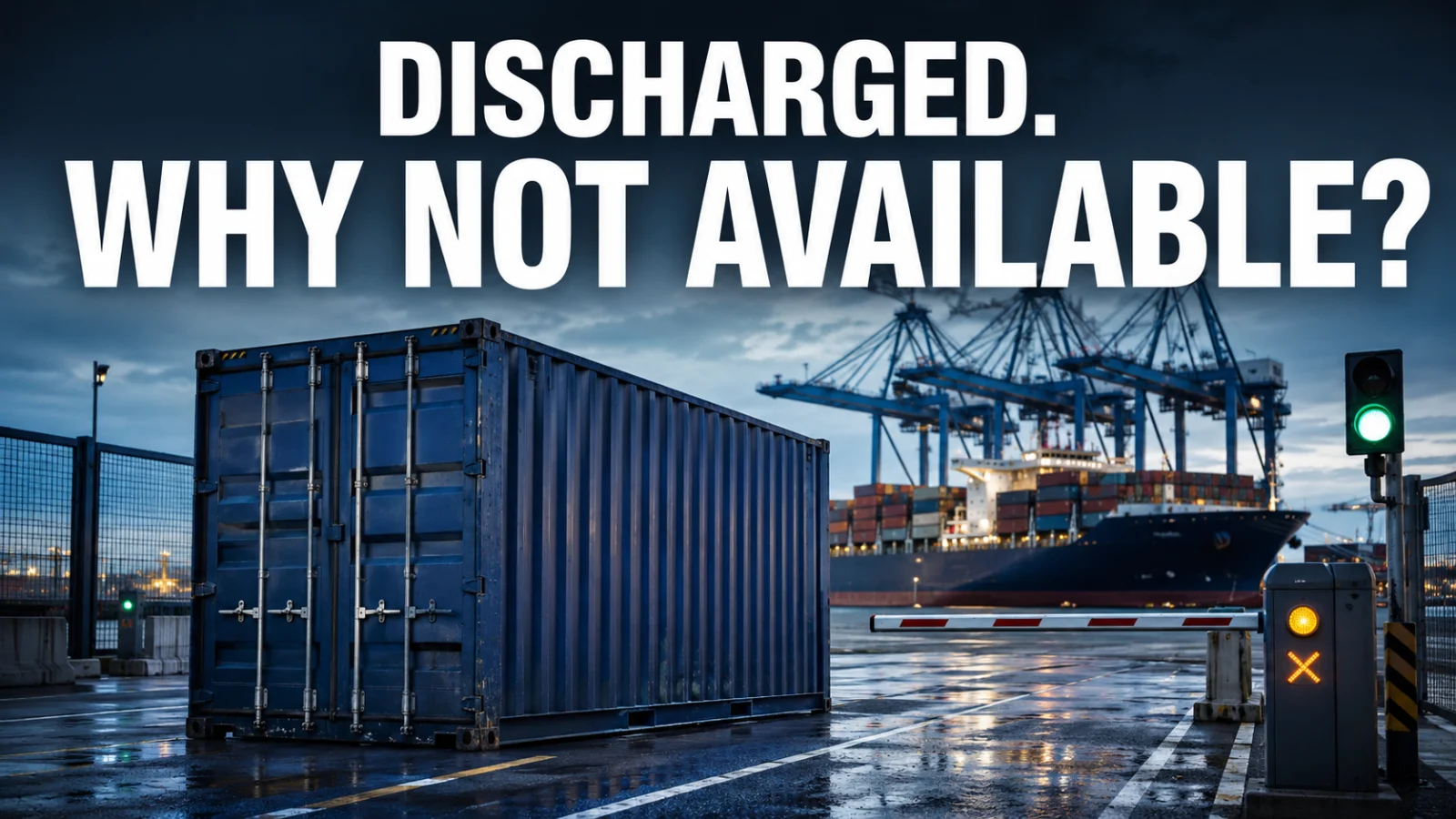





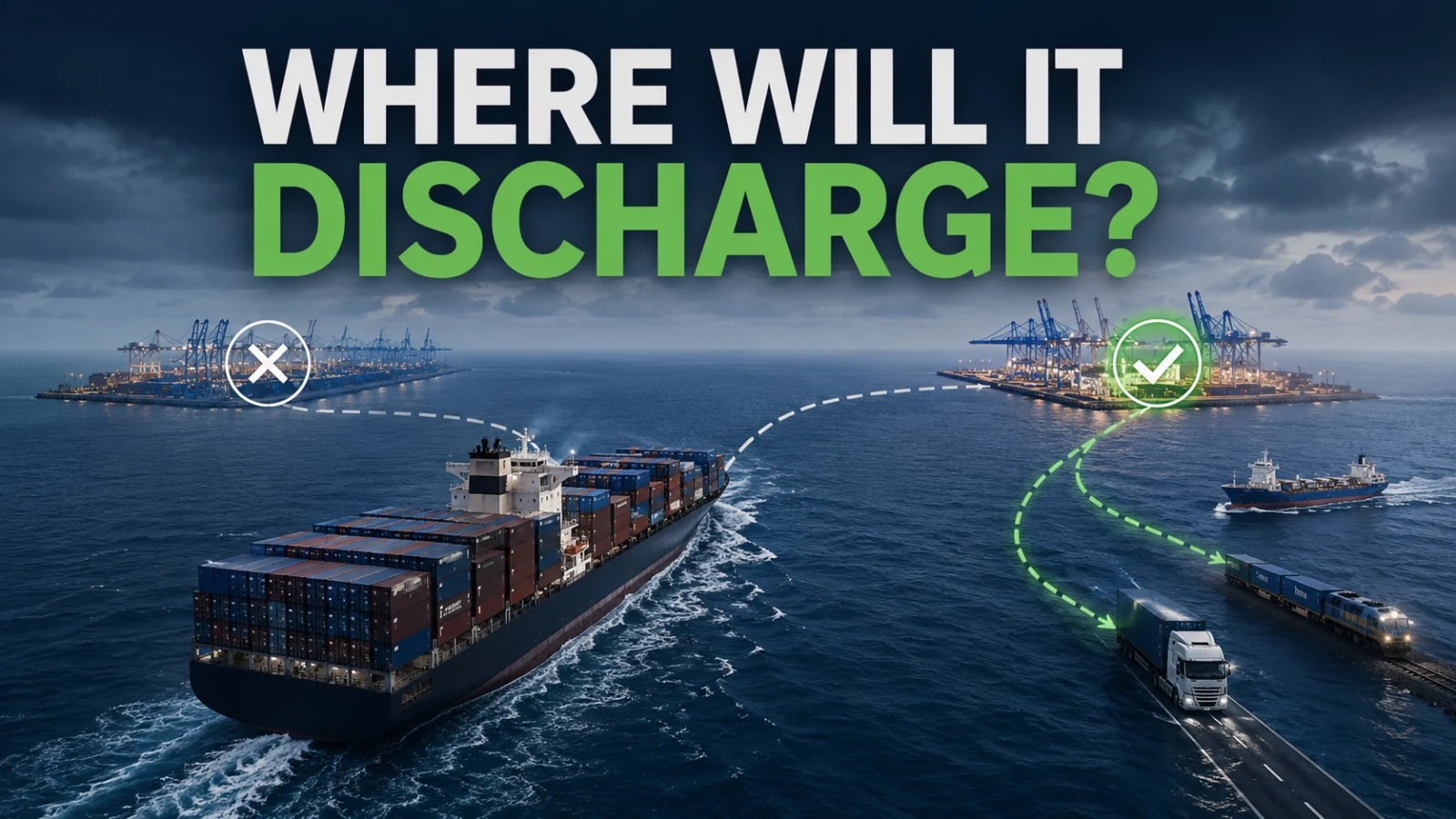
A port omission container problem begins when the vessel continues its voyage but skips a port that was part of the planned rotation. For cargo already onboard, the key question becomes: where will the container actually be discharged, and how will it reach the original destination?
For export cargo still waiting at the omitted port, the problem is different: the container may need a new vessel, service, gate-in plan or even another load port.
Direct answer
Where does your container go after a port omission?
Start with the carrier’s omission advisory, then check whether your cargo is import cargo already onboard or export cargo still waiting to load. For onboard import cargo, identify the alternative discharge port and the onward movement — feeder, mainline connection, truck or rail where applicable. For export cargo, check the revised vessel, voyage, load port and gate-in instructions.
The strongest confirmation comes from shipment-specific booking or routing data followed by actual container discharge and onward-movement events.
First thing to check
Was your box already onboard?
This single fact usually determines the recovery path. An onboard import container needs an alternative discharge and onward route. A container still waiting at the omitted port needs a new loading plan.
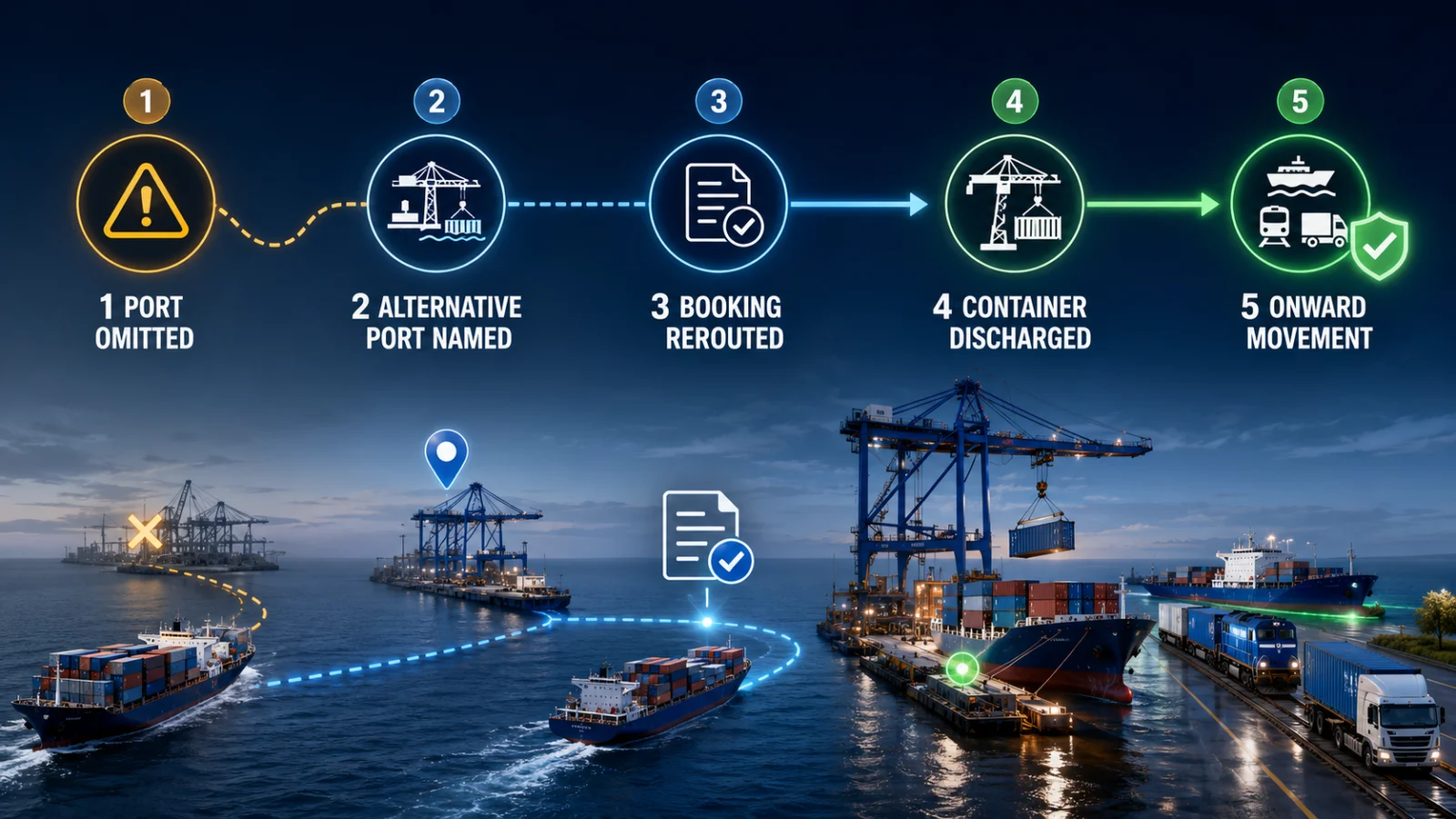
State 1
Port omitted
The vessel will not call the originally planned port.
State 2
Alternative port pending
The carrier confirms the omission but the substitute discharge or load plan is still under review.
State 3
Shipment rerouted
A new port, vessel, voyage or onward route is assigned to the affected shipment.
State 4
Movement confirmed
Tracking shows the container discharged, loaded or otherwise moved according to the revised plan.
In this guide
- What port omission means
- Import cargo vs export cargo
- Port omission vs blank sailing vs rollover
- Where onboard import cargo can go
- What happens to export cargo
- Alternative-port evidence ladder
- Carrier advisory vs booking vs tracking
- When the alternative port is still under review
- Feeder, mainline or inland recovery
- When carriage may end at the alternative port
- Customs, documentation and delivery checks
- Charges and free-time uncertainty
- Watch, verify or act
- Worked Shanghai example
- Worked Cape Town example
- Related TPS shipping diagnostics
- Verification boundaries
- Limitations
- FAQs
A port omission container problem starts when the vessel skips one planned call
DCSA defines a port omission as a vessel not calling a port that was included in the long-term schedule and planned at the start of the voyage.
The practical distinction is simple:
Port omission
The vessel keeps sailing but does not call one planned port.
Blank sailing
The sailing or service position itself is cancelled or removed from the planned operation.
That difference matters because an omission can affect onboard and waiting cargo in completely different ways.
The first diagnostic split is import cargo versus export cargo
Import cargo already onboard
The container must either remain onboard for another call or discharge somewhere else and continue toward the intended destination.
Export cargo still at omitted port
The vessel never arrives to load the box, so the booking needs another vessel, service or load-port plan.
Transshipment cargo
A port omission can create a new hub or connection that later becomes a separate transshipment problem.
Operational shortcut: ask whether the container was already on the vessel before asking where it will go next.
Port omission, blank sailing and rollover are different failure states
| Event | What happened | Primary question |
|---|---|---|
| Port omission | The vessel sailed but skipped one scheduled port | Where will this cargo discharge or load instead? |
| Blank sailing | The sailing or service position itself was cancelled | Which vessel or voyage replaces it? |
| Rollover | The vessel called the port but the individual container did not move as booked | Why did my box stay behind and where was it rebooked? |
| Missed transshipment | The container reached a hub but failed to make the planned onward connection | Which onward vessel owns the box now? |
If the sailing itself was cancelled rather than one port being skipped, use ThePulseSignal’s blank-sailing replacement-vessel guide.
Where onboard import cargo can go after an omission
Current carrier examples show several recovery patterns.
Alternative discharge port
The carrier discharges the box at another port and arranges onward movement.
Remain onboard
The container may stay on the vessel until another suitable port or later operational call, depending on the carrier’s plan.
Alternative port as final carrier stop
In more severe disruptions, carriage may end at the substitute port rather than continuing automatically.
Maersk’s 2026 omission advisories provide current examples of import cargo being discharged at Hong Kong for onward connection when Shanghai was omitted, and cargo originally destined for Cape Town being discharged at Coega and rerouted onward.
TPS interpretation: after a port omission, the original port of discharge can remain the commercial destination while a different port becomes the first physical discharge point.
Export cargo needs a replacement loading plan
If the container is waiting at the port the vessel now plans to skip, the problem is not alternative discharge. The container was never loaded.
Carrier recovery may involve:
- another vessel on the same service;
- another service;
- a revised voyage;
- an alternative load port;
- new gate-in instructions;
- a changed terminal or receiving window.
Maersk’s 2026 Shanghai and Brisbane omission notices show export cargo being reassigned to named alternative vessels, with revised gate-in or terminal instructions where needed.
Do not apply import logic to export cargo. An alternative discharge port is meaningful only once the container is actually onboard.
Use an evidence ladder to find where the box is really going
Port-omission verification chain
| Evidence | What it establishes | Strength |
|---|---|---|
| Carrier omission advisory | The original call will not happen | Strong event evidence |
| Alternative-routing notice | The carrier’s current recovery plan | Planning evidence |
| Named alternative POD/POL | A specific substitute port is planned | Stronger routing evidence |
| Updated booking or shipment routing | The revised plan is tied to your shipment | Strong shipment evidence |
| Container discharge event | The box physically came off at the substitute port | Very strong movement evidence |
| New load or onward departure event | The box has begun the next leg | Very strong onward evidence |
Carrier advisory, booking and tracking answer different questions
Carrier advisory
What the carrier currently plans for the service, vessel or affected cargo population.
Your booking or tracking
Whether your individual container has actually been assigned and moved according to that plan.
A public omission notice can say all Shanghai-bound containers will discharge in Hong Kong. That is strong carrier guidance. But container-specific tracking still provides stronger evidence that your box actually discharged there.
Sometimes the alternative port is not known immediately
A carrier can confirm that a port will be omitted before it has finalised the substitute discharge location.
Hapag-Lloyd’s March 2026 Gulf operational updates included cases where cargo discharged at a named substitute port and others where the alternative discharge location was still under review.
Unresolved
Omission confirmed
Your planned port is no longer valid, but no substitute is final.
Provisional
Alternative under review
The carrier is evaluating where or how to recover the cargo.
Assigned
Alternative port named
The carrier has identified the substitute port or revised vessel path.
Observed
Container event confirms it
Tracking shows discharge or onward movement on the revised route.
Alternative discharge does not tell you the onward mode
Once a substitute port is named, the next question is how the cargo will continue.
Feeder connection
The container is discharged at a hub and loaded onto a smaller or connecting vessel.
Mainline connection
The container transfers to another deep-sea or regional vessel.
Inland recovery
The carrier or customer may use truck or rail where operational and contract conditions support that option.
The revised routing may introduce a new transshipment leg. If the box later sits at that hub and the onward connection becomes unclear, use ThePulseSignal’s transshipment-port diagnostic guide.
In severe disruption, alternative discharge can become the end of carriage
Most port omissions are operational recovery events, but severe network disruption can create a different legal and commercial state.
MSC’s March 2026 Arabian Gulf advisory declared an end of voyage for affected shipments, with cargo diverted to a safe port, discharged there and placed at customers’ disposal. Customers wanting onward carriage were told to arrange a new transport booking.
Do not assume an alternative port is always a temporary transshipment point. Verify whether the carrier still plans onward carriage under the existing transport arrangement or whether carriage has been declared complete at the substitute port.
Check which operational instructions changed
A port omission can affect more than the vessel route. Depending on the shipment and carrier, verify whether any of the following changed:
- actual discharge port;
- connecting vessel or voyage;
- final destination routing;
- estimated arrival date;
- export gate-in instructions;
- pickup or delivery location;
- customs or transit handling;
- bill of lading or shipment-document status;
- inland delivery plan;
- terminal receiving or release instructions.
Do not assume every field will change. Check the carrier’s shipment-specific instructions and updated transport documents.
Charges and free time need shipment-specific confirmation
An omission can create additional storage, transshipment, inland movement or delay, but the commercial treatment is not universal.
Do not assume automatically that:
- all additional costs are for the carrier;
- all additional costs are for the shipper;
- free time restarts at the alternative port;
- demurrage or detention rules are unchanged;
- customs or terminal charges will remain identical.
Commercial terms depend on the carrier, contract, route and circumstances. Treat routing evidence and charge responsibility as separate questions.
Watch, verify or act
1
WATCH
The omission is confirmed, the carrier has announced a recovery plan and your shipment is not yet at a point requiring immediate operational action.
2
VERIFY
The alternative port, revised vessel, onward connection or booking details are still provisional or not yet shipment-specific.
3
ACT
The revised route changes a gate-in, customs, pickup, delivery, documentation or commercial deadline, or the carrier has ended carriage at the substitute port.
Worked example: Shanghai omitted, import cargo discharged in Hong Kong
Maersk’s July 2026 Dragon-service advisory provides a useful current example.
| Evidence | What it means |
|---|---|
| Original plan includes Shanghai | Shanghai is the planned discharge or load call. |
| Carrier announces Shanghai omission | The vessel will not call Shanghai. |
| Import cargo directed to Hong Kong | Hong Kong becomes the substitute physical discharge point for affected import cargo. |
| Carrier states onward connection | The cargo is intended to continue beyond Hong Kong rather than terminate there. |
| Shipment routing updates | The revised plan is tied more directly to the individual booking. |
| Container discharge event in Hong Kong | Strong evidence that the box physically followed the revised route. |
| New connection departs | The onward recovery leg has begun. |
Worked example: Cape Town omitted, cargo discharged at Coega
In January 2026, Maersk said Maersk Florence 601E would omit Cape Town and proceed to Coega.
Export bookings from Cape Town were transferred to another vessel, while import containers destined for Cape Town were discharged in Coega and rerouted onward.
Import-side recovery
Original destination: Cape Town → actual first discharge: Coega → onward rerouting.
Export-side recovery
Original load call omitted → cargo transferred to another vessel.
This is why import and export cargo should never be handled as one generic omission workflow.
Where port omission fits in the TPS shipping-diagnostics cluster
Port disruption: is your container actually affected?
Use this when the starting signal is congestion, closure, disruption or broader service instability and you first need to prove that your shipment intersects with it.
Blank sailing: which vessel replaces the cancelled sailing?
Use this when the sailing or service position itself was cancelled rather than the vessel merely skipping one port.
Container stuck at a transshipment port
Use this after the box reaches an intermediate hub and the problem becomes whether it made the onward connection.
Verification notes: confirmed, carrier plan, interpretation and unresolved
Confirmed
- A port omission means a planned port call does not occur.
- Onboard cargo can be discharged at another port and moved onward.
- Export cargo at an omitted port can be reassigned to another vessel or service.
- Current carriers publish named substitute-port and replacement-vessel arrangements.
Carrier plan
- An alternative discharge port or revised vessel can be announced before container-specific movement occurs.
- The substitute route may involve feeder, mainline or inland recovery.
TPS interpretation
- Import and export cargo should be diagnosed separately.
- Container-specific tracking provides stronger evidence than a generic network advisory that the box actually followed the revised route.
Not established by omission alone
- where the box will definitely discharge;
- whether the substitute port is final;
- whether onward carriage remains under the same transport arrangement;
- whether extra charges apply;
- whether every document or customs field changes.
Verification method
ThePulseSignal reviewed DCSA terminology; current 2026 Maersk advisories covering Shanghai, Ningbo, Brisbane, Cape Town and Coega omissions; Hapag-Lloyd operational updates showing named and still-under-review alternative discharge ports; MSC’s Arabian Gulf end-of-voyage guidance; and shipping-industry explanatory material covering omission recovery and alternative discharge.
The article separates network-level carrier plans from shipment-specific booking, discharge and onward-movement evidence.
Limitations and unresolved facts
No general article can identify the live substitute port or onward routing for a specific container without current carrier and shipment data.
- Carrier omission terminology and recovery practices can vary by service and contract.
- An announced alternative port can change before physical discharge.
- Onboard cargo and export cargo waiting at the omitted port follow different workflows.
- An alternative discharge port does not automatically prove that onward carriage is included.
- Customs, documentation and inland arrangements differ by route and jurisdiction.
- Charge responsibility and free-time treatment depend on carrier terms and circumstances.
- Estimated arrival dates remain operational plans rather than guarantees.
- Container tracking events can appear after the carrier has already changed the routing plan.
Port omission container: frequently asked questions
What happens to my container if the vessel skips my port?
If the container is already onboard, the carrier may discharge it at another port and arrange onward movement. If it is export cargo still waiting at the omitted port, it may be moved to another vessel, service or load plan.
Does a port omission mean my shipment is cancelled?
No. The vessel can continue sailing while skipping one port. The cargo may still move through an alternative routing.
How do I find the alternative discharge port?
Check the carrier omission advisory first, then your current booking or shipment routing. Container-specific discharge events provide stronger confirmation once the box actually reaches the substitute port.
Is port omission the same as blank sailing?
No. A port omission means the vessel skips a port while continuing its voyage. A blank sailing removes the sailing or service position itself.
Is port omission the same as rollover?
No. In a rollover, the vessel calls the port but your container does not load as booked. In a port omission, the vessel does not call that port.
Can my container be discharged at a completely different port?
Yes. Current carrier examples show cargo being discharged at substitute ports such as Hong Kong or Coega and then moved onward toward the intended destination.
Will the carrier always move the container onward from the alternative port?
Not always. In severe disruption, the carrier may declare carriage ended at the substitute port. Verify the carrier’s shipment-specific instructions rather than assuming onward transport continues automatically.
Can a port omission create a transshipment delay?
Yes. A substitute discharge port can introduce a new feeder or mainline connection. If the box then misses or waits for that connection, the problem becomes a transshipment issue.
Bottom line
When dealing with a port omission container problem, the first question is whether your box was already onboard.
Best evidence chain: port omitted → alternative port or vessel announced → booking rerouted → container discharge or load event → onward movement confirmed → revised final ETA checked.
A carrier advisory tells you the recovery plan. Your booking and container events tell you whether your shipment actually followed it.
Last verified: August 22, 2026. This guide reflects current carrier examples showing alternative discharge ports, onward connections, replacement vessels and cases where substitute-port carriage may become final rather than temporary.