







If your vessel is late, a moving ETA alone does not tell you why. Start by confirming that the same vessel is still in the active transport plan. Then compare the carrier’s latest schedule with fresh AIS movement and current port or terminal conditions. Those sources answer different questions: the carrier schedule shows the current plan, AIS shows observed vessel movement, and port data can explain whether the ship is waiting for berth or facing local congestion.
Direct answer
How do you check why a vessel is late?
Compare the original ETA or ETD with the carrier’s latest schedule, verify that the vessel and voyage have not changed, check how fresh the latest AIS position is, see whether the vessel left the previous port late, determine whether it is underway, slow, anchored or berthed, and then check current port or terminal waiting conditions.
Do not treat any one signal as the complete answer. A schedule can move without explaining the physical cause, AIS can show vessel motion without proving cargo status, and port congestion statistics do not prove that one particular ship is delayed for that reason.
First boundary check
Is it still the same vessel?
If the active vessel changed, the problem may be rollover or rebooking rather than a simple vessel delay. If the sailing itself was cancelled, use the blank-sailing workflow. If the port disappeared from the rotation, investigate port omission.
State 1
ETA moved
The carrier’s current estimate changed, but AIS movement still appears broadly normal.
State 2
Still at previous port
The upstream port call or turnaround appears to be running late.
State 3
Underway but late
The vessel is physically moving but behind the earlier schedule.
State 4
Near port / waiting
The vessel is near the destination or at anchorage and may be waiting for berth.
State 5
Berthed
The vessel has reached berth, but cargo discharge and availability remain separate milestones.
State 6
Routing changed
Vessel, voyage or port changed, so this is no longer a simple same-vessel delay diagnosis.
In this guide
- Confirm the same vessel is still active
- Start with the carrier’s latest schedule
- Compare original and current ETA
- Check AIS freshness first
- What AIS position, speed and course can tell you
- Why AIS destination can be stale
- Why AIS ETA is indicative
- Check the previous port departure
- Underway but behind schedule
- Port approach, anchorage and berth
- Use port congestion carefully
- Live waiting vs historical averages
- Carrier schedule vs AIS disagreement
- Why schedules can differ for one vessel
- AIS does not prove your container is onboard
- Missing AIS does not prove the vessel stopped
- Vessel-delay evidence ladder
- Watch, verify or escalate
- Worked example
- Related TPS shipping diagnostics
- Verification boundaries
- Limitations
- FAQs
Confirm that the same vessel is still carrying the active plan
This article owns the case where the vessel itself is still the expected carrier but its schedule has slipped.
Same vessel + later ETA
This is primarily a vessel-delay diagnosis. Compare schedule, physical movement and port state.
Different vessel or voyage
The shipment may have been rebooked or rolled. Use the replacement-vessel workflow instead.
If your carrier has moved the container to another vessel, use ThePulseSignal’s container-rollover guide. If the sailing itself was cancelled, use the blank-sailing replacement-vessel guide. If the vessel skipped the planned port, use the port-omission guide.
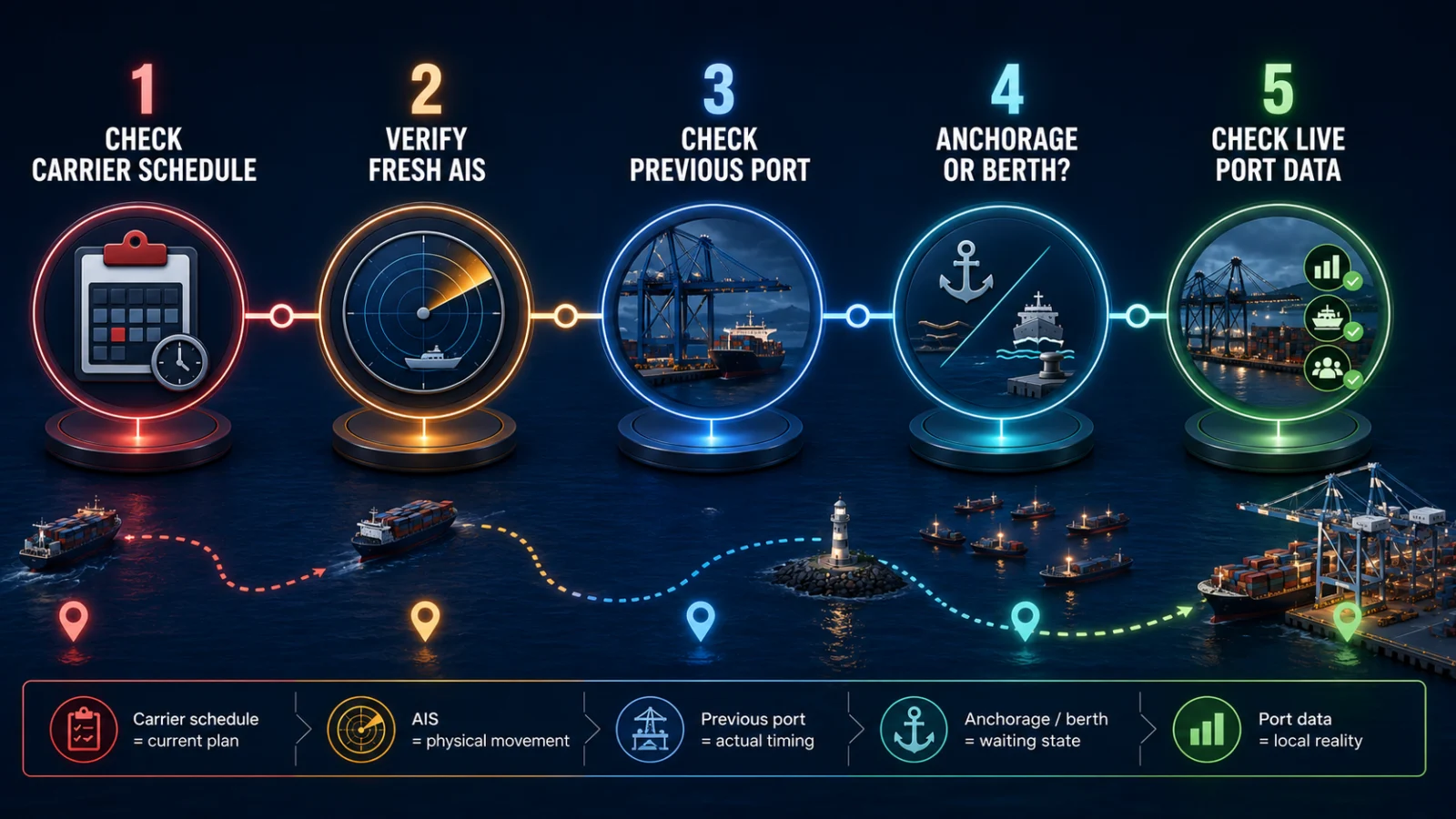
Start with the carrier’s latest schedule because it is the current commercial plan
Carrier schedule tools can show the latest planned arrival and departure dates, port calls and vessel information. Maersk also documents customer notifications when ETA, ETD, vessel, voyage, port or terminal information changes.
That makes the carrier schedule your best starting point for answering:
- Is the same vessel still assigned?
- Did the voyage number change?
- Did the ETA or ETD move?
- Did the port or terminal change?
- Did the carrier publish an operational reason?
Important: carrier arrival, berthing, departure and transit times are still estimates rather than guaranteed timestamps.
Compare the original ETA with the latest ETA before diagnosing the cause
Keep both the original schedule and the current schedule if possible.
Original schedule
Establishes the baseline plan you booked against.
Latest carrier schedule
Shows the carrier’s current operational expectation.
Difference
Shows how much the plan has moved, but not necessarily why.
A two-day ETA shift could originate from a late previous-port departure, slower transit, weather, a changed port window, berth congestion or another operational adjustment. You need physical evidence before assigning the cause.
Check the timestamp of the AIS position before interpreting the map
A vessel marker is only as useful as the freshness of the underlying observation.
Before concluding that the ship is stationary or still in one place, check:
- when the last AIS position was received
- whether the source is terrestrial or satellite-supported
- whether the vessel is in an area with known coverage gaps
- whether subsequent observations exist.
Stale AIS position ≠ current vessel position. A vessel can continue moving after the last observation shown to you.
AIS can show physical vessel movement
Depending on the available AIS data, useful fields can include:
- position
- speed over ground
- course
- navigational status
- destination
- reported ETA
- time of the last received position.
What AIS is strong at
Showing where the vessel was observed and whether it appeared to be underway, slow, anchored or near a port.
What AIS is not
A guaranteed carrier schedule or proof that your individual container is onboard.
AIS destination is self-reported voyage information and can be stale
MarineTraffic explains that destination and ETA fields come from information entered into the vessel’s AIS equipment and can be outdated if they are not updated correctly.
A public AIS map also does not automatically provide the carrier’s complete commercial port rotation. The vessel can have multiple planned calls even though the AIS field shows only one next destination.
Safe interpretation: AIS destination is one operational clue, not a substitute for the carrier’s current transport plan.
AIS ETA is indicative, not a guaranteed arrival time
Calculated vessel-arrival estimates can use present position, course and speed, but the vessel may change speed, make another port call, deviate from the predicted route, wait outside the port or receive a different berth window.
That means:
ETA evidence hierarchy
Do not treat a continuously recalculated map ETA as a contractual or operational guarantee.
Check whether the vessel left the previous port late
Many apparent destination delays begin upstream.
If the vessel’s previous-port departure was already hours or days later than scheduled, that delay can propagate into later calls even when the vessel’s sea passage is otherwise normal.
Previous port departure late
Points toward upstream turnaround, berth or operational delay.
Previous port departure on time
Makes later transit or destination-port factors more relevant.
Departure time unknown
Keep the cause unresolved rather than guessing.
A vessel can be underway normally and still be behind the commercial schedule
If AIS shows the vessel moving toward the destination but the latest carrier ETA remains later than the original booking, the delay is real at schedule level even if the vessel itself is not currently stopped.
Possible explanations can include:
- late departure from an earlier port
- slower passage than originally planned
- changed port sequence
- operational speed adjustments
- weather or route deviation
- anticipated berth waiting incorporated into the schedule.
Do not assign one of these causes unless the carrier, port data or other evidence supports it.
Port approach, anchorage and berth are different milestones
A vessel can reach the destination port area and still spend substantial time waiting before berthing.
Physical arrival sequence
Port arrival ≠ berth arrival ≠ cargo discharge. Each milestone answers a different question.
If the vessel is near the port but not alongside a terminal, the reader should investigate whether it is at anchorage, waiting for a berth window or operating under another local restriction.
Use current port congestion as supporting evidence, not an automatic diagnosis
MarineTraffic defines congestion in terms that include vessels waiting outside a port because berth capacity or terminal conditions prevent immediate berthing. Its terminal metrics can include waiting vessels, berthed vessels, live waiting averages and berth-stay information.
Useful evidence can include:
- the vessel is actually waiting at anchorage
- current live waiting time is elevated
- several vessels are queued
- berth occupancy is high
- the terminal or carrier issued an operational notice
- the vessel’s berth window repeatedly moved.
TPS interpretation: congestion becomes a stronger explanation when the affected vessel’s observed waiting state matches current local port evidence.
Live waiting conditions are more useful than an old congestion average
A historical port average describes normal or past performance. It does not necessarily describe what your vessel is experiencing now.
Historical metric
Useful as context for whether a port often experiences waiting.
Live metric
More useful for determining whether current waiting conditions could explain today’s vessel delay.
If live conditions are normal but the vessel is still waiting, keep other explanations open.
Carrier schedule and AIS can disagree without either source being meaningless
The sources measure different things.
| Source | Primary question answered | Main limitation |
|---|---|---|
| Carrier schedule | What does the carrier currently expect to happen? | It is still an operational estimate and can lag or change. |
| AIS | What was the vessel physically doing when last observed? | Coverage can be stale or incomplete and commercial itinerary information may be outdated. |
| Port / terminal data | What local waiting or berth conditions exist? | General congestion does not prove the cause for one vessel. |
A useful diagnostic combines all three rather than trying to crown one source as universally correct.
The same physical vessel can appear under different commercial schedule views
Maersk has documented cases where customers could see different schedules associated with the same physical vessel, including situations involving vessel-sharing arrangements and different commercial schedule representations.
This means that:
same physical ship + different schedule view can occur without implying that the vessel itself is duplicated or that one data source is necessarily fraudulent.
Use the shipment’s own carrier transport plan as the commercial reference for your booking, then use AIS and port observations as independent operational context.
AIS does not prove your container is onboard the vessel
This is the same evidence boundary that matters in rollover investigations.
AIS follows the vessel. It does not confirm that an individual container was physically loaded.
Vessel position ≠ container-load confirmation. If there is uncertainty about whether your box actually moved on the booked vessel, use carrier shipment events or the TPS rollover verification workflow.
Missing AIS does not prove the vessel stopped or disappeared
Terrestrial AIS does not cover every area of the world’s seas, and available public tracking can depend on receiver coverage, satellite data, roaming feeds and platform processing.
No fresh AIS
Means current movement is not visible in the data you are using.
Vessel stopped
Requires actual movement evidence or another source establishing that the ship is stationary.
No fresh AIS position ≠ vessel stopped.
Use a vessel-delay evidence ladder
| Evidence | What it establishes | Confidence / boundary |
|---|---|---|
| Original carrier ETA / ETD | Baseline plan | Original estimate |
| Latest carrier ETA / ETD | Current carrier expectation | Current plan, still estimated |
| Same vessel / voyage retained | Problem remains a same-vessel delay | Important boundary check |
| AIS update timestamp | Whether vessel-movement data is fresh | Required before interpreting map position |
| Vessel position | Where vessel was last observed | Physical observation, subject to freshness |
| Speed / course | Whether vessel appears underway, slow or stationary at observation time | Momentary physical evidence |
| AIS destination | Self-reported next destination field | May be stale or incomplete |
| AIS ETA | Indicative arrival estimate | Not guaranteed |
| Previous port departure | Whether delay propagated from upstream | Strong contextual evidence |
| Anchorage / waiting state | Vessel reached port area but has not berthed | Strong local-status evidence |
| Live port waiting metrics | Whether current congestion may explain berth delay | Supporting evidence, not vessel-specific proof alone |
| Berth arrival | Vessel physically reached berth | Strong port milestone |
| Carrier operational notice | Carrier’s stated reason for disruption | Strong cause evidence when shipment-relevant |
Watch, verify or escalate
1
WATCH
The same vessel remains assigned, AIS is fresh, movement is consistent with the route and the current carrier schedule gives a plausible revised ETA.
2
VERIFY
AIS is stale, the vessel is still at the previous port, the ship is anchored near destination, schedule sources disagree or the carrier ETA keeps moving without explanation.
3
ESCALATE
The vessel or voyage changes, the planned port disappears, repeated berth or schedule changes threaten cargo deadlines, or shipment-level events conflict with vessel movement.
Worked example: the ETA moves by two days while the vessel waits outside port
| Evidence | Interpretation |
|---|---|
| Original carrier ETA: Monday | Baseline commercial plan. |
| Latest carrier ETA: Wednesday | Carrier now expects a two-day later arrival. |
| Same vessel and voyage remain assigned | Still a same-vessel delay case rather than rollover. |
| AIS updated 20 minutes ago | Movement data is reasonably fresh. |
| Vessel is near destination at very low speed / anchorage area | The vessel appears to have reached the port area but is not yet berthed. |
| Live terminal waiting conditions are elevated | Current berth congestion becomes a plausible explanation. |
| Vessel later reaches berth | Berth waiting phase has ended. |
| No container discharge event yet | Cargo handling remains a separate milestone. |
The safe conclusion is not merely “the ship arrived.” It is that the vessel reached the port area, waited before berth and then progressed to berth, while cargo discharge still required separate confirmation.
Where vessel delay fits in the TPS shipping-diagnostics cluster
Container rollover: which vessel now?
Use this when the original sailing operated but your individual container did not move and was reassigned.
Blank sailing: find the replacement sailing
Use this when the sailing or service position itself was cancelled.
Port omission: where will the container go?
Use this when the vessel skipped the planned port entirely.
Container stuck at a transshipment port
Use this when the box has already reached an intermediate hub and the onward connection is uncertain.
Port disruption: is your shipment affected?
Use this when the starting signal is a broader port closure, congestion event or operational disruption.
Verification notes: confirmed, observed, interpreted and not established
Confirmed
- Carrier arrival, berthing and departure times are estimates rather than guarantees.
- AIS can provide vessel position, speed, course, destination and ETA-related data.
- AIS destination and ETA fields can be stale or limited by onboard updates and prediction assumptions.
- Port congestion can involve vessels waiting outside port or at anchorage for berth availability.
Observed evidence
- Fresh AIS can show vessel movement.
- Anchorage or berth state can help locate the current delay phase.
- Live port waiting metrics can provide current local context.
TPS interpretation
- Carrier schedule = current commercial plan.
- AIS = observed vessel movement.
- Port data = local waiting and berth context.
- The strongest diagnosis combines all three.
Not established by vessel delay alone
- that the container is onboard
- the exact cause of the delay
- the final discharge time
- whether the ETA will move again
- whether costs will arise.
Needs current data
- latest carrier schedule
- fresh AIS timestamp
- previous-port departure
- current anchorage or berth state
- live port conditions
- shipment-level events.
Route elsewhere if
- vessel changes
- sailing is cancelled
- port is omitted
- container misses the vessel
- transshipment connection fails.
Verification method
ThePulseSignal reviewed MarineTraffic documentation covering AIS position, speed, course, destination and ETA limitations, route forecasting, missing AIS coverage, port congestion, anchorage and live terminal waiting metrics. TPS also reviewed Maersk schedule terms and support material covering schedule estimates, vessel schedules and transport-plan changes, plus Hapag-Lloyd guidance directing customers to current vessel schedules and tracking.
The article separates carrier-plan evidence, physical vessel movement, port waiting conditions and shipment-specific cargo evidence rather than treating them as interchangeable.
Limitations and unresolved facts
No general article can determine the exact cause of one vessel’s delay without current vessel, carrier, port and shipment data.
- Carrier ETA and ETD remain estimates and can change repeatedly.
- AIS data quality depends on transmission, receiver coverage and data freshness.
- AIS destination and ETA fields can be stale or incomplete.
- Public trackers may not expose the carrier’s full commercial rotation.
- An anchored vessel is not automatically proof of congestion; it may be waiting for another operational reason.
- General port congestion does not prove why one particular vessel is delayed.
- AIS cannot prove an individual container is onboard.
- Berth arrival does not equal container discharge or availability.
- Vessel-sharing or commercial schedule differences can produce different schedule views for the same physical ship.
- A missing AIS position does not prove that the vessel stopped.
Vessel delay: frequently asked questions
Why does my vessel ETA keep changing?
The carrier may be updating its operational plan as previous-port delays, transit conditions, port waiting or berth expectations change. A moving ETA alone does not identify the cause.
Is AIS vessel ETA accurate?
AIS-based or calculated ETA is useful as an indication, but it is not guaranteed and can change with speed, route, port calls, waiting and data freshness.
Should I trust the carrier schedule or AIS?
Use both for different purposes. The carrier schedule shows the current commercial plan, while AIS shows observed physical movement when the data is fresh.
Why is the vessel waiting outside the port?
One possibility is berth congestion, but it can also be waiting for a berth window, operational clearance or another local condition. Check current port and carrier information before assigning the cause.
Does vessel arrival mean my container has arrived?
Not necessarily. Port approach, anchorage, berth arrival, container discharge and cargo availability are separate milestones.
Can AIS prove my container is onboard?
No. AIS tracks the vessel. Shipment-specific carrier events are needed to establish whether an individual container loaded.
What does it mean if the vessel is still at the previous port?
It suggests the schedule delay may have originated upstream at that port, but you still need carrier or port evidence to determine the reason.
Does no AIS signal mean the vessel stopped?
No. AIS coverage can be unavailable or stale. A missing position only means the tracking source does not currently have a fresh observation.
What if the carrier changed the vessel?
That is no longer a simple same-vessel delay. Investigate rollover or rebooking and confirm the replacement vessel and actual load event.
Bottom line
When your vessel is late, diagnose the delay state instead of relying on one moving ETA.
Best evidence chain: original carrier schedule → latest carrier schedule → same-vessel check → AIS freshness → vessel position / speed / course → previous-port departure → anchorage or berth state → live port conditions → shipment-specific cargo events.
The carrier schedule tells you what should happen now. AIS tells you what the ship was physically doing when last observed. Port data can explain whether local waiting conditions may be delaying berth. None of those signals alone tells the complete cargo story.
Last verified: August 22, 2026. This guide reflects current carrier schedule terms and current MarineTraffic documentation covering AIS, destination and ETA limitations, port congestion, vessel waiting and live terminal metrics.