






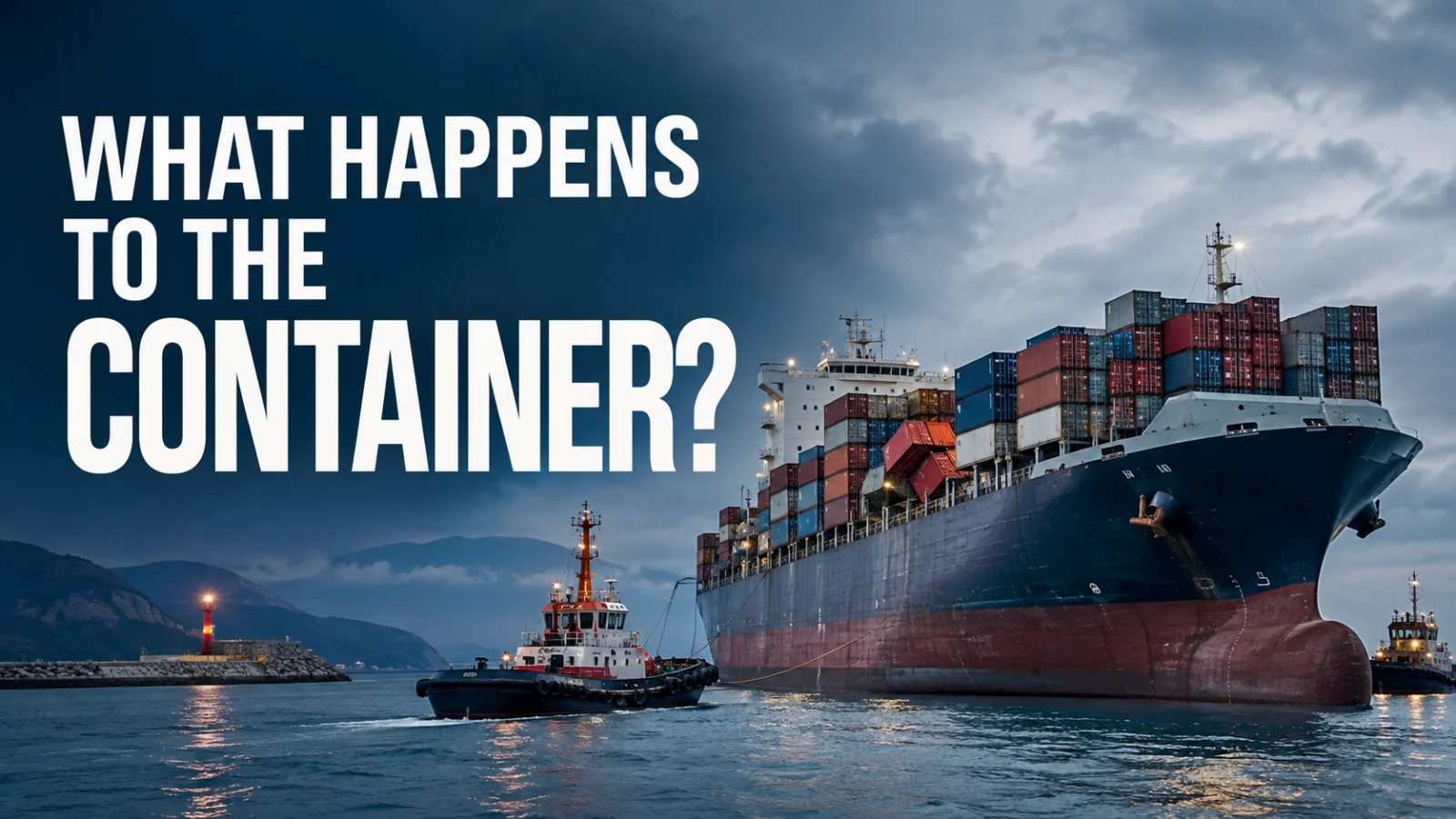
If a container ship diverts to a port of refuge, the vessel’s new location does not tell you what happens to your container next. The box may remain aboard, be temporarily discharged, inspected, reloaded, transshipped, delivered locally or held while the carrier determines the casualty and onward-carriage plan.
Direct answer
What happens after a vessel reaches a port of refuge?
First the ship and casualty are stabilized and assessed. Cargo disposition follows from that assessment. For your container, the next useful evidence is whether it remains aboard or was discharged, why any discharge occurred, its condition, whether release or security is pending and whether the carrier has confirmed onward carriage.
Critical distinction
Discharged does not mean destination changed
A container can be removed at a refuge port for safety, repair, inspection or transshipment while the original contract destination remains unchanged. Wait for the carrier’s disposition instruction before treating the refuge port as the new delivery point.
State 1
Still on board
The vessel has diverted, but no container discharge has been confirmed.
State 2
Discharged at refuge
The container has physically left the ship, but its onward disposition may still be undecided.
State 3
New plan confirmed
Same vessel, replacement vessel, alternative transport, local delivery or termination of carriage has been explicitly communicated.
In this guide
- What a port of refuge actually means
- Why did the vessel divert?
- Is your container still aboard?
- What if the container is discharged?
- Sound vs damaged cargo
- How onward carriage can continue
- Has the original carriage ended?
- General Average
- Salvage and other security
- Customs status at the refuge port
- New storage and D&D clocks
- Tracking and AIS limitations
- India port-of-refuge example
- 10-question next-step workflow
- FAQs
What does a port of refuge actually mean?
The International Maritime Organization’s current guidelines describe a place of refuge as a location where a ship in need of assistance can take action to stabilize its condition, reduce navigational risks and protect life and the environment. The current IMO framework is Resolution A.1184(33), adopted in 2023.
A port or place of refuge is therefore different from a normal scheduled port call. It may also differ from a commercial diversion caused by congestion, schedule recovery or a routine port omission.
| Situation | Primary reason | What it tells you about your container |
|---|---|---|
| Scheduled port call | Normal voyage plan | Normal planned cargo operation |
| Commercial diversion / port omission | Network or operational rerouting | Original discharge plan may change |
| Port/place of refuge | Ship needs assistance, stabilization or casualty management | Container disposition may remain undecided until vessel and cargo are assessed |
If this is simply a scheduled-port omission rather than a casualty/refuge event, use the TPS guide Port Omission: Where Will Your Container Be Discharged Now?.
Question 1: Why did the vessel divert?
The cause strongly influences what happens next.
A ship may need refuge because of:
- fire
- machinery or propulsion failure
- grounding
- collision
- structural damage
- flooding
- cargo shift or dangerous-cargo condition
- environmental threat
- salvage requirements
- another emergency or exceptional security situation
IMO guidance recognizes that a place of refuge may allow cargo or bunkers to be transferred and repairs to be carried out before the casualty deteriorates further.
The casualty type matters: a machinery repair in which all containers stay aboard is operationally very different from a fire that requires discharge, survey and cargo segregation.
Seeking refuge does not guarantee immediate port entry
A vessel needing assistance cannot assume it will automatically be accepted into the nearest container terminal. IMO guidance requires the ship’s needs to be balanced against navigation, environmental, economic and coastal risks.
The vessel may therefore:
- remain at anchorage
- move to a designated sheltered location
- enter a port under restrictions
- move between refuge, repair and discharge locations
This is one reason vessel tracking can show several unusual movements before any container disposition is known.
Question 2: Is your container still on board?
Do not infer container discharge merely because the vessel reached the refuge location.
The first useful cargo-specific state is:
Container still aboard
The vessel may be undergoing inspection, stabilization or temporary repair. If it can safely resume the voyage, the cargo may continue on the same ship.
Container discharged
Physical removal has occurred, but the reason and next disposition still need to be identified.
VESSEL AT PORT OF REFUGE ≠ CONTAINER AVAILABLE.
Question 3: If the container was discharged, why?
A discharge event at a refuge port does not have one universal meaning.
The box may have been removed for:
- vessel stabilization
- access to damaged areas
- temporary repair
- cargo inspection
- damage segregation
- safety reasons
- transshipment preparation
- local delivery under a changed disposition
- termination or abandonment of onward carriage
This leads to one of the most important rules in the article:
DISCHARGED AT PORT OF REFUGE ≠ FINAL DESTINATION CHANGED. Physical discharge and contractual delivery are different events.
Question 4: Is the cargo sound, damaged or still awaiting inspection?
After a casualty, containers from the same vessel can enter different workflows.
| Cargo state | Possible next action | Why timeline may differ |
|---|---|---|
| Apparently sound | Reload or transship when commercially and legally released | May still require security, terminal or carrier clearance |
| Inspection required | Survey, opening or specialist assessment | Actual condition has not yet been confirmed |
| Damaged | Survey, segregation, claim handling, salvage or controlled delivery | May not be fit for ordinary onward carriage |
| Dangerous / unsafe | Special regulatory, salvage or disposal procedure | Safety controls take priority over ordinary delivery planning |
Carrier casualty updates from incidents such as Yantian Express and Maersk Honam show why cargo-condition assessment can be necessary before onward disposition is known.
Question 5: How can the container continue from the refuge port?
There are several possible outcomes.
1
SAME VESSEL
The ship is stabilized or repaired and resumes the voyage with cargo aboard or reloaded.
2
REPLACEMENT VESSEL
The container is discharged and later transshipped to another ship.
3
OTHER DISPOSITION
Feeder/land transport, local delivery or termination of carriage may be arranged depending on circumstances and contract.
If a replacement vessel is eventually assigned, use the TPS guide Container Rollover: How to Confirm Which Vessel Your Cargo Was Rebooked On to verify the new movement rather than relying only on an estimated ETA.
Has the original contract of carriage ended?
Do not infer this from the container’s physical location.
A container can be sitting ashore at the refuge port while the carrier still intends to transport it to the original contractual destination.
Alternatively, exceptional circumstances and the applicable contract may lead the carrier to place cargo at the merchant’s disposal at another safe location or formally terminate or abandon onward carriage.
The evidence you need is explicit carrier wording such as:
- onward carriage confirmed
- replacement vessel nominated
- change of destination accepted
- cargo available for local delivery
- carriage terminated
- carriage abandoned and cargo placed at customer’s disposal
TRACKING LOCATION ≠ CONTRACTUAL DESTINATION. The original bill of lading or sea waybill and the carrier’s casualty instructions remain critical.
Does a port-of-refuge call automatically trigger General Average?
No.
General Average is a separate maritime-law mechanism and should not be inferred merely because a vessel sought refuge.
The York-Antwerp Rules address qualifying expenses associated with entering a port or place of refuge and, in defined circumstances, cargo handling, storage and reloading. Whether General Average applies to a real casualty depends on the declaration, contractual incorporation, facts and applicable law.
If General Average is declared, even undamaged cargo may require financial security before delivery.
PORT OF REFUGE ≠ GENERAL AVERAGE AUTOMATICALLY. Look for an actual declaration and instructions from the shipowner, carrier or average adjuster.
General Average security and salvage security are not the same release
Severe casualties may also involve professional salvors.
Depending on the incident, cargo interests can encounter separate requirements such as:
- General Average bond
- General Average guarantee
- salvage security
- cargo survey documentation
- insurer or average-adjuster instructions
A container can therefore be physically safe and sitting in a terminal but still not be commercially releasable.
CARGO SOUND ≠ CARGO RELEASED.
What happens to Customs status when cargo is discharged in another country?
Physical discharge at an unscheduled country does not automatically turn the container into a local import.
Depending on local rules and the carrier’s disposition, cargo may remain:
- transshipment cargo
- transit cargo
- temporarily stored cargo
- or become local-import cargo if destination and delivery arrangements are formally changed
Do not begin an ordinary local-import workflow simply because tracking says the box was discharged. First determine whether the container is only passing through the refuge location or has actually been made available for local delivery.
Can new storage, demurrage or detention charges start at the refuge port?
Potentially.
Once a container is discharged and occupies terminal space, the applicable carrier and terminal tariffs, incident arrangements and contractual terms determine whether storage or D&D clocks apply and whether special relief has been granted.
During the 2026 Strait of Hormuz disruption, Maersk published specific temporary arrangements for containers diverted to Indian ports of refuge. Its April 1 advisory distinguished containers whose final destination was changed for delivery in India from containers for which carriage was abandoned and the box placed at the customer’s disposal. It also separately addressed storage and D&D treatment.
If charges are now appearing, use the TPS guide Which Container Delay Charge Is Running? Demurrage vs Detention vs Storage.
Who pays port-of-refuge costs?
There is no universal answer.
Possible cost categories include:
- emergency port costs
- cargo discharge and handling
- storage
- reloading
- transshipment
- salvage
- survey
- onward carriage
- demurrage/detention
- local-delivery and Customs costs
The responsible party can depend on the bill of lading, carrier tariff, General Average adjustment, salvage arrangements, insurance, cause of casualty, applicable law and any incident-specific agreement.
Do not ask only “who pays the port-of-refuge costs?” Identify the specific charge first, then identify the contractual or legal mechanism under which it is being claimed.
What can tracking and AIS actually tell you?
During a casualty, movement data and cargo-disposition evidence should be separated.
| Source | Can help establish | Usually cannot establish by itself |
|---|---|---|
| AIS | Vessel diversion, anchorage, berth movement, departure | Your container’s condition, release, GA status or replacement vessel |
| Carrier tracking | Container discharge/load/movement events | Why it was discharged, cargo damage, legal release or whether carriage has ended |
| Carrier casualty advisory | Casualty status, cargo disposition, special arrangements | Every container’s individual physical condition |
| Survey / adjuster notice | Damage or security requirements | Normal vessel-network schedule |
For the boundaries of AIS and carrier schedule evidence, see Vessel Is Late: What AIS, Carrier Schedule and Port Data Can Actually Tell You.
India’s 2026 port-of-refuge context
India now has unusually relevant current examples.
On March 27, 2026, Adani Ports and Special Economic Zone announced that it had operationalised what it described as India’s first Port of Refuge, supported by a tripartite arrangement involving SMIT Salvage and the Marine Emergency Response Centre.
Separately, Maersk’s April 1, 2026 Strait of Hormuz disruption advisory addressed customers whose cargo had been diverted to Indian ports of refuge. It described different treatment for containers whose final destination was changed to India and containers for which carriage was abandoned and the box was placed at the customer’s disposal.
The important evergreen lesson is not the temporary 2026 rule itself. It is:
A refuge-port discharge can lead to different contractual and operational outcomes even within one disruption. Always identify your container’s specific disposition.
Use this 10-question port-of-refuge workflow
Documents and evidence to collect
- bill of lading or sea waybill
- container number
- vessel and voyage
- original port of loading, discharge and final destination
- carrier casualty advisory
- carrier tracking events
- refuge arrival information
- container discharge confirmation
- cargo-condition or survey notice
- General Average declaration or adjuster instructions
- salvage-security request
- Customs or transshipment instructions
- terminal notice
- onward-carriage or replacement-vessel instruction
- new free-time or storage notice
If your container has been discharged but cannot yet be collected, use Container Discharged but Not Available: Which Release Is Still Missing? to separate physical discharge from Customs, carrier, delivery and terminal release.
Evidence boundary
A port-of-refuge event does not create one universal cargo outcome. The carrier’s bill of lading terms, casualty instructions, coastal-State requirements, terminal rules, survey findings, General Average or salvage arrangements, Customs treatment and applicable law can all affect what happens next. Use carrier- and container-specific instructions before making delivery, insurance or cost decisions.
Port of refuge: frequently asked container questions
Does a vessel reaching a port of refuge mean my container will be discharged?
No. The container may remain aboard while the vessel is stabilized, inspected or repaired. Discharge depends on the casualty and operational plan.
If my container is discharged at the refuge port, is that now my destination?
Not automatically. Discharge can be temporary for repair, safety, inspection or transshipment. Look for an explicit destination-change, local-delivery or termination-of-carriage instruction.
Will my container automatically be put on another vessel?
No. The same vessel may resume the voyage, a replacement vessel may be arranged, another transport mode may be used, local delivery may be offered or carriage may be terminated depending on the circumstances.
Does port of refuge mean General Average?
No. General Average requires a separate basis and declaration. Do not infer it from the diversion alone.
Can an undamaged container still be held?
Yes. General Average or salvage security, carrier release, Customs treatment, terminal status or other casualty-related conditions may still prevent delivery.
Can AIS tell me whether my container is safe?
No. AIS reports vessel movement, not your container’s cargo condition, release state or contractual disposition.
Can storage charges begin after emergency discharge?
They can, depending on the applicable terminal/carrier rules and any incident-specific relief. Check the actual tariff and casualty notice rather than assuming charges automatically pause.
Bottom line
A container diverted to a port of refuge has entered a casualty-management process, not simply another scheduled port call.
The vessel’s arrival answers only one question: where the ship is being stabilized or managed. It does not tell you whether your container will remain aboard, be temporarily discharged, be inspected, be reloaded, be transshipped, be delivered locally or have onward carriage terminated.
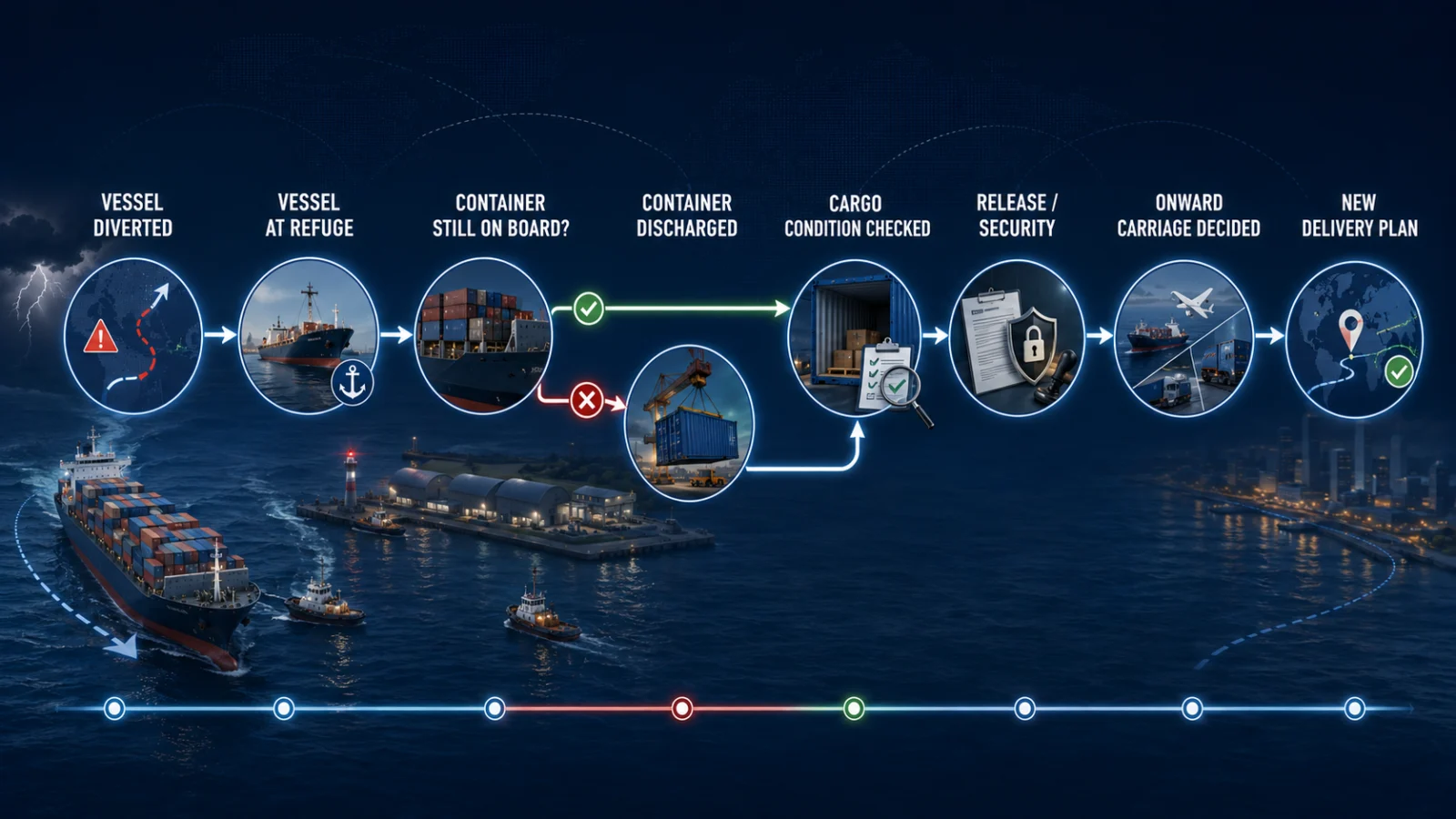
Best evidence chain: reason for diversion → vessel refuge status → container aboard/discharged → reason for discharge → cargo condition → release/security → carrier disposition → onward carriage → cost clocks → next confirmed transport event.
Last verified: August 22, 2026. IMO place-of-refuge guidance and carrier/port casualty and diversion examples were reviewed, including current 2026 India refuge-port arrangements.