






If your supplier shipment stuck problem begins with the supplier saying the goods are “shipped,” do not assume the cargo is already at sea. Identify the last confirmed physical or documentary milestone and then find the next expected event that has not happened. Factory readiness, pickup, terminal gate-in, vessel loading, vessel departure, transshipment, destination discharge, customs release and delivery availability are separate states.
Direct answer
Where is the supplier shipment actually stuck?
Start with evidence, not status language. Ask for the booking or transport reference, container number if containerized, pickup evidence and latest carrier event. Then move forward through each handoff until you reach the first expected milestone with no confirmed event.
Critical distinction
“Shipped” is not one transport milestone
A supplier may use “shipped” to mean production completed, cargo handed to a forwarder, truck collected, container gated into port or cargo actually loaded on a vessel. Those states have very different consequences for delay diagnosis.
In this guide
Supplier shipment stuck? Find the last confirmed milestone first
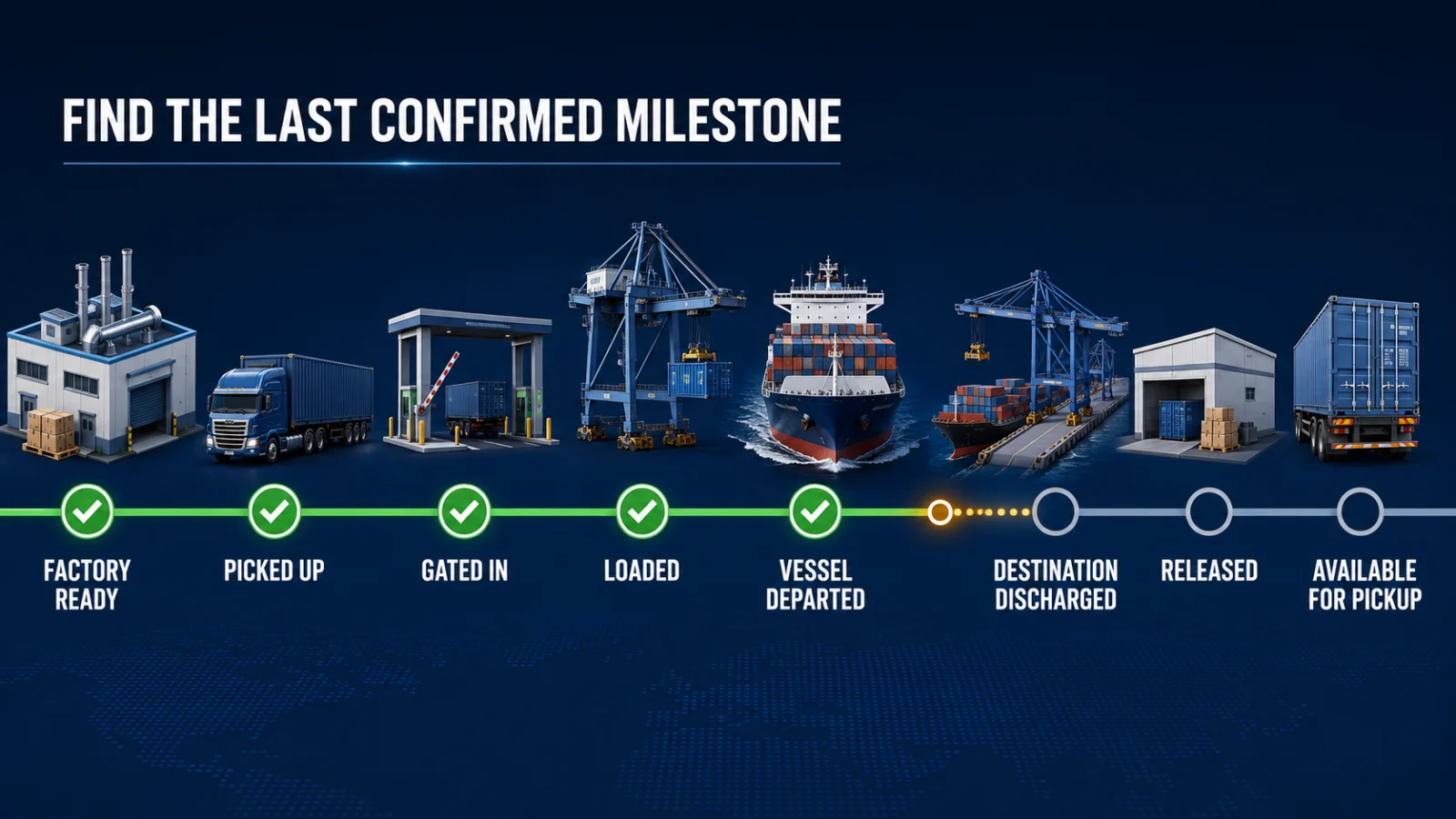
The safest diagnosis is to identify the strongest completed milestone and then identify the next milestone that should have occurred.
Shipment evidence chain
TPS rule: LAST CONFIRMED MILESTONE → NEXT EXPECTED MILESTONE → FIRST MISSING EVENT.
Stage 1: Supplier says the goods are ready
Production complete or cargo ready is still a pre-carriage state unless independent transport evidence shows that custody moved beyond the supplier.
Ask for:
- commercial invoice and packing list status
- booking reference
- pickup date or truck appointment
- container number if already assigned
- forwarder or carrier handling reference
No carrier milestone does not automatically prove the supplier has done nothing. Carrier visibility may begin only after the cargo or container enters the carrier’s own transport network.
Stage 2: Was the cargo actually picked up or handed to the forwarder?
A booking confirms transport was arranged. It does not by itself prove physical pickup.
Booking confirmed
Space or transport arrangement exists, subject to the booking terms and operational changes.
Pickup confirmed
There is evidence the trucker, forwarder or carrier took custody or began the inland movement.
If the supplier says “collected,” request the pickup record, equipment interchange information, truck reference or forwarder event rather than relying only on an email status.
Stage 3: Did the container reach the origin terminal?
For containerized shipments, gate-in is a stronger physical milestone. It establishes that the container entered the terminal or relevant facility.
Gated in ≠ loaded on vessel. A container can sit inside the terminal and still miss the intended sailing.
If the booked vessel has departed but no load event exists, investigate cutoff failure, rollover, documentation problems or another operational reassignment.
Use the TPS container rollover investigation when the container reached the shipping network but did not move on the expected vessel.
Stage 4: Was the container actually loaded onto the vessel?
This is one of the most important evidence boundaries. A container number, booking confirmation, terminal arrival and vessel schedule do not prove loading.
Evidence state
At terminal
The container has reached the facility but its sailing status remains unresolved.
Stronger state
Loaded
The carrier event establishes loading onto the relevant vessel or transport leg.
Failure state
Vessel departed, no load
Investigate whether the container missed the sailing or was reassigned.
Stage 5: Did the vessel actually depart?
Loaded and vessel departed are separate milestones. A container can be loaded while the vessel remains at berth.
If the same vessel remains assigned but its schedule keeps moving, use the TPS vessel-delay evidence guide to compare the carrier schedule, AIS movement and current port conditions.
If the sailing itself was cancelled, the problem belongs to the blank-sailing workflow rather than a normal vessel delay.
Stage 6: Did the shipment clear its transshipment connection?
Many shipments have more than one ocean leg. Discharge at an intermediate hub does not mean the cargo is moving toward final destination again.
At a transshipment port, check the sequence:
- discharged from the inbound vessel
- connection vessel identified
- loaded onto the onward vessel
- onward vessel departed
If the container was discharged at the hub but no onward load event appears, use the TPS transshipment-port diagnostic.
Stage 7: Vessel arrived does not mean the container is ready
Port approach, berth arrival, container discharge and cargo availability are different milestones.
A destination vessel arrival tells you the ship reached the port call. A discharge event tells you the container was removed from the vessel. Neither automatically proves customs clearance or collection readiness.
VESSEL ARRIVED ≠ CONTAINER DISCHARGED ≠ CARGO RELEASED ≠ AVAILABLE FOR PICKUP.
Stage 8: Check customs, carrier release and terminal availability separately
After discharge, the shipment can still stop at a regulatory, commercial or terminal gate.
| State | What it establishes | What may still be pending |
|---|---|---|
| Discharged | Container removed from vessel | Customs, carrier and terminal release |
| Customs released | Applicable customs block cleared | Carrier or terminal conditions |
| Carrier / freight released | Carrier-side requirement cleared | Terminal availability or pickup requirement |
| Delivery authorization | Applicable delivery authority issued | Terminal processing or appointment |
| Available for pickup | Container can enter collection workflow | Truck appointment and gate-out |
If the container is already discharged but cannot be collected, use the TPS container discharged but not available guide to identify the unresolved release gate.
Use this supplier shipment stuck diagnostic workflow
1
VERIFY THE CLAIM
Translate “ready,” “shipped,” “at port” or “in transit” into a real transport milestone and obtain the relevant reference.
2
FIND THE LAST EVENT
Identify the strongest confirmed pickup, gate-in, load, departure, discharge or release event.
3
FIND THE MISSING EVENT
Determine which expected milestone should come next and investigate the system or party responsible for that handoff.
| Last confirmed milestone | Next expected milestone | Likely investigation lane |
|---|---|---|
| Factory ready | Pickup | Supplier / forwarder / trucker |
| Pickup complete | Origin gate-in | Inland transport / origin handling |
| Origin gate-in | Vessel load | Carrier / terminal / cutoff / rollover |
| Loaded | Vessel departure | Vessel or port operations |
| Transshipment discharge | Onward load | Connection / rollover / schedule |
| Destination discharge | Customs / carrier release | Broker / customs / carrier |
| All releases clear | Pickup availability | Terminal / appointment / haulier |
Where this article fits in the TPS shipping cluster
Container rollover
Use when the container missed the expected vessel or was reassigned.
Container stuck at transshipment
Use when the box reached an intermediate hub but the onward leg is unresolved.
Vessel is late
Use when the same vessel remains assigned but the schedule has slipped.
Discharged but not available
Use after destination discharge when release or terminal readiness is blocking collection.
Verification boundary
Carrier milestone terminology and visibility can differ by shipment, carrier, forwarder and country. Factory and pre-carriage activity may not appear in carrier systems. The method in this guide therefore uses the last confirmed milestone and first missing expected milestone rather than assuming one tracking platform has end-to-end visibility.
Supplier shipment stuck: frequently asked questions
My supplier says the shipment has shipped. Does that mean it is on the vessel?
No. Ask which specific event “shipped” refers to. It may mean cargo ready, collected by a forwarder, delivered to port or actually loaded.
Does a booking number prove the cargo was collected?
No. A booking establishes a transport arrangement. Physical pickup needs its own evidence.
Does gate-in mean the container made the vessel?
No. Gate-in establishes entry into the terminal or facility. Look for a separate load event.
Can a container be stuck even though the vessel departed?
Yes. If your container lacks a load event, the vessel’s departure does not establish that your box sailed with it.
Why is my shipment stuck at a transshipment port?
The inbound discharge may be complete while the onward vessel, connection or load event remains pending.
Does destination vessel arrival mean customs can clear the cargo?
Not by itself. Vessel arrival, discharge, customs release, carrier release and terminal availability are distinct stages.
What is the fastest way to find where a shipment is stuck?
Write down the last confirmed event, identify the next expected event, and investigate the party or system responsible for that handoff.
Bottom line
A supplier shipment stuck investigation becomes much easier when vague status words are replaced with evidence.
Best evidence chain: factory ready → pickup → origin gate-in → loaded → vessel departed → transshipment completed → destination discharged → customs/carrier release → available for pickup.
Do not ask only “Where is my shipment?” Ask: What is the last confirmed milestone, and what expected milestone has not happened yet?
Last verified: August 22, 2026. Carrier milestone terminology, tracking visibility, release procedures and local customs or terminal workflows can change, so shipment-specific carrier, forwarder and terminal evidence should be checked before acting.