





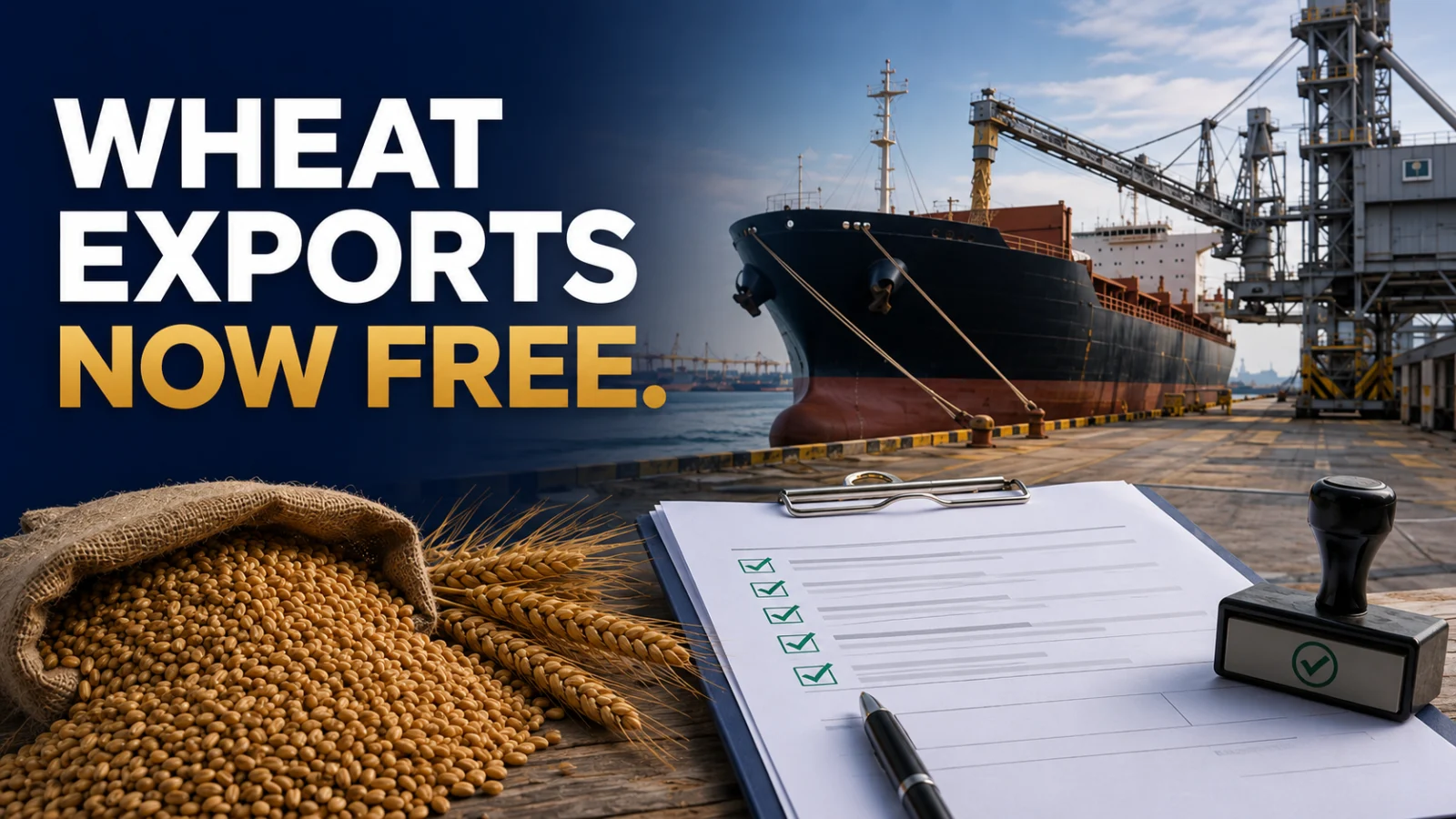
India’s current DGFT wheat export policy classifies specified wheat and wheat-flour tariff lines as Free. Notification 35/2026-27 changed wheat under HS 10011900 and 10019910 from Prohibited to Free with immediate effect on August 24, 2026. Notification 34/2026-27 did the same for wheat flour and related products under HS 11010000.
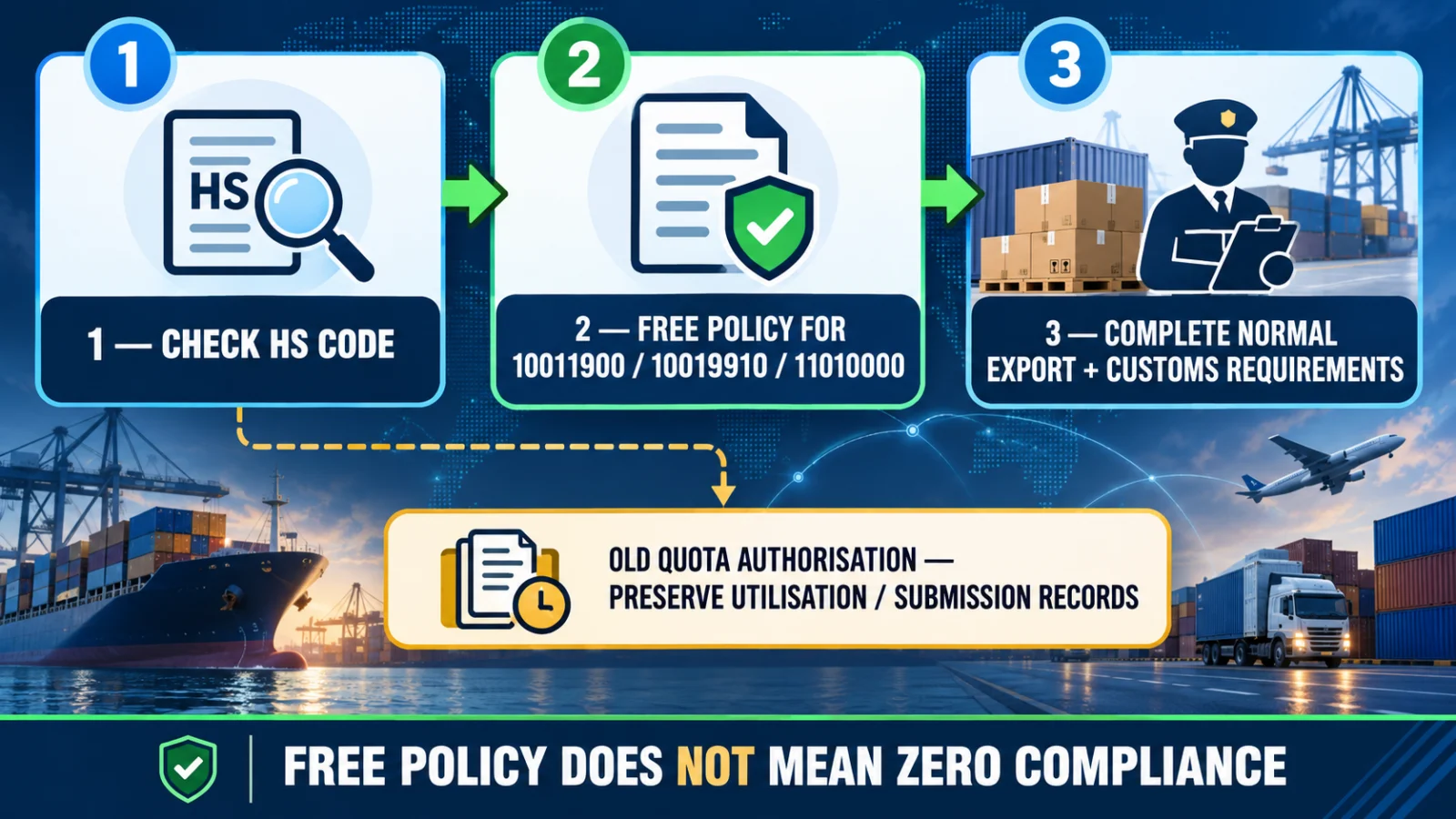
Direct answer: a new export shipment correctly falling under one of these Free tariff lines no longer depends on the earlier wheat-quota route merely because the product was previously Prohibited. Free policy does not remove normal IEC, Customs, shipping, product, phytosanitary or destination-country requirements that otherwise apply.
FREE EXPORT POLICY ≠ ZERO EXPORT COMPLIANCE
FREE STATUS ≠ AUTOMATIC ERASURE OF RECORDS OR OBLIGATIONS LINKED TO AN OLD QUOTA AUTHORISATION
Which wheat HS codes are Free for export?
| Product | HS code | Current DGFT export-policy state |
|---|---|---|
| Durum wheat, other | 10011900 |
Free |
| Wheat | 10019910 |
Free |
| Wheat or meslin flour, including covered atta, maida, semolina and related forms under the notified line | 11010000 |
Free |
Exporters should classify the actual product against the applicable tariff line before relying on this policy. A wheat-derived product under another HS code should be checked separately.
What did Notification 35/2026-27 change?
DGFT Notification 35/2026-27, dated August 24, 2026, revised the export policy for HS 10011900 and HS 10019910 from Prohibited to Free with immediate effect.
This replaced the earlier policy state under which commercial wheat exports were generally restricted while defined quantities could be exported through quota or other permitted routes.
What did Notification 34/2026-27 change?
DGFT Notification 34/2026-27 revised the policy for HS 11010000 from Prohibited to Free with immediate effect.
The notified description covers wheat or meslin flour and specified forms including atta, maida, semolina, wholemeal atta and resultant atta within that tariff line.
What does Free mean for a new wheat export shipment?
For a product correctly classified under a tariff line that is now Free, the earlier prohibition or quantitative quota gate is no longer the controlling DGFT export-policy restriction merely because of that product classification.
That means an exporter planning a new covered shipment should begin from the current Free-policy state rather than from the older assumption that a wheat quota is required for every commercial export.
Other requirements can still include:
- valid IEC or other exporter-registration requirements where applicable;
- correct ITC (HS) classification;
- shipping-bill and Customs filing;
- commercial invoice and contract documentation;
- quality, inspection, plant-health or phytosanitary documentation where applicable;
- destination-country import conditions;
- carrier, port and logistics documentation; and
- any independent restriction or condition applicable to the shipment.
How is Free policy different from the earlier wheat quota system?
Earlier restricted state
The underlying export policy remained Prohibited while the government permitted defined quantities through quota or other authorised exceptions.
Quota authorisation
Approved exporters operated within allocated quantity, utilisation and procedural conditions.
Current Free state
The notified tariff lines themselves are Free, so a new covered shipment does not rely on the old prohibition-and-quota gate in the same way.
What happened to the old August 31 quota-utilisation deadline?
Before the Free-policy change, DGFT Trade Notice 18/2026-27 initiated a review and reallocation exercise for previously allocated wheat export quota under HS 10011900 and 10019910.
That process asked covered authorisation holders to provide utilisation information by the stated August 31 boundary. That date has now passed.
The current DGFT/APEDA trade-notice listing reviewed through September 8 does not show a later wheat-specific trade notice expressly withdrawing, modifying or reopening Trade Notice 18/2026-27.
Practical meaning: the August 31 submission window is historical, not a current filing deadline. Existing authorisation holders should preserve whatever utilisation, shipping-bill, surrender, contract or submission evidence applies to their case and check any DGFT communication attached to that authorisation.
Does the Free-policy notification automatically cancel an old quota authorisation?
The August 24 notifications change the forward export-policy classification of the covered products. They do not state that every historical record, submission, reporting obligation or compliance consequence associated with a previously issued authorisation is erased.
An exporter that held an older quota authorisation should therefore distinguish two questions:
- What policy applies to a new covered shipment now? The notified tariff line is Free.
- What records or consequences remain attached to an older authorisation? Check the old authorisation, the earlier trade notice and any later DGFT communication specific to the case.
New shipment vs old quota authorisation
| Your situation | Current policy answer | What still needs checking |
|---|---|---|
| Planning a new export under HS 10011900, 10019910 or covered HS 11010000 goods | The notified export-policy state is Free | Normal exporter, Customs, product and destination requirements |
| Holding an older wheat quota authorisation | The forward product policy is now Free | Records, utilisation history and any authorisation-specific DGFT communication |
| Already exported under an earlier quota | The new notification governs the forward policy state | Preserve evidence of utilisation and any submission made under the earlier review process |
| Product falls under another wheat-derived HS code | No conclusion should be drawn from Notifications 34 and 35 alone | Verify the exact ITC (HS) export-policy entry |
Does Free status mean an IEC is no longer required?
No. Free describes the export-policy status of the goods. It does not mean the broader Foreign Trade Policy, Customs or exporter-registration framework disappears.
The same distinction applies to shipping bills, invoices, certificates and destination-country requirements.
Does the change cover every wheat-derived product?
No. The notifications identify specific tariff lines. Products such as bran, preparations, mixes or other wheat-derived goods may fall under different HS codes and must be checked separately.
Can exporters now ignore destination-country requirements?
No. India’s Free export-policy classification answers only one part of the shipment’s regulatory path.
The importing country can still impose documentation, food-safety, quality, phytosanitary, labelling or other import requirements. Exporters should verify those requirements before contracting or dispatching goods.
Do the notifications guarantee that Customs will clear every shipment?
No. A Free DGFT policy classification does not guarantee Customs clearance for a particular shipment. Customs can still require correct classification, documentation and compliance with other applicable laws or restrictions.
Why the policy change remains useful after August 2026
The August 24 notifications created the current baseline for the specified tariff lines. Exporters, traders and logistics teams still need to know whether they should begin a shipment from a quota-controlled assumption or a Free-policy assumption.
The current answer is Free for the notified lines, subject to other applicable compliance requirements.
What should an exporter verify before shipment?
Confirm the exact HS code
Do not rely only on a commercial product name such as wheat, atta or flour.
Check the current DGFT policy entry
Verify that the tariff line remains Free and that no later notification has changed the policy.
Check shipment compliance
Review IEC, Customs, shipping, quality and destination-country requirements that apply independently of the Free classification.
Separate legacy authorisation records
If you held an earlier quota authorisation, preserve the authorisation, utilisation and submission evidence rather than assuming the historical file disappeared.
Use later DGFT guidance if issued
A later notification, trade notice or applicant-specific communication can change the answer for a particular workflow.
Frequently asked questions
Is wheat export banned in India now?
For HS 10011900 and 10019910, DGFT Notification 35/2026-27 changed the policy from Prohibited to Free with immediate effect on August 24, 2026.
Is wheat flour export Free?
DGFT Notification 34/2026-27 changed HS 11010000 wheat flour and related notified products from Prohibited to Free with immediate effect.
Do I need the old wheat quota for a new covered shipment?
The notified tariff lines are now Free, so the previous prohibition-and-quota gate is no longer the current product-policy basis for a new covered shipment. Other applicable export requirements still remain.
What if I already had a wheat quota authorisation?
Use the current Free policy for the forward product-policy state, but preserve the old authorisation and any utilisation or reporting evidence. Check any DGFT communication specific to that authorisation before treating the historical file as closed.
Can I still submit the August 31 utilisation information now?
The August 31 boundary under the earlier review process has passed. No general reopening route was identified in the current DGFT/APEDA trade-notice listing reviewed through September 8. Any late or corrective action should be based on an authorised DGFT route or case-specific instruction.
Does Free mean there are no Customs formalities?
No. Free is the DGFT product-policy status. Customs, exporter, shipment, product and destination requirements can still apply.
Verification method
ThePulseSignal checked the current DGFT notification surface and the Government of India/APEDA DGFT notification listing. The current listing makes Notifications 34/2026-27 and 35/2026-27 publicly identifiable, and Gazette reproductions confirm the operative Prohibited-to-Free wording and HS-code scope. TPS also checked the current DGFT/APEDA trade-notice listing for a later wheat-specific notice that would expressly withdraw, modify or reopen Trade Notice 18/2026-27 and did not identify one through the September 8 review.
Limitations and unresolved facts
- The current public review does not establish the private status of any individual quota authorisation or whether DGFT accepted a specific August 31 submission.
- No general post-August-31 late-submission or correction route for Trade Notice 18/2026-27 was identified in the reviewed current listing.
- Customs, destination-country and product-specific requirements can differ by shipment.
- This guide does not determine the correct HS classification for an individual product.
- Any later DGFT notification or trade notice can change the current export-policy answer and should be checked before shipment.
Official and supporting sources
- DGFT notification portal
- Government of India/APEDA DGFT notification listing
- Government of India/APEDA DGFT trade-notice listing
Bottom line: specified wheat and wheat-flour tariff lines are currently Free for export under DGFT Notifications 35/2026-27 and 34/2026-27. New covered shipments should be evaluated from that Free-policy baseline, while normal shipment compliance still applies. Exporters with old quota authorisations should preserve historical utilisation and submission evidence and use any later DGFT or case-specific instruction for unresolved legacy issues.
Last verified: September 8, 2026.