







A Gitea vulnerability affecting versions 1.17 through 1.27.0 can allow remote command execution when the required access and deployment conditions are present. Gitea lists version 1.27.1 as the patched release for CVE-2026-60004, and the vulnerability was later added to CISA’s Known Exploited Vulnerabilities catalogue after evidence of exploitation in the wild.
The important operational distinction is that three questions must be answered separately: Is your version affected? Can your deployment satisfy the exploit conditions? And could the instance have been compromised before you patched it? A yes to the first question does not automatically prove exploitation, while a successful upgrade does not prove that nothing happened earlier.
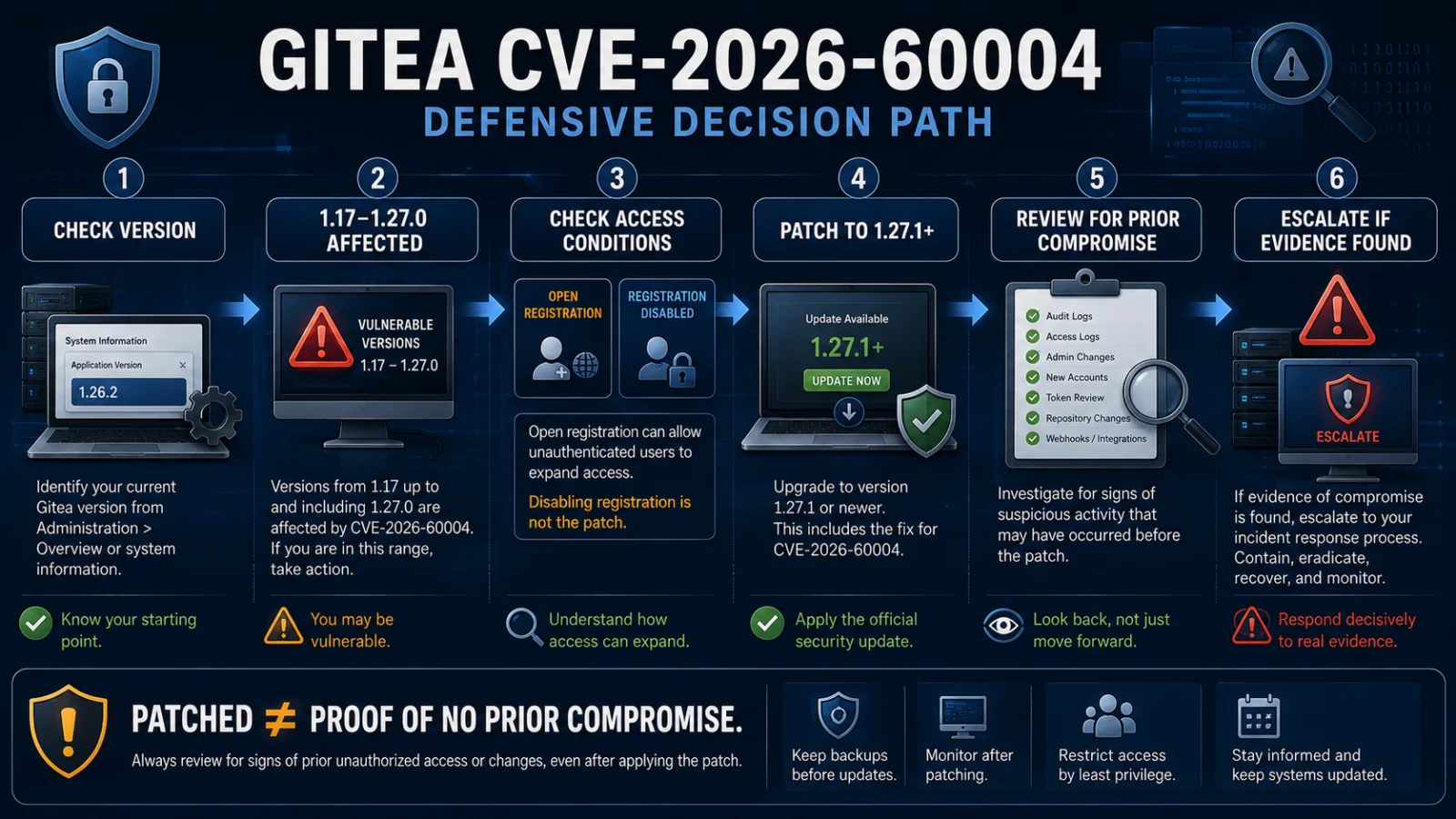
Gitea vulnerability decision path
1. Check the installed version. If the instance is older than 1.17, this specific advisory does not list it in the affected range. If it is version 1.17 through 1.27.0, continue the exposure check. If it is 1.27.1 or a later fixed supported release, the vendor-listed vulnerable version condition is no longer present.
2. Check the deployment conditions. The vendor advisory describes repository write access, Git 2.32 or later, an enabled diffpatch route and a writable/executable temporary filesystem as relevant conditions.
3. Patch the affected instance. Upgrade to Gitea 1.27.1 or a later supported fixed release. Do not treat disabling registration as a substitute for patching.
4. Decide whether historical compromise needs investigation. Because active exploitation has been confirmed, an internet-exposed affected deployment should not treat the version upgrade alone as evidence that the server was never exploited.
Which Gitea versions are affected by CVE-2026-60004?
Gitea’s advisory lists versions greater than or equal to 1.17 and lower than 1.27.1 as affected. The first vendor-listed patched version is 1.27.1.
That means an administrator should begin with the actual running version rather than assuming that every Gitea deployment is vulnerable. If the deployment is inside the affected range, the next step is to understand the exploit conditions rather than jumping directly from “affected version” to “confirmed compromise.”
How does the Gitea vulnerability work?
The issue involves Gitea’s diffpatch functionality. According to the vendor advisory, an attacker who can write to a repository can abuse the affected path to plant and execute a Git hook. Successful exploitation can result in arbitrary shell-command execution under the privileges of the Gitea service account.
The impact therefore depends partly on how that service account and the surrounding deployment are isolated. Code execution as a narrowly restricted service user is still serious, but the practical consequences can become larger when the same process can reach repositories, application secrets, database credentials, integration tokens or other mounted resources.
Does exploitation require an authenticated Gitea account?
The vendor describes repository write access as a relevant precondition. That creates an important distinction between authentication state and practical exploitability.
On a deployment with open registration, a previously unauthenticated visitor may be able to register an account and create or obtain a writable repository, which can satisfy the access requirement without the attacker having an account beforehand. This helps explain why the vulnerability can still present a no-prior-credential attack path on default-style deployments.
But open registration is not required for every possible exploitation path. If an attacker already controls an account with repository write access, disabling new registration does not remove the underlying vulnerable code path from an unpatched server.
Does disabling Gitea registration fix CVE-2026-60004?
No. Disabling open registration can reduce the number of people who can obtain repository write access without an existing account, but it does not remediate the vulnerable software.
The primary remediation remains upgrading the affected Gitea version to 1.27.1 or a later supported fixed release. Registration policy should be treated as a separate exposure-control decision rather than as the vulnerability fix.
Which other deployment conditions matter?
The vendor advisory identifies several technical conditions relevant to exploitation, including Git 2.32 or later, availability of the affected diffpatch functionality and a temporary filesystem that permits the required write and execution behaviour.
These conditions are useful for triage, but they should not be used to justify leaving a known affected release unpatched. Configuration can change, administrators can misread runtime state, and existing users may already have the repository access needed to reach the vulnerable path.
Why patching is not the end of the investigation
CISA’s decision to place CVE-2026-60004 in the Known Exploited Vulnerabilities catalogue changes the risk context. It means exploitation is not merely theoretical.
For an administrator who operated an affected and reachable deployment before upgrading, two different questions now exist:
- Remediation: Is the vulnerable code path closed now?
- Verification: Is there evidence that the server, repositories or credentials were affected before remediation?
Upgrading can answer the first question. It cannot by itself answer the second.
What should administrators check after patching?
No authoritative universal campaign-specific IOC set was established in the reviewed evidence. Administrators should therefore avoid treating an arbitrary public list of hashes, addresses or filenames as definitive proof of compromise or safety.
A more defensible approach is to review deployment-specific behavioural evidence. Depending on available telemetry, useful investigation targets can include:
- unexpected user registrations or repositories created during the exposure window;
- unexpected or anomalous use of the affected
diffpatchpath; - shells or unusual child processes launched under the Gitea service account;
- unexpected Git hooks or repository modifications;
- reverse-proxy, application, audit and operating-system logs showing unusual access around suspicious repository activity;
- unexpected changes involving configuration, application secrets, integration credentials or database access.
These are behavioural investigation targets, not a claim that every exploited system will show the same artifacts.
Should Gitea credentials and secrets be rotated?
Credential rotation should follow the evidence and the organisation’s incident-response process. If suspicious activity indicates that the Gitea service account, application configuration, database credentials, integration tokens or other secrets may have been exposed, affected credentials should be revoked or rotated as part of containment and recovery.
TPS is not treating simple presence of a vulnerable version as proof that every stored credential was stolen. A deployment with no evidence of compromise may require a different response from one showing unauthorised command execution or access to secret-bearing files.
What could successful exploitation expose?
Because the vulnerability can execute commands as the Gitea service account, potential impact depends on what that account can access. Possible exposure can include repositories, application configuration, process-environment secrets, database credentials or data, and connected-service credentials.
This is another reason to review service-account privilege and deployment isolation. The CVE establishes a code-execution path; it does not establish that every possible resource was accessed on every affected installation.
Does the CISA remediation deadline apply to every Gitea operator?
No. Inclusion in CISA’s Known Exploited Vulnerabilities catalogue is important evidence that active exploitation exists, but CISA’s binding remediation requirements apply to the relevant U.S. federal scope.
Private companies, Indian organisations and other operators should not present the U.S. federal remediation date as their own legal deadline unless another applicable policy, regulator or contractual requirement says so. The KEV entry is still a strong reason to prioritise remediation.
Is there evidence that Indian Gitea servers were compromised?
No India-specific victim set or CERT-In incident advisory was established in this research. TPS therefore does not claim that Indian organisations have been compromised simply because Gitea is used globally or because CISA confirmed exploitation.
What should a self-hosted Gitea team do now?
- Identify the exact running Gitea version.
- If it is 1.17 through 1.27.0, treat it as affected.
- Review repository-access and deployment conditions, including open registration, without using those checks as a substitute for patching.
- Upgrade to 1.27.1 or a later supported fixed release.
- Review logs, repository changes, process activity and relevant host telemetry for signs of prior exploitation.
- If compromise is suspected, escalate through the organisation’s incident-response process and rotate affected credentials or secrets based on evidence.
The core rule is simple: affected version, exploitable deployment and confirmed compromise are not the same state. Administrators should close the vulnerability first, then use available evidence to determine whether recovery work must go further.