







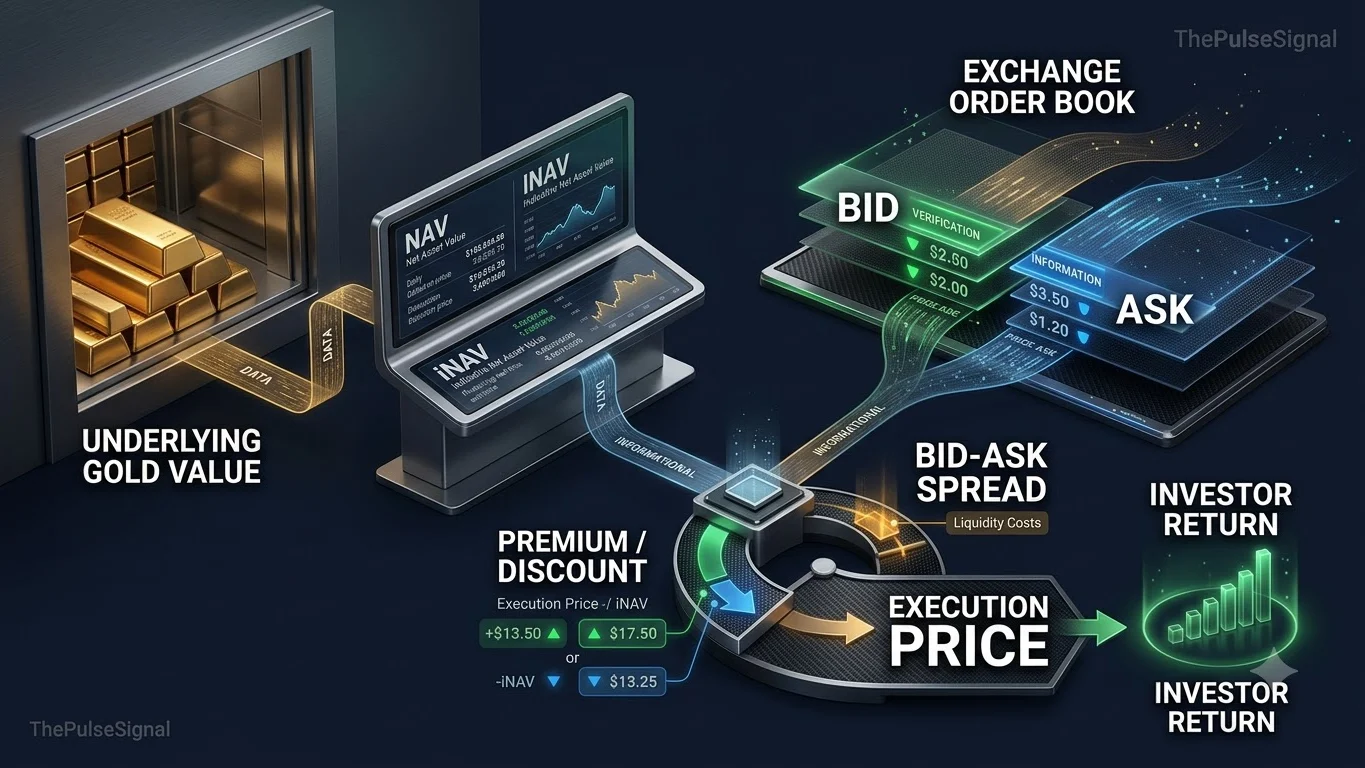
If you are comparing Gold ETF NAV vs market price, the first thing to know is that they are not supposed to be the same number at every moment. NAV represents the fund’s underlying per-unit value, while the market price is the price at which ETF units are actually trading between buyers and sellers on the exchange.
That difference matters because an investor can buy a Gold ETF at a premium to its underlying value or sell at a discount. The bid-ask spread can create an additional execution cost even when the ETF’s quoted market price appears close to NAV.
Gold ETF NAV vs market price: what each number tells you
| Number | What it represents | Why it matters |
|---|---|---|
| NAV | The scheme’s per-unit underlying value calculated from its assets and liabilities. | Useful for understanding the fund’s underlying value, but it is not automatically the live exchange price available to you. |
| iNAV | An indicative intraday reference for the ETF’s underlying value during market hours. | More useful than an older day-end NAV when judging a live exchange trade. |
| Market price | The exchange price created by actual buying and selling. | This is where the ETF can trade above or below its underlying reference value. |
| Bid | The highest current price a buyer is offering. | Relevant when you want to sell immediately. |
| Ask / offer | The lowest current price a seller is offering. | Relevant when you want to buy immediately. |
| Bid-ask spread | The gap between the current bid and ask. | A wider spread can increase the effective cost of entering or exiting the ETF. |
What is a Gold ETF’s NAV?
Net Asset Value, or NAV, represents the value of the fund’s assets after applicable liabilities, expressed on a per-unit basis. For a Gold ETF, the underlying portfolio is designed to track gold subject to the scheme’s mandate, expenses and permitted holdings.
NAV is therefore an important valuation reference, but a retail investor normally buys and sells ETF units on the stock exchange. The exchange does not guarantee that every transaction happens exactly at NAV.
What is iNAV?
Indicative NAV, commonly written as iNAV, is intended to provide an intraday reference for the ETF’s underlying value while the market is open. SEBI investor-education material distinguishes NAV, iNAV and traded price and advises investors to check iNAV while making ETF buy or sell decisions.
This distinction matters because a previous day-end NAV can become a poor comparison point for a live trade if gold prices or other relevant inputs have moved since that NAV was calculated.
Why can a Gold ETF market price differ from NAV or iNAV?
ETF units trade on an exchange, so their immediate price is influenced by buyers, sellers, available liquidity and the order book. A surge in demand can push the exchange price above underlying value, while heavier selling or weak buying interest can move it below that value.
Gold ETF scheme disclosures explicitly recognise that units can trade above or below NAV. This is not automatically evidence that the fund’s underlying gold holdings themselves have been misvalued. It can be an exchange-execution effect.
What does a premium to NAV mean?
A premium exists when the comparable exchange price is above the ETF’s underlying reference value.
For a buyer, this can mean paying more per unit than the contemporaneous underlying value suggests. If the premium later disappears while gold itself is unchanged, part of the investor’s apparent loss can come from the execution premium rather than from a fall in gold.
There is no evidence-backed universal percentage at which every Gold ETF premium becomes unacceptable. The practical significance depends on the current reference value, spread, liquidity, order size and the investor’s own price limit.
What does a discount to NAV mean?
A discount exists when the comparable exchange price is below the ETF’s underlying reference value.
A discount is not automatically a bargain. It can reflect weak liquidity, selling pressure, stale comparison data or a market in which effective arbitrage is temporarily impaired. Before treating a discount as an opportunity, check whether the reference value is current and whether there is enough order-book liquidity to enter and later exit efficiently.
Premium or discount is not the same as the bid-ask spread
These are two different execution concepts.
A premium or discount compares the ETF’s market price with an underlying reference such as NAV or iNAV. The bid-ask spread compares the prices currently offered by buyers and sellers in the exchange order book.
An ETF can therefore be close to its underlying value and still have a relatively wide spread. It can also have a narrow spread while trading at a temporary premium or discount to the underlying reference.
Which price matters when you are buying?
If you want an immediately executable purchase, the relevant exchange price is normally the current ask or offer, not merely the last traded price displayed on a screen.
The last traded price tells you where the most recent transaction occurred. It does not guarantee that another seller is still offering units at that price or that enough units are available there for your entire order.
A more useful comparison is therefore the current ask against a reasonably current iNAV or other appropriate underlying-value reference, while also checking the spread and available order-book depth.
Which price matters when you are selling?
For an immediately executable sale, the current bid matters because it represents the highest visible price buyers are presently offering.
If the bid is materially below the ETF’s current underlying reference value, the investor may be accepting a discount. A wide bid-ask spread can also reduce sale proceeds even when the underlying gold price itself has barely moved.
Why comparing live market price with yesterday’s NAV can mislead
Premium and discount calculations are meaningful only when the compared values refer to reasonably compatible times.
If you compare a live Gold ETF quote with a previous day-end NAV after gold prices have already moved, part of the apparent premium or discount may simply reflect the time difference between the two numbers.
During market hours, a current iNAV can be a more useful reference than blindly comparing the exchange quote with an older NAV.
What do market makers and authorised participants do?
ETF structures use authorised participants and market makers to support liquidity and help keep exchange prices aligned with underlying value. When an ETF trades sufficiently away from its underlying value, creation, redemption and arbitrage activity can provide an economic incentive to narrow the difference.
That mechanism helps explain why well-functioning ETFs often trade relatively close to underlying value, but it is not a guarantee that every divergence disappears immediately.
Gold ETF scheme disclosures recognise that premiums or discounts can widen when normal arbitrage becomes difficult or when market demand, supply and liquidity are unusually imbalanced.
Why liquidity still matters
Liquidity is not only about the total trading volume shown for the day. What matters to your order is also the current quantity available near the best bid and ask prices.
A thin order book can cause a larger order to execute across multiple price levels. This means the investor’s average execution price can be worse than the first price visible on the screen.
That is one reason a last traded price alone is not enough to judge execution quality.
Market order vs limit order for a Gold ETF
Exchange order types involve a trade-off between execution certainty and price control.
A market order prioritises execution against available prices in the order book. It does not promise one fixed execution price, particularly when liquidity is thin or the order is large relative to available depth.
A limit order specifies the maximum price a buyer is willing to pay or the minimum price a seller is willing to accept. That provides price control, but the order may remain partly or completely unexecuted if the market never reaches the specified price.
TPS does not treat one order type as universally correct. The relevant choice depends on the investor’s need for execution, price tolerance, current spread and available liquidity.
How poor execution can affect your actual Gold ETF return
An investor’s result depends not only on what happens to gold after the purchase.
If you buy at a material premium, your starting cost is higher than the underlying reference value. If that premium later closes, your ETF price can underperform the gold move you expected.
Similarly, selling at a discount or crossing a wide spread can reduce the amount you actually receive. These execution effects are separate from the fund’s longer-term tracking difference, expense ratio and the underlying movement in gold.
Does a high trading volume guarantee good execution?
No single number guarantees execution quality.
Trading activity can be useful context, but investors should still inspect the current bid, ask, spread, available quantity and underlying reference. A fund can show substantial daily activity while the order book available at a particular instant still matters for the price you receive.
How should you compare two Gold ETFs at trade time?
If you have already shortlisted two Gold ETFs, do not compare only their last traded prices. Their units can have different face values, NAVs and exchange conditions, so the absolute rupee price of one ETF unit does not by itself tell you which trade is better.
Instead, compare each ETF’s executable price against its own current underlying reference, then examine the bid-ask spread and available liquidity.
If you are still deciding which fund to shortlist before reaching the execution stage, TPS’s separate guide on how to choose a Gold ETF in India covers tracking error, tracking difference, costs, liquidity and broader selection factors.
Gold ETF trade-time checklist
Check the correct ETF
Confirm the exchange symbol and scheme before comparing prices or entering an order.
Check the underlying reference
Use a current iNAV or other appropriate scheme reference and note its timestamp.
Check bid and ask
Do not rely only on last traded price. Look at the side of the order book relevant to your trade.
Check premium or discount
Compare the executable price with a contemporaneous underlying-value reference.
Check the spread
A wider bid-ask spread can increase the effective cost of entering or exiting.
Check quantity and depth
Make sure enough units are available near the displayed price for the size of your order.
Set your price tolerance
Decide the maximum purchase price or minimum sale price you are willing to accept before choosing the order type.
Do not assume execution
A limit order can protect your price but may not fill; a market order can execute but may do so across available prices.
What should not be treated as a universal rule?
- There is no universal safe premium percentage for every Gold ETF and every market condition.
- A discount is not automatically a buying opportunity.
- A narrow spread at one moment does not guarantee the same spread later.
- A market maker does not guarantee that the ETF always trades exactly at NAV.
- A limit order does not guarantee that the trade will execute.
- A last traded price does not guarantee the same price is currently available for your full order.
Verification note
ThePulseSignal reviewed SEBI ETF investor guidance, SEBI material distinguishing NAV, iNAV and traded price, current Gold ETF scheme disclosures describing premium or discount and market-making mechanics, and exchange guidance on market and limit orders.
Limitations and unresolved facts
Premiums, discounts, bid-ask spreads, iNAV values and order-book depth change during the trading day. TPS has not assigned a universal acceptable premium, discount or spread because the reviewed evidence does not support one threshold for every Gold ETF or investor. A numerical example should be treated as illustrative unless it uses synchronized, timestamped market and underlying-value data.
Bottom line
The practical answer to Gold ETF NAV vs market price is that NAV or iNAV tells you about underlying per-unit value, while the exchange order book determines what you can actually buy or sell at.
Before placing a Gold ETF order, compare a current underlying reference with the relevant bid or ask, then examine the bid-ask spread and available liquidity. A premium or discount and a wide spread can affect your actual return even when the underlying gold price itself has barely moved.