




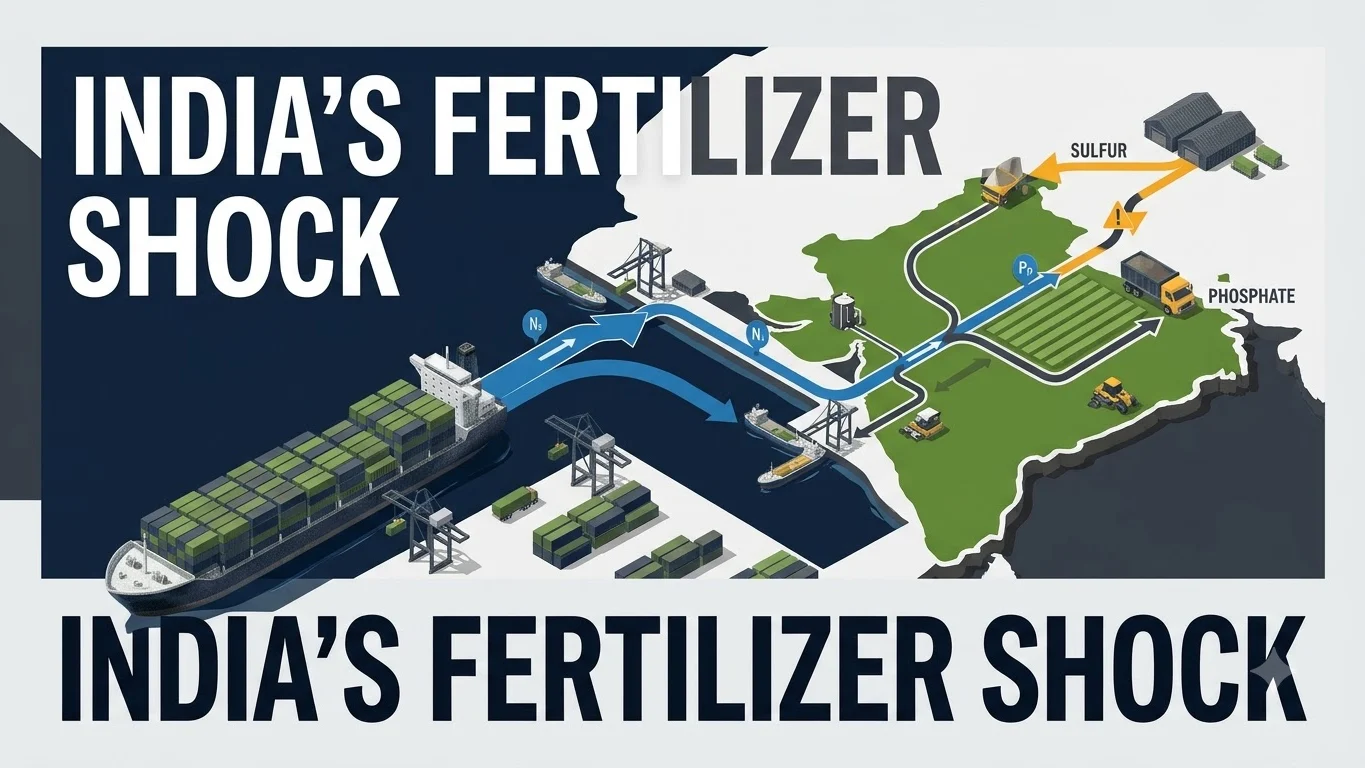
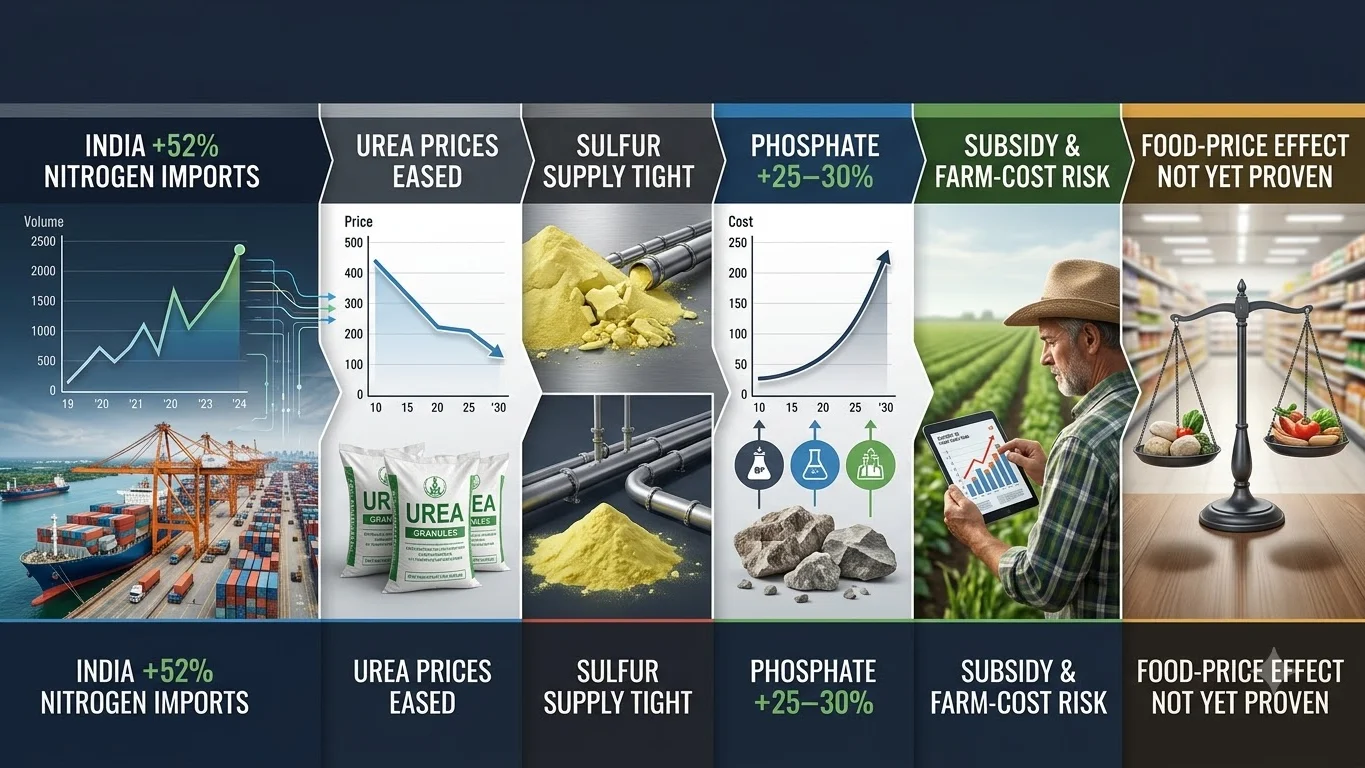
The latest Strait of Hormuz fertilizer India data shows that the fertilizer shock has changed shape rather than disappeared. IFPRI’s September 18 analysis estimates that India’s nitrogen-fertilizer imports increased by more than 1.1 million metric tonnes, or 52% year-on-year in the first half of 2026, as disrupted Gulf fertilizer and LNG flows forced India to rely more heavily on alternative international suppliers.
That number sounds like evidence of a worsening fertilizer shortage. The current evidence points to a more complicated state. India has expanded imports and diversified suppliers, while global and Indian urea costs have fallen substantially from their spring peaks. The more persistent pressure is now concentrated in sulfur and phosphate fertilizer markets, alongside the fiscal cost of shielding Indian farmers from global price volatility.
Direct answer: India’s 52% increase in nitrogen-fertilizer imports does not mean the country is currently running out of urea. It shows how aggressively the supply chain adjusted after Hormuz disrupted Gulf fertilizer and LNG flows. Nitrogen availability and prices have improved, while sulfur and phosphate remain the more important unresolved fertilizer risks. Those pressures can raise import, subsidy and farm-input costs, but current evidence does not establish a direct September 2026 increase in Indian retail food prices caused by the fertilizer shock.
What changed in the latest Hormuz fertilizer data?
Early in the Hormuz disruption, the dominant risk was a broad fertilizer shortage. The Gulf is a major source of nitrogen fertilizer, ammonia, sulfur and the natural gas used to manufacture nitrogen fertilizer. When shipping and LNG flows were disrupted, fertilizer prices rose sharply and countries dependent on imported fertilizer began searching for replacement supply.
Six months later, IFPRI’s trade analysis shows that the global market adapted more successfully than the earliest fears suggested. Global nitrogen-fertilizer exports were still about 9% lower year-on-year in H1 2026, with major Gulf exporters sharply lower, but other suppliers expanded exports enough to reduce the immediate shortage pressure.
China was particularly important in that adjustment. IFPRI estimates China’s nitrogen-fertilizer exports rose about 47% in H1 2026. That directly contradicts a stale version of the story in which China is simply withholding nitrogen fertilizer from world markets.
Why did India’s nitrogen-fertilizer imports rise 52%?
India faced two connected pressures. The first was reduced access to traditional Gulf fertilizer supply. The second was disruption to Gulf LNG flows, which matters because natural gas is the principal feedstock for ammonia and urea production.
IFPRI says reduced LNG availability constrained domestic nitrogen-fertilizer production and increased India’s need for imported nitrogen fertilizer. India compensated by sourcing more material from countries including China, Egypt, Viet Nam and Russia.
The 52% increase therefore represents a supply-chain substitution response. It should not be read as a 52% increase in fertilizer consumption, a 52% fall in domestic production or a 52% increase in India’s long-term import dependence.
Does India have a urea shortage now?
Current evidence does not support describing the situation as an immediate Indian urea shortage. Government measures included prioritising gas for fertilizer plants, diversifying overseas supply and moving fertilizer and raw-material cargo through the disrupted region when conditions allowed.
Current Indian reporting also shows that imported urea costs have fallen sharply from the May peak and that available urea stocks are materially stronger than the most severe early-crisis scenarios implied.
This is the key contradiction the current article needs to resolve: India imported much more nitrogen fertilizer precisely because it was adapting to the disruption. The import surge helped reduce the immediate availability risk rather than proving the shortage was getting worse.
What happened to urea prices?
IFPRI says global urea prices climbed to almost 80% above their January 1 level by late April. By the end of August, however, the benchmark had returned to roughly its January level.
Ammonia followed a similar pattern, with a sharp early increase followed by substantial retracement. Indian landed urea costs also fell significantly from their May high.
That means an article written from early-2026 fertilizer-crisis data alone would now give readers an incomplete answer. Nitrogen markets remain disrupted, but the extreme price stress has eased considerably.
Why sulfur is becoming the bigger fertilizer concern
The current weak point is increasingly sulfur. Elemental sulfur is a critical raw material for producing sulfuric acid, which is then used in manufacturing phosphate fertilizers such as DAP and MAP.
IFPRI estimates that global elemental sulfur exports fell from about 13.5 million tonnes to 9 million tonnes in H1 2026, a decline of roughly 33%. Gulf supply accounted for a large share of that reduction.
Sulfur prices more than doubled over the six-month period examined by IFPRI. Current market reporting indicates some recent price softening from earlier highs, so TPS should not describe sulfur as being at an absolute peak today. The important point is that the market remains structurally tighter than before the Hormuz disruption.
Why phosphate fertilizer prices remain elevated
The sulfur squeeze matters because phosphate fertilizer production depends heavily on sulfuric acid. IFPRI says MAP and DAP prices were still roughly 25% to 30% above pre-closure levels in its September assessment.
Those figures apply to phosphate products, not to all fertilizer categories. Nitrogen prices have retraced much more substantially, which is why describing the whole fertilizer market as uniformly 25% to 30% more expensive would be misleading.
Hormuz is also not the only cause of sulfur tightness. IFPRI points to lower shipments from Kazakhstan, transport restrictions involving Russia and national export controls. The current sulfur problem therefore combines Hormuz disruption with other supply constraints.
How India has protected fertilizer availability
India’s response has relied on several layers rather than a single emergency purchase. The government prioritised natural gas for domestic fertilizer production, diversified import sources, facilitated fertilizer and raw-material cargo movements and used the subsidy system to protect farmer-facing prices.
Earlier government updates showed fertilizer vessels carrying urea, DAP and sulfur crossing Hormuz despite the disruption. India also widened sourcing away from its most exposed Gulf suppliers.
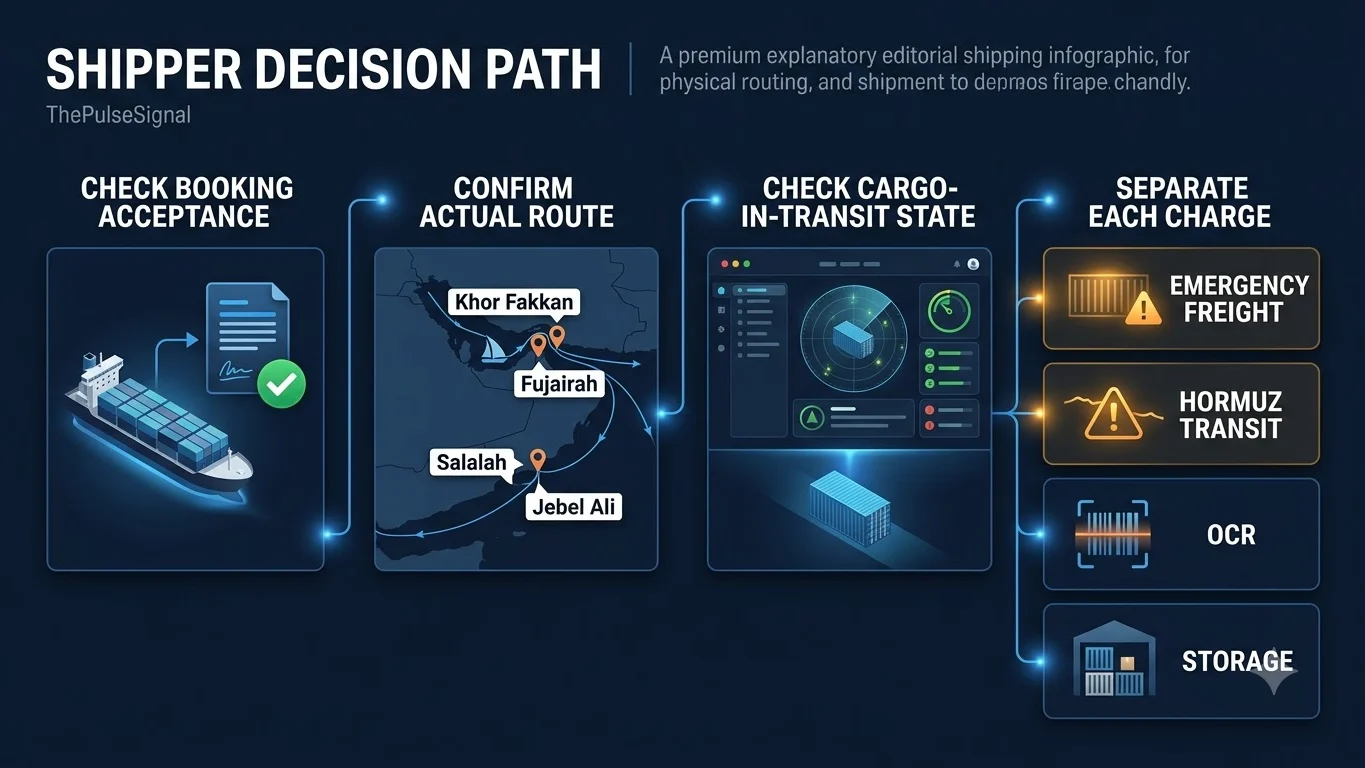
For broader shipping and route-status context, TPS separately tracks the Strait of Hormuz status and its wider implications for India. This article focuses on the fertilizer and food-system transmission path.
Are Indian farmers paying the full global fertilizer price?
No. India’s fertilizer system is heavily subsidised. Urea in particular is sold to farmers at a government-controlled price, while the state absorbs much of the difference between the regulated farmer price and production or import cost.
That means an international fertilizer shock can first appear as a larger government subsidy bill rather than an equivalent increase in what farmers immediately pay for urea.
Other fertilizer products and agricultural inputs can transmit global cost pressure differently, but there is still no simple one-to-one relationship between international fertilizer benchmarks and the price Indian consumers eventually pay for food.
Will India’s fertilizer subsidy bill exceed ₹3 lakh crore?
Earlier in the crisis, some estimates warned that the fertilizer subsidy bill could cross ₹3 lakh crore if extreme international prices and disruption persisted. That was a conditional scenario, not a confirmed fiscal outcome.
The subsequent drop in urea import costs reduces the confidence of the earlier worst-case estimate. The fiscal risk has not disappeared because India has had to import more material and phosphate/sulfur costs remain elevated, but TPS should not present ₹3 lakh crore as the settled FY2026-27 subsidy outcome.
What does this mean for Indian food prices?
The fertilizer-to-food-price pathway is real, but it is indirect. Higher fertilizer and feedstock costs can increase government subsidy requirements, raise costs for fertilizer producers and importers, and make some crop nutrients less affordable. If farmers respond by applying less fertilizer, switching nutrients or changing crop decisions, yields and production costs can eventually be affected.
That is the supported risk pathway. The reviewed evidence does not establish that India’s retail food inflation in September 2026 has increased by a specific amount because of the Hormuz fertilizer disruption.
India’s subsidy system also delays or absorbs part of the international shock. The ultimate consumer effect therefore depends on the duration of sulfur and phosphate tightness, government fiscal support, fertilizer application, crop yields, weather, logistics and many other food-price drivers.
What would make the food-cost risk more serious?
The risk would become materially stronger if sulfur and phosphate prices remain elevated through the next major procurement cycle, if nitrogen prices rise again, if domestic fertilizer production weakens, if fertilizer availability becomes constrained during Rabi demand, or if farmers materially reduce nutrient application because of cost or supply problems.
Evidence of lower fertilizer use, lower crop yields or a measurable increase in agricultural production costs would strengthen the case for a downstream food-price effect. Those outcomes are not yet established by the September IFPRI trade data alone.
The fertilizer shock changed shape rather than disappearing
The most useful conclusion is neither that the fertilizer crisis is over nor that a global fertilizer catastrophe is approaching.
Nitrogen markets have adapted. Replacement exporters expanded supply, India sharply increased imports, and urea prices retreated from their spring extremes. At the same time, the global system remains vulnerable because sulfur supplies are tight, phosphate fertilizers remain expensive and countries such as India are paying for resilience through a more complex import mix and potential subsidy pressure.
That makes sulfur, phosphate and fiscal exposure the more important indicators to watch now than the earlier headline question of whether India can secure enough urea.
What happens next?
The next meaningful evidence will come from India’s Rabi fertilizer procurement and stock data, new urea and DAP import tenders, sulfur and phosphate price movements, changes in domestic nitrogen production, fertilizer subsidy revisions and any material recovery in Gulf fertilizer, sulfur or LNG flows.
If those indicators improve, the remaining fertilizer shock could continue to fade. If sulfur or phosphate constraints intensify, the pressure may shift further from physical nitrogen availability toward fertilizer affordability, fiscal cost and agricultural production economics.
Verification note
TPS reviewed IFPRI’s September 18 fertilizer-market analysis and reconciled its trade findings with Indian government fertilizer-supply measures and current reporting on urea costs, stocks and sulfur-market pressure. The observed trade and fertilizer-price changes are evidence-backed; downstream Indian retail food-price effects remain a forward-looking risk rather than a confirmed current outcome.