






If you are comparing a bank vs NBFC gold loan India decision, the most useful starting point is not the old shortcut that banks are always cheaper while NBFCs are always faster. Under the RBI’s current gold-collateral framework, regulated banks and NBFCs now share many of the same core rules on eligible collateral, valuation, loan-to-value limits, collateral handling and borrower protection.
What still differs materially is the actual lender offer: the quoted interest rate or APR, processing and appraisal charges, sanctioned amount, repayment structure, tenure, renewal and prepayment terms, branch convenience, digital servicing and how the lender handles a stressed or defaulted loan.
Bank vs NBFC gold loan: what is common and what still differs?
| Decision factor | Common RBI foundation | What can still vary by lender |
|---|---|---|
| Eligible collateral | Regulated lenders operate within the RBI gold-collateral framework. | Product eligibility and lender-specific acceptance criteria can differ within the rules. |
| Valuation | Eligible gold content, purity and prescribed valuation principles matter; stones and decorative value do not create equivalent collateral value. | The actual appraisal of your jewellery determines the lender’s assessed value. |
| LTV | Consumption loans are subject to common regulatory ceilings based on loan size. | A lender can sanction below the regulatory maximum. |
| Interest and APR | RBI sets the regulatory framework, not one universal gold-loan rate. | Rates vary by lender, product, loan size, repayment pattern and borrower. |
| Fees | Disclosure and fair-practice requirements apply. | Processing, appraisal, documentation, renewal and other permitted charges can differ. |
| Repayment | Products must operate within applicable RBI rules. | EMI, bullet and overdraft-style options can differ significantly by product. |
| Service | Both banks and NBFCs are regulated institutions when covered by the RBI framework. | Branch reach, operating hours, digital payment tools and actual turnaround can differ. |
| Default and auction | Common regulatory safeguards apply to collateral handling and auction conduct. | Contract-specific notices, servicing and recovery execution can still differ. |
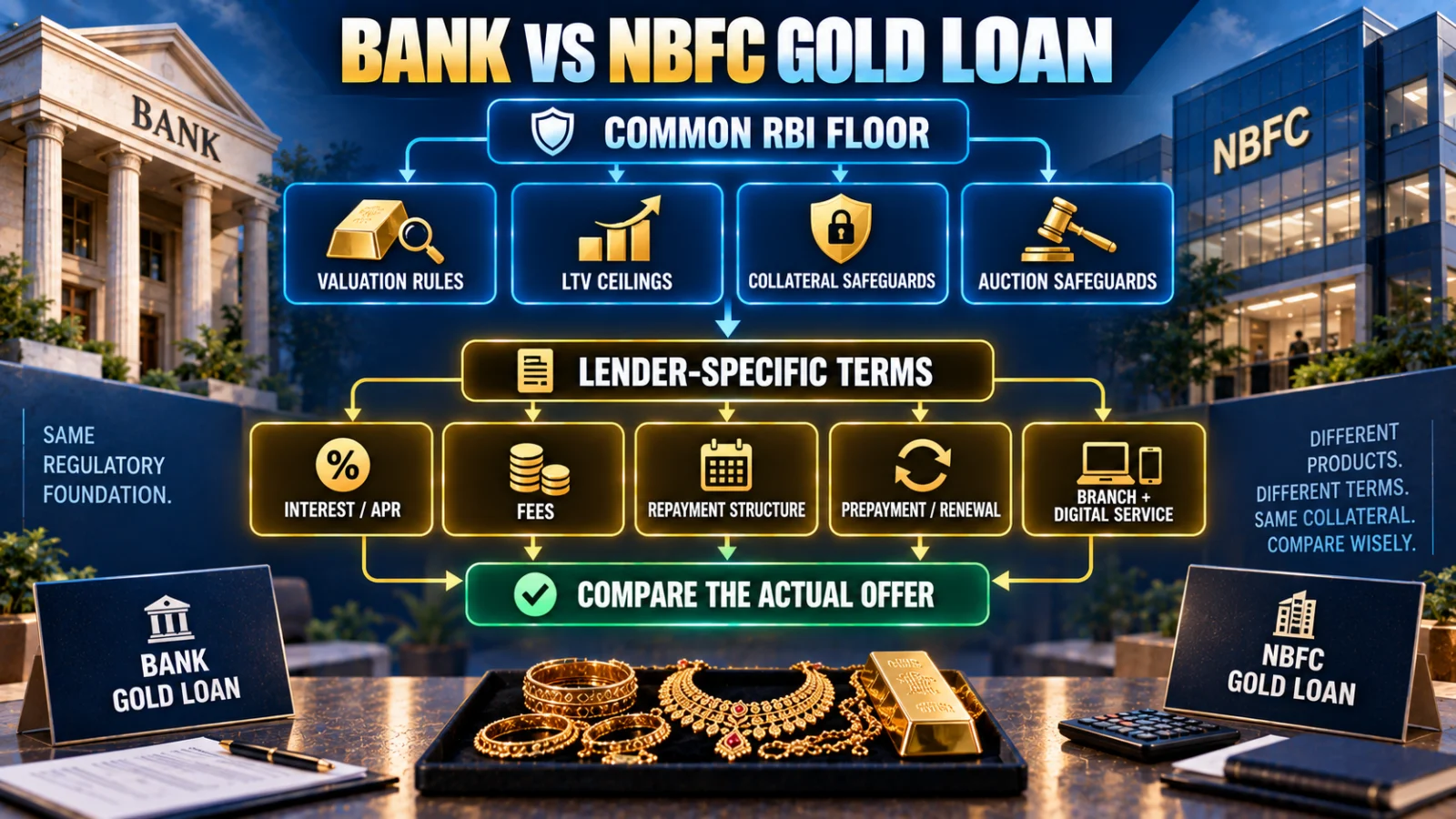
The RBI rules are now a common floor
The Reserve Bank of India’s 2025 directions created a substantially harmonised framework for lending against gold and silver collateral across regulated lenders, including commercial banks and NBFCs. Compliance with the new framework was required no later than 1 April 2026.
That change matters because some older comparison advice treated banks and NBFCs as if they operated under fundamentally different gold-loan prudential rules. That is no longer a safe assumption for the core regulated dimensions covered by the current directions.
Do banks and NBFCs have different gold-loan LTV limits?
For consumption loans, the current framework uses tiered maximum loan-to-value ceilings rather than one flat limit for every loan size:
- Up to ₹2.5 lakh: maximum LTV of 85%.
- Above ₹2.5 lakh and up to ₹5 lakh: maximum LTV of 80%.
- Above ₹5 lakh: maximum LTV of 75%.
These are regulatory ceilings, not guaranteed sanction ratios. A lender can offer less than the maximum after assessing purity, eligible net gold content, the loan product and its internal risk parameters.
This also means an NBFC should not automatically be assumed to provide a higher LTV than a bank merely because it is an NBFC.
Why can the loan amount be lower than the jewellery bill value?
Gold-loan collateral value is not based on the jewellery’s full retail purchase price.
The lender is interested in the eligible intrinsic gold content. Stones, diamonds and other non-gold components do not contribute equivalent collateral value, and retail making or design charges do not become recoverable gold value merely because they appeared on the original purchase invoice.
The lender therefore assesses eligible gold weight and purity under the applicable valuation framework before applying its sanctioned LTV.
Are bank gold loans always cheaper?
No evidence supports that as a universal rule.
Current bank product disclosures show competitive gold-loan rates, but the actual rate can differ across products even within the same bank. Current NBFC disclosures likewise show multiple schemes with different rates and repayment conditions.
The useful comparison is therefore not simply bank rate versus NBFC rate. It is the effective cost of the exact offers available to you.
Compare APR and all-in cost, not only the headline rate
A lower advertised interest rate can still produce a less attractive loan if the product has higher fees or a repayment structure that does not fit your cash flow.
Before choosing, compare:
- quoted interest rate or APR,
- processing fee,
- appraiser or valuation charges where applicable,
- documentation or service charges where applicable,
- renewal charges,
- penal charges,
- prepayment or foreclosure treatment, and
- the repayment schedule that determines how long interest remains outstanding.
Use the lender’s current Key Facts Statement, sanction letter and official fee schedule rather than relying on a comparison site’s promotional number.
Are NBFC gold loans always faster?
No universal lender-class claim is safe.
Gold-loan-focused NBFCs often compete heavily on branch convenience and quick processing, but banks also advertise rapid appraisal and disbursal for eligible customers. Actual turnaround can depend on your branch, KYC, jewellery appraisal, product, loan amount and operating channel.
If speed matters, ask each shortlisted lender for the exact process required at the branch you intend to use rather than assuming the institution type determines the answer.
Paperwork can also vary by product, not just lender type
A gold loan is secured by pledged jewellery, so underwriting does not necessarily resemble an unsecured personal loan. Some bank gold-loan products require relatively limited documentation, while some NBFC products can require additional checks depending on the amount or purpose.
Do not assume that every bank has heavy paperwork or that every NBFC is documentation-light.
Repayment structure can matter more than lender category
Gold loans can be structured in materially different ways.
Current lender disclosures show products using combinations of regular EMI repayment, bullet repayment and overdraft-style structures. Two products from the same institution can therefore create very different monthly cash-flow requirements.
A borrower with stable monthly income may prefer regular amortisation. A borrower expecting a known future inflow may consider a bullet structure, provided the maturity obligation is manageable. An overdraft-style facility may suit a different cash-flow pattern altogether.
The correct comparison is the repayment obligation you can reliably meet, not the lender label printed above it.
Check tenure and interest-payment frequency
Do not compare two offers unless you are comparing similar tenures and repayment structures.
A lower nominal rate on a longer outstanding balance can cost more in absolute rupees than a slightly higher rate on a loan repaid much earlier. Likewise, a bullet loan can create a large maturity payment even when monthly cash outflow appears small.
Ask each lender for the repayment calendar and total contractual obligation before choosing.
Prepayment and renewal terms are lender-specific
There is no safe rule that every NBFC allows free prepayment or every bank has restrictive foreclosure terms.
Some lenders disclose no prepayment penalty for particular products, while other products may use different conditions. Renewal rules can also depend on updated valuation, interest servicing and current lender policy.
Read the exact sanction and fee terms for your product instead of relying on a lender-class assumption.
Does valuation differ between a bank and an NBFC?
The RBI framework now provides a common regulatory foundation for valuation, but your actual sanctioned value can still differ because the physical jewellery being appraised, purity assessment and lender’s permitted internal lending margin affect the result.
Two lenders assessing the same ornament should not be treated as free to invent arbitrary collateral value, but the final loan offer can still differ within the regulatory framework.
Branch and servicing convenience can be a real differentiator
This is one area where actual lender comparison matters.
Check whether the lender has a convenient branch for appraisal, repayment and final jewellery release. Also check whether you can make interest or principal payments digitally, obtain statements easily and reach customer support without repeatedly visiting the branch.
A marginally cheaper loan may not be better if servicing it is operationally difficult throughout the tenure.
What happens if you default?
Gold loans are secured by pledged jewellery. If contractual repayment obligations are not met and the default is not resolved, the lender can eventually proceed toward recovery and auction subject to applicable RBI requirements and contractual procedure.
Both regulated banks and NBFCs operate under borrower-protection and auction safeguards. That does not remove the risk of losing pledged jewellery.
Before taking the loan, read the default clause, notice process, auction provisions and treatment of any surplus after recovery.
How quickly should your gold be returned after repayment?
The current RBI framework includes borrower protections for the return of pledged collateral after full repayment or settlement. This is part of the common regulatory floor rather than a reason to presume that one lender class is automatically safer.
When closing the loan, keep evidence of full settlement and follow the lender’s documented collateral-release process.
What about grievances?
Check the lender’s formal grievance channel before you borrow. Keep appraisal records, sanction documents, payment receipts and closure evidence throughout the loan.
If a problem arises, start with the lender’s grievance process. Depending on the regulated entity and the nature of the dispute, RBI’s applicable grievance or ombudsman framework may provide an escalation route after the institution’s process has been used.
Do not compare only the maximum loan amount
Borrowing the maximum permitted against your jewellery is not automatically the best decision.
A higher LTV means more debt against the same collateral. That can increase the repayment burden and the amount of interest exposed to time.
Start with the cash amount you actually need, then compare lenders for that amount.
How to compare two actual gold-loan offers
1. Fix the loan amount
Compare lenders for the same amount rather than comparing each lender’s maximum eligible sanction.
2. Match the repayment structure
Compare EMI with EMI, bullet with bullet or equivalent structures so the cost comparison remains meaningful.
3. Add every disclosed cost
Include interest or APR, processing, appraisal, renewal and other applicable charges.
4. Check the sanctioned collateral value
Review assessed purity, eligible gold weight, valuation and the LTV actually offered.
5. Test repayment fit
Choose a tenure and payment schedule that your expected cash flow can support without risking the jewellery.
6. Check servicing and exit
Compare branch convenience, digital payments, prepayment, renewal, grievance handling and how the gold is returned after closure.
Bank or NBFC: which should you choose?
There is no evidence-backed universal winner.
A bank may offer the better deal for one borrower because its quoted rate, fees and repayment structure are attractive. An NBFC may be better for another borrower because the available scheme, branch access, servicing or repayment design fits better. The reverse can also be true.
The strongest decision is to obtain two or three current offers and compare them on the same loan amount and repayment structure.
If you are still deciding whether to use a gold-backed loan at all, TPS’s separate guide on gold loan versus personal loan in India addresses that different borrowing decision.
Verification note
TPS reviewed the RBI’s current gold-collateral framework together with current product and fee disclosures from regulated lenders. The regulatory comparison is stable at publication, but lender rates, fees, schemes, branch processes and borrower-specific offers can change.
Bottom line
The best way to handle a bank vs NBFC gold loan India comparison is to stop treating lender type as the answer.
Banks and NBFCs now share a substantially harmonised RBI regulatory floor for core gold-loan rules. The decision should therefore turn on the actual offer: all-in cost, sanctioned amount, valuation, repayment structure, tenure, prepayment and renewal terms, branch or digital convenience, default provisions and service quality.
Compare the exact scheme you can obtain today rather than choosing from the stereotype that every bank is cheaper or every NBFC is faster.