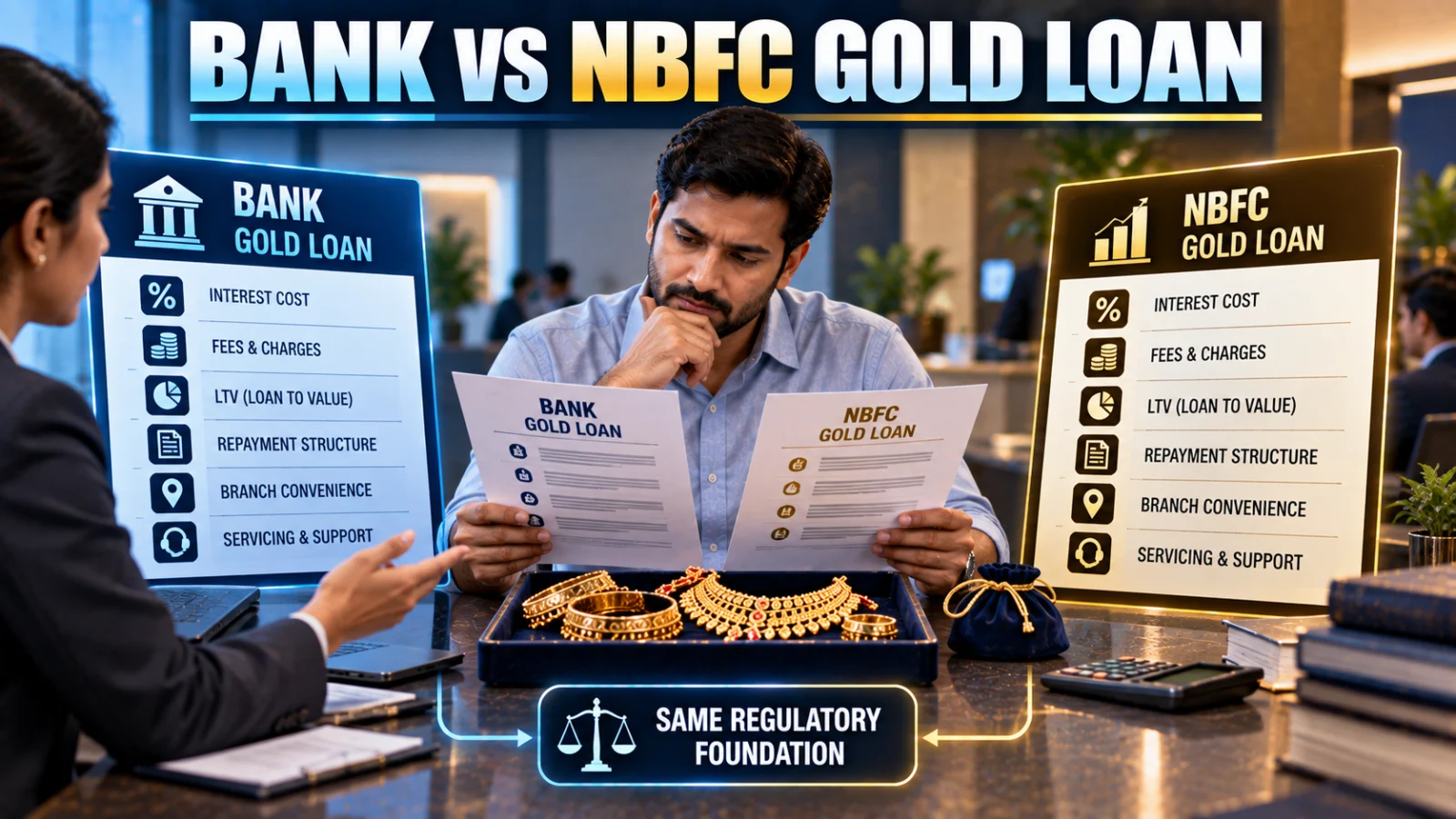





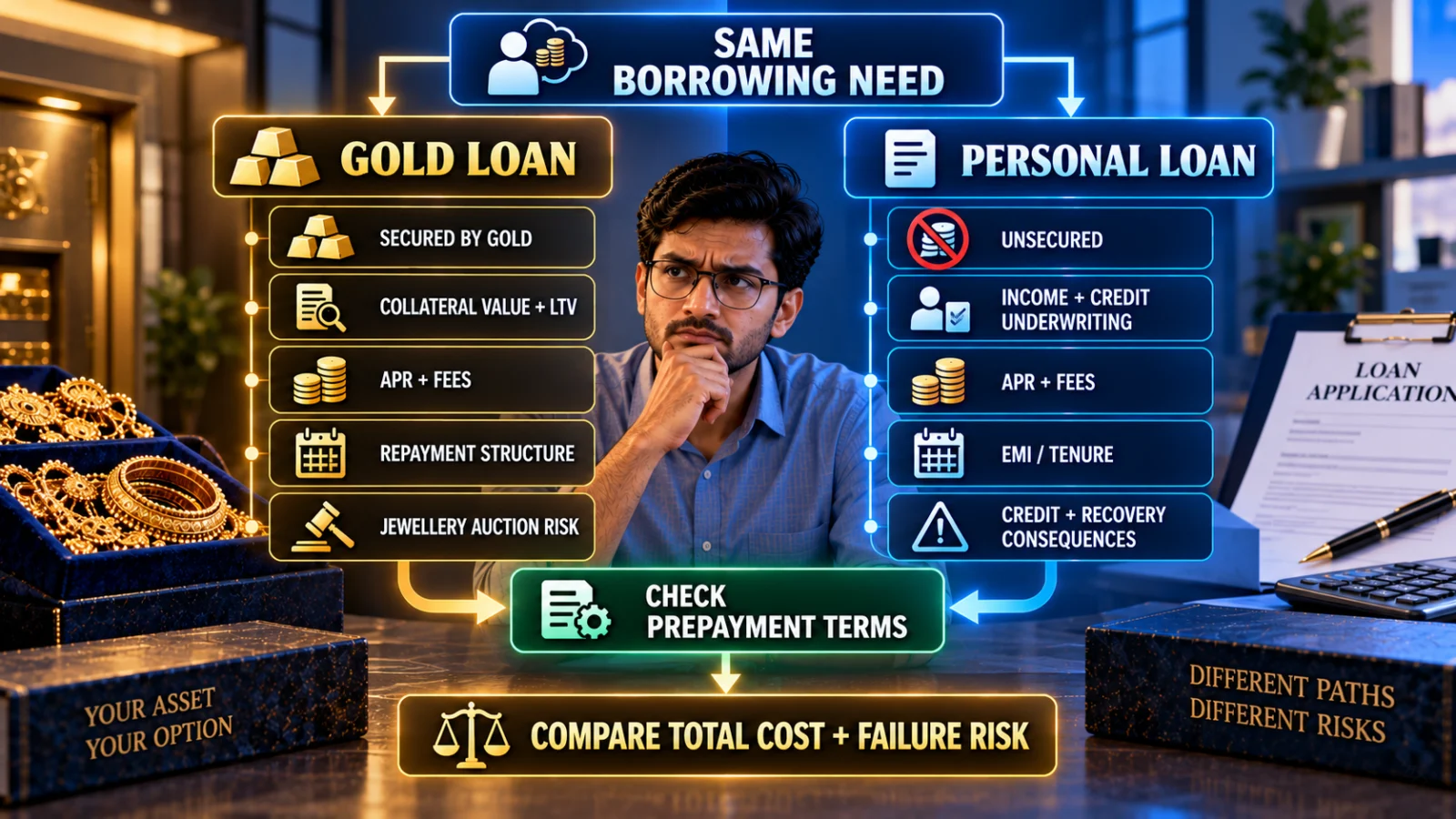
Gold loan vs personal loan India comparisons are often reduced to one question: which loan has the lower interest rate? That is not enough. The two products can fund the same cash need, but they transfer risk very differently.
A gold loan is secured by pledged eligible gold. The collateral can reduce the lender’s credit exposure, but it places your jewellery inside the lender’s recovery process if repayment fails. A personal loan is normally unsecured, so your jewellery is not pledged, but approval and pricing depend more heavily on your income, repayment capacity, credit profile and lender policy.
The useful comparison is therefore APR and total repayment for the same amount and expected borrowing period, plus collateral risk, repayment structure, prepayment terms and what happens if you cannot repay.
| Decision factor | Gold loan | Personal loan |
|---|---|---|
| Security | Secured against eligible pledged gold | Normally unsecured |
| Main underwriting driver | Collateral value is central; lender checks and borrower assessment still vary | Income, repayment capacity, credit profile and lender policy are central |
| Loan amount | Constrained by accepted gold value and applicable LTV rules | Based on lender credit assessment and borrower eligibility |
| Cost comparison | Compare actual APR and total rupee cost | Compare actual APR and total rupee cost |
| Repayment structure | Can include bullet, EMI or overdraft-style structures depending on product | Commonly amortising EMI, but product terms vary |
| Collateral consequence of default | Pledged gold can ultimately enter auction after the applicable recovery process | No pledged jewellery exists in an ordinary unsecured personal loan |
| Other default consequences | Charges, recovery action, credit consequences and possible collateral sale | Charges, recovery action, credit reporting and possible legal recovery |
| Prepayment | Depends on rate type, product and current disclosed terms | Depends on rate type, product and current disclosed terms |
Gold loan and personal loan price different risks
With a gold loan, the lender has pledged collateral. With an unsecured personal loan, the lender has no jewellery or property pledged specifically for that loan and therefore depends more heavily on the borrower’s ability and willingness to repay.
That structural difference can affect pricing, approval, documentation, loan amount and recovery. It is also why a lower-looking gold-loan rate should not be viewed in isolation from the risk of pledging jewellery.
Do not compare only the headline interest rate
RBI’s Key Facts Statement framework makes Annual Percentage Rate, or APR, important because the cost of borrowing is broader than the nominal interest rate.
For two offers covering the same borrowing need, compare the actual lender-issued KFS and ask: what is the APR, what amount will be disbursed after applicable deductions, and what total amount will be paid if the loan is kept for the expected period?
A loan with a lower advertised rate can still become less attractive if processing, valuation, other disclosed charges, repayment structure or prepayment terms do not fit the borrower.
Compare the same amount over the same realistic repayment period
A fair comparison needs the same requested amount and the same expected repayment date. Comparing a short gold-loan product with a much longer personal-loan EMI schedule only by monthly payment can produce the wrong conclusion.
For example, a longer personal-loan tenure can reduce the monthly instalment while increasing the period over which interest is paid. A short or bullet-style gold loan can look cheaper in total but create a much larger repayment requirement at one point in time.
The relevant question is not simply which EMI is lower. It is whether the repayment structure fits the borrower’s actual cash flow.
How the gold-loan amount is determined
A gold loan is not based on the jewellery’s original retail purchase price. The lender values eligible gold under the applicable regulatory and product framework and then applies the relevant loan-to-value, or LTV, ceiling.
Under the current RBI framework for consumption loans, the maximum LTV is tiered by loan size: up to ₹2.5 lakh, up to 85%; above ₹2.5 lakh and up to ₹5 lakh, up to 80%; and above ₹5 lakh, up to 75%.
These are ceilings, not promises that every borrower will receive the maximum possible amount. The lender’s valuation and product rules still control the actual sanctioned loan.
How a personal-loan amount is determined
A personal loan normally has no pledged gold securing it. Lenders therefore assess the borrower through factors such as income, existing obligations, repayment capacity, credit history or score and internal risk rules.
That means two borrowers asking for the same amount can receive different approvals or pricing.
It also means a borrower with substantial gold but a weaker unsecured-credit profile may experience a very different approval path across the two products.
Does a gold loan avoid credit checks?
No universal claim is safe. The pledged gold is central to the secured-loan structure, but lenders can still perform KYC, borrower verification, repayment-capacity checks, credit checks or other internal risk assessment.
Some lender products may require less income documentation than a personal loan, but TPS should not describe every gold loan as a “no CIBIL” or “no credit-check” product.
Which loan is faster?
Gold loans can often involve simpler underwriting because the lender has collateral that can be valued. But actual processing time depends on the lender, branch or digital process, documentation, gold appraisal, borrower checks and product design.
Likewise, an existing bank customer with a strong pre-approved personal-loan offer may receive unsecured credit quickly.
Do not choose solely from an advertised “minutes to disbursal” claim. Compare the actual offer available to you.
Tenure can change the real decision
Gold loans are not one single repayment product. Current lender structures can include short bullet-repayment loans, EMI loans and overdraft-style facilities. Personal loans more commonly use a scheduled EMI structure and can offer longer repayment periods, although there is no universal tenure.
This difference matters because the cheapest nominal rate can still create an unsuitable cash-flow burden.
A borrower who expects money in six months may judge a short secured structure differently from someone who needs a predictable multi-year EMI. The correct comparison is the borrowing period the reader actually expects to use.
Fees can change the all-in cost
Check the KFS and product disclosure for processing fees and any other applicable charges. Gold loans may also involve valuation or appraisal-related cost depending on the lender and product structure.
Personal-loan fees can differ materially by lender and borrower profile. Do not assume that one product always has the lower processing fee.
Applicable taxes on charges should also be included when calculating the actual cash cost of borrowing.
Prepayment rules need the actual loan terms
RBI’s 2025 prepayment framework protects covered floating-rate loans to individuals for non-business purposes from prepayment charges for loans sanctioned or renewed from January 1, 2026.
That does not mean every gold loan or every personal loan has free foreclosure. Fixed-rate products and other arrangements can fall outside that specific protection.
Before choosing, check the loan’s rate type and the prepayment or foreclosure clause in the KFS and agreement.
Default consequences are fundamentally different
The most important non-price difference is what the lender can recover against if the loan fails.
With a gold loan, your pledged jewellery is collateral. If dues remain unresolved, it can ultimately be auctioned after the applicable notice and recovery process under the current RBI framework.
With an ordinary unsecured personal loan, there is no pledged jewellery attached to the loan for auction. That does not make personal-loan default harmless. Overdue interest, disclosed penal charges, collection activity, credit reporting and legal recovery can still follow depending on the circumstances and contract.
Collateral risk has a personal value as well as a financial value
Jewellery can have family, cultural or emotional significance that is not captured by its market valuation. A borrower may therefore rationally place a higher cost on pledging it than a spreadsheet comparison of interest alone would show.
If losing the jewellery would create severe personal consequences, that risk belongs in the borrowing decision even if the secured-loan APR is lower.
A decision path for comparing actual offers
1. Fix the borrowing need.
Compare the same required amount rather than two products with different loan sizes.
2. Fix the realistic repayment period.
Estimate when you can actually clear the debt, not merely the maximum tenure offered.
3. Get the KFS for both offers.
Record APR, interest structure, processing and other disclosed charges, repayment schedule and total amount payable.
4. Check what you are putting at risk.
A gold loan places eligible pledged jewellery into the lender’s collateral framework. A personal loan does not pledge that jewellery.
5. Compare the repayment cash flow.
Check whether the obligation is EMI, bullet repayment or another structure and whether your income can support it.
6. Check prepayment rules.
Confirm the rate type and whether any foreclosure or prepayment charge can apply under the current rules and loan terms.
7. Model the failure case.
Ask what happens if income is interrupted or repayment becomes late. For a gold loan, include the possibility of collateral auction after due process. For a personal loan, include credit, collection and legal consequences.
8. Choose only after comparing both cost and consequence.
The lower headline interest rate is not automatically the better borrowing structure.
When a gold loan may fit better
A gold loan may be more aligned when the borrower has eligible gold, accepts the collateral risk, receives a competitive all-in cost and has a credible repayment plan that fits the offered tenure and structure.
This is not a recommendation to pledge gold merely because the nominal rate is lower.
When a personal loan may fit better
A personal loan may be more aligned when preserving jewellery outside the lender’s collateral process is important, the borrower qualifies for acceptable unsecured pricing and the repayment schedule better matches predictable income.
The trade-off can be a higher borrowing cost or stricter credit underwriting, depending on the actual offer.
When neither loan should be chosen yet
If the repayment source is uncertain, neither option becomes safe merely because a lender is willing to approve it.
Pause the decision if you cannot explain how the debt will be repaid, if the repayment schedule is unaffordable, if you have not reviewed the KFS, or if pledging the jewellery would create an unacceptable personal loss if repayment later fails.
Bottom line
Gold loan vs personal loan India is not simply a contest between a low interest rate and a high interest rate. It is a choice between secured borrowing backed by pledged jewellery and unsecured borrowing priced more heavily around your credit and repayment capacity.
For the same borrowing need, compare APR, total rupee cost, repayment structure, fees, prepayment conditions and what happens if repayment fails. A lower-cost gold loan can still be the wrong choice if the collateral risk is unacceptable, while a personal loan can be unnecessarily expensive if a short, well-planned secured loan genuinely fits the borrower’s needs.
Verification note
TPS reviewed the RBI framework for lending against gold collateral, current KFS/APR requirements, the 2025 prepayment framework and current lender product disclosures to separate regulator-wide rules from lender-specific rates, fees and eligibility.
Limitations and unresolved facts
Actual approval, interest rate, APR, processing fees, gold valuation, credit assessment, tenure, prepayment terms and repayment structure depend on the lender, product and borrower. Future RBI rules and lender terms can also change. TPS therefore does not declare one product universally cheaper or better and does not treat current lender examples as permanent market-wide terms.