





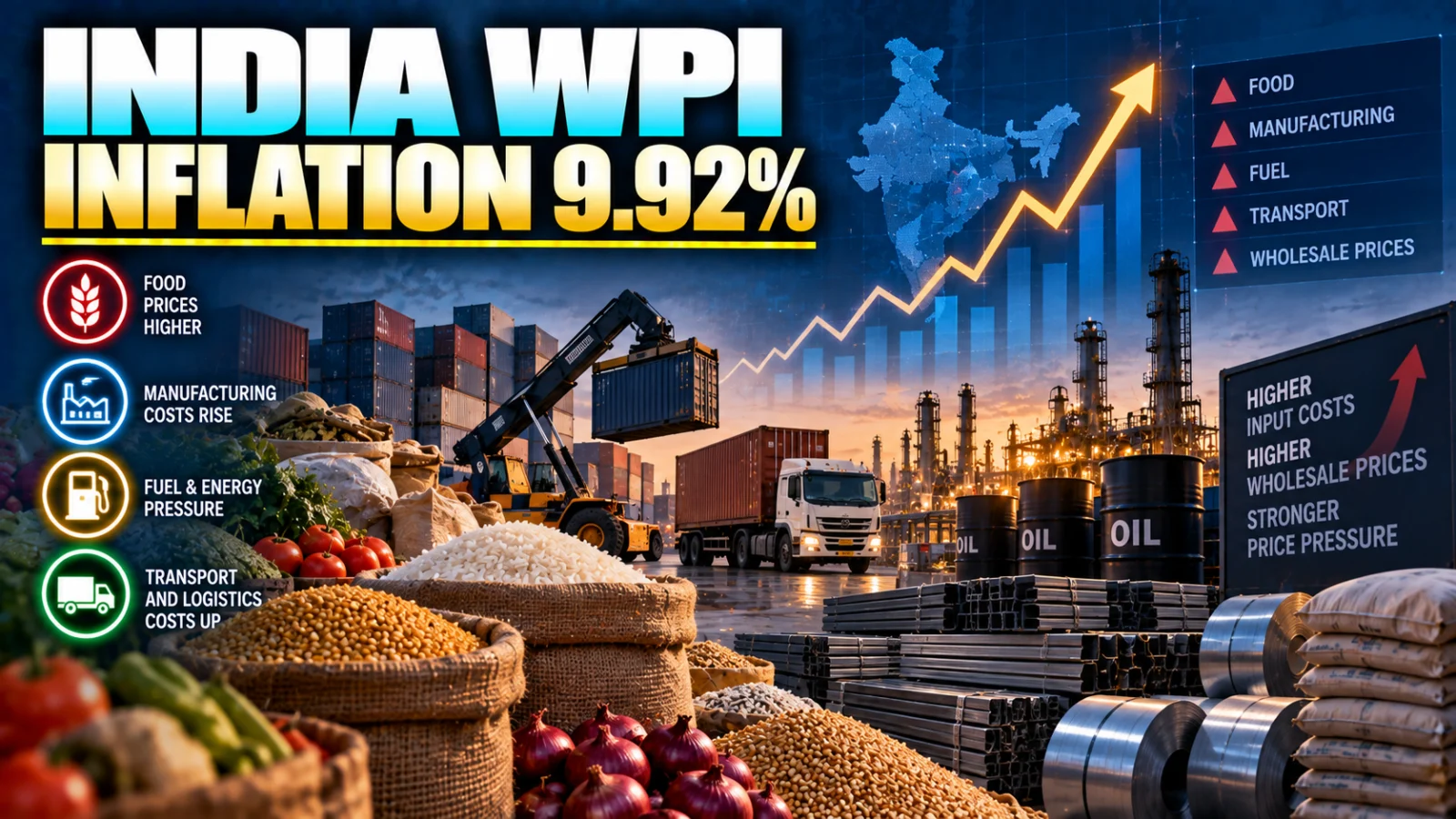
India WPI inflation August 2026 rose to 9.92% year-on-year, according to current reporting based on government data. That compares with 9.78% in July, meaning the year-on-year wholesale inflation rate increased by 14 basis points.
The headline number needs an important qualification: this is Wholesale Price Index inflation, not India’s Consumer Price Index or household retail inflation. A higher WPI reading can signal stronger producer and input-cost pressure, but it does not mean household prices rose by 9.92%, and it does not automatically trigger an RBI interest-rate increase.
What changed in India’s August WPI inflation?
The August reading increased to 9.92% from 9.78% in July. Current reporting based on government data also shows stronger inflation across several major WPI components.
- Food inflation: 7.05%, up from 6.65% in July.
- Manufactured products: 8.37%, up from 8.29%.
- Fuel and power: 22.93%, up from 20.05%.
- Petroleum and natural gas: 34.41%, according to the current government-data reporting reviewed by TPS.
Those movements suggest that the August increase was not concentrated in only one broad category. Food, manufacturing and fuel-related wholesale price pressure all strengthened.
What does 9.92% WPI actually measure?
India’s WPI measures price changes for a basket of goods at the wholesale level. It is useful for tracking price pressure faced across commodity, fuel and manufactured-goods markets and can help show whether input-cost pressure is building before or alongside other inflation measures.
It should not be read as a direct measure of the cost of living for households. That is one reason a WPI headline can look very different from India’s CPI inflation number during the same period.
Is 9.92% the same as India’s CPI inflation?
No. WPI and CPI answer different questions.
| Measure | What it broadly tracks | What readers should not assume |
|---|---|---|
| WPI | Wholesale prices of goods and producer/input price pressure | That households directly experienced the same inflation rate |
| CPI | Retail prices faced by consumers across goods and services | That it moves one-for-one with WPI |
So the August 9.92% figure should be described as wholesale inflation, not simply as “India inflation” without qualification.
Why do food, fuel and manufacturing matter?
Food prices can affect both wholesale trade and later retail pricing, but the pass-through is neither automatic nor one-for-one. Manufacturers may absorb some input-cost increases through margins, change sourcing, alter inventory levels or pass some costs onward depending on market conditions.
Fuel-and-power inflation matters because energy is an input across transport, production and logistics. Higher wholesale fuel pressure can therefore affect business costs beyond the energy sector itself, although the eventual impact varies by industry and company.
Manufactured-products inflation is also important because it gives a broader view of pricing pressure across industrial goods rather than only primary commodities.
Does higher WPI mean the RBI will raise interest rates?
No automatic conclusion follows from the WPI number alone. India’s formal inflation-targeting framework is centred on headline CPI inflation, not WPI.
The RBI assesses a much broader set of information, including consumer inflation, inflation expectations, growth conditions, liquidity, financial conditions and the expected inflation path. WPI can still matter as evidence of producer and input-cost pressure, but one monthly WPI print does not mechanically determine a repo-rate decision.
That distinction is especially important when readers see a near-10% wholesale inflation number and assume it is the same inflation measure used for the RBI’s formal target.
Is the August WPI number final?
The Office of the Economic Adviser treats the latest WPI months as provisional and later revises them as more data become available. The August reading should therefore be treated as the current provisional information state rather than an immutable final number.
TPS had not recovered the direct August 2026 OEA or PIB press-release artifact at preparation time. The 9.92% headline and component figures are therefore presented using current reporting based on government data, while the official WPI framework and July baseline were checked separately.
What should businesses and investors take from the August print?
The strongest supported conclusion is that wholesale price pressure remained high and increased slightly in August, with stronger food, manufacturing and fuel-related inflation. For businesses, that can matter for procurement costs, margins, pricing decisions and inflation expectations.
It would be too strong to infer that every company faces the same cost increase, that wholesale pressure will fully pass into consumer prices, or that monetary policy must tighten because of this one release.
What happens next?
The next useful checkpoints are any recovered direct August OEA or PIB release details, later revisions to the provisional August data, CPI developments, explicit RBI commentary and the September WPI release.
If the direct government release is recovered after publication, this same page should be updated with the exact official index levels, contribution tables or revisions rather than creating another URL for the same August reader job.
Verification note
ThePulseSignal reviewed current reporting based on the August government WPI data, the official July WPI release and release schedule, the Office of the Economic Adviser WPI framework, and RBI material explaining India’s CPI-based inflation-targeting framework. TPS kept the unrecovered direct August release and future RBI response explicitly unresolved.