






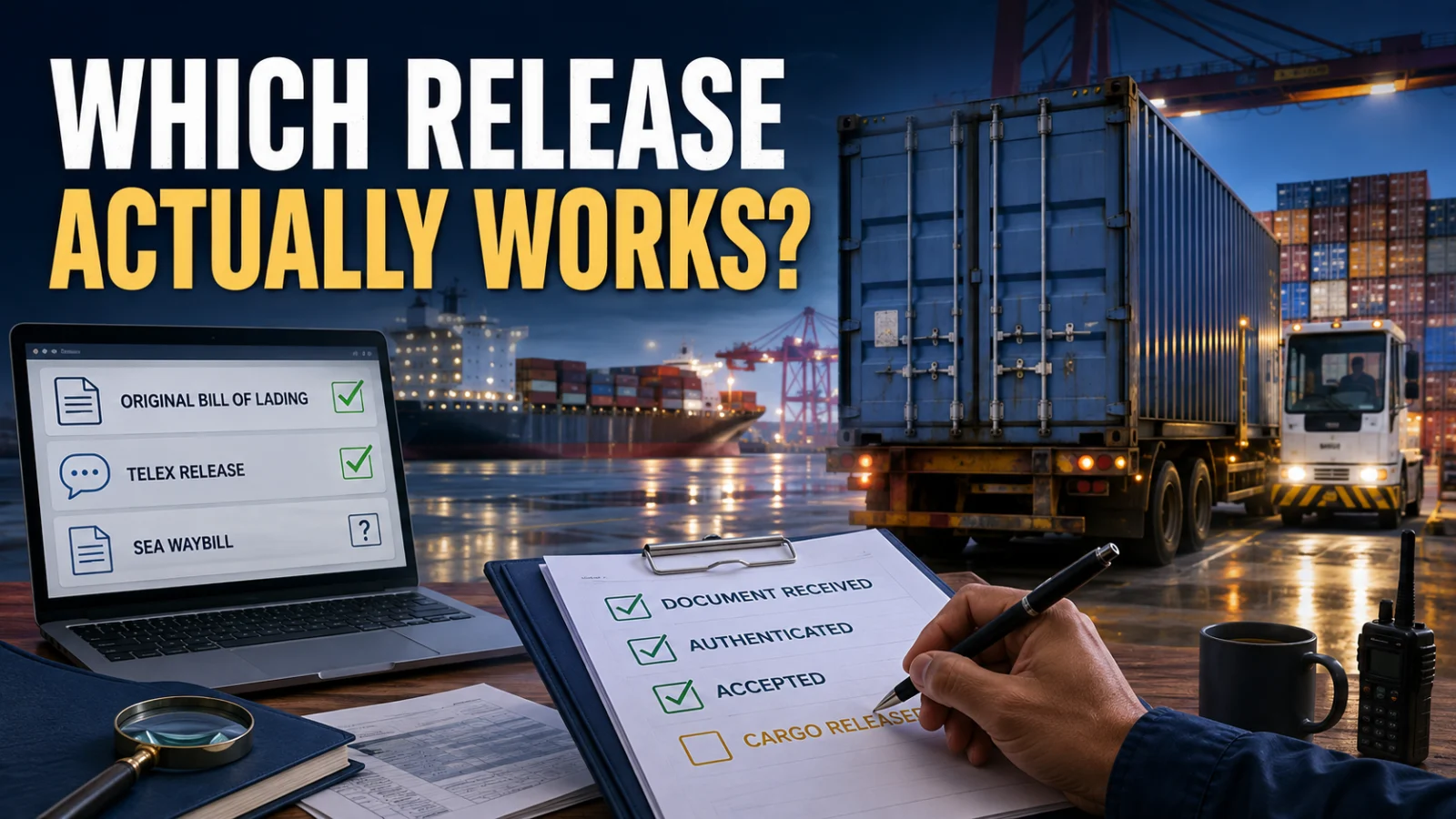
Original bill of lading vs telex release vs sea waybill is not just a documentation comparison. Each creates a different cargo-release path. The document type tells you what evidence the carrier may require, but it does not by itself prove the cargo is released, the delivery order is issued or the container is available for pickup.
Direct answer: if a negotiable Original Bill of Lading was issued, the controlling question is whether the entitled original has been correctly endorsed and surrendered under the carrier’s rules. If the originals were surrendered for telex release, the important state is whether the carrier has actually completed the surrender and transmitted or activated destination release—not merely whether someone requested it. If a sea waybill was issued, physical original presentation is normally not the release mechanism, but consignee identity, carrier documentation, charges, delivery-order processing, customs and terminal readiness can still block cargo.
DOCUMENT TYPE TELLS YOU THE RELEASE PATH. IT DOES NOT PROVE THE CARGO IS RELEASED.
Original B/L vs telex release vs sea waybill at a glance
Original Bill of Lading
A negotiable original can function as a document of title. Cargo release can depend on possession, endorsement and surrender of the entitled original under the carrier’s applicable procedure.
Telex Release
Telex release is a release method, not a separate type of bill of lading. Originals were issued and are surrendered so destination cargo can be released without presenting those physical originals there.
Sea Waybill
A sea waybill is non-negotiable and is not a document of title in the same way as an original negotiable B/L. Physical original presentation is normally not the controlling release step.
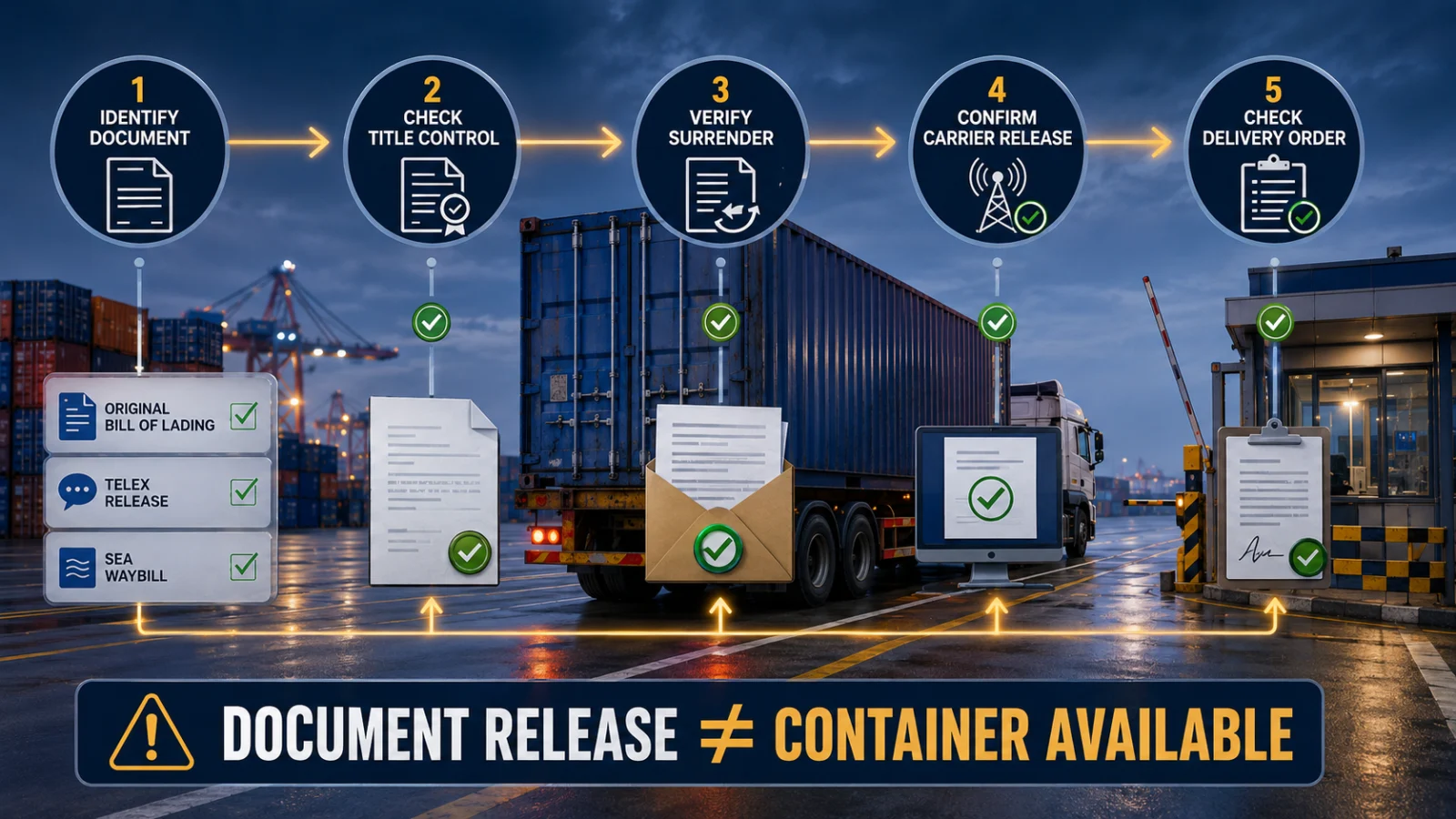
The release chain most importers actually need to diagnose
When cargo is stuck, separate the documentary stages instead of asking only whether the bill is “released.”
A failure at any one of these stages can leave a shipment unavailable even when another party says the cargo is “released.”
Step 1: identify what transport document was actually issued
Check the document type
Determine whether the shipment uses a negotiable Original Bill of Lading, a straight/non-negotiable B/L, an original B/L later surrendered for telex release, or a sea waybill.
Check who controls release
Identify the shipper, named consignee, bank, freight forwarder, NVOCC and ocean carrier involved. The party holding documentary control may not be the party physically handling the container.
Verify surrender or release status
Do not rely only on a scanned B/L or a shipper message saying “telex requested.” Ask what the carrier’s system or destination office shows.
Confirm the carrier-side release
Determine whether the carrier has accepted the required documents, charges and authority and whether destination release is active.
Check delivery order and terminal status separately
Even after documentary release, delivery-order, customs, terminal, line-hold or availability conditions may remain.
If an Original Bill of Lading was issued
For a negotiable original B/L shipment, a scan or photocopy normally does not replace the documentary-control function of the original.
The practical questions are:
- Where are the original bills?
- Who is entitled to endorse or surrender them?
- Is the B/L consigned directly, “to order” or to a bank?
- Has the required endorsement been completed?
- Has the carrier accepted surrender under the applicable local procedure?
COPY OF ORIGINAL B/L ≠ CARGO RELEASE. A PDF can prove what the document says, but it does not by itself establish possession, endorsement or surrender of the negotiable original.
What if the original B/L is still with the shipper?
If the consignee needs the originals at destination and they are still with the shipper, the shipment can become a courier/document-timing problem. One alternative may be surrender at origin for telex release, but whether that is possible depends on the B/L status, carrier rules, documentary control and commercial arrangement.
Do not assume the carrier can simply convert every original B/L shipment to telex release after issuance. A bank-controlled or otherwise restricted document can require approval from the party holding title or documentary control.
Telex release: requested is not the same as completed
Carrier guidance reviewed by TPS distinguishes telex release from a sea waybill. With telex release, original bills existed. The shipper or entitled party surrenders them and the carrier then processes release so the destination side does not require presentation of those originals.
TELEX REQUESTED ≠ TELEX CONFIRMED. A shipper email saying the request was submitted does not prove the carrier accepted surrender or that the destination office has activated release.
When a telex-release shipment is stuck, check the chain:
- Were the full required originals actually surrendered?
- Did the carrier accept the surrender?
- Were applicable freight, documentation or release charges settled?
- Has the origin office completed the carrier-side release process?
- Does the destination office or agent show the B/L as released?
- Can the delivery order now be requested or issued?
The exact documents, fees and process vary by carrier and jurisdiction. Do not apply one carrier’s local checklist universally.
Sea waybill: no original title presentation does not mean instant pickup
A sea waybill is non-negotiable. Carrier guidance reviewed by TPS states that it does not transfer title in the same way as a negotiable original B/L, and the named consignee can normally receive the cargo without presenting a negotiable original at destination.
But other release conditions can remain:
- consignee identity or company authority
- freight and destination charges
- local carrier documentation
- delivery-order processing
- customs release
- terminal or container availability
SEA WAYBILL ≠ AUTOMATIC TERMINAL PICKUP. Removing the original-B/L surrender requirement removes one potential blocker, not every downstream release condition.
Straight B/L is not automatically the same as a sea waybill
A straight B/L is generally non-negotiable and names a specific consignee, but its presentation requirements can differ by carrier and jurisdiction. Industry guidance reviewed by TPS warns against assuming that every country treats a straight B/L exactly like a sea waybill.
If a straight B/L is involved, verify the destination carrier’s local surrender and identification rules rather than applying a universal rule.
To-order or bank-consigned B/L: payment alone may not release title
If the B/L is issued “to order,” to the order of a bank or under trade-finance control, documentary entitlement becomes especially important.
The importer should verify:
- who is currently named as consignee or order party
- whether the bank or shipper must endorse the B/L
- whether the endorsement is correctly completed
- whether documentary collection or letter-of-credit conditions remain
- whether the endorsed original has actually reached the party that can surrender it
PAID SUPPLIER ≠ DOCUMENTARY TITLE RELEASED. Commercial payment and documentary entitlement are related in many transactions, but one does not automatically prove the other is complete.
House B/L vs Master B/L: there may be two release chains
Freight-forwarder and NVOCC shipments can involve both a House Bill of Lading and a Master Bill of Lading.
The house bill usually governs the forwarder’s relationship with its customer. The master bill governs the carrier-side transport relationship between the ocean carrier and the forwarder/NVOCC.
This means a consignee can receive confirmation that the HBL is released while the forwarder still has an unresolved master-B/L release, freight or documentation problem with the carrier.
HBL RELEASED ≠ MBL RELEASED. If the forwarder cannot obtain carrier release under the master shipment, the container can remain blocked even though the customer-facing house document appears complete.
Ask both questions:
- Has the House B/L release condition been satisfied between shipper/consignee and forwarder?
- Has the Master B/L release condition been satisfied between forwarder/NVOCC and ocean carrier?
Why “the shipper says it is released” may not be enough
The word “released” can refer to several different states:
- shipper authorised release
- originals surrendered at origin
- telex request lodged
- carrier surrender accepted
- destination release instruction received
- freight hold removed
- delivery order issued
- customs clearance completed
- terminal pickup made available
Those are not interchangeable.
The strongest operational evidence is the state shown by the party that controls the next blocked step. If the next required action is carrier D/O issuance, a shipper message alone is weaker evidence than confirmation from the carrier or destination agent that the release condition has been accepted.
Delivery order is another separate stage
Documentary entitlement or telex confirmation generally allows the carrier’s delivery process to proceed, but the delivery order itself can still depend on local documentation, charges and authorization.
Current CMA CGM India material illustrates the distinction. Its import process separates Original B/L surrender from the D/O request workflow. For sea-waybill or telex-release shipments, the customer can use the electronic process without physically surrendering an original B/L at the documentation counter, subject to the carrier’s required supporting documentation.
That is useful India-specific evidence, but it should not be treated as the universal process for every shipping line.
Document release vs container availability
Even when the B/L side is completely resolved, the cargo can remain unavailable because of:
- customs hold or incomplete customs clearance
- carrier freight or local-charge hold
- delivery order not yet issued
- terminal system not showing pickup availability
- container not yet discharged or grounded
- inspection or regulatory hold
- forwarder/NVOCC master-shipment issue
The documentary release question therefore sits inside a larger cargo-availability chain.
Useful boundary: if Original B/L, telex-release or sea-waybill status is already confirmed but the container is still unavailable, move the diagnosis downstream to carrier release, delivery order, customs and terminal readiness rather than continuing to chase the same document.
Diagnostic table: what your evidence actually proves
| What you have | What it proves | What may still be missing |
|---|---|---|
| Scanned Original B/L | The document exists and you can inspect its wording | Possession of original, correct endorsement, surrender or carrier acceptance |
| Physical Original B/L | You possess an original document | Correct entitlement/endorsement and carrier surrender |
| “Telex requested” email | A release request may have started | Surrender acceptance, carrier processing and destination confirmation |
| Carrier telex-release confirmation | Carrier-side surrender/release has been processed to the confirmed extent | D/O, charges, customs or terminal availability |
| Sea waybill copy | The shipment uses a non-negotiable sea-waybill release path | Identity/authority, charges, D/O, customs or terminal readiness |
| House B/L released | Forwarder/customer-side release may be complete | Master B/L or ocean-carrier release |
| Delivery order issued | Carrier delivery authorization has reached a later stage | Customs, terminal or physical availability conditions |
| Container discharged | Physical discharge from the vessel occurred | Document, customs, carrier, D/O or terminal release |
Evidence checklist when cargo is stuck
Before escalating, collect the minimum evidence needed to identify the blocked layer:
- Master B/L number and House B/L number, if applicable
- document type actually issued
- consignee and notify-party details
- whether the B/L is straight, negotiable or to-order
- current location of original bills
- endorsement status
- carrier confirmation of original surrender or telex release
- freight and local-charge status
- delivery-order status
- customs release status
- terminal/container availability status
The objective is not to collect more paperwork. It is to identify the last confirmed release milestone and the first required milestone that has not happened.
Which release method should parties choose before shipment?
The correct choice depends on commercial control, payment terms, trust between parties, trade-finance requirements and destination/carrier rules.
An Original B/L can be appropriate where negotiability and documentary control matter. A sea waybill can simplify release where title transfer through negotiable documents is unnecessary and parties have sufficient commercial trust. Telex release can remove the need to courier originals to destination after an original B/L was issued and surrendered.
Those are commercial/documentary choices, not universal recommendations. If a bank, letter of credit, documentary collection or other financing arrangement controls the documents, align the release method with the bank and carrier before changing the document process.
What this article does not establish
- that every carrier follows identical telex-release procedures
- that every country permits sea waybill or telex release under identical conditions
- that a sea waybill guarantees immediate delivery order or pickup
- that every straight B/L can be released without presentation
- that a scan of an Original B/L substitutes for the original negotiable document
- that supplier payment automatically proves documentary title transfer
- that HBL release proves MBL release
- that carrier documentary release proves customs or terminal release
- that CMA CGM India’s ODeX workflow applies to other carriers
Frequently asked questions
Is telex release a type of Bill of Lading?
No. Carrier guidance reviewed by TPS treats telex release as a release method used after originals were issued and surrendered, not as a separate B/L type.
If I have a scanned Original B/L, can I collect the cargo?
Do not assume so. A scan does not by itself prove possession, endorsement or surrender of the negotiable original required under the applicable carrier process.
The shipper says telex release was requested. Is that enough?
No. Verify that the carrier accepted the surrender and that the destination side shows the release as effective.
Does a sea waybill mean no documents are required?
No. It normally removes the negotiable-original presentation step, but identity, authority, charges, carrier documentation, D/O, customs and terminal conditions can still apply.
Why can cargo still be stuck after telex release?
Telex release resolves only the relevant original-B/L surrender layer. Delivery-order, freight, customs, terminal, inspection or physical-availability conditions may still remain.
Can my House B/L be released while the carrier still blocks the shipment?
Yes. The forwarder-side House B/L release and the ocean-carrier-side Master B/L release can be separate dependencies.
Is a straight B/L the same as a sea waybill?
Do not treat them as universally identical. Straight-B/L release requirements can depend on carrier rules and jurisdiction.
Verification note
The document-type distinctions were checked against direct ocean-carrier guidance. Telex-release and India delivery-order mechanics were cross-checked against current carrier process material, while industry guidance was used for straight-B/L and endorsement edge cases. Carrier and jurisdiction procedures vary, so this article distinguishes general documentary logic from local operational requirements instead of presenting one shipping line’s checklist as universal.
Last verified: August 24, 2026.